Authentication Guide

How to Authenticate a Luxury Watch: The Complete Guide for Every Brand

By Grailr Watch IntelligenceMay 202612 min read
How to authenticate a luxury watch — the complete verification guide for Rolex, Omega, Cartier, AP, and Patek

Key Takeaways

  • Every authentic luxury watch has a unique serial number that is deeply and cleanly engraved — never scratched or shallow. Fakes reuse the same serials across entire production batches.
  • Genuine Rolex date magnification is 2.5x (filling most of the Cyclops lens). Fakes typically only achieve 1.5x — the single easiest tell on a counterfeit Rolex.
  • Superfakes costing $500–$2,000 now fool most untrained observers. They replicate weight, finishing, and even movement appearance. Professional or AI-assisted verification is increasingly essential.
  • Always get professional authentication for purchases over $5,000. A $100–$300 inspection is cheap insurance against a $10,000+ mistake.

The counterfeit watch market is a $4.5 billion industry, and it's getting more sophisticated every year. In 2024 alone, customs agencies worldwide seized over 30 million fake luxury goods — with watches among the most commonly counterfeited items.

Worse, the rise of “superfakes” — high-quality counterfeits that cost $500–$2,000 to produce and replicate weight, finishing, and even movement aesthetics — means the old advice of “just feel the weight” no longer catches everything. If you're buying or selling a luxury watch in 2026, you need a systematic approach to authentication.

This guide gives you exactly that: a 7-point home check that catches 90% of fakes, brand-specific tells for the most counterfeited brands, and clear guidance on when to bring in a professional. Whether you're examining a Rolex, Omega, Cartier, Audemars Piguet, or Patek Philippe — this is your authentication playbook.

Why Authentication Matters More Than Ever

Ten years ago, spotting a fake was relatively straightforward. Poor finishing, wrong weight, obviously printed dials, and quartz movements in watches that should be automatic made counterfeits easy to identify by anyone with basic knowledge.

That era is over. Modern superfakes — particularly for Rolex, Audemars Piguet, and Patek Philippe — use genuine Swiss ETA or Asian clone movements, real sapphire crystal, correct weight distribution, and finishing that requires magnification to distinguish from genuine. Some even replicate the laser-etched coronet on Rolex crystals and the micro-engraved rehaut text.

The secondary market has exploded to over $20 billion annually, with platforms like Chrono24, eBay, and Facebook Marketplace making it easier than ever to buy — and easier than ever to get scammed. Private sellers account for an estimated 5–10% of pre-owned sales being counterfeit, and even some dealers have been caught selling fakes unknowingly.

Authentication isn't optional anymore. It's the cost of doing business in the luxury watch market.

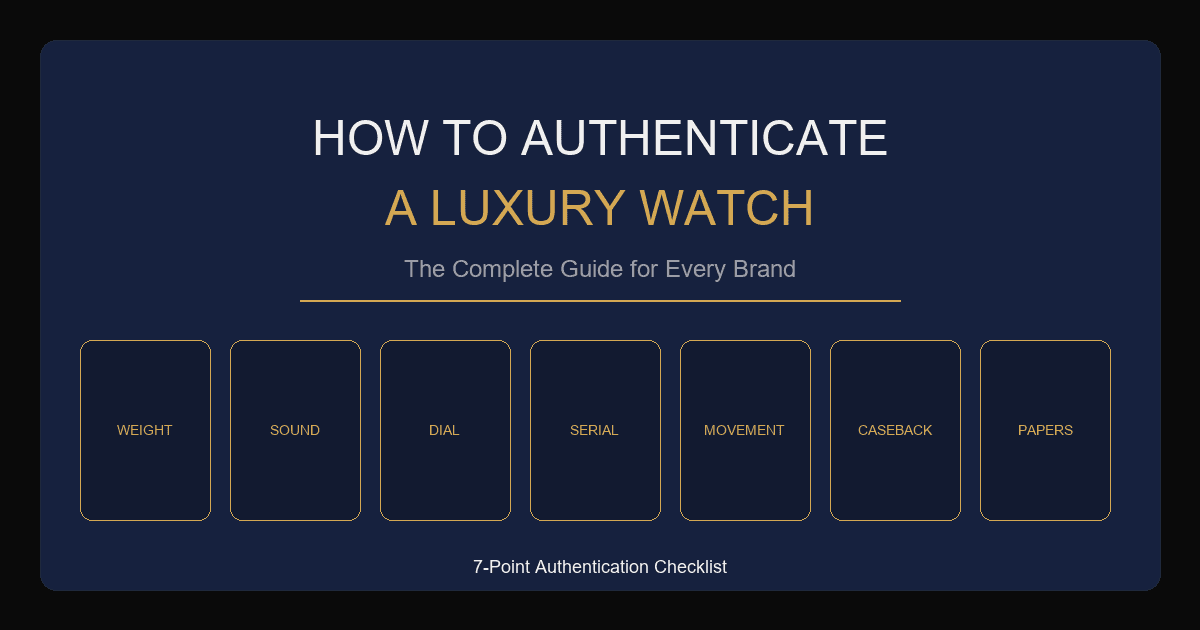
The 7-point luxury watch authentication check — serial, weight, sound, dial, movement, caseback, papers
The 7-point home authentication check that catches the majority of counterfeit watches

The 7-Point Home Authentication Check

You don't need a watchmaker's loupe and 20 years of experience to catch most fakes. These seven checks, performed in order, will identify the vast majority of counterfeit watches — including mid-range fakes that might fool a casual observer.

1. Serial and Model Numbers

Every authentic luxury watch has a unique serial number engraved into the case. On Rolex models made after 2005, this is between the lugs at 6 o'clock. On Omega, it's typically on the caseback.

What to look for: The engraving should be deeply cut, perfectly clean, and consistent in depth. Under magnification, genuine engravings have crisp, sharp edges with no rough spots. Fakes often have shallow, scratchy engravings that look like they were done with a hand tool rather than a CNC machine.

The critical tell: Counterfeiters reuse serial numbers across entire production runs. Search the serial number online — if multiple watches share it, you have a fake. You can also cross-reference against known production ranges. Check our Rolex serial number lookup guide for date-range verification.

2. Weight Test

Luxury watches are significantly heavier than their counterfeit copies due to premium materials — 904L or 316L stainless steel, 18k gold, sapphire crystal, and ceramic bezels. A genuine Rolex Submariner weighs approximately 155g. Most fakes weigh 120–135g.

How to test: Use a kitchen scale accurate to 1g. Compare the weight against published specifications for that exact reference. A deviation of more than 5–10g in a steel watch is a red flag. Note that superfakes have largely closed this gap by using denser alloys, so weight alone isn't definitive — but a lightweight “luxury” watch is almost certainly fake.

3. Sound Test

Hold the watch close to your ear in a quiet room. Genuine mechanical luxury watches are nearly silent — you might hear a very faint, refined hum from the balance wheel at 28,800 vibrations per hour. Quartz fakes produce a distinct, audible tick once per second that no mechanical movement makes.

Even among mechanical fakes, cheaper clone movements produce more noise than genuine Swiss movements. A Rolex should be essentially inaudible at arm's length. If you can clearly hear ticking from 6 inches away, something is wrong.

4. Dial Details

The dial is where most fakes fall apart under scrutiny. Genuine luxury watch dials have absolutely flawless printing: consistent letter spacing, crisp font edges, perfectly aligned text, and smooth gradient or sunburst finishes.

Rolex-specific: The date magnification through the Cyclops lens should be 2.5x, making the date fill most of the lens window. Fakes typically only achieve 1.5x magnification — this is the single easiest tell on a counterfeit Rolex and visible to the naked eye.

Universal tells: Look for uneven lume plots (the dots on hour markers), misaligned indices, text that's slightly off-center, or coronets/logos that aren't perfectly sharp. Under 10x magnification, genuine dials are immaculate. Fakes show imperfections that are invisible to the naked eye but obvious under a loupe.

5. Movement Observation

A genuine mechanical watch has a smooth, sweeping second hand that makes 5–8 micro-movements per second (depending on the caliber's beat rate). This creates the characteristic “gliding” motion. A quartz movement ticks once per second with a visible jump between each position.

Better fakes use mechanical movements, so look more closely: is the sweep perfectly smooth, or slightly stuttery? Does the second hand hit each marker precisely, or land slightly off? On a genuine Rolex with the Calibre 3235, the second hand sweeps at 8 beats per second — smooth enough that individual ticks are nearly invisible.

6. Caseback Inspection

The caseback reveals enormous information about authenticity — and each brand has specific rules that counterfeiters frequently violate.

The golden rule for Rolex: Modern Rolex watches NEVER have a transparent display caseback (with one exception — the vintage Ref. 6085 from the 1950s). If someone shows you a Rolex with a see-through caseback, it's fake. Period. Rolex uses a solid, screw-down caseback with fine engravings.

Omega: Most modern Omega models DO have display casebacks, showing decorated movements. Check that the movement matches the caliber for that reference. The finishing should include Geneva stripes, perlage, and beveled edges visible under magnification.

7. Box, Papers, and Accessories

Genuine packaging is high quality: real leather presentation folders, heavy card stock, embossed logos, and precise printing. Rolex boxes use a specific shade of green with a magnetic clasp and a textured surface. Omega boxes are white/grey with precise construction.

Red flags: Cheap feeling materials, spelling errors on warranty cards, incorrect fonts, mismatched serial numbers between the card and watch, and instruction booklets with poor printing quality. The warranty card should have the serial number, reference number, and dealer stamp — all matching the watch.

Note: buying without box and papers doesn't mean the watch is fake. Many legitimate owners lose packaging over decades. But the absence of papers should lower the price by 10–20% and increase your scrutiny of the watch itself.

Brand-specific authentication markers for Rolex, Omega, Cartier, and Audemars Piguet
Each brand has unique authenticity markers that counterfeiters consistently get wrong

Brand-Specific Red Flags

Beyond the universal 7-point check, each major brand has specific tells that counterfeiters struggle to replicate perfectly. Here's what to look for on the most commonly faked brands.

Rolex

  • Cyclops magnification: Must be exactly 2.5x. Anything less is fake.
  • Coronet at 12: The Rolex crown logo at 12 o'clock should be perfectly formed with rounded tips, not flat or uneven.
  • Rehaut engraving: Post-2004 models have “ROLEX ROLEX ROLEX” engraved on the inner bezel ring (rehaut). The serial number appears at 6 o'clock. Letters should be perfectly uniform.
  • Laser-etched crown: Since 2002, a tiny Rolex coronet is laser-etched into the crystal at 6 o'clock. Nearly invisible to the naked eye — visible only at specific angles.
  • Green hologram sticker: Pre-2007 Rolex watches have a green hologram sticker on the caseback. Post-2007 models do not. A “new” Rolex with this sticker is using outdated counterfeit techniques.

For a deeper dive, see our complete guide to spotting a fake Rolex.

Omega

  • Seahorse caseback: The Seamaster line features an embossed Hippocampus (seahorse) on the caseback. The detail should be razor-sharp with defined scales and flowing lines.
  • Master Chronometer certificate: Modern Omega watches ship with a METAS testing certificate showing the individual watch's performance data. Each certificate has a unique number tied to the specific watch.
  • Liquid metal bezel: The Seamaster 300M uses Omega's proprietary Liquidmetal ceramic bezel with crisp, white-filled numerals. Fakes have blurry fills or uneven ceramic color.
  • Helium escape valve: On dive models, the HEV at 10 o'clock should operate smoothly with a conical crown shape. Fakes use flat, non-functional decorative valves.

Cartier

  • Blued steel hands: Cartier's sword-shaped hands are heat-treated to a specific shade of blue. Fakes use painted blue hands that appear flat rather than having the depth of heat treatment.
  • Secret “Cartier” in dial: On many Cartier models, the word “Cartier” is hidden within the Roman numeral VII at 7 o'clock (or in the minute track). Under magnification, you can see tiny letters. Fakes rarely replicate this.
  • Cabochon crown: The winding crown features a genuine sapphire or spinel cabochon. It should be perfectly round, well-set, and match the documented color for that reference.

Audemars Piguet

  • Tapisserie dial pattern: The Royal Oak's iconic “Grande Tapisserie” pattern consists of tiny, hand-stamped squares that catch light uniformly. Fakes have uneven depth, inconsistent spacing, or machine-cut patterns that look flat.
  • Screw placement: The octagonal bezel has 8 hexagonal screws that sit perfectly flush and align with the edge of the bezel. Fakes have screws that are slightly raised, unevenly tightened, or misaligned.
  • Bracelet brushing: The Royal Oak bracelet alternates brushed and polished surfaces with laser-sharp transitions. The brushing direction should be perfectly consistent across all links.

Patek Philippe

  • Calatrava cross: The Patek Philippe logo should be incredibly detailed and proportioned perfectly. Under magnification, each element of the cross should be symmetrical and sharply defined.
  • Movement finishing: Patek movements feature Geneva stripes, mirror-polished bevels, and hand-engraved rotors that are museum-quality under magnification. No fake has ever perfectly replicated this level of finishing.
  • Case proportions: Patek cases are typically thinner and more elegantly proportioned than fakes, which tend to be slightly thicker due to inferior movement architecture.
Superfake red flags — what modern high-quality counterfeits get wrong
Superfakes are getting better every year — here is what they still get wrong

Superfakes: What You're Really Up Against

The term “superfake” refers to high-quality counterfeit watches that cost $500–$2,000 to produce and are specifically designed to fool even knowledgeable watch enthusiasts. They represent the top 1–2% of the counterfeit market, and they're growing rapidly.

What Superfakes Get Right

  • Correct weight (using denser alloys or tungsten inserts)
  • Genuine sapphire crystal with anti-reflective coating
  • Ceramic bezels with accurate color and finish
  • Swiss or Japanese mechanical movements (not quartz)
  • Laser-etched logos and crystal markings
  • Correct lume color and glow characteristics

What Superfakes Still Get Wrong

  • Rehaut engraving depth and consistency (visible at 10x magnification)
  • Date font weight — slightly too thick or thin compared to genuine
  • Crown guards geometry (measured in tenths of millimeters)
  • SEL (solid end links) fitment — gaps between bracelet and case
  • Movement finishing under magnification (unpolished edges, rough perlage)
  • Bezel click action and alignment precision
  • Lume consistency — slight color variation between hour markers and hands

The most commonly superfaked watches are the Rolex Submariner, Daytona, and GMT-Master II; the Audemars Piguet Royal Oak; and the Patek Philippe Nautilus. If you're buying any of these on the secondary market, assume you need professional verification regardless of how “perfect” the watch looks.

The superfake market is estimated to be growing 15–20% annually, driven by improvements in CNC manufacturing and access to higher-quality movement clones. What cost $2,000 to fake in 2020 now costs $500. The barrier to producing convincing counterfeits is dropping every year.

Professional verification tools and when to use them — watchmaker inspection, AI scanning, certification services
Professional tools and services for watch authentication — from AI scanners to certified watchmakers

When to Get Professional Authentication

Home checks are valuable for an initial screen, but they have limits. Here's when you should always involve a professional:

  • Any purchase over $5,000 — the authentication cost ($50–$300) is negligible compared to the risk
  • Private sales — no dealer guarantee or return policy to fall back on
  • High-value references — Rolex Daytona, AP Royal Oak, Patek Nautilus are superfake magnets
  • Anything without papers — no provenance trail increases risk substantially
  • Deals that seem too good — a Submariner at 40% below market is either stolen or fake

Professional authentication options:

Certified watchmakers can open the caseback and inspect the movement directly. They verify the caliber matches the reference, check serial numbers against brand databases (for authorized service centers), and assess movement finishing quality. Cost: $100–$300.

Authentication services like Beckett (for watches), WatchCSA, and brand service centers provide certificates of authenticity after thorough inspection. These carry legal weight if you later discover a fake. Cost: $50–$150.

AI-powered tools like Grailr's scanner offer an instant first-pass check using image analysis. While not a replacement for hands-on inspection, AI can flag obvious inconsistencies in seconds — useful as a screening tool before committing to meet a seller or paying for professional authentication.

Thinking about selling? Authentication adds value. A verified watch commands 5–15% more than an unverified one. See our guide on how to sell a Rolex for the best price and learn whether your watch is worth anything on today's market.

Frequently Asked Questions

Can I authenticate a luxury watch myself at home?

You can perform basic checks at home — weight test, sound test, dial inspection, serial number verification, and movement observation. These will catch most low-quality fakes. However, high-end superfakes costing $500–$2,000 can fool untrained eyes, so professional authentication is recommended for any purchase over $5,000.

How much does professional watch authentication cost?

Basic certificate of authenticity: $50–$150. Full service inspection with case opening and movement verification: $100–$300. Given that a fake Rolex Submariner might cost you $10,000+, authentication is a tiny insurance premium worth paying every time.

What are superfake watches and how do I spot them?

Superfakes are high-quality counterfeits costing $500–$2,000 to produce that replicate weight, finishing, and even movement characteristics. They fool most untrained observers. Key tells include slightly off date magnification, imperfect rehaut engraving, and movement finishing that doesn't hold up under 10x magnification. AI-powered scanners and professional watchmakers are the most reliable detection methods.

Does Rolex have a way to verify authenticity online?

Rolex does not offer public online serial number verification. Only authorized service centers can confirm authenticity through their internal database. You can cross-reference serial number ranges with production years to catch obvious fakes (see our serial number lookup guide), but this alone doesn't guarantee authenticity. AI tools like Grailr's scanner provide an instant visual analysis as a first check.

The Bottom Line

Authentication is no longer optional in the luxury watch market. With superfakes getting better every year and the secondary market growing to $20+ billion, the question isn't whether to authenticate — it's how thoroughly.

Start with the 7-point home check: serial numbers, weight, sound, dial details, movement observation, caseback inspection, and papers verification. This catches 90% of counterfeits. For the remaining 10% — the superfakes — you need professional tools or trained eyes.

The smartest approach combines instant AI screening (catching obvious fakes before you waste time) with professional verification for any serious purchase. A $100 authentication fee on a $10,000 watch is the best 1% insurance policy in existence.

Don't trust. Verify.

Get an Instant AI Authenticity Check

Snap a photo of any luxury watch. Grailr's AI scanner analyzes visual markers, identifies the reference, and flags potential authenticity concerns in seconds — before you spend a dollar or meet a seller.

How to Authenticate a Luxury Watch: The Complete Guide for Every Brand | Grailr