Key Takeaways
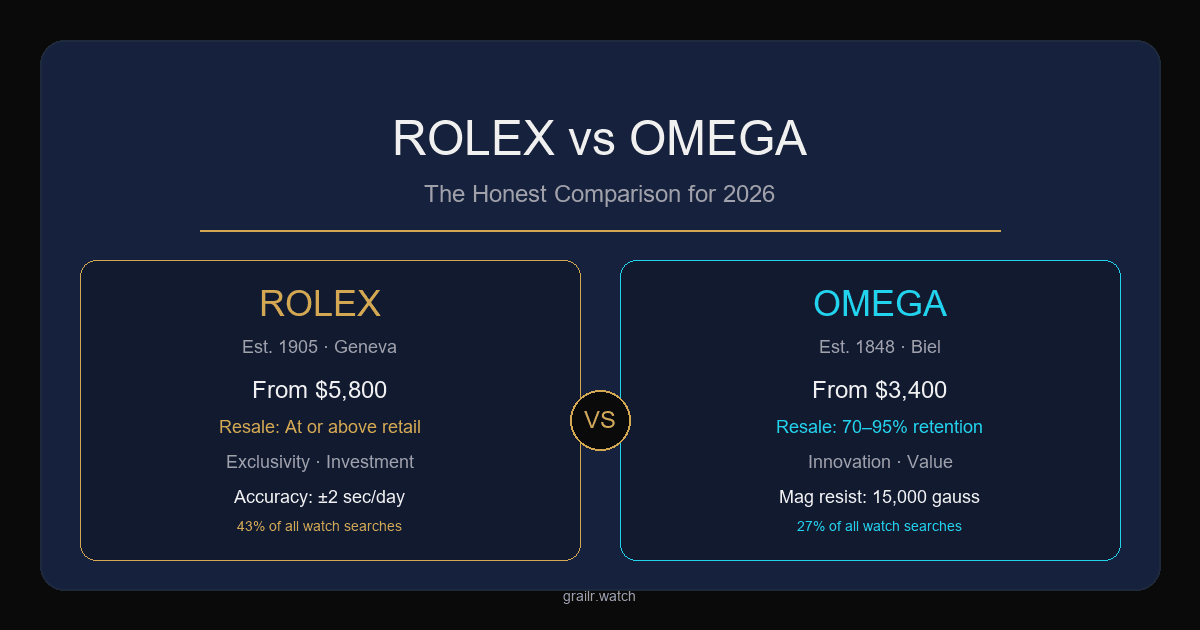
- Rolex's cheapest watch starts at ~$5,800 (Oyster Perpetual 28mm). Omega starts at ~$3,400. For comparable sport watches in steel, Omega is 40–60% cheaper.
- Rolex sport models regularly trade at or above retail on the secondary market. Omega typically depreciates 25–40% from retail, though core models like the Speedmaster hold 80–95%.
- Omega's Master Chronometer certification tests magnetic resistance at 15,000 gauss — over 15x what standard Rolex models handle. In raw movement technology, Omega leads.
- You can walk into most Omega boutiques and buy a Speedmaster the same day. Getting a Rolex Submariner at retail usually means 6–18 months on a waitlist.
Rolex vs Omega is the most searched luxury watch comparison on the internet. Rolex accounts for 43% of all watch brand searches globally, with Omega second at 27%. And the usual answer you'll find — “Rolex is better but Omega is good value” — is too simplistic to be useful.
These are two of the greatest watchmakers on earth, and they've taken fundamentally different approaches to luxury. Rolex sells exclusivity, scarcity, and bulletproof resale value. Omega sells technical innovation, accessibility, and more watch per dollar at retail. Neither approach is objectively better — it depends on what you actually value.
Our guide to where Rolex watches are made gives additional background on its manufacturing facilities.
For the sporting side of the Rolex brand, our US Open watch guide separates documented partnerships from claims about the exact watch in a photograph.
Here's the real comparison with actual data, not forum opinions.
Price Comparison: What You're Actually Paying
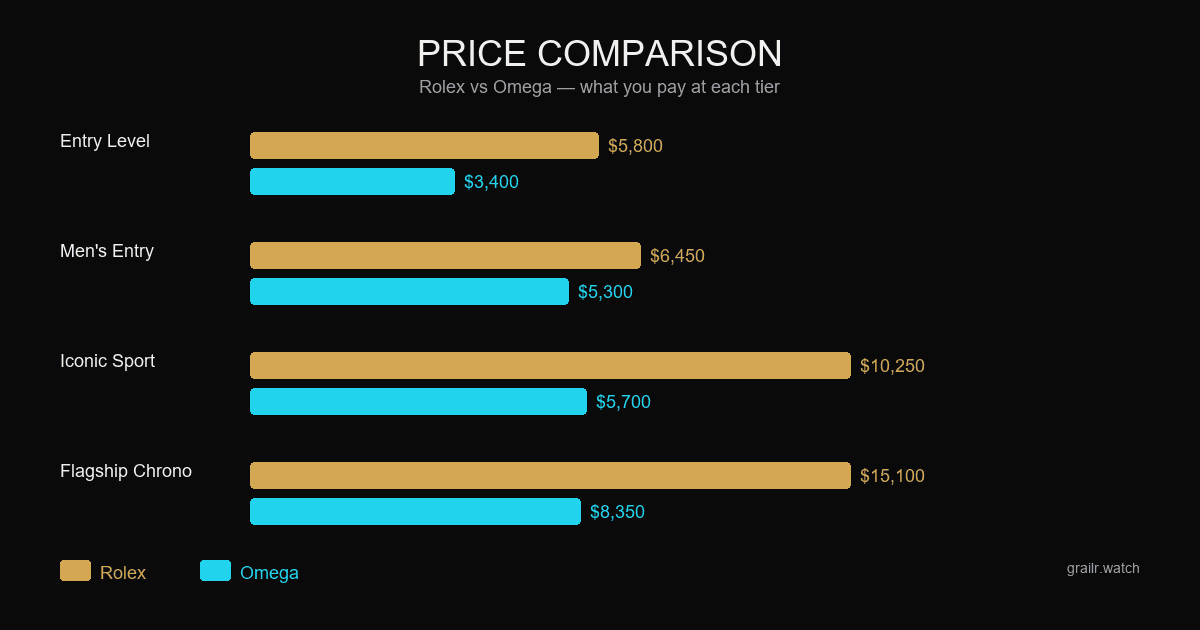
Rolex implemented a 7–10% price increase across most collections in January 2026, pushing entry-level models even further from Omega's range. Here's what the real numbers look like head-to-head.
| Category | Rolex | Omega |
|---|---|---|
| Entry level | ~$5,800 (Oyster Perpetual 28mm) | ~$3,400 (Seamaster Aqua Terra quartz) |
| Men's entry | ~$6,450 (OP 36mm) | ~$5,300 (Speedmaster Moonwatch) |
| Iconic sport | $10,250 (Submariner Date) | ~$5,700 (Seamaster Diver 300M) |
| Flagship chrono | $15,100 (Daytona) | ~$8,350 (Speedmaster Racing) |
| Precious metal | $40,000+ (Submariner gold) | ~$25,000+ (Seamaster gold) |
The pattern is consistent: for comparable watches in comparable materials, Omega costs roughly 40–60% less than Rolex at retail. That's not a quality gap — it's a brand premium and scarcity strategy.
Movement Technology: Where Omega Surprises
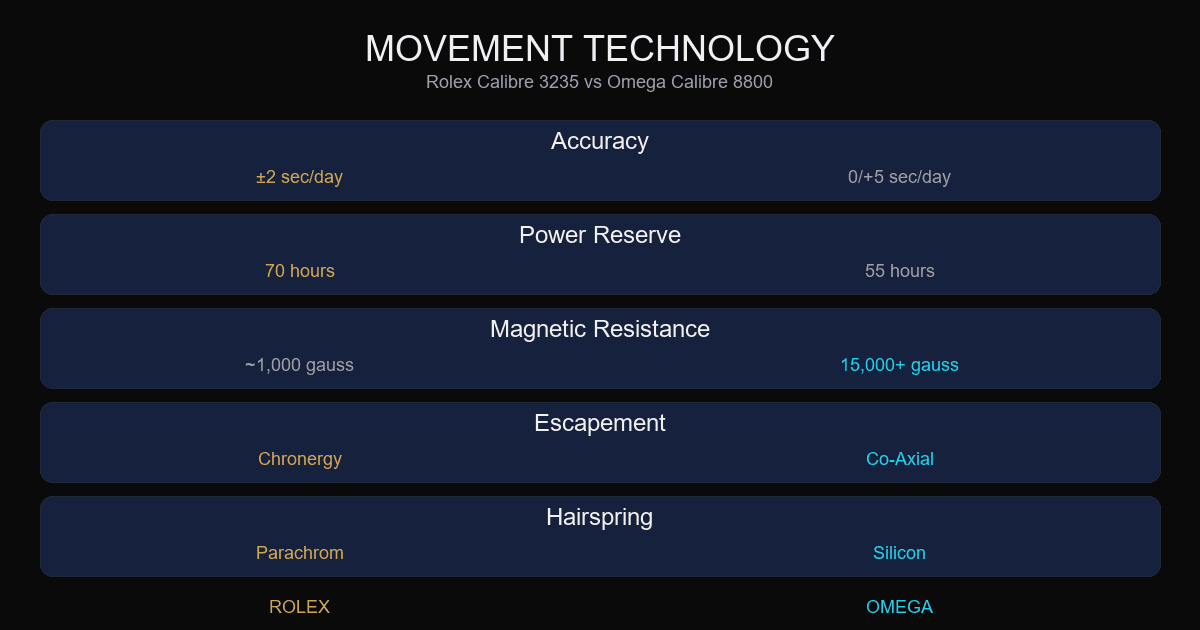
This is the category where most people expect Rolex to dominate — and they'd be wrong. Omega's Co-Axial escapement and Master Chronometer certification represent a genuine technical achievement that Rolex hasn't matched in some areas.
| Spec | Rolex (Cal. 3235) | Omega (Cal. 8800) |
|---|---|---|
| Accuracy | −2/+2 sec/day (Superlative Chronometer) | 0/+5 sec/day (Master Chronometer) |
| Power reserve | 70 hours | 55 hours |
| Magnetic resistance | ~1,000 gauss | 15,000+ gauss |
| Escapement | Chronergy (optimised Swiss lever) | Co-Axial (reduced friction) |
| Hairspring | Parachrom (paramagnetic alloy) | Silicon (non-magnetic) |
| Certification | COSC + Rolex Superlative | COSC + METAS Master Chronometer |
Rolex wins on raw accuracy (±2 seconds vs 0/+5) and power reserve (70 vs 55 hours). Omega wins decisively on magnetic resistance — 15,000 gauss vs roughly 1,000 — which matters if you're regularly exposed to electronics, speakers, or MRI machines.
Omega's Co-Axial escapement also reduces friction between components, theoretically extending the time between services. Both brands recommend servicing every 5–10 years, but Omega's design has a slight edge in long-term movement wear.
Build Quality and Materials
Rolex uses proprietary 904L Oystersteel — harder, more corrosion-resistant, and more difficult to machine than the 316L stainless steel used by most watchmakers, including Omega. You'll notice the difference in how a Rolex bracelet feels on the wrist: denser, more substantial, with tighter link tolerances.
Rolex's Cerachrom ceramic bezels are virtually scratch-proof and fade-proof. The Glidelock clasp system on Rolex sport models allows 20mm of micro-adjustment without tools — genuinely one of the best bracelet systems in watchmaking.
Omega's finishing is excellent at its price point but doesn't quite reach Rolex levels. The newer ceramic bezels on models like the Seamaster Diver 300M are comparable in scratch resistance, and Omega's bracelets have improved significantly in recent years. But a side-by-side handling reveals the Rolex's edge in polish, chamfering, and bracelet articulation.
Where Omega compensates: transparent casebacks. Many Omega models let you see the decorated movement, which Rolex never offers. If “the view from behind” matters to you, Omega wins by default.
Resale Value and Investment
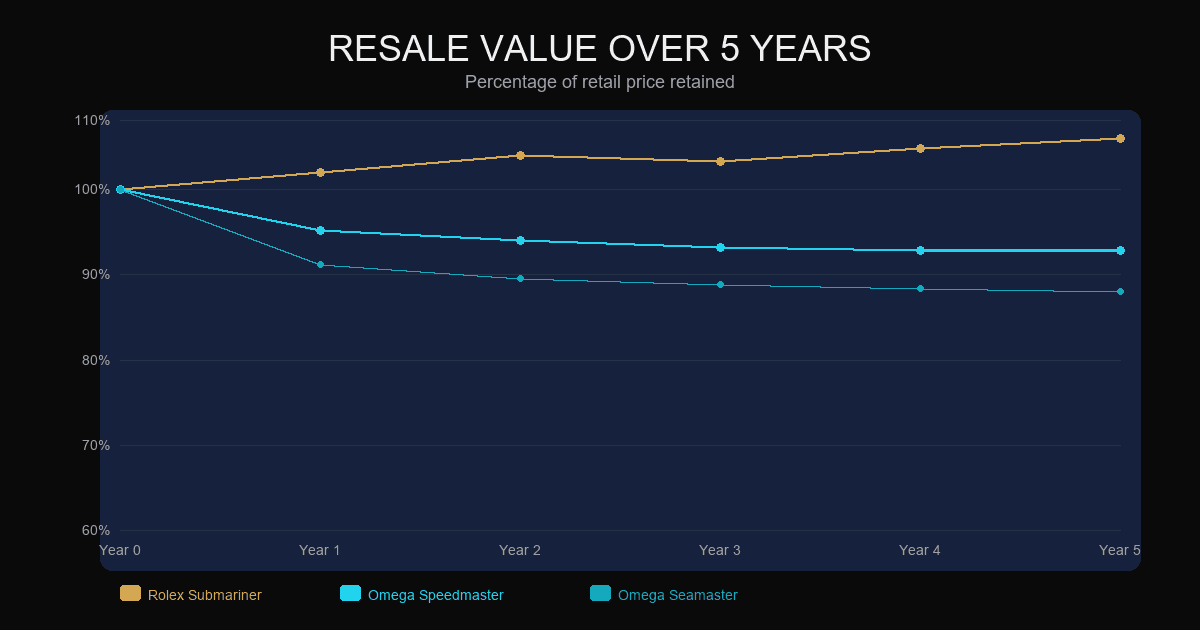
This is where Rolex pulls away decisively. Popular Rolex sport models — Submariner, Daytona, GMT-Master II — routinely sell at or above retail on the secondary market. The Submariner Date retails for $10,250 but trades for $12,000–$14,000 pre-owned. The Daytona is even more extreme: $15,100 retail, $30,000+ grey market.
Omega's resale picture is different. Most models depreciate 25–40% from retail when sold used. The Speedmaster Professional — Omega's strongest performer — retains 80–95% of retail, which is excellent by any standard. The Seamaster Diver 300M holds 70–80%.
Context matters here: Rolex steel sport models have pulled back 30–50% from their March 2022 bubble peaks. The Daytona dropped from $50,000+ to the mid-$30,000s. The market has stabilised, but anyone who bought at 2022 highs is underwater. Rolex resale is strong — but it's not guaranteed money.
For more on which watches hold value best, see our watches under $5,000 that hold value and 2026 market trends guides.
The Buying Experience
Here's where the brands differ most in 2026 — and where Omega has an underrated advantage.
Omega: Walk into any Omega boutique or authorized dealer. Try on a Speedmaster, Seamaster, or Aqua Terra. If you like it, buy it. Same day. No waitlist, no purchase history required, no relationship to cultivate. The watch you see advertised is the watch you can actually buy.
Rolex: For popular sport models (Submariner, Daytona, GMT-Master), expect waitlists of 6–18 months at authorized dealers. Many ADs require existing purchase history before they'll even add you to the list. The alternative is the grey market, where you pay $2,000–$20,000 above retail depending on the model.
The Rolex buying experience is part of the brand's scarcity strategy — and it works brilliantly for resale value. But if you just want to buy a great watch and wear it home today, Omega is the dramatically easier path.
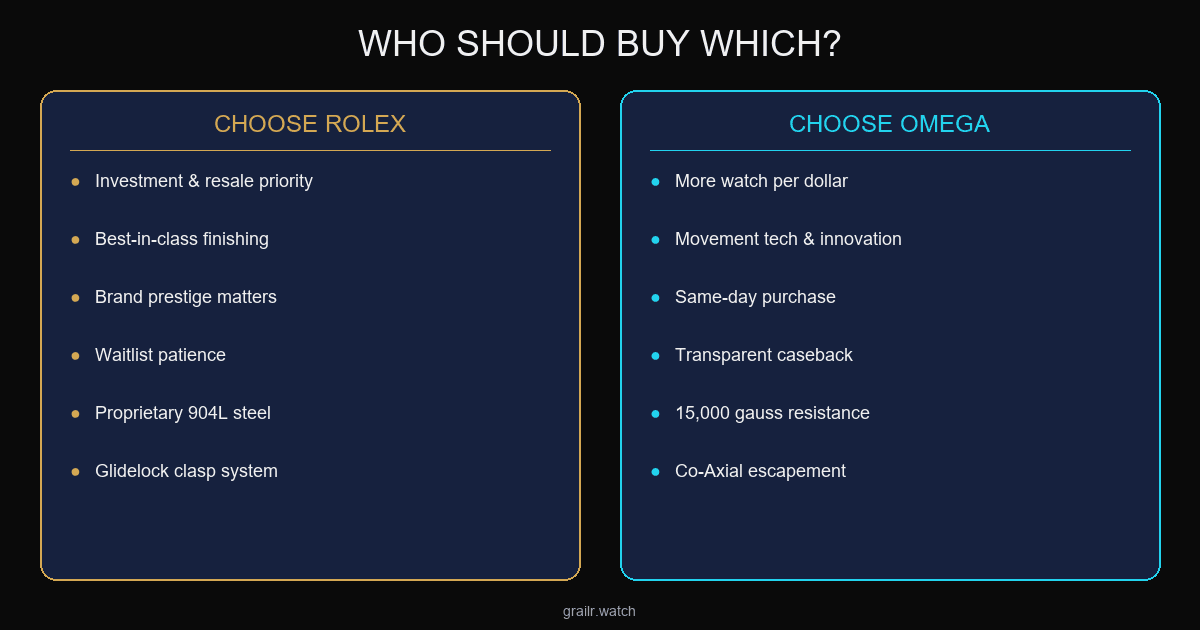
Who Should Buy Which?
Choose Rolex if...
- Resale value and investment potential are top priority
- You want the absolute best finishing and build quality
- Brand recognition and exclusivity matter to you
- You don't mind waitlists or grey market premiums
Choose Omega if...
- You want more watch per dollar at retail
- Movement technology and innovation excite you
- You want to buy at retail and wear it home the same day
- A transparent caseback and visible movement appeal to you
The Head-to-Head: Submariner vs Seamaster vs Speedmaster
Most people comparing Rolex and Omega are really comparing specific icons. Here's how the three most popular models stack up.
| Model | Submariner Date | Seamaster 300M | Speedmaster Moonwatch |
|---|---|---|---|
| Type | Dive watch | Dive watch | Chronograph |
| Case size | 41mm | 42mm | 42mm |
| Water resistance | 300m | 300m | 50m |
| Retail price | $10,250 | ~$5,700 | ~$5,300 |
| Pre-owned | $12,000–$14,000 | $3,800–$4,500 | $4,200–$5,000 |
| Heritage | Since 1953 | Since 1993 | Since 1957 (Moon, 1969) |
The Seamaster 300M is the closest Omega equivalent to the Submariner — both are 42/41mm dive watches rated to 300m. At nearly half the price with superior magnetic resistance, the Seamaster is the better objective value. The Submariner is the better investment and status symbol.
The Speedmaster is its own category entirely — the only watch worn on the Moon, and arguably the most iconic chronograph ever made. If you want a chronograph rather than a dive watch, the Speedmaster at $5,300 is one of the best value propositions in all of watchmaking. For more context on comparable dive watches, see our Submariner vs Tudor Black Bay comparison.
Frequently Asked Questions
Is Omega as good as Rolex?
In movement technology, Omega arguably leads — the Master Chronometer certification tests magnetic resistance at 15,000 gauss, far beyond Rolex's standard. In finishing, materials, and resale, Rolex has the edge. They're different value propositions, not a simple better-or-worse ranking.
Does Omega hold its value like Rolex?
No. Most Omega models depreciate 25–40% from retail. The Speedmaster Professional holds 80–95%, which is excellent — but Rolex sport models often trade above retail. If pure financial return matters, Rolex wins.
Why is Rolex more expensive than Omega?
Rolex controls supply through waitlists and limited dealer allocation, creating scarcity that drives grey market premiums. They also use proprietary alloys and invest heavily in exclusivity. Omega produces more watches and distributes more broadly, keeping prices accessible.
Should I buy a Rolex or Omega as my first luxury watch?
For most first-time buyers, Omega offers better value: walk in, buy a Speedmaster or Seamaster for $3,400–$8,000, and wear it home. A comparable Rolex costs $6,500–$10,000+ and may require months on a waitlist. If budget and resale are priorities, consider the best first watches under $3,000.
Related Articles
The Bottom Line
Rolex and Omega are both world-class watchmakers, and comparing them isn't a matter of “which is better” — it's “which is better for you.”
If you want a luxury watch as a financial asset, a status symbol, and a family heirloom with unbeatable resale, Rolex is the rational choice — if you can get one at retail or stomach the grey market premium.
If you want the most technically advanced movement, a buying experience that doesn't require grovelling at an AD, and $3,000–$7,000 left in your pocket compared to a comparable Rolex, Omega is the smarter play.
The best move? Know what your specific watch is worth in today's market before you buy or sell.
Check Any Watch's Value Instantly
Grailr can suggest a model and reference from a clear photo and provide an indicative AI price estimate. Active eBay listings, when available, show asking prices for comparison. Confirm the reference and condition with the seller; a photo scan does not authenticate a watch.
Sources and price context
- Rolex manufacturing and testing — Swiss production sites, manufacturing responsibilities and testing.
- OMEGA Moonwatch technical release — The white-dial Moonwatch, 42mm case and calibre 3861.
The links identify the specific manufacturer information and marketplace guidance used for this guide. Price ranges and resale percentages in this guide are illustrative, not live quotes or guaranteed returns; compare the exact reference, condition and sale date before relying on them.