Best Affordable Chronograph Watches in 2026
Quartz, meca-quartz and mechanical chronographs from $50 to $500 — compared by movement type, build quality and what you actually get for your money.
Price context: this guide includes indicative prices from its original publication period. They have not all been refreshed to current quotes. Use the linked primary sources for specifications and policies, and verify prices independently.
- A real mechanical chronograph starts at roughly $150 with the Seagull 1963 and its column-wheel ST1901 movement
- Meca-quartz hybrids (Seiko VK series) give you the mechanical “feel” with quartz accuracy for $150–$400
- Quartz chronographs from Casio, Seiko and Citizen start under $100 and are the most practical daily timers
- Mechanical chronographs hold resale value far better than quartz — the Seagull 1963 typically resells at 60–80% of retail
What a Chronograph Does and Why It Costs More
A chronograph is a watch with a built-in stopwatch. Press the top pusher to start timing, press it again to stop, and press the bottom pusher to reset. That sounds simple, but adding a chronograph to a watch movement means adding a clutch mechanism, a column wheel or cam lever, additional gears, and two or three extra hands — all of which must engage and disengage without disturbing the main timekeeping train.
In a mechanical watch, that complexity is why a chronograph costs significantly more than a time-only piece. A basic Seiko automatic runs about $200. A basic Seiko mechanical chronograph doesn’t exist at any price — Seiko doesn’t make one below the $3,000 Prospex Speedtimer. The Seiko Speedtimer line starts with the mechanical 8R46 caliber, which involves over 100 additional parts compared to a standard three-hand movement.
Quartz chronographs sidestep most of that cost. An electronic module can run multiple counters with a single integrated circuit, so brands like Casio and Citizen offer quartz chronographs for under $100. The trade-off is that the chronograph seconds hand ticks rather than sweeps, the pushers feel lighter, and there’s no mechanical soul to admire through a display caseback. For pure functionality, though, a $50 quartz chronograph keeps better time than a $5,000 mechanical one.
Quartz vs Mechanical Chronographs
The first decision is the movement type. Each has genuine advantages, and neither is objectively better — it depends on what you value.
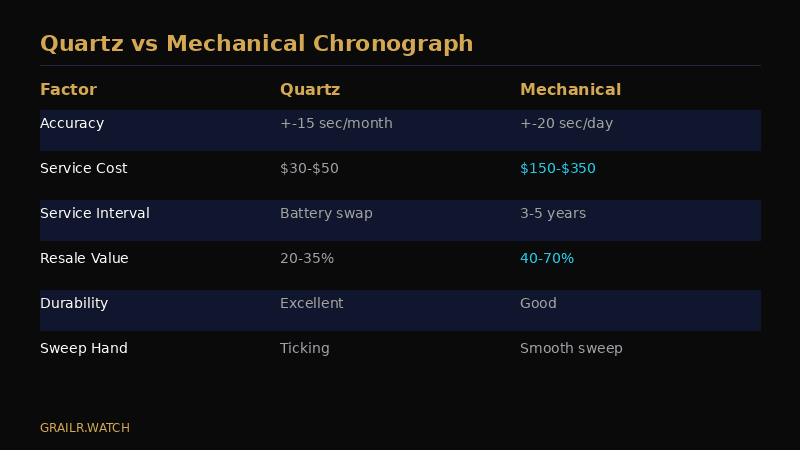
| Factor | Quartz Chronograph | Mechanical Chronograph |
|---|---|---|
| Accuracy | ±15 sec/month | ±15 sec/day |
| Entry price | $30–$50 | $150–$200 |
| Chrono seconds hand | Ticks (1-sec steps) | Sweeps (smooth) |
| Battery/power reserve | 2–5 years (battery) | 40–70 hours (mainspring) |
| Service cost | $10–$30 battery swap | $150–$400+ full service |
| Thickness | 10–13mm typical | 13–16mm typical |
| Resale retention | 20–40% | 50–80% |
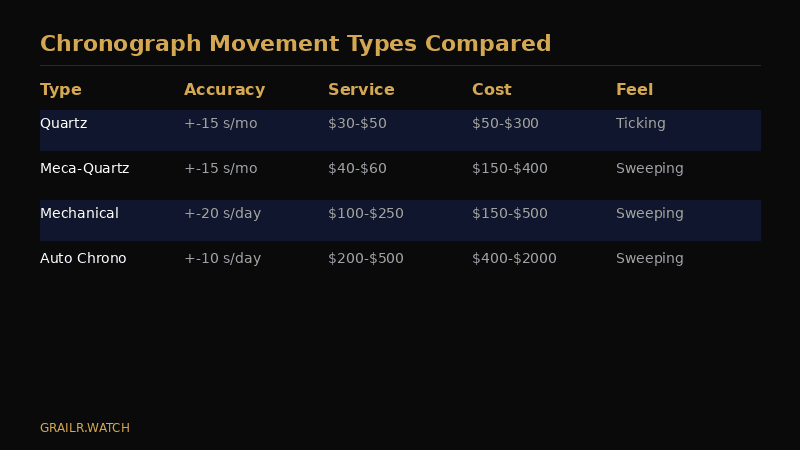
There’s also a third option: the meca-quartz hybrid. Movements like the Seiko VK63 and VK64 use a quartz module for timekeeping but a mechanical module for the chronograph function. The result is a sweeping chronograph seconds hand that snaps back to zero with a satisfying mechanical “click,” quartz-level accuracy, and a three-year battery life. Brands like Dan Henry and Undone have built entire collections around this movement, typically priced between $150 and $400.
The Movement Guide: What Powers Your Chronograph
Understanding the movement inside a chronograph tells you more about its quality than the brand name on the dial. Here are the calibers you’ll encounter most often under $500.
Miyota OS Series (Quartz)
Citizen-owned Miyota makes the OS10, OS20 and OS60 quartz chronograph calibers. These are workhorses: cheap, reliable, and found in hundreds of fashion-brand chronographs from $50 to $300. The OS20 is the most common, offering three subdials and a date window. Accuracy is about ±20 seconds per month. The main limitation is a ticking chronograph hand and subdials that can be hard to read at smaller sizes.
Seiko VK Meca-Quartz (Hybrid)
The VK63 (no date) and VK64 (with date) are Seiko’s hybrid chronograph modules. The quartz side keeps time; the mechanical side operates the chronograph. The big advantage is the smooth, sweeping chronograph seconds hand and a tactile pusher feel that pure quartz can’t match. Battery life is roughly three years. These movements cost manufacturers about $25–$40, so they appear in watches from $150 to $500. Dan Henry, Undone, Nezumi and Lorier all use VK calibers.
Seagull ST1901 / ST19 (Mechanical)
A direct descendant of the Swiss Venus 175, the ST1901 is a hand-wound column-wheel chronograph. China’s Tianjin Sea-Gull factory has produced it since the 1960s, and it remains the cheapest true mechanical chronograph movement in the world. It beats at 21,600 vph, offers about 45 hours of power reserve, and can be serviced by most watchmakers. Finishing is basic but functional. You’ll find it in watches from $100 to $600, including the iconic Seagull 1963.
Seiko Caliber V175 / V176 (Solar Quartz)
Found in the Orient RA-TX0203 and some Seiko SSC models, these solar-powered quartz chronographs convert light into energy. A full charge lasts about six months in the dark, so you never change a battery. Accuracy matches standard quartz at roughly ±15 seconds per month. The trade-off is a ticking chronograph hand and thicker cases to accommodate the solar cell beneath the dial.
Budget Tiers: Under $100 to $500
Under $100: The Beaters
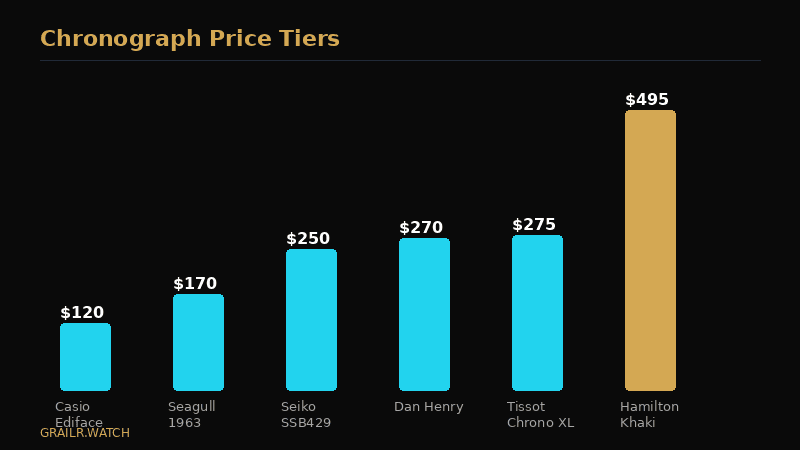
At this price, you’re buying quartz — and that’s fine. The Casio Edifice EFV-540D ($65–$80) gives you a stainless steel case, 100m water resistance, and a three-subdial layout with a date window. It’s the chronograph equivalent of the Casio Duro diver: absurdly good for the money. For even less, the Casio MTP-E515 ($40–$55) offers a similar layout in a smaller case. Both use Miyota-made quartz modules and are essentially disposable on service cost — a battery swap costs less than $15 at most jewellers.
The Pagani Design PD-1644 ($70–$90) is the wild card here. It’s a Chinese homage piece with a Seiko VK63 meca-quartz movement, sapphire crystal, and solid links — features that normally cost three times the price. The catch: quality control is inconsistent, and the brand name carries zero resale value. Buy it to wear, not to invest.
$100–$250: The Sweet Spot
This is where the chronograph market gets interesting. The Seiko SSB429 ($200–$250) is a reverse-panda quartz chronograph with a vintage racing aesthetic that punches well above its price. It uses the caliber 8T63 with 1/5-second chronograph resolution and a tachymeter bezel. The case is 40.5mm, which is the right size for a chronograph on most wrists.
The Seagull 1963 ($150–$230, depending on variant) is the most important watch in this tier. We’ll cover it in detail below, but the summary is this: it’s the cheapest true mechanical chronograph in the world, with a column-wheel movement that would cost $2,000+ from a Swiss brand. The acrylic crystal and 38mm case aren’t for everyone, but the movement is the real deal.
Also worth considering: the Citizen AN8050-51A ($100–$130), a clean quartz chronograph with 100m water resistance and a steel bracelet. It won’t win awards for finishing, but it’s a reliable affordable daily watch that does the chronograph job without fuss.
$250–$500: Near-Luxury Territory
At $275, the Tissot Chrono XL Classic is the cheapest Swiss-made chronograph you can buy. It uses the ETA G10.212 quartz movement with a 45mm case — large, but proportional on bigger wrists. The “Swiss Made” label means at least 60% of manufacturing costs occurred in Switzerland, which buys you tighter quality control than most watches at this price.
The Dan Henry 1964 ($270) is a fan favourite in the enthusiast community. It uses the Seiko VK63 meca-quartz for that satisfying sweeping chronograph hand, comes in a 38mm panda or reverse-panda dial, includes both a leather strap and a NATO, and ships in a watch roll. The brand’s limited-production model keeps secondary market prices stable — some editions resell above retail on forums.
At the top of this range, the Orient Star RK-AV0B01S ($450–$500) and the Hamilton Khaki Aviation Pilot Pioneer Chrono Quartz ($495) represent different philosophies. The Orient Star offers a mechanical movement with display caseback and dressy finishing. The Hamilton trades on its aviation heritage and uses a reliable ETA quartz module. Both are watches you could still be wearing in ten years.
The Orient RA-TX0203S ($280–$320) deserves a special mention. It’s a solar-powered chronograph with a panda dial, 200m water resistance, and a six-month power reserve. The solar V175 movement means you never change a battery, and the 200m rating means you can actually use it in water. For a chronograph you plan to wear daily without thinking about, this is arguably the best value in the entire guide.
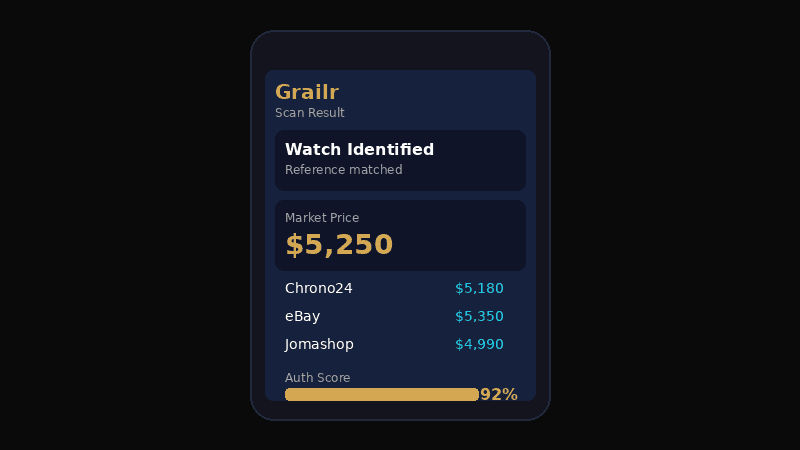
Check Any Watch Price in Seconds
Grailr scans your watch photo and pulls live pricing from Chrono24, eBay, and Jomashop.
- AI identifies brand, model & reference number
- Live market prices from 3+ sources
- Authentication confidence score
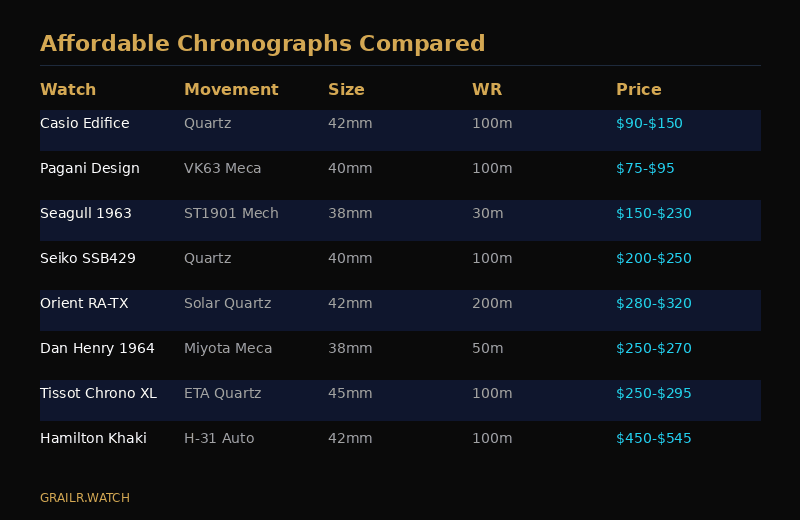
Master Comparison Table
Every chronograph in this guide side by side. All prices are indicative retail or typical street prices as of publication; verify current pricing before purchasing.
| Watch | Price | Movement | Type | Size | WR | Crystal |
|---|---|---|---|---|---|---|
| Casio MTP-E515 | $45 | Miyota quartz | Quartz | 42mm | 50m | Mineral |
| Casio Edifice EFV-540D | $75 | Miyota quartz | Quartz | 43mm | 100m | Mineral |
| Pagani Design PD-1644 | $80 | Seiko VK63 | Meca-quartz | 40mm | 100m | Sapphire |
| Citizen AN8050-51A | $115 | Miyota OS20 | Quartz | 42mm | 100m | Mineral |
| Seagull 1963 (38mm) | $150 | ST1901 | Mechanical | 38mm | 30m | Acrylic |
| Seiko SSB429 | $225 | Cal. 8T63 | Quartz | 40.5mm | 100m | Hardlex |
| Dan Henry 1964 | $270 | Seiko VK63 | Meca-quartz | 38mm | 50m | Double-dome mineral |
| Tissot Chrono XL | $275 | ETA G10.212 | Quartz | 45mm | 100m | Sapphire |
| Orient RA-TX0203S | $300 | Solar V175 | Solar quartz | 42.5mm | 200m | Sapphire |
| Citizen Zenshin CA4590 | $469 | Eco-Drive B612 | Solar quartz | 41mm | 100m | Sapphire |
| Hamilton Khaki Aviation | $495 | ETA quartz | Quartz | 42mm | 100m | Sapphire |
| Orient Star RK-AV0B01S | $475 | Cal. F6S42 | Mechanical | 41mm | 100m | Sapphire |
The Seagull 1963: The Cheapest Real Mechanical Chronograph
The Seagull 1963 deserves its own section because nothing else comes close to what it offers at the price. In 1963, China’s PLA Air Force needed a chronograph for its pilots. The Tianjin Watch Factory (now Sea-Gull) reverse-engineered the Swiss Venus 175 column-wheel movement and began production. That movement, now called the ST1901, has been in continuous production ever since.
What you get for roughly $150 is a hand-wound, column-wheel chronograph — the same architecture found in movements costing $2,000 or more from Swiss manufacturers. The column wheel is the key: it’s the more refined, more expensive method of engaging the chronograph clutch. Most affordable Swiss chronographs (even some costing $3,000+) use a cam-actuated system instead, which is cheaper to produce but delivers a less smooth engagement.
The 38mm case with acrylic crystal is deliberately retro, matching the original military specification. The acrylic is easy to polish out with Polywatch if it scratches. Water resistance is rated at only 30 metres — enough for hand washing, not for swimming. The movement runs at 21,600 vibrations per hour with approximately 45 hours of power reserve when fully wound.
Available variants include a sapphire crystal upgrade ($180–$230), a 40mm version, and limited editions with different dial colours. The standard cream dial with blue hands is the classic, and it’s the one most collectors recommend starting with. For anyone interested in mechanical watches, the 1963 is often recommended as a first chronograph alongside a basic Seiko or Orient automatic as a first watch.
Value Retention and Resale Reality
Let’s be honest: most affordable chronographs are not investments. A $75 Casio Edifice will be worth $20–$30 on the secondary market within a year. A $275 Tissot Chrono XL might fetch $120–$150 used. That’s the reality of quartz watches under $500 — they depreciate quickly because there’s always a new model available at retail, and a battery swap is a maintenance event that adds to the cost of ownership.
Mechanical chronographs tell a different story. The Seagull 1963 typically resells for $100–$150 on watchmaking forums, which is 60–80% of its retail price. That’s better retention than most Swiss quartz watches costing twice as much. The Dan Henry 1964, despite being meca-quartz, benefits from limited production runs — some colourways have sold out and now trade at or above retail on the secondary market.
The Orient RA-TX0203S holds value reasonably well at around 50–60% of retail, partly because Orient’s brand recognition is rising and the solar movement eliminates the battery concern. At the top of the range, the Hamilton Khaki Aviation retains about 55–65% thanks to the Hamilton name and ETA movement. If resale matters to you, buy mechanical or meca-quartz, avoid fashion brands entirely, and keep your box and papers.
Common Mistakes When Buying a Chronograph
1. Buying Too Large
A chronograph has pushers that extend beyond the case width, so a 42mm chronograph wears more like a 44mm time-only watch. If your wrist is 6.5–7 inches, aim for 38–40mm. The Seagull 1963 (38mm) and Dan Henry 1964 (38mm) wear beautifully on smaller wrists. The 45mm Tissot Chrono XL is genuinely large and suits wrists over 7.5 inches best.
2. Ignoring Water Resistance
The Seagull 1963’s 30m rating means it can handle hand washing and light rain — nothing more. Many vintage-style chronographs share this limitation. If you need a chronograph for any water activity, the Orient RA-TX0203S (200m) or Casio Edifice (100m) are far safer choices. Never press chronograph pushers underwater unless the watch is specifically rated for it.
3. Paying Brand Tax on a Basic Module
A $400 fashion-brand chronograph with a Miyota OS20 inside is the same movement as a $100 Citizen. The brand name on the dial doesn’t change the accuracy, reliability or serviceability of the movement. Before buying, check what caliber is inside. If it’s a Miyota OS or basic Seiko quartz, ask yourself whether the case and dial finishing justify the premium over a watch brand that doesn’t mark up the same movement.
4. Expecting Swiss Quality at Chinese Prices
The Seagull 1963 is a remarkable value, but it’s not finished like a $2,000 Swiss chronograph. Expect minor cosmetic imperfections: slightly uneven printing, basic polishing on the movement, and a case that won’t match a Sinn or Hamilton in fit and finish. For $150, you’re buying the movement, not the finishing. If finishing matters more than the movement type, step up to the $400–$500 tier and buy an Orient Star or Hamilton.
5. Not Using Grailr to Check Prices
Before buying any watch on the secondary market, scan the listing photo with Grailr to get an indicative price estimate and model identification. This is especially useful for Seagull 1963 variants, where different crystal types, case sizes, and editions carry different values. A photo scan cannot authenticate a watch, but it can flag a price that’s significantly out of line with the market.
Frequently Asked Questions
What is the cheapest mechanical chronograph watch?
The Seagull 1963 is the cheapest true mechanical chronograph, starting around $150. It uses the ST1901 column-wheel movement, a descendant of the Venus 175, and has been in continuous production since the 1960s.
Is a quartz or mechanical chronograph more accurate?
Quartz chronographs are far more accurate for timekeeping, typically within ±15 seconds per month versus ±15 seconds per day for a mechanical. However, for stopwatch use, both are accurate enough for everyday timing tasks.
What is a meca-quartz chronograph?
A meca-quartz movement, such as the Seiko VK63 or VK64, combines a quartz timekeeping module with a mechanical chronograph module. You get quartz accuracy with the satisfying sweep and snap of a mechanical chronograph hand. Models using this hybrid typically cost $150 to $400.
Do affordable chronograph watches hold their value?
Most quartz chronographs under $300 lose 50-70% of their value on the secondary market. Mechanical chronographs fare better: the Seagull 1963 typically resells for 60-80% of retail, and limited-edition Dan Henry models sometimes trade above their original price on forums.
What size chronograph should I buy?
A 38-40mm case suits most wrists for a chronograph. Chronographs have pushers that add width, so a 42mm chronograph wears closer to a 44mm time-only watch. If your wrist is under 7 inches, stick to 40mm or smaller.
Is the Seiko VK meca-quartz movement good?
The Seiko VK series is excellent for the price. It offers a sweeping chronograph seconds hand that snaps back to zero like a mechanical, quartz-level accuracy, and a battery life of about three years. It is widely used by microbrands including Dan Henry, Undone and Nezumi.
Related Articles
The Bottom Line
An affordable chronograph doesn’t have to mean compromising on what matters. The Seagull 1963 gives you a genuine column-wheel mechanical chronograph for $150. The Dan Henry 1964 offers the best meca-quartz experience at $270. The Orient RA-TX0203S is the most practical daily chronograph with its solar power and 200m water resistance. And if you just need a reliable stopwatch on your wrist, a $75 Casio Edifice will outlast watches costing five times more. Identify any chronograph with Grailr before you buy, and focus on the movement inside rather than the name on the dial.
Found a Chronograph You Like?
Grailr uses a photo to suggest a watch identity and an indicative price estimate, with active eBay listings where available. Check the exact reference and condition independently; a photo scan cannot authenticate a watch.
Scan a Watch NowSources and price context
- Seiko Prospex Speedtimer collection — Lists the mechanical chronograph calibers and specifications for Seiko’s Speedtimer lineup.
- Tissot Chrono XL collection page — Official pricing and ETA G10.212 movement specifications for the Chrono XL range.
These primary sources support the specific specification and collection points noted above. Prices elsewhere in this guide are indicative editorial figures, not a verified transaction dataset or guaranteed returns. Confirm the exact reference, region, condition and current quote before buying; asking prices are not completed-sale prices.