Key Takeaways
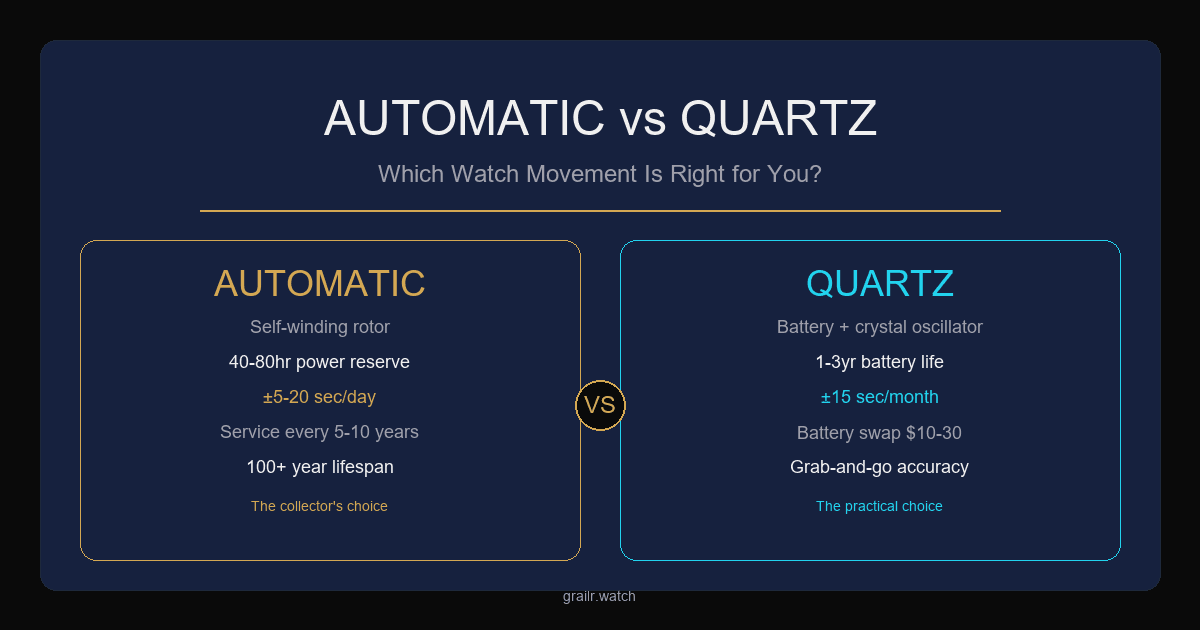
- Quartz watches are 10–30x more accurate than automatics — ±15–20 seconds per month vs ±5–20 seconds per day.
- Automatic watches can last 100+ years with periodic servicing. Quartz modules are typically replaced, not repaired.
- True cost of ownership favours quartz: $10–30 per battery every 1–3 years vs $200–800+ for automatic servicing every 5–10 years.
- The “Quartz Crisis” of the 1970s nearly destroyed the Swiss watch industry. Mechanical survived by repositioning as luxury and craftsmanship.
Automatic vs quartz is the most fundamental question in watch collecting. Every watch ever made uses one of these two power sources (or a hybrid of both), and your choice determines everything — accuracy, maintenance, lifespan, cost, and how the watch feels on your wrist.
The internet is full of tribal opinions. Mechanical enthusiasts call quartz “soulless.” Practical buyers call automatics “overpriced inaccuracy.” Both are wrong — and both are right, depending on what you value.
Here's the complete comparison with real numbers, not forum gatekeeping.
How Each Movement Works
Despite both telling time, automatic and quartz movements are fundamentally different machines. Understanding the mechanism helps explain why they differ in accuracy, cost, and longevity.
Quartz Movement
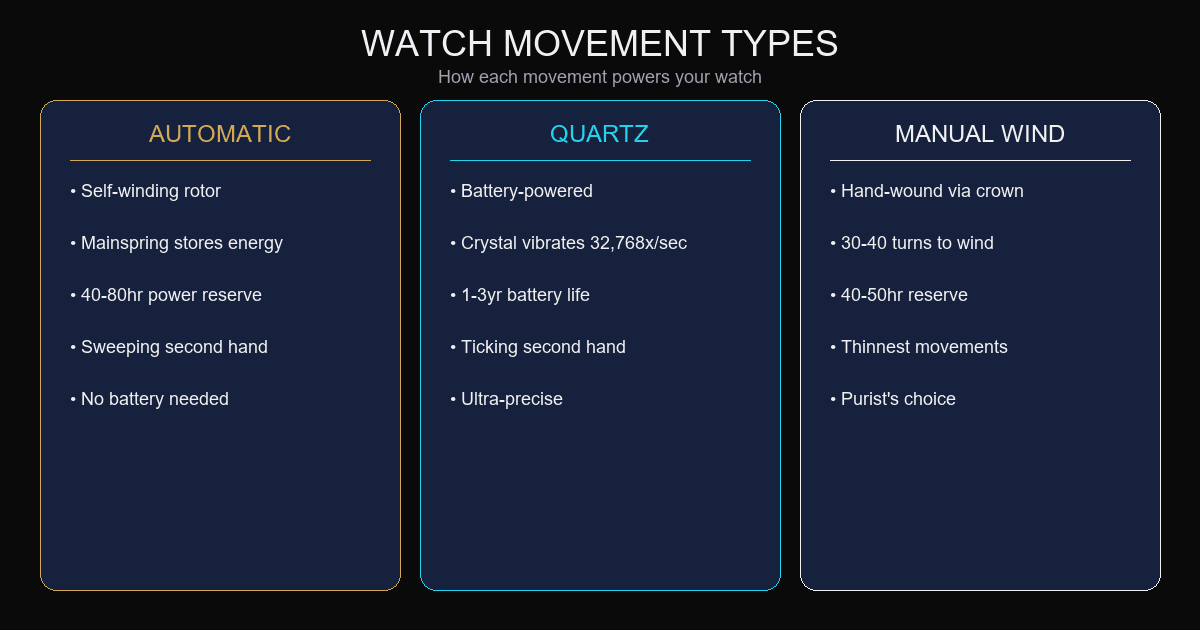
A battery sends an electrical current through a tiny quartz crystal, causing it to vibrate at a precise frequency of 32,768 times per second. A circuit counts these vibrations and converts them into one pulse per second, driving the hands forward. The entire system has very few moving parts — which is why quartz watches are so accurate and low-maintenance.
Automatic (Self-Winding) Movement
A weighted rotor spins with your wrist movement, winding a coiled mainspring that stores mechanical energy. As the mainspring slowly unwinds, it releases energy through a gear train regulated by an escapement and balance wheel oscillating 6–10 times per second (21,600–36,000 vibrations per hour). This is pure mechanical engineering — no battery, no electronics.
Manual Wind
Identical to an automatic, but without the rotor. You wind the crown by hand — typically 30–40 turns to fully charge the mainspring. Manual-wind watches tend to be thinner because there's no rotor adding height to the movement.
Accuracy: The Numbers Don't Lie
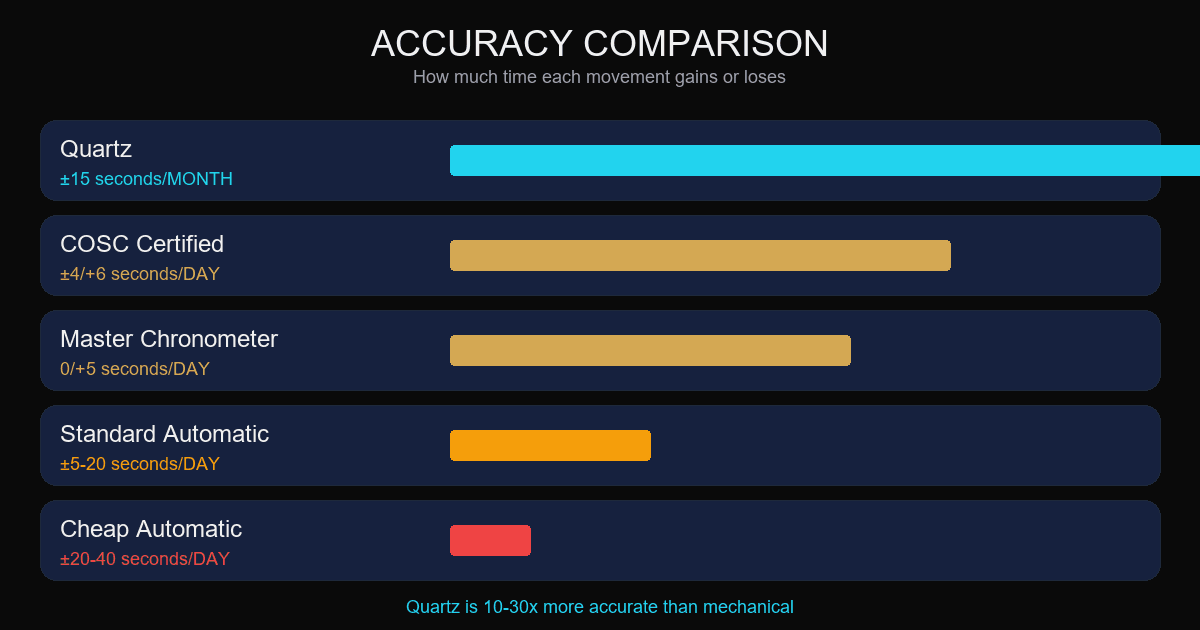
If raw timekeeping precision is your only metric, quartz wins by an order of magnitude. It's not even close.
| Movement Type | Accuracy | Annual Drift |
|---|---|---|
| Standard quartz | ±15–20 sec/month | ~2–4 min/year |
| High-end quartz (HAQ) | ±5–10 sec/year | 5–10 sec/year |
| Standard automatic | ±5–20 sec/day | ~30–120 min/year |
| COSC-certified automatic | −4/+6 sec/day | ~24–36 min/year |
| Master Chronometer | 0/+5 sec/day | ~0–30 min/year |
A $15 Casio F-91W keeps better time than a $10,000 Rolex Submariner. That's not an insult to Rolex — it's physics. Quartz crystal oscillation is inherently more stable than a mechanical balance wheel influenced by gravity, temperature, and position.
For context: COSC certification (Contrôle Officiel Suisse des Chronomètres) requires −4/+6 seconds per day. Master Chronometer certification by METAS tightens that to 0/+5 seconds per day and adds 15,000-gauss magnetic resistance testing. These are the gold standards for mechanical accuracy — and a $30 quartz watch still beats them.
Maintenance and True Cost of Ownership
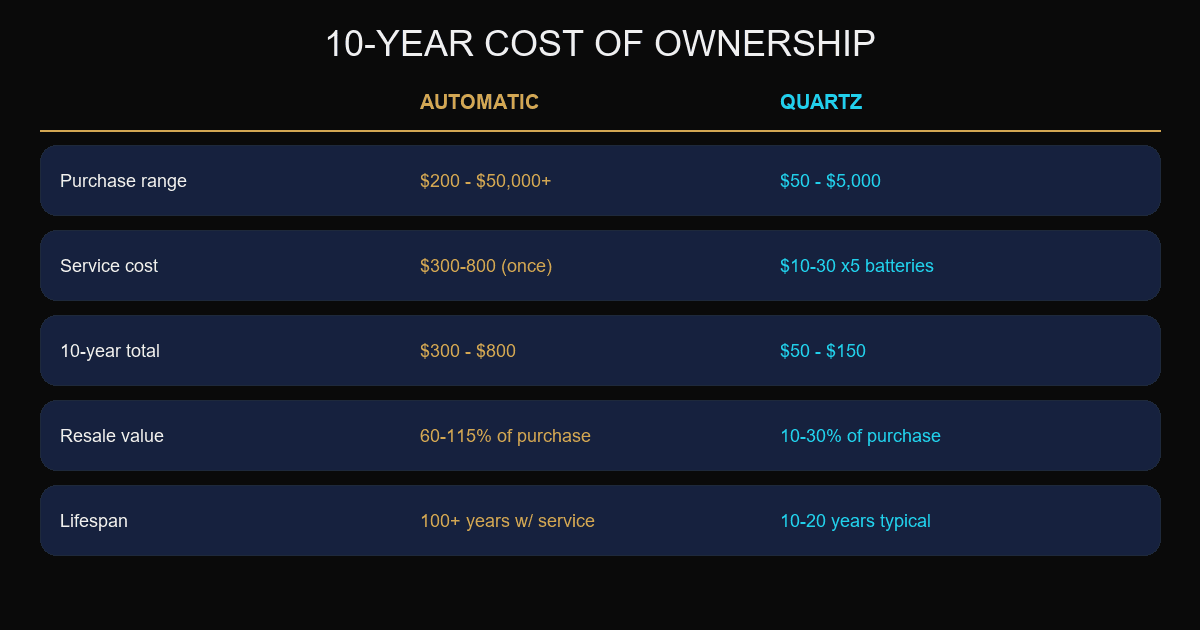
The purchase price is only part of the story. What you spend over a decade of ownership reveals which movement is truly more “affordable.”
| Cost Factor | Quartz | Automatic |
|---|---|---|
| Routine maintenance | Battery: $10–30 every 1–3 years | Full service: $200–800+ every 5–10 years |
| 10-year total | ~$50–150 | ~$400–1,600 |
| Luxury brand service | $50–100 (battery + reseal) | $600–1,500 (Rolex/Omega service) |
| DIY potential | Battery swap: easy | Not recommended (precision work) |
| Major repair | Usually module replacement | Individual parts can be repaired/replaced |
A key distinction: when a quartz movement fails catastrophically, the entire module is typically replaced rather than repaired. When an automatic movement needs work, a skilled watchmaker can disassemble, clean, and replace individual components — keeping the same movement running for generations.
For detailed pricing on luxury watch servicing, see our complete guide to watch service costs.
Durability and Lifespan
Both movement types are durable enough for daily wear, but they age very differently.
Automatic: Built for Generations
A well-made automatic watch can last 100+ years with periodic servicing. Vintage Omega Seamasters from the 1960s, Rolex Submariners from the 1970s — these are still running on their original movements, six decades later. The mechanical design means every component is individually replaceable.
Power reserve is typically 40–80 hours. Modern movements from Rolex and Tudor offer 70 hours, meaning you can leave the watch off all weekend and it'll still be running Monday morning. Older movements typically offer 38–48 hours.
Quartz: Reliable but Finite
Quartz watches are extremely shock-resistant (fewer delicate moving parts) and unaffected by position or gravity. They're the more rugged choice for hard daily wear. However, quartz circuits do degrade over decades, and finding replacement modules for discontinued movements can become impossible.
A quartz watch from the 1980s may still work perfectly — or its circuit may have failed with no available replacement. An automatic from the 1920s almost always can be brought back to life by a competent watchmaker.
The Feel Factor: Why Enthusiasts Choose Mechanical
Numbers alone don't explain why automatic watches command premium prices when quartz is objectively more accurate and lower maintenance. The difference is emotional and experiential.
An automatic watch is alive. The sweeping seconds hand moves in a smooth arc (typically 6–8 beats per second), not the tick-tick-tick of quartz. You can feel the rotor spinning when you gesture. Winding the crown creates a tangible mechanical connection between your fingers and the mainspring storing energy.
There's also the craft argument. An automatic movement contains 100–300+ individual components, many finished by hand — polished, bevelled, engraved. A quartz module is a circuit board and a battery. Both tell time. Only one is a feat of micro-engineering you can appreciate through a display caseback.
The 1970s Quartz Crisis nearly destroyed the Swiss watch industry when cheap, accurate quartz flooding the market made mechanical watches seem obsolete. Mechanical watchmaking survived by leaning into what quartz couldn't offer: craftsmanship, heritage, emotional connection, and luxury positioning. That narrative still drives the market today.
For context on how this plays out in buying decisions, see our guide to choosing your first luxury watch under $3,000.
Hybrid Movements Worth Knowing
The automatic-vs-quartz binary isn't the full picture. Several hybrid technologies blur the line:
| Technology | How It Works | Example |
|---|---|---|
| Spring Drive | Mechanical mainspring + electronic regulator (no battery) | Grand Seiko (exclusive) |
| Solar quartz | Light-powered quartz — no battery changes needed | Citizen Eco-Drive, Casio Tough Solar |
| Kinetic / Autoquartz | Rotor charges a capacitor that powers quartz circuit | Seiko Kinetic |
| Meca-Quartz | Quartz timekeeping + mechanical chronograph module | Seiko VK series |
Grand Seiko's Spring Drive is arguably the pinnacle: mechanical power source, electronic regulation, quartz-level accuracy (±1 second per day), and the smoothest seconds hand in all of watchmaking — a true glide with zero stepping. It's Seiko-exclusive and starts around $5,000.
Which Movement Is Right for You?
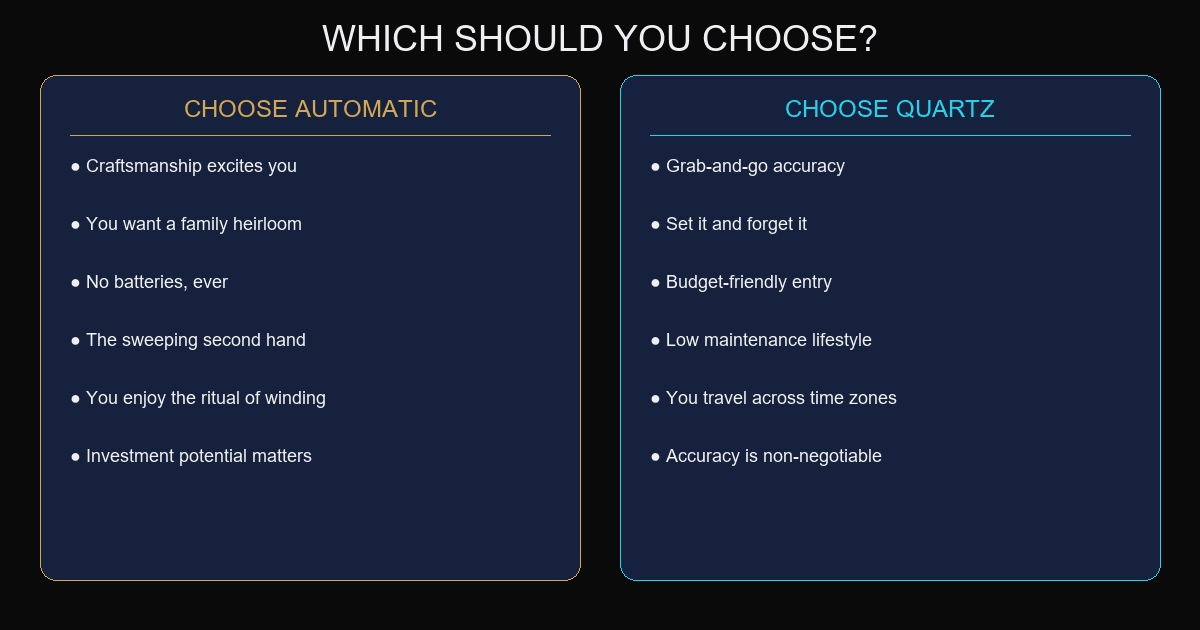
There's no universally “better” movement. The right choice depends entirely on your priorities. Here's the honest breakdown:
Choose Quartz if...
- Accuracy matters — you hate resetting your watch
- Low maintenance is a priority (set it and forget it)
- You rotate between multiple watches and don't want to reset each one
- Budget matters — you want great value without ongoing service costs
Choose Automatic if...
- You appreciate craftsmanship and micro-engineering
- You want a watch that can be passed down for generations
- The sweeping seconds hand and mechanical feel excite you
- You wear one watch daily and enjoy the ritual of winding
A note on wrist size: Automatic movements are generally thicker than quartz due to the rotor mechanism. If you have wrists under 6.5″, a 36–40mm watch tends to fit best. For 6.5–7.5″ wrists, 40–44mm works well. Quartz watches can be made thinner — so if you prefer a slim profile, quartz opens more options.
Frequently Asked Questions
Is quartz more accurate than automatic?
Yes, significantly. A standard quartz watch is accurate to ±15–20 seconds per month, while even a well-regulated automatic is ±5–20 seconds per day. Quartz is roughly 10–30x more accurate than mechanical movements in real-world use.
How long does an automatic watch last without servicing?
Most manufacturers recommend servicing every 5–10 years. The watch will still run beyond this interval, but accuracy declines and component wear accelerates. A well-maintained automatic can last 100+ years — many vintage pieces from the 1950s and 1960s still run on their original movements today. For more details, see our watch service cost guide.
Do automatic watches stop when you take them off?
Yes, eventually. Most automatics have a power reserve of 40–80 hours. If you don't wear the watch (or keep it on a winder) for longer than its power reserve, the mainspring will fully unwind and the watch will stop. You'll need to manually wind it and reset the time to restart.
Are expensive quartz watches worth it?
High-end quartz like Grand Seiko 9F or Breitling SuperQuartz offer thermocompensated movements accurate to ±5–10 seconds per year — far beyond standard quartz. You're paying for extreme precision, superior finishing, and often solar or kinetic power. If accuracy and low maintenance matter most, premium quartz delivers genuine value.
Related Articles
The Bottom Line
Quartz is the rational choice. It's more accurate, cheaper to maintain, and requires zero attention from you. If a watch is a tool for telling time, quartz wins on every measurable metric.
Automatic is the emotional choice. It's a miniature mechanical engine on your wrist — hundreds of components working in concert, powered entirely by your movement. It connects you to centuries of horological craft. It's less accurate, more expensive to maintain, and requires regular interaction. And millions of collectors wouldn't have it any other way.
The best answer for most people? Own both. A reliable quartz for days when precision and zero hassle matter. An automatic for when you want something with soul on your wrist. They're not competitors — they're complements.
Whichever you choose, know what it's worth before you buy.
Check Any Watch's Value Instantly
Grailr uses a photo to suggest a watch identity and an indicative AI price estimate, with active eBay listings where available. Check the exact reference and condition independently; a photo scan cannot authenticate a watch.
Sources and price context
- Grand Seiko Spring Drive technology — Explains the mainspring and electronic regulation; accuracy differs by calibre.
These primary sources support the specific history, specification or policy points noted above. Prices and resale percentages elsewhere in this guide are indicative editorial figures, not a verified transaction dataset or guaranteed returns. Confirm the exact reference, region, condition and current quote before buying; asking prices are not completed-sale prices.