Key Takeaways
- Value isn’t about being cheap — it’s the intersection of build quality, resale strength, and daily enjoyment. A $280 Orient can be better value than a $10,000 fashion watch.
- Rolex Oyster Perpetual 41 leads in retention at ~106% of MSRP on the secondary market, but Tudor, Omega, and Cartier also deliver exceptional value across price tiers.
- Every pick on this list features an in-house or premium movement, sapphire or hardlex crystal, and comes from a brand with genuine horological heritage — no fashion brands, no mushroom brands.
The word “value” gets thrown around recklessly in the watch world. Some people think it means “cheapest possible watch.” Others think it means “best investment.” Both are wrong.
A truly great value watch sits at the intersection of three things: build quality that punches above its price, strong resale performance so you don’t lose your shirt if you sell, and genuine enjoyment every time you look at your wrist. A $500 Seiko that makes you smile every day and sells for $400 three years later is better value than a $15,000 fashion chronograph that trades for $4,000 the moment you leave the store.
For a broader shortlist organized by budget and style, see our watches for men buying guide.
This editorial shortlist compares 12 watches across three price tiers for specifications, design and ownership considerations. No underlying completed-sale dataset is available to substantiate the resale rankings. Whether your budget is $280 or $7,750, there’s a watch on this list that will reward you for buying smart. If you want to dig deeper into which brands hold their value best, we’ve got a dedicated guide for that too.
What Makes a Watch “Good Value”?
Before we get into specific models, let’s establish what we mean by value. It’s not a single metric — it’s a framework built on five pillars:
Movement Quality
In-house or premium-grade movements (not generic unfinished ETA clones) with strong power reserves, accuracy ratings, and serviceability. A watch with a COSC-certified in-house caliber at $3,500 is objectively better value than a fashion brand using a basic Miyota at $2,000.
Build & Materials
Sapphire crystals, solid end-links, properly finished cases and bracelets, ceramic bezels where applicable. These are the tangible differences between a watch that feels like it’s worth the money and one that doesn’t.
Resale Strength
A watch that retains 80%+ of its purchase price gives you an “exit strategy.” You’re not locked in. If your tastes change or you need the money, you recover most of what you paid. This is a massive part of real-world value.
Brand Heritage
Brands with decades (or centuries) of watchmaking history have earned their reputation through consistent quality. Heritage isn’t just marketing — it translates directly into collector demand, parts availability, and long-term serviceability.
Daily Enjoyment
The best value watch is one you actually wear. Comfort on the wrist, a dial that catches light beautifully, the right size for your wrist — these intangibles matter more than any spec sheet.
Best Value Watches Under $1,000
This tier is where value-per-dollar is at its absolute peak. You’re getting legitimate horological quality — in-house movements, sapphire crystals, serious water resistance — at prices that would have been unthinkable a decade ago. The three picks below all outperform watches costing two or three times as much from lesser brands.
Seiko Presage SPB467
~$525 · 40.2mm · Stainless Steel
Seiko’s Presage line has quietly become the best value proposition in all of watchmaking. The SPB467 runs on the 6R35 movement — Seiko’s workhorse automatic with a 70-hour power reserve, which is longer than many Swiss watches costing five times as much. The dial finishing on these pieces is genuinely remarkable at this price: enamel-like textures, applied indices, and the kind of depth you usually see from Grand Seiko.
The crystal is Hardlex (Seiko’s proprietary hardened mineral glass), which is more scratch-resistant than standard mineral but not quite sapphire. That’s the only real compromise here. Water resistance is 50m — fine for daily wear, not for swimming. Pre-owned examples trade around $400–$450, giving you roughly 76–86% retention — excellent for this price range.
Orient Kamasu RA-AA0004E
~$280 · 41.8mm · Stainless Steel
The Orient Kamasu might be the single best value in a mechanical watch today. At roughly $280, you get an in-house F6922 movement (Orient is a Seiko subsidiary but designs their own calibers), a sapphire crystal, 200 meters of water resistance, a 120-click unidirectional bezel, and a screw-down crown. These are specs that compete with $800–$1,200 dive watches from European brands.
The power reserve is 40 hours — shorter than some competitors — and the bracelet could be better (hollow end links). But dollar-for-dollar, nothing else comes close. The green-dial variant (RA-AA0004E) has become a collector favourite, and pre-owned demand keeps resale values around $200–$240 (71–86% retention). For a $280 watch, losing $40–$80 over years of ownership is practically free.
Tissot PRX Powermatic 80
~$650 · 40mm · Stainless Steel
The Tissot PRX has taken the watch world by storm, and for good reason. It’s a Swiss-made watch with an 80-hour power reserve and an integrated bracelet design that draws obvious (and favourable) comparisons to the Audemars Piguet Royal Oak — at roughly 1/30th of the price. The Powermatic 80 movement (based on the ETA C07.111) is proven, accurate, and easy to service.
The sapphire crystal, exhibition caseback, and genuinely excellent bracelet with butterfly clasp make this feel like a much more expensive watch. It’s 100m water resistant, wears comfortably at 40mm, and comes in a huge range of dial colours. Pre-owned values sit at $475–$550 (73–85% retention). If you’re looking for your first serious watch, the PRX is a phenomenal starting point.
Best Value Watches $1,000–$5,000
This is the sweet spot of serious watchmaking. You’re now getting COSC-certified chronometers, genuine in-house movements, and brand heritage that holds up on the secondary market. The jump in quality from the sub-$1,000 tier is significant — and unlike the jump from $5,000 to $10,000, you actually get proportionally more watch for your money here.
Tudor Black Bay 58
~$3,575 · 39mm · Stainless Steel
The Tudor Black Bay 58 is the benchmark for mid-range value. Inside is the in-house MT5402 caliber, which is COSC-certified, runs at 28,800 vph, and delivers a 70-hour power reserve. The 39mm case wears perfectly on a wide range of wrists, and the vintage-inspired design with gilt details has broad appeal among both casual buyers and serious collectors.
Tudor’s position as Rolex’s sister brand gives it serious credibility, and that shows in resale. Pre-owned Black Bay 58s trade at $2,900–$3,250 (81–91% retention). Discontinued dial colours — like the navy blue 79030B — have actually appreciated above retail. This is a watch you can wear daily for years and sell without regret. For a deep dive, check our complete Tudor Black Bay guide.
Longines Spirit Zulu Time
~$3,100 · 42mm · Stainless Steel
A genuine GMT watch with a COSC-certified movement and 72-hour power reserve for just over $3,000 — that’s remarkable. The Longines Spirit Zulu Time uses an exclusive caliber (L844.4, based on the ETA A31.L01) with a silicon hairspring for improved magnetic resistance and a flyer GMT function that lets you independently set the local hour hand.
The ceramic bi-colour bezel is beautifully executed, and the overall finishing — polished and brushed surfaces, applied hour markers, well-proportioned hands — competes with watches at twice the price. Water resistance is 100m. Pre-owned values are $2,400–$2,700 (77–87% retention). The only reason this doesn’t score higher is that Longines’ brand recognition lags behind Tudor with casual buyers, which slightly dampens resale demand.
Omega Seamaster Aqua Terra 150M
~$5,800 · 41mm · Stainless Steel
The Aqua Terra sits at the top of this price bracket but earns its place through sheer technical excellence. It’s a Co-Axial Master Chronometer, meaning it’s passed METAS testing for magnetic resistance up to 15,000 gauss, accuracy of 0/+5 seconds per day, and water resistance validation. The 60-hour power reserve from the caliber 8900 is powered by a free-sprung balance with silicon balance spring.
The teak-pattern dial (inspired by the wooden decks of luxury sailboats) is an Omega signature, and the watch transitions effortlessly from boardroom to beach. At 150m water resistance, it’s genuinely versatile. Pre-owned prices range from $4,200–$4,800 (72–83% retention). For a more thorough look at the Seamaster lineup, see our Omega Seamaster buying guide.
Grand Seiko SBGA413 Spring Drive
~$5,400 · 40mm · Stainless Steel
Nothing else at any price does what Spring Drive does. The 9R65 caliber achieves ±1 second per day accuracy — better than most Swiss chronometers — through a unique hybrid mechanism that uses a mainspring for power but an electronic regulator for precision. The result is the smoothest sweep seconds hand in watchmaking: no tick, no stutter, just a continuous glide.
The SBGA413 “Snowflake” features Grand Seiko’s legendary textured dial inspired by the snow drifts of the Shinshu region, with 72 hours of power reserve and Zaratsu polishing that creates mirror-like distortion-free surfaces. It’s 100m water resistant and comes on a titanium bracelet that’s remarkably light and comfortable. Pre-owned values sit at $4,000–$4,600 (74–85% retention), and the trend is upward as Western collectors increasingly discover Grand Seiko.
Best Value Luxury Watches Over $5,000
At this level, you’re paying for brand prestige, supply scarcity, and resale strength as much as raw specs. The value proposition shifts: these watches don’t just hold value — several of them appreciate. That changes the math entirely. A Rolex that costs $6,150 and sells for $6,500 two years later is technically cheaper to own than a $500 fashion watch that’s worth $50 after the same period.
Rolex Oyster Perpetual 41
~$6,150 · 41mm · Oystersteel
The entry point to Rolex ownership, and arguably the best pure value in the entire Rolex catalogue. The Caliber 3230 delivers a 70-hour power reserve, Superlative Chronometer certification (±2 sec/day), and Rolex’s Chronergy escapement with paramagnetic blue Parachrom hairspring. The Oystersteel case is virtually indestructible, and the watch is rated to 100m.
Here’s where it gets interesting: secondary market prices for the OP 41 consistently exceed retail at approximately 106% retention. Certain dial colours (green, turquoise, coral red) trade at even steeper premiums. You are literally making money by buying this watch at retail — if you can get one. That’s value in the purest possible sense. Waitlists exist, but they’re shorter than for Daytonas or Submariners.
Rolex Explorer 40
~$7,350 · 40mm · Oystersteel
The Explorer is the watch that summited Everest and launched Rolex’s legend. The current 40mm reference uses the Caliber 3230 (same as the OP 41), with 70-hour power reserve and Superlative Chronometer accuracy. The dial is pure legibility: 3-6-9 numerals with Chromalight lume that glows blue in the dark. 100m water resistance, Oyster bracelet with Easylink comfort extension.
Resale is exceptional at approximately 97% retention. The Explorer doesn’t get the hype of a Submariner or Daytona, which ironically makes it easier to acquire at retail — and that accessibility combined with near-full value retention makes it one of the smartest buys in all of luxury watchmaking. It’s a true “buy it for life” piece that your children will want to inherit.
Cartier Santos Medium
~$7,750 · 35.1mm · Stainless Steel
The Santos de Cartier is the watch that started it all — literally. Designed in 1904 for aviator Alberto Santos-Dumont, it was one of the first purpose-built wristwatches in history. The modern version honours that heritage with an iconic square case, exposed screws, and Cartier’s QuickSwitch system that lets you swap between bracelet and leather strap in seconds without tools.
Inside is the caliber 1847 MC automatic movement with approximately 42 hours of power reserve. The real value here is versatility and timelessness: the Santos looks as natural with a suit as it does with a t-shirt, and its design has remained fundamentally unchanged for over 120 years. Pre-owned values are strong at $5,800–$6,500 (75–84% retention), and the trend is upward as the Santos enjoys a renaissance in collector circles.
Omega Speedmaster Professional
~$7,000 · 42mm · Stainless Steel
The Moonwatch needs no introduction. It’s the only watch qualified by NASA for extravehicular activity and was worn on the lunar surface during six Apollo missions. The current reference (310.30.42.50.01.002) uses the caliber 3861 manual-wind movement with Co-Axial escapement and Master Chronometer certification. Power reserve is 50 hours, and the hesalite crystal is a deliberate heritage choice (sapphire caseback version available).
Manual wind might seem like a drawback, but enthusiasts consider it a feature — the daily ritual of winding connects you to the watch in a way automatics don’t. Pre-owned values sit at $5,200–$5,800 (74–83% retention), and vintage Speedmasters from the 1960s–1980s have appreciated dramatically. Buying a current-production Speedmaster is buying into one of the most culturally significant objects in watchmaking history.
Tudor Pelagos 39
~$4,475 · 39mm · Titanium
The Pelagos 39 is a masterclass in getting more than you pay for. The case and bracelet are grade 2 titanium — lighter than steel, hypoallergenic, and incredibly comfortable for all-day wear. Inside is Tudor’s in-house MT5400 caliber with COSC certification, 70-hour power reserve, and silicon balance spring. Water resistance is an extraordinary 500 meters.
At $4,475, you’re getting titanium construction, an in-house chronometer movement, and 500m WR — specs that would cost $8,000+ from Omega (Seamaster Planet Ocean Titanium) or $12,000+ from Rolex (Sea-Dweller). Pre-owned values are strong at $3,800–$4,200 (85–94% retention). The Pelagos 39 is arguably the single best value proposition in the entire Tudor lineup, and one of the best in all of watchmaking under $5,000.
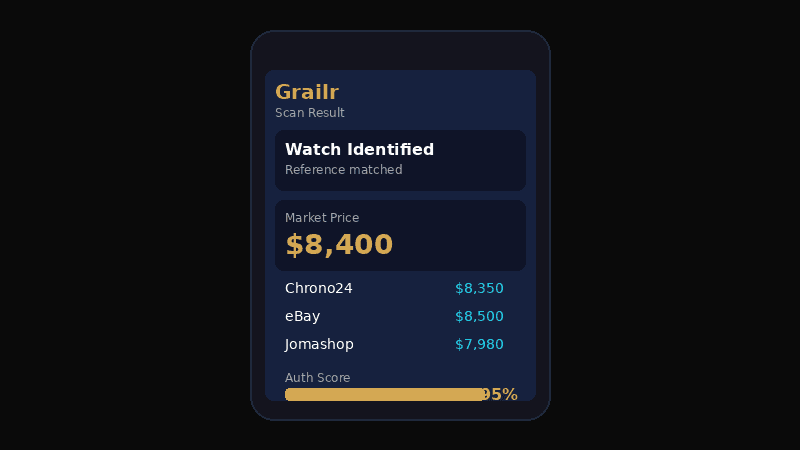
Check Any Watch Price in Seconds
Grailr uses a photo to suggest a watch identity and an indicative price estimate, with active eBay listings where available. Check the exact reference and condition independently; a photo scan cannot authenticate a watch.
- Grailr suggests brand, model & reference
- Active eBay listings where available
- Identification confidence, not authentication
Value Retention Comparison Table
Here’s how all 12 picks stack up side by side. The “Value Score” factors in movement quality, build, resale strength, brand heritage, and wearability — not just price retention alone.
| Watch | MSRP | Pre-Owned | Retention % | Value Score |
|---|---|---|---|---|
| Orient Kamasu | $280 | $200–$240 | 71–86% | 9.5 |
| Seiko Presage SPB467 | $525 | $400–$450 | 76–86% | 9.0 |
| Tissot PRX Powermatic 80 | $650 | $475–$550 | 73–85% | 9.0 |
| Longines Spirit Zulu Time | $3,100 | $2,400–$2,700 | 77–87% | 8.5 |
| Tudor Black Bay 58 | $3,575 | $2,900–$3,250 | 81–91% | 9.5 |
| Tudor Pelagos 39 | $4,475 | $3,800–$4,200 | 85–94% | 9.0 |
| Grand Seiko SBGA413 | $5,400 | $4,000–$4,600 | 74–85% | 8.5 |
| Omega Aqua Terra 150M | $5,800 | $4,200–$4,800 | 72–83% | 8.0 |
| Rolex Oyster Perpetual 41 | $6,150 | $6,300–$6,700 | ~106% | 9.5 |
| Omega Speedmaster Pro | $7,000 | $5,200–$5,800 | 74–83% | 8.5 |
| Rolex Explorer 40 | $7,350 | $7,000–$7,250 | ~97% | 9.0 |
| Cartier Santos Medium | $7,750 | $5,800–$6,500 | 75–84% | 8.5 |
Pre-owned prices based on Chrono24 and eBay completed listings as of May 2026 for watches in excellent condition with box and papers. Your results may vary based on condition, dial variant, and market timing.
How to Spot a Bad “Value” Watch
For every genuinely good value watch, there are dozens of pretenders. Here are the red flags that should make you walk away:
Fashion Brand Watches
Brands like Michael Kors, MVMT, Daniel Wellington, and Vincero use $15–$30 Miyota or Chinese movements in cases that cost $5–$10 to manufacture, then mark them up to $200–$500 through aggressive social media marketing. These watches have near-zero resale value and offer no horological merit. You’re paying for an Instagram ad, not a watch. An Orient Kamasu at $280 is a better watch in every measurable way than a fashion brand piece at $400.
Mushroom Brands
“Mushroom brands” is the watch industry’s term for companies that pop up overnight with slick Kickstarter campaigns, claim to offer “luxury quality at disruptive prices,” and disappear within a few years. They typically use generic Miyota 8215 or Seagull movements, source cases from the same Chinese factories, and have zero brand equity on the secondary market. If a brand didn’t exist five years ago and has no heritage story beyond “we cut out the middleman,” proceed with extreme caution.
Inflated MSRPs and Permanent “Sales”
If a watch has an MSRP of $2,000 but is always on “sale” for $599, the real price is $599 — and even that is probably inflated. This tactic is common among lower-tier brands (Invicta is the most notorious example) and is designed to make you feel like you’re getting a deal. Legitimate brands like Rolex, Omega, Tudor, and Grand Seiko never discount at authorized dealers. If there’s always a coupon code, the MSRP is a fiction.
Spec-Sheet Warriors with No Soul
Some microbrands load watches with impressive specs — sapphire crystal, ceramic bezel, Swiss movement, 300m WR — at suspiciously low prices. The specs look great on paper, but the execution (finishing, lume quality, bracelet feel, bezel action) tells the real story. A Longines with an ETA-based movement will feel like a $3,000 watch because of its finishing. A microbrand with the same base movement will often feel like a $300 watch with a $900 price tag.
How to Verify You’re Paying Fair Market Price
Even when you’ve identified the right watch, paying the right price requires homework. Here’s how to avoid overpaying:
Start Your Price Research With Grailr
Scan a photo of any watch and Grailr technology can suggest a brand, model and possible reference, with an indicative value estimate and active eBay listings where available. These listings show asking prices, not verified completed sales. You can also identify an unknown watch or explore a value estimate and learn when a professional appraisal is needed.
Check Completed Sales, Not Asking Prices
Anyone can list a watch for any price. What matters is what buyers actually paid. On eBay, filter by “Sold Items” to see completed transactions. On Chrono24, look at the “Sold” tab. Compare at least 5–10 recent sales of the same reference in similar condition to establish a fair market range. If a seller’s price is above the top of that range, negotiate or walk away.
Be Cautious with Grey Market Dealers
Grey market dealers sell new, unworn watches at discounted prices — but often without the manufacturer’s warranty. For brands like Tissot, Longines, and even Omega, grey market discounts of 15–30% are common. But the trade-off is no manufacturer warranty coverage and potentially more difficult after-sale service. For Rolex and Tudor, grey market prices are typically above retail because of supply constraints. Know which category your target watch falls into before you buy.
Verify Authenticity Before You Pay
Counterfeits have become frighteningly good, especially for Rolex, Omega, and Tudor. Always verify authenticity before completing a purchase. Check serial numbers against manufacturer records, examine the movement (if possible), and look for telltale signs of fakes: misaligned text, incorrect lume colour, sloppy finishing on the crown or caseback. When buying pre-owned over $1,000, an independent authentication service pays for itself.
Frequently Asked Questions
What is the best watch for value in 2026?
It depends on your budget. Under $1,000, the Tissot PRX Powermatic 80 (~$650) offers Swiss-made quality with an 80-hour power reserve. Between $1,000 and $5,000, the Tudor Black Bay 58 ($3,575) delivers COSC-certified in-house movement with outstanding resale. Over $5,000, the Rolex Oyster Perpetual 41 ($6,150) actually appreciates on the secondary market at roughly 106% retention.
Which watch brands offer the best value for money?
Seiko, Orient, and Tissot dominate under $1,000 with in-house movements and sapphire crystals at affordable prices. Tudor and Longines lead the $1,000–$5,000 range with COSC-certified calibers. Rolex, Omega, and Cartier offer the strongest value retention above $5,000.
Do luxury watches hold their value?
Most don’t — the average luxury watch loses 20–40% of its value after purchase. However, select models from Rolex, Tudor, Omega, and Cartier consistently retain 80–106% of retail price. The key factors are brand heritage, supply constraints, in-house movements, and collector demand.
Is it better to buy a new or pre-owned luxury watch?
Buying pre-owned is usually smarter financially. Most luxury watches depreciate 20–40% in the first year. A pre-owned watch in excellent condition lets you skip that initial loss. The exception is Rolex, where certain models sell above retail even when new, making authorized dealer purchases a form of instant equity.
What is a good entry-level luxury watch?
The Tissot PRX Powermatic 80 (~$650) is widely regarded as the best entry-level luxury watch. It features an 80-hour power reserve, integrated bracelet design, and Swiss-made quality. The Seiko Presage SPB467 (~$525) is another excellent option with a 70-hour power reserve and refined dress-watch styling.
How can I check if I’m paying a fair price for a watch?
Use Grailr to scan a watch photo and get an indicative price estimate and active eBay listings where available. Compare at least three sources before buying. Check completed (sold) listings rather than asking prices, and be wary of prices significantly below market average — they often indicate counterfeits or missing documentation.
The Bottom Line
Value in watches isn’t about finding the cheapest option — it’s about finding the watch that gives you the most quality and enjoyment per dollar spent. These options span different budgets, whether you’re spending $280 on an Orient Kamasu or $7,750 on a Cartier Santos.
The common thread is substance over marketing. These are watches from brands that have earned their reputations through decades of consistent quality, not through Instagram ads and influencer deals. They use real movements, real materials, and real craftsmanship — and the secondary market rewards them for it.
Our advice: pick the watch that makes your heart rate go up when you look at it, start your price research using Grailr’s indicative estimate, then compare independent prices for the exact reference and condition. Care and original accessories can help resale, but they do not guarantee how much you will recover.
Get an Indicative Watch Price Estimate
Grailr uses a photo to suggest a watch identity and an indicative price estimate, with active eBay listings where available. Check the exact reference and condition independently; a photo scan cannot authenticate a watch.
Related Articles
Sources and price context
- Tissot PRX Powermatic 80 specifications — Confirms this reference has an automatic movement, sapphire crystal and 80-hour reserve.
- eBay Product Research documentation — Explains sold-price research, including accepted Best Offers; separate from Grailr listing results.
These primary sources support the specific history, specification or policy points noted above. Prices and resale percentages elsewhere in this guide are indicative editorial figures, not a verified transaction dataset or guaranteed returns. Confirm the exact reference, region, condition and current quote before buying; asking prices are not completed-sale prices.