Watch Brands That Hold Value: 2026 Resale Data by Brand & Model
Real retention percentages for Rolex, Patek Philippe, AP, Omega, Tudor, Cartier, Breitling, TAG Heuer, and Grand Seiko — with specific models that hold value best.

Key Takeaways
- Rolex professional models retain 85-140% of retail — the Submariner and GMT-Master II lead the pack
- Omega and Tudor offer the best value retention in the $2,000-6,000 range at 55-80%
- Cartier has improved dramatically — the Santos Medium now retains 70-80% of retail value
- Breitling and TAG Heuer average 40-55% retention, making them better buys on the pre-owned market
- Steel sport watches from any brand retain value better than precious metal dress watches
What Determines Whether a Watch Holds Value
Before diving into brand-by-brand data, it helps to understand the five factors that drive value retention. These apply regardless of brand and explain why some $5,000 watches hold value better than $50,000 ones.
Supply vs demand: The single biggest factor. Rolex makes over a million watches per year but demand exceeds supply for professional models, creating premiums. Conversely, brands that overproduce relative to demand see steeper depreciation.
Material: Steel sport watches almost always retain value better than gold or platinum dress watches. A steel Rolex Submariner appreciates; a gold Cellini depreciates. The exception is Patek Philippe complications in precious metals, which hold value at auction due to collector demand.
Movement: In-house movements generally correlate with better retention than third-party movements (ETA, Sellita). Brands like Rolex, Patek, and AP — all with fully in-house calibres — outperform brands using modified ETA movements.
Brand prestige: Heritage, cultural relevance, and perceived exclusivity matter. Rolex and Patek have decades of brand equity that insulates their pricing even during market downturns.
Condition and completeness: Full sets (box, papers, warranty card, hang tags) can command 10-25% premiums over watch-only sales. Keeping original bracelets, avoiding aftermarket modifications, and maintaining service records all protect value.
The Complete Brand Retention Ranking
Here's how every major luxury watch brand performs on the secondary market, ranked by average value retention after 3-5 years of ownership. These figures represent typical results for the most popular models — individual references will vary.
| Brand | Avg Retention | Best Model | Worst Model |
|---|---|---|---|
| Rolex | 85-140% | Daytona, GMT | Cellini |
| Patek Philippe | 70-300% | Nautilus | Calatrava |
| Audemars Piguet | 60-130% | Royal Oak | Code 11.59 |
| Tudor | 70-85% | Black Bay 58 | 1926 |
| Omega | 55-80% | Speedmaster Pro | Constellation |
| Grand Seiko | 60-75% | Snowflake | Quartz models |
| Cartier | 50-75% | Santos Medium | Tank Must QZ |
| Breitling | 40-55% | Navitimer | Colt |
| TAG Heuer | 35-50% | Monaco | Formula 1 QZ |
The gap between Tier 1 (Rolex, Patek, AP) and the rest is significant. But within each tier, choosing the right model matters more than choosing the right brand. A Tudor Black Bay 58 retains value better than many gold Omega Seamasters, and a steel Cartier Santos outperforms most Breitling models despite the lower retail price.
Rolex: The Retention King
No brand matches Rolex for consistent value retention. The professional lineup — Submariner, GMT-Master II, Daytona, Explorer — retains 85-140% of retail value depending on the reference. Even “less desirable” models like the Datejust and Oyster Perpetual hold 80-100% in popular configurations.
The Daytona 116500LN has famously traded at 2x retail since its 2016 launch, though the premium has cooled from its 2022 peak. The GMT-Master II “Pepsi” 126710BLRO commands $17,000+ against its $11,250 retail. Even the entry-level Oyster Perpetual 41mm in popular dial colors trades above MSRP.
The key exception is Rolex's dress watch line. The Cellini collection retains only 50-65% of retail, and discontinued quartz models from the 1980s-90s trade for a fraction of their original prices. For detailed model-by-model pricing, see our Oyster Perpetual guide and GMT-Master II guide.
Do Cartier Watches Hold Their Value?
This is one of the most-searched questions in the watch world, and the answer has changed dramatically in recent years. Historically, Cartier depreciated 40-50% from retail — a “fashion brand” penalty. But since 2022, the Santos redesign and renewed collector interest have pushed Cartier's retention significantly higher.
The Santos Medium in steel now retains 70-80% of its $7,750 retail price, trading at $5,500-6,200 pre-owned. The Tank Normale, at $14,200 retail, has become a collector piece that trades at or above retail in some configurations. Even the entry-level Tank Must at $2,980 holds 60-65% — respectable for a fashion-adjacent brand.
Where Cartier still depreciates: quartz models, gem-set pieces (which lose the premium instantly), and the Ballon Bleu (50-55% retention). For a full Tank breakdown, see our Cartier Tank Buying Guide.
Check Your Watch's Value Instantly
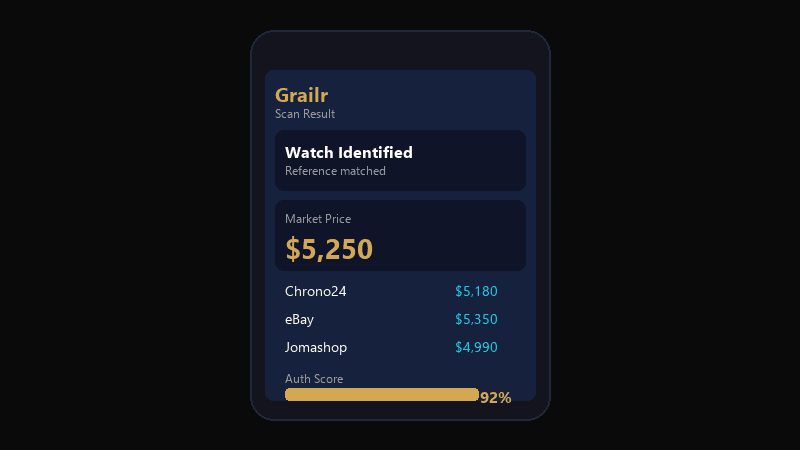
Grailr can suggest a watch identification and an indicative AI price estimate from a photo. Active eBay listings, when available, are asking-price comparisons, not completed-sale records.
- AI suggests a model and reference
- Active eBay asking-price comparisons
- See how your watch compares to retail
Do Breitling Watches Hold Their Value?
Breitling's retention sits at 40-55% across most models — below Omega and Tudor but on par with TAG Heuer. The brand's overproduction in the 2000s and 2010s flooded the secondary market, and that oversupply continues to suppress prices for older references.
The Navitimer B01 Chronograph (in-house movement, 43mm) is the standout, retaining 50-60% of its $9,400 retail. The Superocean Heritage in 42mm holds similarly well. Under Georges Kern's leadership since 2017, Breitling has repositioned upmarket with better movements and controlled distribution, which should improve retention over time.
Where Breitling struggles: any model with an ETA movement (pre-B01 era), the Colt line, and quartz models. These can lose 50-65% of retail value. If you're buying Breitling for retention, stick to the current B01-powered lineup and buy pre-owned to avoid the initial depreciation hit.
Omega, Tudor & Grand Seiko: The Value Sweet Spot
For buyers who want genuine horological quality with reasonable value retention, these three brands occupy the sweet spot between affordable and aspirational.
Omega retains 55-80% depending on the model. The Speedmaster Professional Moonwatch is the standout at 65-80% — its cultural significance (NASA heritage) and consistent design create stable demand. The Seamaster Diver 300M holds 60-70%, while the Aqua Terra retains 55-65%. Buying Omega pre-owned at 30-40% below retail means your future depreciation is minimal. See our Seamaster Buying Guide for model-specific pricing.
Tudor has emerged as the value retention leader in the $2,000-5,000 range. The Black Bay 58 retains 70-85% of retail, the Black Bay GMT holds 65-75%, and even the Pelagos maintains 60-70%. Tudor's in-house MT5600 series movements and Rolex association create a strong value proposition.
Grand Seiko retains 60-75%, with the “Snowflake” SBGA211 Spring Drive leading at 70-80%. Grand Seiko's Zaratsu polishing and Spring Drive technology deliver finishing that rivals brands 3-5x the price. The challenge is brand recognition — Grand Seiko is still building mainstream awareness outside of enthusiast circles, which caps secondary market demand.
TAG Heuer: Better Bought Pre-Owned
TAG Heuer retains 35-50% of retail on average, placing it at the bottom of the luxury tier for value retention. However, that depreciation curve makes TAG Heuer one of the best values on the pre-owned market — you can buy a barely-used Carrera Chronograph for 40-50% of retail and lose very little from there.
The Monaco holds value best at 50-60% retention, thanks to the Steve McQueen association and its status as one of the most recognizable chronographs ever made. The Carrera Chronograph with the in-house Heuer 02 movement retains 45-55%. The Formula 1 quartz lineup depreciates the most — 50-65% loss from retail — which is typical for entry-level quartz watches from any brand.
TAG Heuer's 2025 collection reset — higher prices, discontinued models, new Solargraph line — may shift these numbers over time. But for now, the smart play is buying TAG Heuer on the secondary market where the value proposition becomes genuinely compelling.
How to Maximize Your Watch's Resale Value
Regardless of which brand you buy, these strategies protect your investment and maximize what you'll get when selling.
Buy steel sport watches: Across every brand, steel sport models with colored bezels, chronograph functions, or GMT complications retain value better than dress watches, gold models, or quartz pieces. This pattern holds from Rolex to TAG Heuer.
Keep the full set: Box, papers, warranty card, purchase receipt, hang tags. A “full set” Rolex commands 10-20% more than watch-only. For Omega and Tudor, the premium is 5-15%. Store everything in a cool, dry place.
Service through the manufacturer: A recent manufacturer service with documentation adds confidence for buyers and can add 5-10% to the sale price. Independent service is fine for daily wear but doesn't carry the same resale weight.
Avoid aftermarket modifications: Custom dials, aftermarket bezels, and non-original bracelets destroy value for collector-grade watches. The exception is if you're keeping the original parts and can reverse the modifications at sale time.
Time your purchase: Buy pre-owned when possible to skip the initial depreciation. If buying new, the first year sees the steepest decline for most brands (except Rolex). For timing the sale, see our guide to selling luxury watches for the best strategies.
Frequently Asked Questions
Do Breitling watches hold their value?
Do Cartier watches hold their value?
Which watch brand holds value the best?
Are luxury watches a good investment?
Do TAG Heuer watches hold their value?
Does Omega hold its value?
Related Articles
What's Your Watch Worth?
Snap a photo and get instant market pricing from Chrono24, eBay, and Jomashop — see exactly where your watch stands.
Scan Your Watch NowSources and price context
- Chrono24 ChronoPulse methodology — A transaction-based market index; its movements are not returns for every individual watch.
- eBay Product Research — How to research actual sold prices separately from active asking prices.
The links identify the specific manufacturer information and marketplace guidance used for this guide. Price ranges and resale percentages in this guide are illustrative, not live quotes or guaranteed returns; compare the exact reference, condition and sale date before relying on them.