Rolex GMT-Master II Guide 2026: Every Reference, Price & How to Get One
The GMT-Master II is the watch that Rolex built for people who cross time zones — and it has become one of the most desired watches on the planet. With steel models trading at 50-80% above retail and waitlists stretching years, buying a GMT requires more than money. It requires strategy. This guide covers every current reference, real market pricing, the waitlist reality, the vintage models worth knowing, and what alternatives exist if the wait is too long.
Key Takeaways
- All steel GMT-Master II models retail at $11,350 but trade at $17,000-19,000+ on the secondary market.
- The Pepsi (126710BLRO) commands the highest premium — $19,000+ — thanks to its direct lineage from the 1955 original.
- Waitlists at authorized dealers run 3-7 years for steel models — building a purchase history is the only reliable shortcut.
- The full gold Root Beer (126715CHNR) is the only GMT that trades below retail — $38,000 vs $43,550 — making it the contrarian play.
- Vintage references 1675, 16750, and 16710 offer an alternative path into GMT ownership with genuine collector appeal.

From Pan Am Cockpits to the Most Desired Rolex
In 1955, Pan American World Airways asked Rolex to create a watch that could display two time zones simultaneously — one for the pilot’s home base and one for their destination. Rolex answered with the GMT-Master (ref. 6542), featuring a 24-hour graduated bezel and an additional hand that completed one rotation every 24 hours. The distinctive red-and-blue bezel — representing day and night — earned it the nickname “Pepsi.”
The GMT-Master II arrived in 1983 (ref. 16760, the “Fat Lady”) with a crucial upgrade: an independently adjustable hour hand. This meant the wearer could now track three time zones — the local time via the main hands, a second zone via the 24-hour hand against the bezel, and a third by rotating the bezel itself. It was, and remains, one of the most practical complications in all of watchmaking.
Four generations later, the current GMT-Master II (ref. 126710/126711/126715/126720) has evolved from a pilot’s tool into a cultural icon. The Cerachrom ceramic bezel replaced the vintage aluminum insert, the Cal. 3285 movement brought a 70-hour power reserve, and the Jubilee bracelet option gave the watch a dressier dimension. But the essence — a watch that tells you what time it is everywhere that matters — has not changed.
The Complete 2026 GMT-Master II Lineup
Rolex currently produces four GMT-Master II configurations in stainless steel and Rolesor, plus one in full gold. Here is every current reference with real pricing:
| Nickname | Reference | Bezel | Retail | Market Price | Premium |
|---|---|---|---|---|---|
| “Pepsi” | 126710BLRO | Red & Blue | $11,350 | $19,000+ | +67% |
| “Batman” | 126710BLNR | Black & Blue | $11,350 | $17,000+ | +50% |
| “Sprite” | 126720VTNR | Green & Black | $11,350 | $17,000+ | +50% |
| “Root Beer” | 126711CHNR | Brown & Black | $16,850 | $17,500+ | +4% |
| “Root Beer” Gold | 126715CHNR | Brown & Black | $43,550 | $38,000 | -13% |
The pattern is clear: steel GMTs trade at massive premiums while the precious metal versions trade near or below retail. This is the fundamental dynamic of the modern Rolex market — steel scarcity drives the premium, and buyers who want a GMT without the markup have exactly one option: the full gold Root Beer. It is an outstanding watch in its own right, with a warmth and presence that the steel models cannot match, and it is arguably the smartest buy in the current lineup if your budget allows it.
The Pepsi: Why It Commands the Highest Premium
The “Pepsi” (ref. 126710BLRO) is not just a GMT-Master II with a colorful bezel — it is a direct descendant of the most important travel watch ever made. The red-and-blue combination has been the GMT-Master’s signature since 1955, and Rolex’s decision to bring it back in ceramic in 2018 (after a decade of absence from the steel lineup) created one of the most explosive demand events in recent watch history.
The current Pepsi features a Cerachrom bezel insert in a single piece of ceramic with the color gradient achieved through a proprietary process. The red bleeds into the blue at the 6 and 18 markers in a way that varies slightly from piece to piece, giving each watch a subtle individuality. The Cal. 3285 movement inside offers a 70-hour power reserve with the Chronergy escapement and paramagnetic blue Parachrom hairspring.
Jubilee vs Oyster Bracelet
One detail that matters more than you might expect: the bracelet. The current Pepsi is offered on both the Jubilee (five-link, dressier) and Oyster (three-link, sportier) bracelets. The Jubilee was the original launch configuration in 2018 and remains slightly more sought-after on the secondary market. The Oyster version is the more traditional tool-watch choice and wears marginally thinner. Both feature the Oysterclasp with Easylink 5mm comfort extension. Choose based on your style preference — neither has a meaningful price advantage.
Batman & Sprite: The Modern Alternatives
The Batman (126710BLNR) debuted in 2013 as the first-ever black-and-blue GMT bezel. Where the Pepsi is bold and heritage-driven, the Batman is sophisticated and versatile. The black-and-blue color combination works with virtually any outfit, from a navy suit to jeans and a t-shirt. It trades at $17,000+ on the secondary market — a lower premium than the Pepsi, which makes it the slightly better value play if you are paying above retail.
The Sprite (126720VTNR) is the wild card. Introduced in 2022, it features a green-and-black bezel and — controversially — a left-handed crown at the 9 o’clock position. This “destro” configuration was originally designed for left-handed wearers but has found fans among right-handed wearers too; the crown does not dig into the back of the hand as it can with traditional 3 o’clock crowns.
Both models share the same Cal. 3285 movement, 40mm Oystersteel case, and 100m water resistance as the Pepsi. The choice between them is purely aesthetic and personal. If you are starting a collection and want one GMT, the Batman is the safest choice for versatility. If you want something that stands out, the Sprite’s left-handed crown makes it an instant conversation piece.
Check Any GMT-Master II Price Instantly
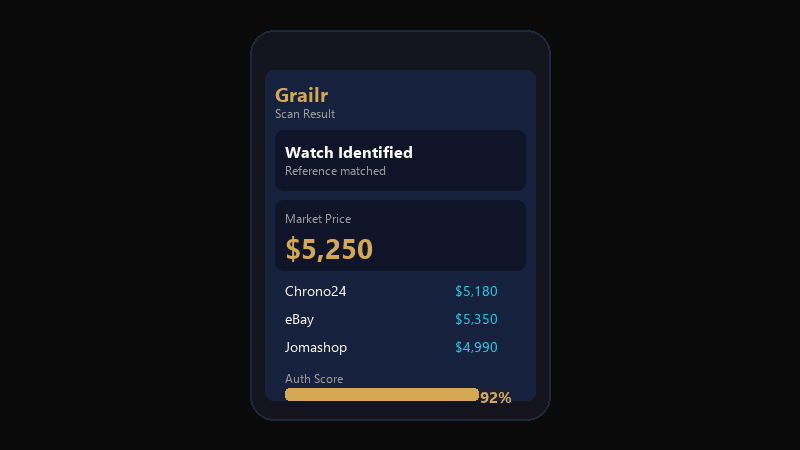
Grailr can suggest a model and reference from a clear photo and provide an indicative AI price estimate. Active eBay listings, when available, show asking prices for comparison. Confirm the reference and condition with the seller; a photo scan does not authenticate a watch.
- AI suggests the GMT reference from a photo
- Shows active eBay listings when available
- Indicative estimate to support further price research
The Waitlist Reality: How to Actually Get a GMT at Retail
The Rolex waitlist situation in 2026 is well-documented, and the GMT-Master II is among the hardest models to obtain at retail. Here is the honest assessment:
Pepsi (126710BLRO)
Typical wait: 5-7 years
Difficulty: Extreme
Batman (126710BLNR)
Typical wait: 3-5 years
Difficulty: Very Hard
Sprite (126720VTNR)
Typical wait: 3-5 years
Difficulty: Very Hard
Root Beer Rolesor (126711CHNR)
Typical wait: 6-18 months
Difficulty: Moderate
Build a purchase history: The single most effective strategy. Buy a Datejust, OP, or Explorer from your AD first. This demonstrates you are a genuine customer, not a flipper. Many ADs will not even put you on the GMT list without prior purchases.
Be flexible: If you tell your AD you only want a Pepsi on Jubilee, you are competing with the maximum number of buyers for the minimum number of watches. Being open to the Batman or Sprite, or to the Oyster bracelet, increases your odds significantly.
Consider the Root Beer Rolesor: The 126711CHNR in Oystersteel and Everose gold has a much shorter waitlist (often 6-18 months) and trades at only a 4% premium on the secondary market. It is a GMT-Master II with the same movement and functionality, just in a warmer colorway. For buyers who want the GMT experience without the multi-year wait, this is the pragmatic choice.
Market Premiums: Are They Worth Paying?
The question every prospective GMT buyer must answer: is it worth paying $17,000-19,000 for an $11,350 watch? The answer depends on how you frame it.
If your time has value: A 5-year waitlist means 5 years of not wearing the watch you want. If you can afford the premium and the watch will bring you daily joy, the calculus may favor buying now. The GMT has held its secondary market premium consistently since 2018 — this is not a bubble; it is structural demand exceeding supply.
If you are investing: Buying at $19,000 and expecting significant appreciation is riskier than buying at retail. The upside is capped unless Rolex discontinues a reference (which would spike demand) or the broader luxury watch market trends push prices higher. You are essentially paying for certainty and immediacy rather than future returns.
If authenticity matters: When paying a premium on the secondary market, verification is critical. The GMT-Master II is one of the most counterfeited Rolex models because of its high value. Always buy from a reputable dealer with authentication guarantees, and use our guide to spotting fake Rolexes before committing to a purchase.
Vintage GMT References Worth Knowing
The vintage GMT market offers a different kind of ownership — less about precision and more about history, character, and the patina that only decades of wear can produce. Here are the key references:
Ref. 1675
1959-1980
The definitive vintage GMT. Acrylic crystal, aluminum bezel, Cal. 1570/1575. Fading bezels ("ghost" Pepsis) command huge premiums.
Market: $15,000-35,000+
Ref. 16750
1981-1988
First GMT with quickset date. Transitional between vintage and modern. Acrylic crystal, better movement (Cal. 3075).
Market: $10,000-18,000
Ref. 16710
1989-2007
Last aluminum-bezel GMT. Sapphire crystal, Cal. 3185/3186. The most wearable vintage GMT for daily use.
Market: $10,000-16,000
Ref. 116710LN
2007-2019
First ceramic bezel GMT. Black bezel only initially, then BLNR (Batman) from 2013. Cal. 3186.
Market: $12,000-15,000
The ref. 16710 is the sweet spot for wearable vintage. It has a sapphire crystal (scratch-resistant, unlike the acrylic on earlier models), a quickset date, and a hacking seconds function. You can wear one daily without babying it, and prices remain reasonable at $10,000-16,000 depending on dial, bezel color, and condition. For understanding reference numbers, our dedicated guide breaks down the Rolex numbering system.
Alternatives: What to Buy If You Cannot Get a GMT
If the GMT-Master II’s waitlist and premium are deal-breakers, these alternatives offer genuine GMT functionality with their own merits:
| Watch | Retail | Availability | GMT Type | Movement |
|---|---|---|---|---|
| Tudor Black Bay GMT | $4,275 | Limited wait | True GMT | MT5652 (COSC, 70h) |
| Omega Seamaster GMT | $6,000 | Walk-in | True GMT | Co-Axial 8906 (60h) |
| Grand Seiko GMT (SBGM221) | $4,900 | Walk-in | True GMT | 9S66 (72h) |
| Breitling Navitimer B02 GMT | $9,400 | Walk-in | True GMT + Chrono | B02 (in-house, 70h) |
The Tudor Black Bay GMT is the most obvious alternative — it shares Rolex’s corporate DNA, offers a true GMT complication, and costs less than half the Rolex retail price. Our Rolex vs Tudor comparison covers the broader relationship between these two brands.
The Omega Seamaster GMT brings Master Chronometer certification and 15,000 gauss anti-magnetic resistance at a price well below the Rolex. For a full Omega-versus-Rolex breakdown, see our dedicated comparison.
Investment Perspective: The GMT as a Financial Asset
The GMT-Master II has one of the strongest investment profiles in the Rolex lineup. All steel references have traded above retail since 2018, and the premiums have proven remarkably sticky even during the broader luxury watch market correction of 2023-2024. The Pepsi, in particular, has maintained a floor around $18,000 since mid-2023.
The key risk factor is a potential increase in Rolex production. If Rolex significantly scales output of the 126710 references (as they have gradually done with other professional models), the supply-demand imbalance that drives premiums would soften. However, Rolex has historically been conservative about production increases, and there are no signs of a major ramp in 2026.
The contrarian play is the full gold Root Beer (126715CHNR). At $38,000 on the secondary market versus $43,550 retail, you are buying below retail with the intrinsic value of 18k gold as a floor. If the watch market turns further, gold models tend to hold value better because the raw material cost provides a backstop. For a deeper dive into watch investing, see our luxury watches investment guide.
Frequently Asked Questions
How much does a Rolex GMT-Master II cost in 2026?
How long is the waitlist for a Rolex GMT-Master II Pepsi?
Rolex GMT Pepsi vs Batman — which is better?
Is the Rolex GMT-Master II a good investment?
What is the Rolex GMT 'Sprite' and is it worth buying?
Are vintage Rolex GMT-Master models worth collecting?
Related Articles
Found the GMT-Master II You Want?
Grailr can suggest a model and reference from a clear photo and provide an indicative AI price estimate. Active eBay listings, when available, show asking prices for comparison. Confirm the reference and condition with the seller; a photo scan does not authenticate a watch.
Scan a GMT-Master II NowSources and price context
- Rolex GMT-Master II — The GMT family and its official model configurations.
- Rolex ownership FAQ — Availability, retail pricing and care guidance from Rolex.
The links identify the specific manufacturer information and marketplace guidance used for this guide. Price ranges and resale percentages in this guide are illustrative, not live quotes or guaranteed returns; compare the exact reference, condition and sale date before relying on them.