Rolex Oyster Perpetual Price Guide 2026: Every Size, Dial & What They’re Worth
The Oyster Perpetual is the purest expression of what a Rolex is: an Oystersteel case, a Perpetual rotor movement, and a Superlative Chronometer certification — nothing more, nothing less. It is also the most affordable new Rolex you can buy, starting at $6,200. But with the 2026 centennial shaking up the lineup with Rolesor and full gold options, and special dials trading at multiples of retail on the secondary market, pricing has never been more complicated. This guide breaks it all down.
Key Takeaways
- The Oyster Perpetual is the most affordable new Rolex — starting at $6,200 for the 28mm and $7,050 for the 41mm.
- New 2026 centennial models add Rolesor 41mm ($9,650) and full 18k gold options ($30,000-$38,100) for the first time.
- Celebration and Tiffany blue dials trade at $15,000+ above retail on the secondary market due to extreme scarcity.
- Pre-owned Oyster Perpetuals average ~$8,000 across all references, with a range of $2,000-$15,000 depending on size, dial, and condition.
- The 36mm is the sweet spot for most buyers — the best resale liquidity, most versatile wrist presence, and broadest dial selection.
What Makes the Oyster Perpetual Special
The Oyster Perpetual is where it all started. In 1926, Rolex patented the Oyster case — the world’s first waterproof wristwatch case. In 1931, they added the Perpetual rotor, creating the first self-winding waterproof watch. Those two innovations defined the modern wristwatch, and the Oyster Perpetual carries both in its name.
What you get for the money is deceptively impressive. Every Oyster Perpetual shares the same Oystersteel 904L alloy, the same Twinlock winding crown, and the same Superlative Chronometer certification (accuracy of -2/+2 seconds per day — tighter than COSC standards) as a Submariner or a Day-Date. The difference is what you don’t get: no date window, no rotating bezel, no complications. Just time, done perfectly.
For buyers considering their first Rolex, the Oyster Perpetual is the most honest entry point — you are paying for the movement and case engineering, not for gold, diamonds, or a ceramic bezel. It is also a surprisingly strong performer on the secondary market, especially if you land one of the sought-after dial colors.
Current Steel Lineup: Every Size and Price
Rolex offers the Oyster Perpetual in four case sizes. Each uses a different movement but shares the same case construction, finishing, and Superlative Chronometer certification. Here is the full breakdown:
| Size | Retail | Movement | Power Reserve | Pre-Owned Range |
|---|---|---|---|---|
| 28mm | $6,200 | Cal. 2232 | 55 hours | $5,000-7,000 |
| 34mm | $6,450 | Cal. 2232 | 55 hours | $5,500-8,000 |
| 36mm | $6,750 | Cal. 3230 | 70 hours | $6,500-12,000 |
| 41mm | $7,050 | Cal. 3230 | 70 hours | $7,000-20,000 |
The price difference between the 28mm and 41mm is only $850 at retail, which makes the larger sizes feel like a relative bargain — you are getting a bigger case, a more capable movement (the Cal. 3230 has 70 hours of power reserve versus 55 for the Cal. 2232), and better resale potential for less than a 14% premium.
The 36mm and 41mm use the same Cal. 3230 movement, which features Rolex’s Chronergy escapement and paramagnetic blue Parachrom hairspring. This is the same movement architecture found in the Submariner and Explorer, just without the date complication.
2026 Centennial Models: The Oyster Perpetual Goes Precious
For the 100th anniversary of the Oyster case, Rolex did something unprecedented: they introduced the Oyster Perpetual in Rolesor (two-tone steel and gold) and full 18k yellow gold. This is the first time the OP has been available in anything other than stainless steel, and it fundamentally changes the collection’s positioning.
| Model | Material | Size | Retail |
|---|---|---|---|
| Rolesor OP | Oystersteel + 18k Yellow Gold | 41mm | $9,650 |
| Full Gold OP | 18k Yellow Gold | 34mm | $38,100 |
| Full Gold OP | 18k Yellow Gold | 28mm | $30,000 |
The Rolesor 41mm at $9,650 is particularly interesting. It slots between the standard steel OP ($7,050) and the entry-level Datejust 36 in Rolesor ($10,800), making it a compelling choice for someone who wants a two-tone Rolex without the date complication. The clean dial and smooth bezel give it a minimalist elegance that the Datejust, with its Cyclops lens and fluted bezel, cannot match.
The full gold models at $30,000-$38,100 are a different proposition entirely. They compete with the Day-Date and gold Datejust for attention, and whether the OP’s simplicity justifies the price next to those complication-rich alternatives will depend on the buyer’s taste for minimalism. Early market reactions suggest strong demand for the Rolesor model and more cautious interest in the full gold pieces.
The Dial Factor: Why Some OPs Are Worth Three Times Retail
No other Rolex model demonstrates the power of dial color on resale value quite like the Oyster Perpetual. When Rolex introduced vibrant new dial colors for the 41mm in 2020 — turquoise (nicknamed “Tiffany blue”), yellow, coral red, green, and candy pink — demand exploded overnight.
The Celebration dial, introduced later with its multi-colored hour markers in a rainbow arrangement, pushed premiums even higher. Here is what the secondary market looks like in 2026:
Turquoise (Tiffany Blue)
Retail: $7,050
Market: $15,000-20,000
+$8,000-13,000
Celebration (Rainbow)
Retail: $7,050
Market: $18,000-25,000
+$11,000-18,000
Yellow / Coral Red
Retail: $7,050
Market: $10,000-14,000
+$3,000-7,000
Black / Silver / Blue
Retail: $7,050
Market: $7,000-9,000
At or near retail
The lesson here is that the Oyster Perpetual’s value story depends almost entirely on which dial you have. A black-dial 41mm trades at or slightly below retail — perfectly respectable for a steel Rolex with no complications. A Celebration dial is a genuine collectible that has more than tripled in value. If you can get any of the vibrant colors at retail from an authorized dealer, you are effectively buying at a deep discount to market.
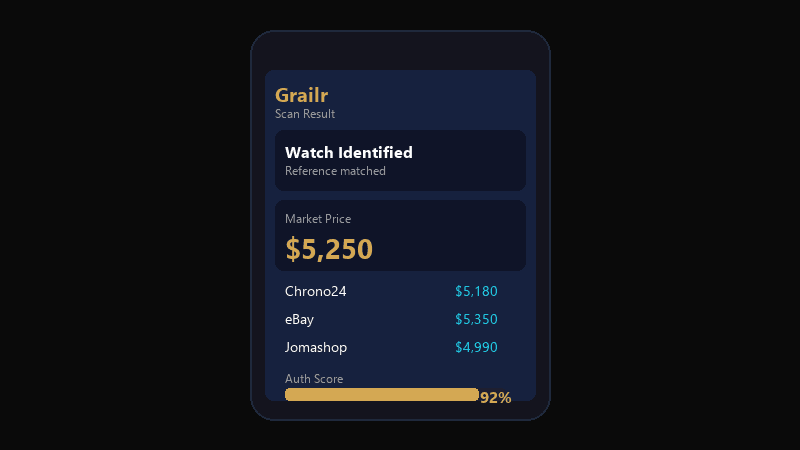
Check Any Oyster Perpetual’s Value Instantly
Grailr can suggest a model and reference from a clear photo and provide an indicative AI price estimate. Active eBay listings, when available, show asking prices for comparison. Confirm the reference and condition with the seller; a photo scan does not authenticate a watch.
- AI suggests a likely reference number from a photo
- Active eBay asking-price comparisons
- Tracks resale value trends over time
The Pre-Owned Market: What Oyster Perpetuals Actually Sell For
The pre-owned Oyster Perpetual market is bifurcated in a way that few other Rolex models are. On one end, you have standard-dial current-production models trading at or slightly above retail. On the other, you have discontinued references and older models available for surprisingly modest prices.
The average pre-owned OP across all references is approximately $8,000, but that number obscures a wide range. Previous-generation 36mm models (ref. 116000) from 2015-2020 can be found for $5,000-6,500 with box and papers. Go back to the ref. 114200 or 114300, and prices drop to $4,000-5,500. Vintage OPs from the 1990s and earlier start around $2,000-3,000 for presentable examples.
For buyers who want a Rolex on a budget, these older Oyster Perpetuals represent one of the best values in the entire market. You get a genuine Rolex with the Oyster case, a reliable automatic movement (often the workhorse Cal. 3130 or Cal. 3131), and the confidence that comes with the crown on the dial — all for less than many mid-range Swiss watches cost new.
If you are evaluating an older reference, use Rolex serial number lookup to verify the production year, and always authenticate before buying.
Oyster Perpetual vs Datejust: Which One Should You Buy?
The question every OP buyer eventually faces: should I spend a bit more and get the Datejust instead? The answer depends on what you value.
| Feature | Oyster Perpetual 41 | Datejust 41 |
|---|---|---|
| Retail Price (Steel) | $7,050 | $8,100-9,550 |
| Date Display | No | Yes (with Cyclops) |
| Bezel Options | Smooth only | Smooth, Fluted, Diamond |
| Movement | Cal. 3230 | Cal. 3235 |
| Material Options | Steel, Rolesor, Gold (2026) | Steel, Rolesor, Gold, Platinum |
| Resale Value | 85-100% (standard dials) | 90-110% (standard dials) |
The Oyster Perpetual wins on purity and simplicity. There is something deeply satisfying about a watch that does one thing — tell the time — and does it with world-class engineering. The clean dial without a date window and the smooth bezel create a symmetry and balance that the Datejust, with its Cyclops lens, cannot quite match.
The Datejust wins on practicality and versatility. The date complication is genuinely useful, the fluted bezel adds visual interest, and the wider range of materials and configurations means there is a Datejust for virtually every taste. If you are buying one watch to do everything, the Datejust is the safer choice. If you are building a collection and want a minimalist time-only piece, the OP is the more interesting pick.
How to Buy Smart: Retail, Pre-Owned, and the Waitlist
At the authorized dealer: Standard-dial Oyster Perpetuals (black, silver, blue) are among the easier Rolex models to acquire in 2026. The waitlist, if one exists at all, is typically weeks to months — not years. Vibrant dials (turquoise, coral, yellow, Celebration) are a different story entirely, with waitlists rivaling the Submariner and Daytona. Building a relationship with your AD through smaller purchases remains the most reliable path.
Pre-owned from trusted dealers: The smartest play for value-conscious buyers. A 2022-2024 reference 124300 (41mm) in black or silver can be found for $7,000-8,000 — essentially at or below retail, barely worn, with full box and papers. Always verify authenticity; the OP is one of the most commonly counterfeited Rolex models because of its clean design simplicity. Our guide on spotting fake Rolexes covers the key tells.
If you are selling: Price your OP realistically using live market data. Standard dials should be priced at 85-95% of retail for recent references with box and papers. Hot dials can be priced at market — but be aware that premiums are softening from their 2022 peak. Our guide to selling a Rolex walks through the process step by step.
Investment Perspective: Will the OP Hold Its Value?
The Oyster Perpetual sits in an interesting position for watch investors. Standard-dial models are not going to make you money — they trade near or slightly below retail, which means you lose the spread and transaction costs. But they also do not depreciate significantly, which puts them ahead of most non-Rolex luxury watches.
The special dials are a different asset class entirely. The Celebration and Tiffany blue dials have shown remarkable price stability even as the broader watch market corrected in 2023-2024. Their scarcity is genuine — Rolex produces far fewer of these dials relative to demand — and the cultural cachet (the Tiffany blue OP was arguably the most viral watch of the decade) provides a floor under prices.
The 2026 centennial models add a new variable. It is too early to know how the Rolesor and gold OPs will perform on the secondary market, but first-year production models of new Rolex categories have historically done well. If Rolex limits production (which their track record suggests they will), the centennial OPs could become sought-after references within a few years.
Frequently Asked Questions
How much does a Rolex Oyster Perpetual cost in 2026?
Is the Rolex Oyster Perpetual a good first Rolex?
Does the Rolex Oyster Perpetual hold its value?
What is the difference between the Oyster Perpetual and the Datejust?
Which Rolex Oyster Perpetual size should I buy?
Can you still get a Tiffany blue Oyster Perpetual?
Related Articles
Ready to Check an Oyster Perpetual’s Value?
Grailr can suggest a model and reference from a clear photo and provide an indicative AI price estimate. Active eBay listings, when available, show asking prices for comparison. Confirm the reference and condition with the seller; a photo scan does not authenticate a watch.
Scan an Oyster Perpetual NowSources and price context
- Rolex Oyster Perpetual — The Oyster Perpetual family and current configuration links.
- Rolex ownership FAQ — Availability, retail pricing and care guidance from Rolex.
The links identify the specific manufacturer information and marketplace guidance used for this guide. Price ranges and resale percentages in this guide are illustrative, not live quotes or guaranteed returns; compare the exact reference, condition and sale date before relying on them.