Cartier Baignoire: Sizes, Prices and History
The definitive guide to Cartier’s iconic oval watch — from the 24.6 mm Mini to the dramatic Allongée, with 2026 pricing, material options and resale data.
Price context: this guide includes indicative prices from its original publication period. They have not all been refreshed to current quotes. Use the linked primary sources for specifications and policies, and verify prices independently.

- The Baignoire is Cartier’s oval dress watch, available in Mini, Small and the elongated Allongée — all in precious metal only
- Retail starts at roughly $9,550 for the Mini in 18K yellow gold after the May 2026 price increase of 6.1 %
- Diamond-set models range from $17,800 to over $40,000; the Allongée trades near $33,000 on the secondary market
- The legendary Cartier Crash is a distorted version of the Baignoire Allongée and regularly sells for six figures at auction
What Makes the Baignoire Special
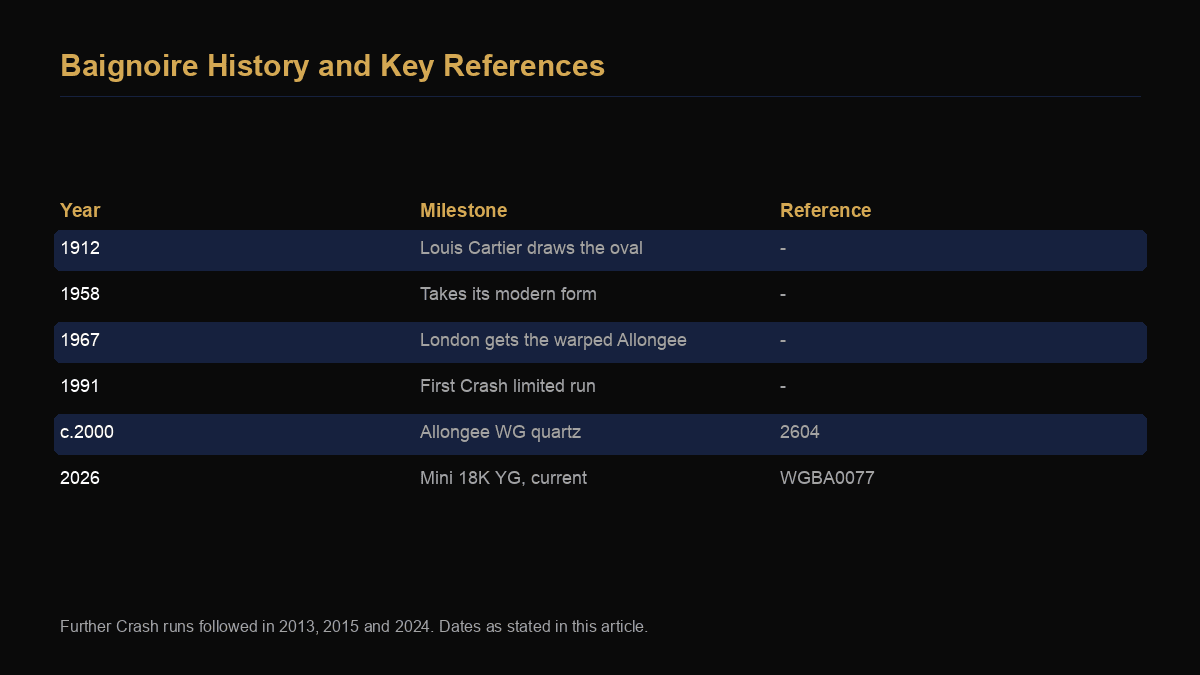
The Cartier Baignoire is one of the most recognisable oval watches in the world, and its history stretches back further than most people realise. Louis Cartier sketched the original oval case concept in 1912, making it one of the earliest non-round wristwatch designs ever drawn. The watch took its modern form in 1958, and Cartier has kept it in continuous production ever since — refining proportions and materials without abandoning the shape that gives the collection its name.
That name, Baignoire, translates literally as “bathtub” in French. The usual explanation points to the elongated oval case resembling a clawfoot bath seen from above. A less-told theory, cited in Sotheby’s guide to the Baignoire, suggests the name comes from baignoire d’avant-scène, the low-walled VIP boxes at the front of French opera houses where well-dressed patrons sat on display. Either way, the name suits a watch designed to be seen.
Unlike the Tank or the Santos, the Baignoire has never been offered in stainless steel at retail. Every current reference is crafted in 18K gold or platinum, placing it firmly in Cartier’s haute joaillerie tradition. The result is a watch that occupies a specific lane: it is not a daily sports watch, not a unisex tool watch, but an elegant dress piece designed around precious materials and the curve of a wrist.
Every Baignoire Size Explained
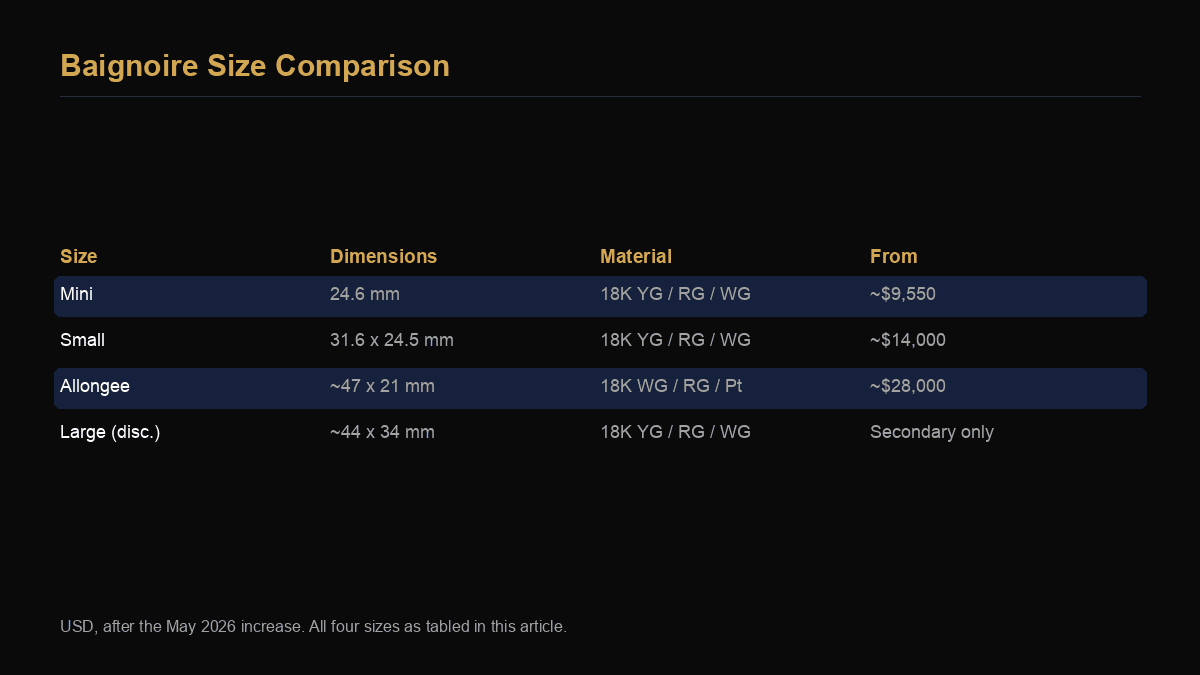
Cartier currently produces the Baignoire in three distinct size families. Each serves a different wrist and a different aesthetic, and the price gap between them is significant. The Mini is a discreet jewellery watch that reads as a bracelet at arm’s length. The Small is the most popular size for everyday wear, balancing legibility with elegance. The Allongée stretches the oval into a dramatic elongated shape that makes the watch the centrepiece of any outfit.
| Size | Dimensions | Case Material | Movement | Starting Price |
|---|---|---|---|---|
| Mini | 24.6 mm | 18K YG / RG / WG | Quartz (cal. 057) | ~$9,550 |
| Small | 31.6 × 24.5 mm | 18K YG / RG / WG | Quartz (cal. 057) | ~$14,000 |
| Allongée | ~47 × 21 mm | 18K WG / RG / Platinum | Quartz | ~$28,000 |
| Large (discontinued) | ~44 × 34 mm | 18K YG / RG / WG | Quartz | Secondary only |
The Mini is the entry point, both in size and price. At 24.6 mm it wears like a piece of fine jewellery — time-telling is secondary to the way the gold case catches light on a slender wrist. The Small adds enough dial real estate to be genuinely readable as a daily watch, and it is the size most often chosen by collectors. The Allongée is a statement piece: nearly 47 mm from top to bottom, but only 21 mm wide, it hugs the wrist in a way that no round or rectangular watch can match.
Materials and Dial Options
Every current Baignoire is made from precious metal. 18K yellow gold is the classic choice and the most common in boutiques. 18K rose gold gives the oval case a warmer, more contemporary feel. 18K white gold and platinum appear in the Allongée and in diamond-set special editions, offering a cooler tone that complements pavé settings.
Dial options are deliberately restrained. Most references feature a silvered sunburst dial with blued-steel sword-shaped hands and Roman numeral hour markers — the signature Cartier formula. Some models use a lacquered white or grey dial, and certain diamond-set versions replace the Roman numerals with diamond indices. The crown on every Baignoire is set with a synthetic cabochon sapphire or spinel, a Cartier hallmark shared with the Tank and Panthère.
Diamond options range from a single row of brilliant-cut stones around the bezel (adding roughly $8,000–$15,000 to the base price) to full pavé cases where every visible surface is set with diamonds. The highest-end Baignoire Allongée models can exceed $60,000 at retail, placing them in the same territory as a solid-gold Santos-Dumont or a diamond-set Panthère de Cartier.
Baignoire Pricing in 2026
Cartier raised United States retail prices on 21 May 2026. The Baignoire collection saw increases of roughly 6 % across the board, consistent with the broader Cartier adjustment that ranged from 2.5 % to 7 % depending on the model. The Mini in 18K yellow gold on leather moved from $9,000 to approximately $9,550 — one of the more moderate increases in the lineup.
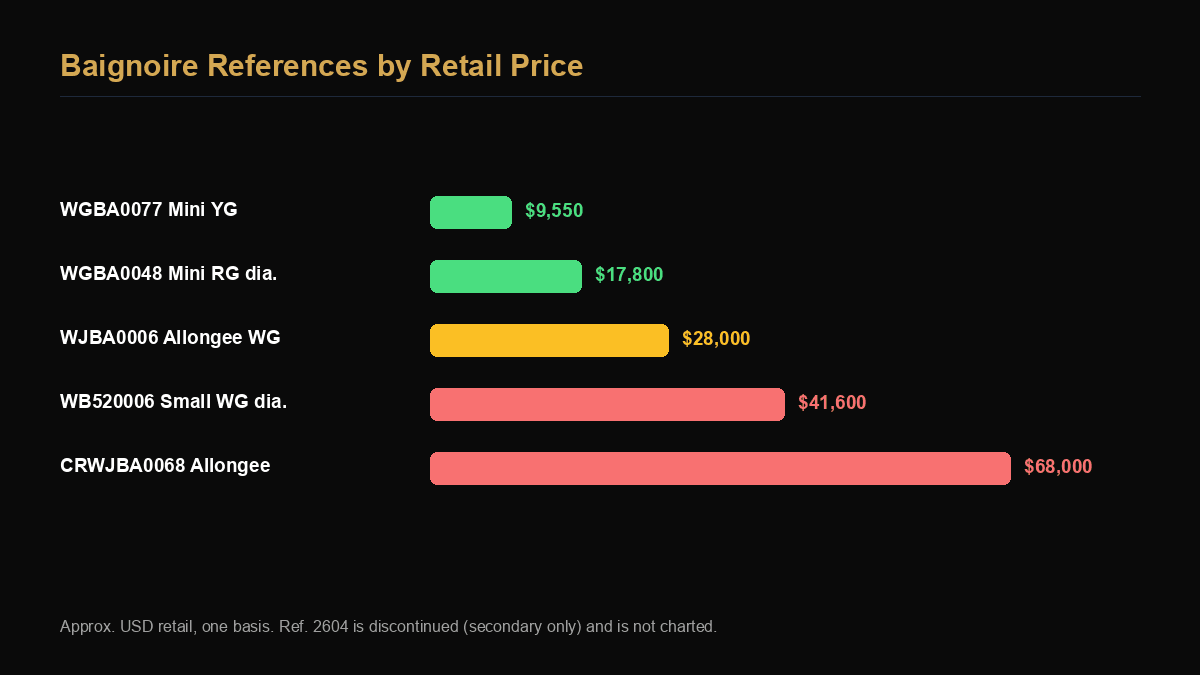
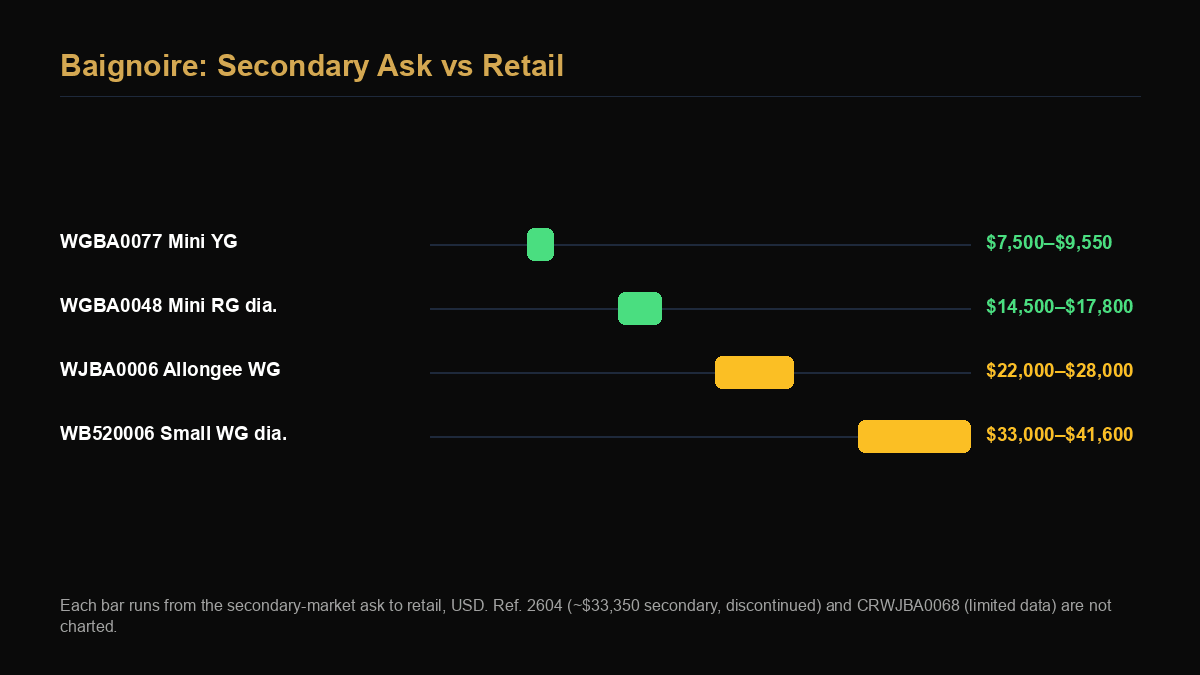
Diamond-set references absorbed larger absolute increases because the percentage was applied to a higher base. The rose-gold Mini with diamond bezel (ref. WGBA0048) now retails near $17,800. The Small with full diamond bezel (ref. WB520006) sits around $41,600 — a figure that has risen roughly $3,000 since early 2025.
| Reference | Description | Retail (post-May ’26) | Secondary Market |
|---|---|---|---|
| WGBA0077 | Mini, 18K YG, leather | ~$9,550 | ~$7,500 |
| WGBA0048 | Mini, 18K RG, diamond bezel | ~$17,800 | ~$14,500 |
| WB520006 | Small, 18K WG, diamond bezel | ~$41,600 | ~$33,000 |
| WJBA0006 | Allongée, 18K WG | ~$28,000 | ~$22,000 |
| 2604 | Allongée, WG quartz (c. 2000) | Discontinued | ~$33,350 |
| CRWJBA0068 | Allongée, YG, full diamond | ~$68,000 | Limited data |
The secondary market tells a slightly different story. Standard Baignoire references trade at roughly 75–85 % of current retail. Diamond-set models hold value better in absolute terms but can still lose 15–20 % of retail on resale, because the aftermarket value of factory diamonds in watches is always lower than what the brand charges. Discontinued references like the 2604 Allongée have their own market: scarcity drives the price above what a comparable new model would cost, particularly if the watch comes with original box and papers.
Check Any Watch Price in Seconds
Grailr scans your watch photo and pulls live pricing from Chrono24, eBay, and Jomashop.
- AI identifies brand, model & reference number
- Live market prices from 3+ sources
- Authentication confidence score
The Baignoire Allongée and the Crash
The Allongée is the most dramatic watch in the Baignoire family. Where the standard oval is soft and balanced, the Allongée stretches the case to nearly 47 mm from lug to lug while keeping the width under 21 mm. The effect is unmistakable on the wrist: the watch wraps around the contour of the forearm in a way that no round or rectangular case can replicate. It is a favourite of stylists and art collectors for exactly this reason.
The Allongée also has a famous offspring. In 1967, Cartier’s London workshop reportedly received a Baignoire Allongée that had been warped in a car accident. Rather than discard the case, the workshop used the distorted shape as the template for a new model: the Cartier Crash. The resulting “melted” watch became one of the most coveted pieces in all of horology. Cartier has produced limited runs of the Crash in 1991, 2013, 2015 and 2024, and each release sells out instantly.
At auction, Crash references regularly sell for $200,000 to $1.5 million depending on metal, year and condition. A platinum Crash sold at Christie’s in 2024 for CHF 1,539,000. For collectors who appreciate the Crash’s DNA but want something wearable and available, the Allongée is the logical alternative — it shares the same elongated silhouette without the extreme distortion or the six-figure price tag.
Resale Value and Investment
The Baignoire is not traditionally considered an investment watch in the way that a steel Rolex Daytona or a Patek Philippe Nautilus might be. Standard production models in gold typically retain 70–85 % of their retail value on the secondary market, which is respectable for a precious-metal dress watch but does not make it a vehicle for capital appreciation.
The exception is at the extremes. Vintage Baignoire references from the 1960s and 1970s, particularly those made in the Cartier London workshop, have seen remarkable price growth in recent years. A 1973–74 London-hallmarked gold oval wristwatch achieved HK$4.9 million (roughly US$630,000) at a Sotheby’s auction in 2026. A 1966–67 gold bracelet version sold for HK$525,000, and a 1968–69 white-gold example reached HK$960,000. These results reflect the growing collector appetite for Cartier London pieces with documented provenance.
Diamond-set models hold value better in absolute dollar terms than plain-gold versions, because the intrinsic material value creates a floor. However, the percentage retained is often similar — the aftermarket never values factory-set diamonds as highly as the brand does. If resale value matters to you, the safest Baignoire purchase is a standard gold Mini or Small on leather, bought at the best available price from a trusted secondary-market dealer. Use Grailr’s appraisal tool to check indicative values before committing.
How to Buy a Baignoire
Cartier boutiques and authorised dealers are the most straightforward route. Unlike many Rolex or Patek Philippe models, the Baignoire does not usually have a significant waitlist. Walk into a Cartier boutique and you can typically try on and purchase most Mini and Small references on the same visit. The Allongée and full-diamond versions may require a special order, but lead times are measured in weeks rather than years.
The secondary market offers savings of 15–25 % on current-production models and is the only route to discontinued references like the Large or the older Allongée. Reputable platforms include Sotheby’s Luxury, WatchBox and Chrono24 Trusted Seller. For any pre-owned Cartier, verify the serial number, check that the crown sapphire is intact, and confirm that the case has not been polished unevenly — oval cases show over-polishing more visibly than round ones.
Before buying, scan any listing photo through Grailr’s free scanner to get an identification suggestion and an indicative price comparison. A photo scan cannot authenticate a watch, but it can flag a price that looks significantly above or below the current market range. For authentication, Grailr’s authentication scoring provides a confidence assessment, though a physical inspection by a qualified watchmaker is always the final word on a precious-metal watch.
Frequently Asked Questions
How much does a Cartier Baignoire cost in 2026?
The Cartier Baignoire Mini in 18K yellow gold on leather starts at approximately $9,550 after the May 2026 price increase. Diamond-set and precious-metal models range from $17,800 to over $40,000 at retail, while secondary-market examples start around $5,000 for older references.
What sizes does the Cartier Baignoire come in?
Cartier currently offers the Baignoire in Mini (24.6mm), Small (31.6 × 24.5mm) and the elongated Allongée (approximately 47 × 21mm). Historical references also included a Large size at roughly 44 × 34mm, available only on the secondary market.
Is the Cartier Baignoire a good investment?
Standard Baignoire models typically retain 70–85% of retail on the secondary market. Vintage examples, rare Crash variants and diamond-set pieces from limited runs can appreciate significantly — a 1973 London-made gold oval sold for HK$4.9 million at Sotheby's in 2026.
Does the Cartier Baignoire come in steel?
No. The Baignoire is available exclusively in 18K yellow gold, rose gold, white gold and platinum. It has never been offered in stainless steel at retail, unlike the Tank Must or Santos.
What movement does the Baignoire use?
Current models use a quartz movement, typically the Cartier caliber 057. This keeps the case profile slim. Some vintage references used hand-wound mechanical movements, and the Crash variant occasionally appears with a manual-wind caliber.
What is the difference between the Baignoire and the Crash?
The Cartier Crash is a distorted version of the Baignoire Allongée. Legend holds that a warped Baignoire case from a 1960s car accident inspired the design. The Crash is produced in extremely limited numbers and commands six-figure prices at auction, while the Allongée remains in regular production.
Related Articles
The Bottom Line
The Cartier Baignoire is one of the few watches that has been in production for over six decades without losing its identity. It is not trying to be a sports watch, a tool watch or a status symbol in the way that a steel-bracelet Rolex is. It is a pure dress watch, made from precious metal, designed around an oval case that Louis Cartier first drew more than a century ago. If that resonates with you, the Mini in 18K yellow gold on leather is the most accessible entry point, while the Allongée is the version that draws the most attention. Whatever size you choose, use Grailr to identify and compare before you buy.
Considering a Baignoire?
Grailr uses a photo to suggest a watch identity and an indicative price estimate, with active eBay listings where available. Check the exact reference and condition independently; a photo scan cannot authenticate a watch.
Scan a Watch NowSources and price context
- Cartier Baignoire collection page — Official specifications, current materials and sizing for in-production references.
- Sotheby’s complete guide to the Cartier Baignoire — History, auction results and reference overview from the auction house.
These primary sources support the specific history, specification or policy points noted above. Prices and resale percentages elsewhere in this guide are indicative editorial figures, not a verified transaction dataset or guaranteed returns. Confirm the exact reference, region, condition and current quote before buying; asking prices are not completed-sale prices.