What Cartier Watches Cost in 2026, New and Used
A complete pricing breakdown of every major Cartier watch collection in 2026 — Tank, Santos, Ballon Bleu, Panthère and Pasha — with current retail prices, pre-owned market values and resale retention data to help you buy smarter.
Price context: this guide includes indicative prices from its original publication period. They have not all been refreshed to current quotes. Use the linked primary sources for specifications and policies, and verify prices independently.
Key Takeaways
- Entry point is $3,750 for a Tank Must small in steel on a leather strap with quartz movement
- On 21 May 2026, Cartier raised US retail prices by roughly 6% on average across all core collections
- The Santos de Cartier is the strongest resale performer, retaining 70–80% of retail value on the secondary market
- Pre-owned Cartier watches trade 20–35% below current retail, with the biggest savings on Ballon Bleu and Panthère
- Steel models absorbed smaller price increases (2–3%) while precious-metal references rose 5–7%
The Cartier Pricing Landscape in 2026
Cartier occupies a distinctive position in the luxury watch market. It is not primarily a watchmaker — it is a jewellery house that happens to make some of the most recognisable wristwatches ever designed. That distinction matters because it shapes both the product line and the pricing strategy. Where Rolex, Omega and Audemars Piguet compete on mechanical complexity and in-house calibres, Cartier competes on design heritage, cultural relevance and the broader Cartier brand ecosystem. A woman who buys a Tank is often buying into the same world as Cartier Love bracelets and Trinity rings — and that is exactly the point.
As a division of the Richemont Group, Cartier benefits from one of the deepest distribution networks in luxury goods. Its watches are sold through Cartier boutiques, authorised retailers and, increasingly, directly through cartier.com. The brand produces watches across a remarkably wide price range: from the $3,750 Tank Must quartz on a leather strap to six-figure precious-metal complications and high jewellery pieces that only appear in private client catalogues. That breadth is a genuine rarity — most of the Swiss watch houses that Cartier competes with on design heritage have entry points two or three times higher.
In 2026, Cartier’s watch collections fall into five main families: the Tank (created in 1917), the Santos (created in 1904, making it the first purpose-built pilot’s wristwatch), the Ballon Bleu (introduced in 2007), the Panthère (relaunched in 2017 after a period of discontinuation) and the Pasha (originally designed in 1985). Each collection has its own pricing logic, its own resale characteristics and its own audience. Understanding those differences is the point of this guide.
For buyers considering a first Cartier, the most important thing to understand upfront is that Cartier watches depreciate less than many collectors assume. The Santos de Cartier in steel retains 70–80% of its retail price on the secondary market — a figure that would be respectable for most Swiss watch brands and is exceptional for a watch that starts under $9,000. The common perception that Cartier is “just a fashion brand” belongs to an earlier era. Since the Santos revival in 2018, with its quick-switch bracelet system and in-house-derived movements, Cartier has earned a place in the horological conversation that its design heritage always deserved.
Tank Collection: Every Model Priced
The Cartier Tank is one of the most iconic watch designs in history. Inspired by the aerial profile of Renault FT-17 tanks on the Western Front, Louis Cartier created the original Tank in 1917 and presented it to General John Pershing. More than a century later, the design language — vertical brancards (side bars) that serve as lugs, a rectangular case and Roman numeral indices — remains essentially unchanged. The Tank has been worn by everyone from Jackie Kennedy and Princess Diana to Andy Warhol and Muhammad Ali, and that cultural weight is embedded in every reference Cartier sells today.
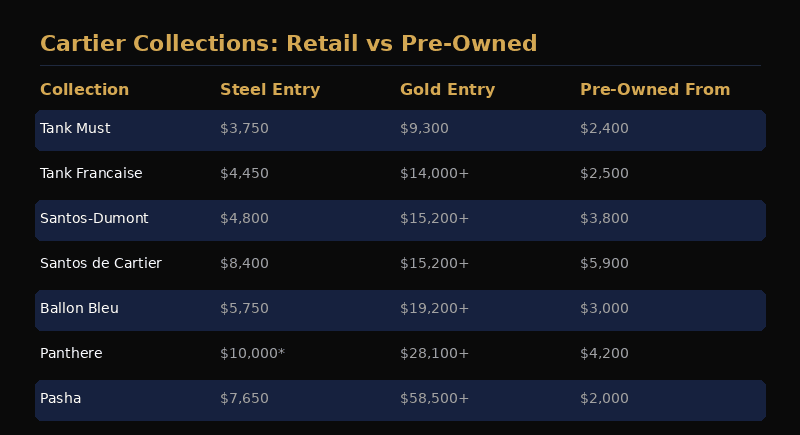
In 2026, the Tank family includes five distinct sub-collections, each with its own case shape, size range and price band. The Tank Must is the entry point, starting at $3,750 for the small steel model on a leather strap with a quartz or SolarBeat movement. The SolarBeat variant uses a photovoltaic dial that converts light to energy, eliminating battery changes for up to 16 years — a practical advantage that makes the Tank Must one of the most low-maintenance luxury watches you can buy. On the pre-owned market, Tank Must models trade from roughly $2,400 to $5,800 depending on size, material and condition.
The Tank Française features an integrated bracelet design that was introduced in 1996 and became a defining 1990s watch. Steel models retail from $4,450 to $39,800 depending on size and diamond setting. Pre-owned Française models are widely available from $2,500 to $6,500, making the secondary market a strong proposition for this reference. For a detailed comparison of every Tank sub-model, see our Cartier Tank buying guide.
The Tank Louis Cartier is the dress-watch pinnacle of the range. Available exclusively in precious metals, the Tank Louis starts at $9,300 in yellow gold and ranges up to $24,500 for larger sizes with mechanical movements. Pre-owned examples trade from $6,000 to $16,000. The Tank Américaine, with its elongated curved case, retails from $3,850 in small sizes to $74,000 for gold chronograph variants. Pre-owned Américaine models sit at $3,750–$28,500.
At the top of the Tank hierarchy sits the Tank Cintrée, a curved tonneau case in white gold that retails at $37,600. Vintage Tank Cintrée models are highly sought after by collectors and can command $15,000 to $100,000 depending on era, condition and provenance. The Cintrée is not a volume model — it is a statement piece for collectors who understand that the most important Cartier watches are the ones most people have never heard of.
| Tank Model | Material | Retail Price | Pre-Owned Range |
|---|---|---|---|
| Tank Must | Steel | $3,750–$6,800 | $2,400–$5,800 |
| Tank Française | Steel | $4,450–$39,800 | $2,500–$6,500 |
| Tank Louis Cartier | Yellow Gold | $9,300–$24,500 | $6,000–$16,000 |
| Tank Américaine | Rose Gold | $3,850–$74,000 | $3,750–$28,500 |
| Tank Cintrée | White Gold | $37,600 | $15,000–$100,000 |
Retail prices reflect post-May 2026 US MSRP. Pre-owned ranges are for watches in good to excellent condition with box and papers where available, sourced from Chrono24, eBay and dealer listings as of September 2026.
Santos Collection: Every Model Priced
The Santos de Cartier holds a unique place in horological history. In 1904, Louis Cartier designed a wristwatch for his friend Alberto Santos-Dumont, the Brazilian aviation pioneer who needed to check the time while flying without releasing his grip on the controls. That watch — with its exposed screws, square bezel and leather strap — became the first purpose-built pilot’s wristwatch and predated the wristwatch’s general adoption by more than a decade. For deeper context on every Santos variant, see our Santos de Cartier buying guide.
Cartier’s 2018 relaunch of the Santos de Cartier transformed the collection. The updated design introduced the QuickSwitch bracelet and strap system, allowing the wearer to swap between a steel bracelet and a leather or rubber strap in seconds with no tools. It also introduced the SmartLink system for adjusting bracelet length at home. These practical innovations, combined with a more refined case shape and modern sizing, turned the Santos from a heritage piece into a genuinely competitive modern sports watch.
The Santos-Dumont is the dressier, thinner sub-family. Steel models retail from $4,800 to $35,300, with the range reflecting different sizes, dial treatments and precious-metal bezels. Pre-owned Santos-Dumont models trade from $3,800 to $5,000 for standard steel references. The Santos de Cartier Medium (35.1mm) in steel retails from $8,400 to $15,800 and trades pre-owned at $5,900–$11,000. The Santos de Cartier Large (39.8mm) retails from $5,250 to $35,300+ and trades pre-owned at $6,500–$12,500+.
Two-tone Santos models, combining steel with yellow or rose gold, retail from $11,500 to $38,900+ and trade pre-owned from $4,500–$12,500+. Full gold Santos references start at $15,200 and climb to $77,000 for larger sizes in yellow or rose gold. The Santos in precious metals is where Cartier’s jewellery-house DNA shows most clearly — the polished gold bezels and case sides receive a level of finishing that competitors in the same price range seldom match.
The Santos is the Cartier collection that most directly competes with the watch industry’s other integrated-bracelet sports watches — the Royal Oak, the Nautilus, the Overseas. It does so at a fraction of the price. A steel Santos de Cartier Large on bracelet retails for roughly $7,400, making it one of the most accessible luxury sports watches with genuine design heritage and a quick-change bracelet system. That value proposition is a large part of why the Santos retains 70–80% of retail on the secondary market — buyers recognise that they are getting more watch per dollar than almost anything else at this price point. For recommendations by gender, see our Cartier watches for men and Cartier watches for women guides.
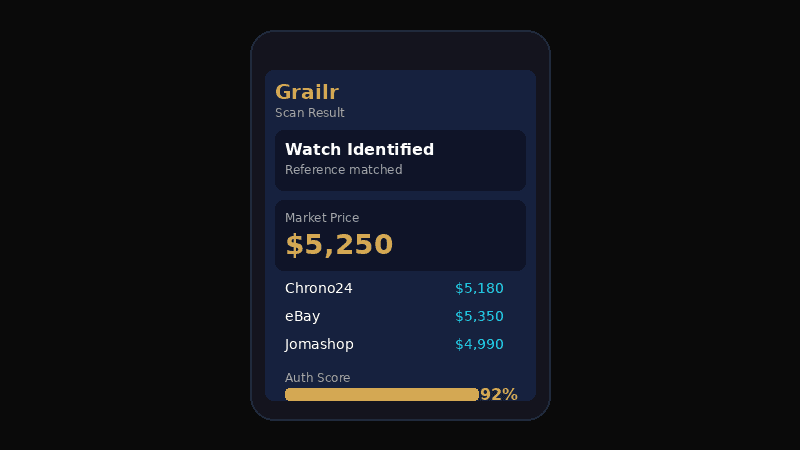
Check Any Watch Price in Seconds
Grailr scans your watch photo and pulls live pricing from Chrono24, eBay, and Jomashop.
- AI identifies brand, model & reference number
- Live market prices from 3+ sources
- Authentication confidence score
Ballon Bleu, Panthère and Pasha: Every Model Priced
The Ballon Bleu de Cartier, introduced in 2007, is the newest of the five major Cartier collections and one of the best-selling luxury watches in the world. Its defining feature is the blue sapphire cabochon set into the crown guard, protected by a curved bridge that sweeps smoothly into the round case. The Ballon Bleu is available in more size and material combinations than any other Cartier watch, ranging from a 28mm quartz model all the way to a 42mm automatic with date.
Steel Ballon Bleu models retail from $5,750 to $20,000 depending on size and complication. Pre-owned steel examples trade at $3,000–$7,500, reflecting the Ballon Bleu’s weaker secondary market performance compared with the Tank and Santos. The Ballon Bleu retains roughly 55–65% of its retail value — still respectable, but lower than Cartier’s other collections. The reason is volume: Cartier produces more Ballon Bleu watches than any other collection, and the model is frequently available at authorised dealers without a waitlist, which limits secondary market demand.
Two-tone Ballon Bleu models retail at $11,500–$14,700 and trade pre-owned at $5,000–$12,000. Full gold models start at $19,200 and reach $50,000 for larger sizes with diamond-set bezels. The gold Ballon Bleu is where the watch starts to cross over into jewellery territory, with many references featuring pavé diamond dials and gem-set bezels that appeal more to jewellery buyers than traditional watch collectors.
The Panthère de Cartier is a jewellery bracelet watch that was relaunched in 2017 after Cartier had quietly discontinued it. The relaunched Panthère brought back the link bracelet design that defined the original 1980s model but updated the case proportions and finishing to contemporary standards. Two-tone Panthère models retail from $10,000 to $12,400 and trade pre-owned at $4,200–$10,500. Gold Panthère models start at $28,100 and reach $52,500 for larger sizes. The Panthère is primarily a women’s watch, though the medium size is increasingly popular as a gender-neutral jewellery piece.
The Pasha de Cartier is the most niche of the five major collections. Originally designed in 1985 for the Pasha of Marrakech, the Pasha features a round case with a screw-down crown cap on a chain, grid-pattern crown guard and luminous Arabic numerals. Full gold Pasha models retail at approximately $58,500. On the pre-owned market, older Pasha references are remarkably accessible at $2,000–$8,500, making the vintage Pasha one of the best-value entry points to Cartier’s back catalogue.
| Collection | Variant | Retail Price | Pre-Owned Range |
|---|---|---|---|
| Ballon Bleu | Steel | $5,750–$20,000 | $3,000–$7,500 |
| Ballon Bleu | Two-Tone | $11,500–$14,700 | $5,000–$12,000 |
| Ballon Bleu | Gold | $19,200–$50,000 | — |
| Panthère | Two-Tone | $10,000–$12,400 | $4,200–$10,500 |
| Panthère | Gold | $28,100–$52,500 | $10,500–$23,500 |
| Pasha | Gold | ~$58,500 | $2,000–$8,500 |
Retail prices reflect post-May 2026 US MSRP. Pre-owned ranges are for watches in good to excellent condition, sourced from Chrono24, eBay and dealer listings as of September 2026. A dash indicates insufficient pre-owned data for a reliable range.
The May 2026 Price Increase: What Changed
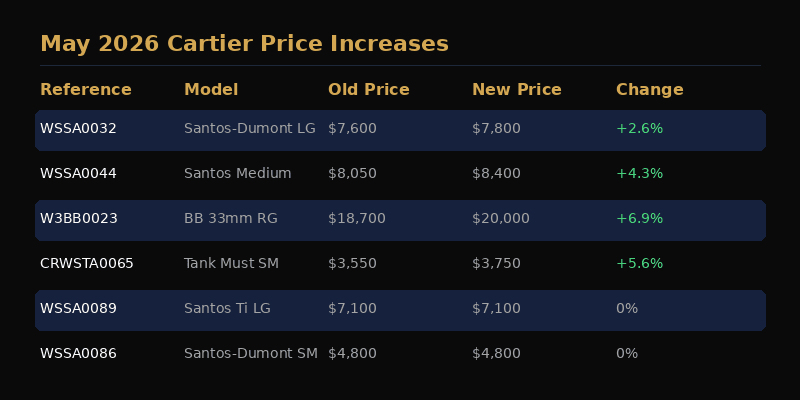
On 21 May 2026, Cartier implemented a price increase across its US watch catalogue. The average increase was approximately 6%, in line with similar adjustments by Rolex, Patek Philippe and Audemars Piguet earlier in the year. However, the increase was not applied uniformly. Entry-level steel models absorbed smaller increases of 2–3%, while precious-metal references saw larger adjustments of 5–7%.
Some specific examples illustrate the pattern. The Santos-Dumont WSSA0032 moved from $7,600 to $7,800 — a modest 2.6% increase on a mid-range steel model. The Ballon Bleu 33mm in rose gold jumped from $18,700 to $20,000 — a more significant 6.95% increase on a precious-metal reference. Meanwhile, some models remained unchanged entirely. The titanium Santos WSSA0089 and the small Santos-Dumont WSSA0086 carried the same prices after the adjustment as they did before.
The pricing strategy reveals Cartier’s thinking. By keeping increases modest on entry-level steel models, Cartier protects its accessibility advantage — the ability to bring new customers into the brand at $3,750–$8,000, a price point that Rolex, AP and Patek cannot match. By taking larger increases on precious-metal models, Cartier captures more margin from buyers who are less price-sensitive. It is a rational, segment-aware approach that most luxury watch brands follow but few execute as consistently as Cartier.
For buyers who are timing a purchase, the May 2026 increase has already taken effect. The next adjustment will likely come in late 2026 or early 2027. Historically, Cartier has implemented one to two price increases per year, typically in the range of 3–7%. This means that a watch priced at $8,000 today could reasonably cost $8,400–$8,560 after the next adjustment — not a dramatic difference, but enough to make buying sooner marginally better than waiting if you have already decided on a model.
The broader context matters as well. Cartier’s 6% average increase is roughly in line with the industry norm for 2026. Rolex implemented increases of 4–8% earlier in the year. Omega adjusted prices by 5–7%. The luxury watch industry as a whole is repricing upward in response to currency fluctuations, raw material costs and the continued strength of demand in the US and Asian markets. Cartier is not an outlier — it is moving with the industry.
Resale Value: How Each Collection Holds Up
Resale performance varies dramatically across Cartier’s collections. The Santos de Cartier is the standout, retaining 70–80% of its retail price on the secondary market. This puts it in the same resale tier as watches from Tudor, IWC and even some Omega references — impressive for a brand that many traditional watch collectors still underestimate. The Santos benefits from strong demand driven by its design heritage (the first pilot’s wristwatch), its practical quick-change bracelet system and its competitive pricing relative to other luxury sports watches.
The Tank Must retains 65–75% of retail value. The Tank’s resale performance is supported by its iconic status and steady demand, but held back slightly by the prevalence of quartz movements in the entry-level range — quartz watches generally retain less value than their mechanical counterparts on the secondary market. The Tank Louis Cartier in gold performs better in percentage terms because the intrinsic metal value creates a floor that steel watches lack.
The Ballon Bleu is the weakest performer at 55–65% retention. Two factors drive this: Cartier produces more Ballon Bleu watches than any other collection, and the Ballon Bleu is more readily available at authorised dealers than the Tank or Santos, which limits the urgency to buy pre-owned. The Ballon Bleu is also the Cartier collection most frequently discounted by grey market and unauthorised dealers, which puts downward pressure on pre-owned valuations.
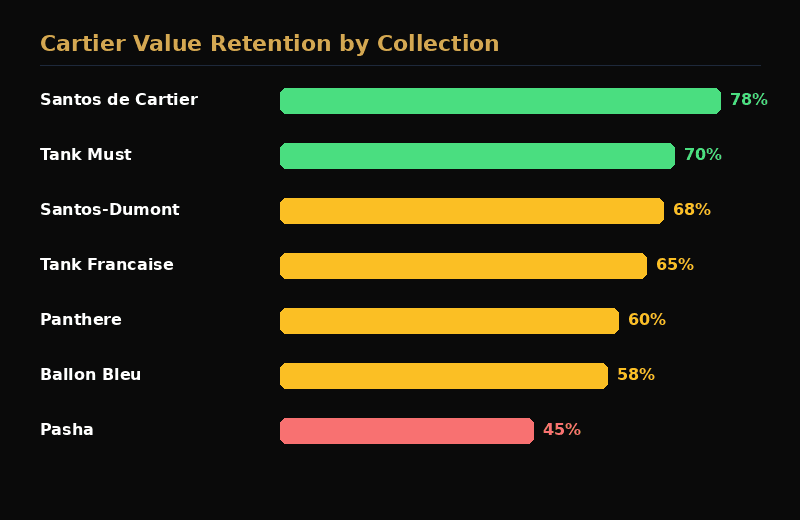
The Panthère sits between the Ballon Bleu and the Tank in resale terms, retaining roughly 60–70% of retail depending on the material. Two-tone Panthère models hold up better than steel Ballon Bleu references because the gold content adds intrinsic value and the Panthère’s production numbers are lower. The Pasha is a special case: current-production gold models depreciate significantly because of their high retail prices, but vintage Pasha references from the 1990s and 2000s have become collector favourites, with prices stabilising or even appreciating for well-preserved examples.
For buyers who care about value retention, the data points clearly to the Santos de Cartier in steel as the optimal purchase. It offers the best combination of entry price, mechanical movement, practical design features and secondary market demand. Use Grailr’s appraisal tool to check the current indicative market value of any Cartier reference before buying new or pre-owned, and confirm the final price independently.
Buying New vs Pre-Owned: Where the Value Sits
Unlike Rolex or Audemars Piguet, Cartier watches do not generally trade above retail on the secondary market. This creates a fundamentally different buying equation. For Rolex, buying pre-owned often means paying more than retail because popular models have multi-year waitlists. For Cartier, buying pre-owned almost always means paying less than retail — typically 20–35% below current MSRP.
The savings are largest on the Ballon Bleu and Panthère, where pre-owned examples can be 30–40% below retail. A Ballon Bleu 36mm in steel that retails for $7,650 can be found pre-owned in excellent condition with box and papers for $4,500–$5,500. A two-tone Panthère that retails for $10,000 trades pre-owned at $5,500–$8,000. For buyers whose priority is getting a genuine Cartier watch at the best possible price, the secondary market offers compelling value in these collections.
The Santos offers smaller but still meaningful savings on the secondary market. A Santos de Cartier Large in steel that retails for roughly $7,400 trades pre-owned at $6,500–$7,000 with box and papers — a saving of 5–12%. The tighter spread reflects stronger demand: Santos buyers want the watch and are willing to pay close to retail for a pre-owned example because the alternative is paying full retail at a boutique. This tighter spread is itself an indicator of the Santos’s strength as a secondary market performer.
Buying new makes the most sense for the Tank Must (where the low entry price limits the absolute dollar savings of buying pre-owned), the Santos in uncommon dial colours or two-tone configurations (where pre-owned supply is thin), and any reference where you want a full manufacturer warranty. Cartier’s standard warranty is eight years for watches purchased from authorised channels since mid-2024 — one of the longest in the industry and a genuine differentiator for new purchases.
Buying pre-owned makes the most sense for the Ballon Bleu (where the savings are largest), the Panthère (same logic), vintage Tank references (where the secondary market offers models that Cartier no longer produces) and the Pasha (where older references trade at a fraction of the current gold model’s retail price). Platforms like Chrono24, WatchBox and Crown & Caliber are reliable sources for pre-owned Cartier watches, though always verify the seller’s ratings, return policy and authentication process before committing.
Whichever channel you choose, Grailr’s scan tool can suggest an identity and indicative price estimate from a photo. Cross-reference that with at least two other sources — Chrono24 sold listings, eBay completed sales and Grailr’s identification tool — before making a decision. Confirm the reference number, condition grade and whether box and papers are included, as these factors can shift the price by 10–15%.
Frequently Asked Questions
What is the cheapest Cartier watch you can buy new?
The Tank Must small in stainless steel on a leather strap starts at $3,750. It uses a quartz or SolarBeat movement and comes in several dial colours. On the pre-owned market, older Tank Must references and pre-2018 Ballon Bleu models can be found from roughly $2,400.
Did Cartier raise prices in 2026?
Yes. On 21 May 2026, Cartier increased US retail prices by an average of roughly 6 percent across the Tank, Santos, Panthère, and Ballon Bleu collections. Entry-level steel models absorbed smaller adjustments of 2 to 3 percent, while precious-metal references saw increases of 5 to 7 percent.
Do Cartier watches hold their value?
It depends on the collection. The Santos de Cartier in steel retains roughly 70 to 80 percent of its retail price, making it Cartier’s strongest performer on the secondary market. The Tank Must holds about 65 to 75 percent. The Ballon Bleu is weaker at 55 to 65 percent, partly because of its higher production numbers and frequent discounting.
Is a Cartier Santos a good investment?
The Santos de Cartier is one of the few non-Rolex, non-Patek models that retains 70 to 80 percent of retail value consistently. It is not an appreciating asset in the way a Submariner can be, but it loses less than most competitors in the same price bracket.
Should I buy a Cartier watch new or pre-owned?
Pre-owned Cartier watches typically trade 20 to 35 percent below current retail, making the secondary market a strong value proposition. The savings are largest on the Ballon Bleu and Panthère, where pre-owned examples can be 30 to 40 percent below retail. Use Grailr to check current market pricing before committing to either channel.
Related Articles
The Bottom Line
Cartier offers one of the widest pricing spectrums in luxury watchmaking, from the $3,750 Tank Must to six-figure gold complications. That breadth makes it one of the most accessible entry points to Swiss luxury watches — and one of the most misunderstood. The perception that Cartier is “just a jewellery brand” no longer holds up against the data. The Santos de Cartier retains 70–80% of its retail value, outperforming many watches from brands that watch enthusiasts would instinctively rank higher.
The May 2026 price increase of roughly 6% is in line with industry norms and is unlikely to be the last adjustment this year. Buyers who have decided on a model have no strong reason to wait. For those still choosing, the Santos de Cartier in steel offers the best combination of design heritage, mechanical movement, practical features and resale value. The Tank Must is the best-value entry point to Cartier. The Ballon Bleu is the best candidate for buying pre-owned, where the 30–40% savings over retail make it a compelling proposition.
Whatever model you choose, verify the reference number, confirm the current market price across multiple sources, and authenticate before committing to a purchase — especially on the secondary market. Indicative pricing in this guide reflects September 2026 data. Confirm independently before buying.
Know What Your Cartier Is Worth
Grailr uses a photo to suggest a watch identity and an indicative price estimate, with active eBay listings where available. Check the exact reference and condition independently; a photo scan cannot authenticate a watch.
Scan Your Watch NowSources and price context
- Cartier Official Watch Collections — Current retail pricing, specifications and available references for all Cartier watch families.
- eBay Product Research documentation — Explains sold-price research, including accepted Best Offers; separate from Grailr listing results.
These primary sources support the specific history, specification or policy points noted above. Prices and resale percentages elsewhere in this guide are indicative editorial figures, not a verified transaction dataset or guaranteed returns. Confirm the exact reference, region, condition and current quote before buying; asking prices are not completed-sale prices.