G-Shock Prices: From $55 to $8,000 and Why
Every G-Shock tier broken down — what you actually get at each price, which models hold value, and where each dollar goes.
Price context: this guide includes indicative prices from its original publication period. They have not all been refreshed to current quotes. Use the linked primary sources for specifications and policies, and verify prices independently.
- G-Shock prices span from roughly $55 for a basic DW-5600 resin square to $7,600 for the limited-edition MR-G Frogman
- Five distinct tiers — core resin, metal-covered, full metal, MT-G, and MR-G — each represent genuine engineering differences, not just marketing labels
- Core resin models have near-zero resale value because supply is unlimited; MR-G and limited editions can retain 70–90% or appreciate
- The average G-Shock costs around $100 — the GA-2100 “CasiOak” at that price is the most popular model in the current lineup
- Every G-Shock, regardless of tier, meets the original “Triple 10” standard: 10-metre drop resistance, 10-bar water resistance, and 10-year battery life
Why G-Shock Prices Span From $55 to $8,000
In 1983, Casio engineer Kikuo Ibe watched a treasured watch shatter after dropping it in a parking lot. That moment launched a three-year development program inside Casio’s Hamura R&D centre, driven by a single specification Ibe called the “Triple 10” standard: survive a 10-metre free fall, resist 10 bars (100 metres) of water pressure, and run for 10 years on a single battery. Over 200 prototypes failed before the first DW-5000C reached shelves. The watch cost roughly $50 and was practically indestructible.
Four decades later, that original design philosophy has spawned a product line that stretches from mass-produced resin quartz watches to hand-finished titanium instruments built by artisans in Casio’s Yamagata premium factory. The brand has sold over 100 million units worldwide, and the average G-Shock still costs about $100 — but the top end now reaches prices that overlap with entry-level Swiss luxury watches. Understanding why requires looking at each tier individually, because a $55 DW-5600 and a $7,600 MR-G Frogman share the Triple 10 DNA but almost nothing else.
If you are wondering how much watch you can get on a budget, the answer from Casio’s perspective is “quite a lot.” But if you want to understand what separates the tiers and where each price jump buys you something real versus something cosmetic, this guide walks through the entire range with specific model numbers and street prices.
Core Resin: $55–$150
The resin tier is where G-Shock’s reputation was built and where most of the brand’s hundred million units have been sold. Every watch in this tier uses a resin case and strap, a quartz module powered by a CR2016 coin cell (or, at the upper end, solar charging), and a mineral glass crystal. What you get at every price point within this tier is the full G-Shock promise: shock resistance, 200-metre water resistance, a stopwatch, countdown timer, alarm, and a backlight — either LED or electroluminescent depending on the module.
The DW-5600 is the direct descendant of the original 1983 G-Shock and still the most affordable at roughly $55 to $70. It keeps the classic square case shape, weighs 53 grams, and uses a screw-back case that contributes to its water resistance rating. The slightly larger DW-6900 runs $70 to $80 and introduces the round case design with three front-facing sensors that has become one of G-Shock’s most recognisable silhouettes, worn famously by hip-hop artists and action-movie characters throughout the 1990s and 2000s.
The GA-2100, nicknamed the “CasiOak” by collectors for its octagonal bezel’s resemblance to the Audemars Piguet Royal Oak, changed G-Shock’s trajectory when it launched in 2019. At roughly $100 to $120, it combined a thin 11.8mm profile with an analog-digital display in a case that looked far more expensive than its price. It became the best-selling G-Shock in the current range almost immediately and remains the model most likely to catch the eye of a buyer who has never owned one before. If you are curious how it compares with other affordable watches in the same price band, the CasiOak’s durability advantage is significant.
At the top of the resin tier sits the GW-M5610 at roughly $130 to $150, which upgrades the classic square with solar charging and multiband 6 radio wave time sync — meaning the watch automatically sets itself to atomic clock accuracy by picking up signals from six transmitters around the world. This is the point where G-Shock’s resin tier crosses from “tool you replace when it finally dies” into “instrument you can realistically set and forget for a decade.”
Metal-Covered and Full Metal: $150–$700
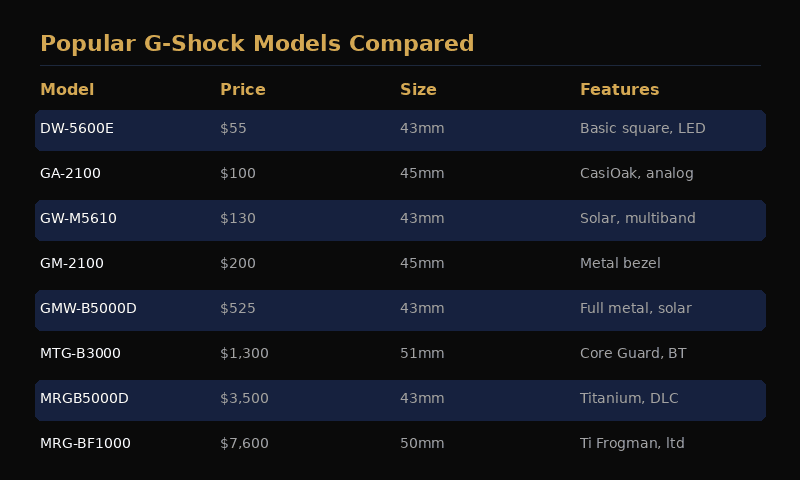
The metal-covered tier starts at roughly $150 and represents G-Shock’s first step toward a more refined aesthetic. These watches use a stainless steel bezel mounted over the same resin inner case and module found in their cheaper counterparts. The GM-5600 ($200) and GM-2100 ($200 to $250) are the most popular examples: functionally identical to their all-resin siblings but with a steel bezel that adds weight, visual heft, and the look of a far more expensive watch. The GM-B2100 at roughly $350 takes the CasiOak shape into full metal bezel territory with added Bluetooth smartphone connectivity for time sync and watch settings management.
Casio also offers limited-run Fine Metallic variants like the GM6900YRA-8 ($270) and GM110YRA-8A ($290), which use textured or coated steel bezels in colourways that the standard metal-covered line does not carry. These are worth noting because they are the cheapest G-Shocks that regularly attract collector interest beyond simple utility purchasing.
The full metal tier begins at $525 with the GMW-B5000D, a watch that takes the original 1983 square design and rebuilds it entirely in stainless steel. Unlike the metal-covered models, which pair a steel bezel with a resin case, the GMW-B5000 is metal through the full case construction. It adds solar charging, Bluetooth, and multiband 6 radio sync — the same technology stack found in the $150 GW-M5610 but housed in a case that weighs roughly twice as much and looks like a completely different watch. The gold-IP-finished GMW-B5000GD at $600 has become a streetwear and fashion crossover piece, and the titanium GMW-B5000TVA Virtual Armor at $700 uses an STN LCD display and a titanium case that bridges the full-metal tier into premium territory.
| Model | Tier | Case | Key Features | Price |
|---|---|---|---|---|
| DW-5600 | Core Resin | Resin | Classic square, LED backlight | $55–$70 |
| DW-6900 | Core Resin | Resin | Round case, EL backlight | $70–$80 |
| GA-2100 | Core Resin | Resin | CasiOak, analog-digital, 11.8mm thin | $100–$120 |
| GA-110 | Core Resin | Resin | Large analog-digital, LED backlight | $100–$130 |
| GW-M5610 | Core Resin | Resin | Solar + multiband 6 radio sync | $130–$150 |
| GM-2100 | Metal-Covered | Steel bezel / resin | Metal CasiOak, analog-digital | $200–$250 |
| GM-5600 | Metal-Covered | Steel bezel / resin | Metal square, classic module | ~$200 |
| GM-B2100 | Metal-Covered | Steel bezel / resin | Full metal bezel CasiOak, Bluetooth | ~$350 |
| GMW-B5000D | Full Metal | Full stainless steel | Solar, Bluetooth, multiband 6 | $525–$550 |
| GMW-B5000GD | Full Metal | Gold IP steel | Solar, Bluetooth, multiband 6 | ~$600 |
| GMW-B5000TVA | Full Metal | Titanium | STN LCD, Virtual Armor finish | ~$700 |
The jump from core resin to metal-covered is primarily cosmetic — the internal module and performance specifications are identical. The jump from metal-covered to full metal is both cosmetic and structural: the entire case changes material, the weight increases substantially, and solar and Bluetooth become standard. For buyers comparing this range with other affordable options, our guide to watches under $500 puts these G-Shocks alongside Seiko, Orient, and Tissot alternatives.
MT-G and MR-G: The Flagship Tiers
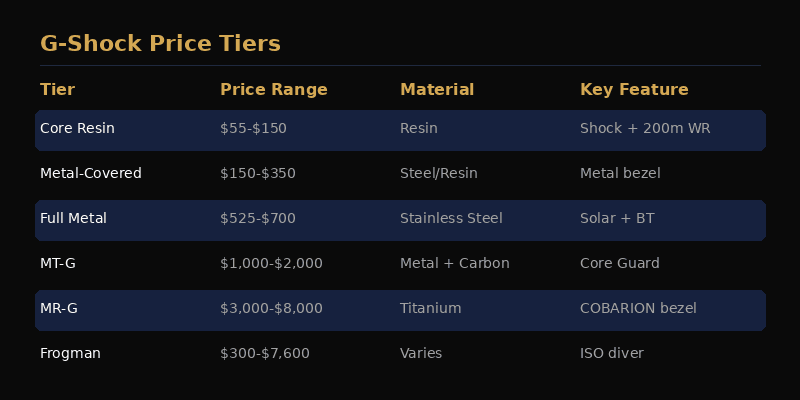
Above the full-metal tier, G-Shock splits into two premium lines that share technology but differ in materials, finishing, and ambition.
MT-G (Metal Twisted G-Shock): $1,000–$2,000
MT-G stands for “Metal Twisted G-Shock,” and the name describes the construction method: a metal frame is twisted into a shock-absorbing structure around the module, combined with a carbon or resin core in what Casio calls its Core Guard architecture. The result is a watch that looks and feels like a luxury metal timepiece but maintains G-Shock’s shock resistance through its hybrid construction rather than brute metal thickness.
The current MTG-B2000 series ($1,000 to $1,300) and MTG-B3000 series ($1,200 to $1,500) all carry Triple G Resist certification — meaning they are engineered to withstand gravitational shock, centrifugal force, and vibration simultaneously. Every MT-G includes a sapphire crystal instead of mineral glass, solar charging, Bluetooth smartphone link, and multiband 6 radio time synchronisation. The case back is typically titanium even when the visible case surfaces are stainless steel, reducing skin contact weight and improving corrosion resistance for daily wear.
MR-G (Mister G-Shock): $3,000–$8,000+
MR-G is Casio’s true flagship, produced at the company’s premium Yamagata factory in Japan, where individual artisans assemble and finish each watch by hand. Where the MT-G uses a hybrid metal-and-carbon approach, the MR-G is built entirely from titanium, with premium surface treatments that include DLC (diamond-like carbon) coatings and, on several references, COBARION bezels — a cobalt-chromium alloy roughly four times harder than standard titanium that maintains a mirror polish under conditions that would scratch steel.
The MRG-B2000 series ($3,000 to $4,000) delivers the core MR-G experience: full titanium construction, sapphire crystal, solar, Bluetooth, multiband 6, and finishing that genuinely rivals mid-range Swiss watches. The MRGB5000D at roughly $3,500 takes the classic square form factor into MR-G territory, making it the most expensive version of the original 1983 shape. At the summit sits the MRG-BF1000EB Frogman at roughly $7,600 — an 800-piece limited-edition titanium diver that represents the most extreme expression of what G-Shock engineering can produce.
If you have the budget for an MR-G and are cross-shopping Swiss alternatives in the same price range, our guide to the best watches under $1,000 and other price-tier breakdowns can help you calibrate expectations. At the $3,000-plus level, the value proposition shifts entirely from utility-per-dollar — where G-Shock dominates — to craftsmanship, heritage, and personal taste, where the answer is genuinely subjective.
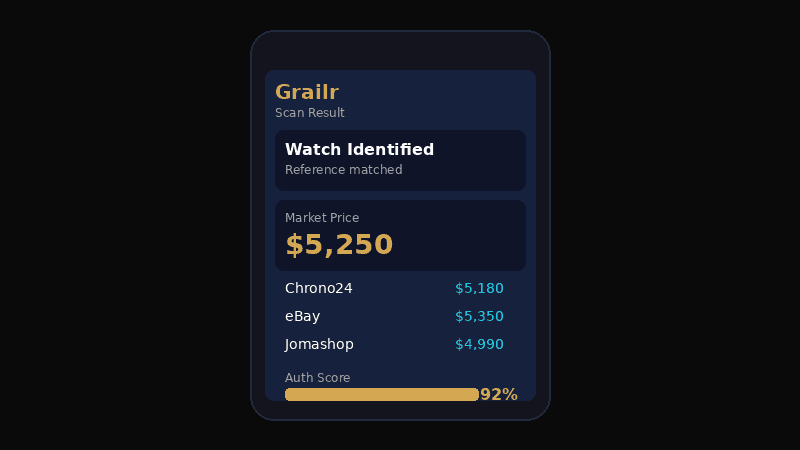
Check Any Watch Price in Seconds
Grailr scans your watch photo and pulls live pricing from Chrono24, eBay, and Jomashop.
- AI identifies brand, model & reference number
- Live market prices from 3+ sources
- Authentication confidence score
The Frogman: A Price Range of Its Own
The Frogman line cuts across G-Shock’s tier system in a way that no other sub-collection does. Introduced in 1993, the Frogman has always been G-Shock’s dedicated diver — the one model designed specifically for underwater use, ISO 200-metre diver’s watch certified, and built with an asymmetric case design that protects the crown and buttons during dives.
What makes the Frogman unusual in a pricing guide is its range. The resin GWF-A1000 sits at $500 to $600, offering analog-digital display, solar charging, and triple sensor capability (altimeter, barometer, compass) in a case that still uses the classic Frogman asymmetric profile. The GWF-D1000 adds a depth sensor and sits around $700. But the MR-G MRG-BF1000EB at $7,600 is the same essential design philosophy — asymmetric diver’s watch, ISO certified, built for water — executed in full titanium with COBARION bezel and DLC coating, limited to 800 pieces worldwide.
That $500-to-$7,600 span within a single model family illustrates the broader G-Shock pricing story in miniature. The engineering concept stays consistent; the materials and finishing scale dramatically. A resin Frogman and an MR-G Frogman both survive the same dive. The difference is in how they look doing it, how long the surfaces stay pristine, and whether you care about the hand-finished details that separate a mass-produced tool from a collector’s piece.
Do G-Shocks Hold Their Value?
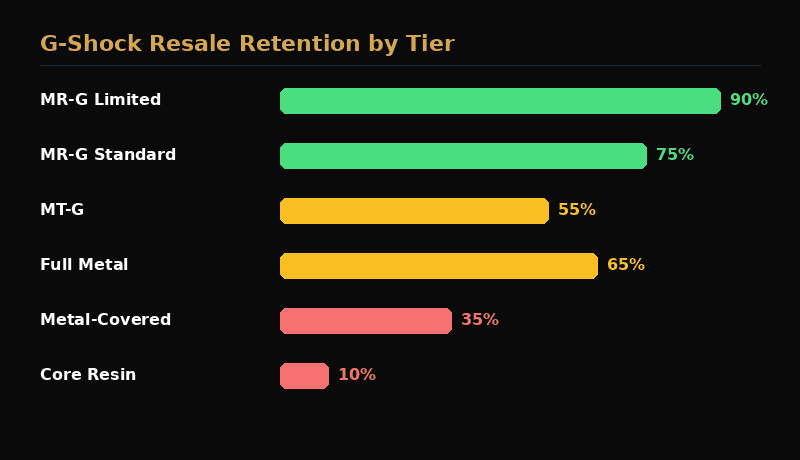
The short answer depends entirely on the tier. At the resin level, resale value is effectively zero for standard models. A DW-5600 that retails for $55 might sell used for $20 to $30, and many simply get worn until they are replaced or given away. Supply is essentially unlimited — Casio produces these in enormous volume and they rarely sell out — so there is no scarcity driver to support prices in the secondary market.
The full-metal GMW-B5000 series tells a different story. These watches retain roughly 60 to 70 percent of their retail price on the secondary market, helped by lower production volumes than resin models, strong visual appeal that photographs well for resale listings, and a genuine differentiation in materials and construction. The gold-IP GMW-B5000GD, in particular, has maintained steady demand since its introduction.
At the MR-G and limited-edition level, value retention can reach 70 to 90 percent or even exceed retail for the right references. Limited-edition collaborations — particularly those with streetwear brands or artists that carry cultural weight beyond the watch community — have occasionally tripled or quadrupled in value on the secondary market, though predicting which collaborations will appreciate is as unreliable as predicting which sneaker releases will become grails.
| Tier | Retail Range | Typical Retention | Key Factor |
|---|---|---|---|
| Core Resin | $55–$150 | Near zero | Unlimited supply, low entry price |
| Metal-Covered | $150–$350 | 20–40% | Same module as resin counterpart |
| Full Metal | $525–$700 | 60–70% | Lower production, strong demand |
| MT-G | $1,000–$2,000 | 50–65% | Niche audience, regular updates |
| MR-G | $3,000–$8,000 | 70–90% | Limited runs, collector demand |
| Limited Editions | Varies | 90%+ (can appreciate) | Scarcity, cultural relevance |
None of these percentages are guarantees. G-Shock resale values are indicative figures based on typical secondary-market asking prices, not a verified transaction dataset. Condition, box-and-papers status, and regional demand all shift real-world prices. If resale value matters to your purchasing decision, check current completed listings on eBay and Chrono24 for the specific reference you are considering — or use Grailr’s appraisal tool to pull live pricing from multiple marketplaces against a photo of the watch.
How to Pick the Right G-Shock Tier
The good news about G-Shock’s tiered pricing is that you genuinely cannot make a bad purchase at any level — every tier delivers on the core promise of durability and functionality. The question is which additional features and materials are worth paying for given how you will actually use the watch.
If You Want a Beater Watch: Core Resin ($55–$150)
Start with the GA-2100 at $100 if you want something that looks modern, or the DW-5600 at $55 if you want the original square and do not care about aesthetics beyond function. Spend up to $150 for the GW-M5610 if you never want to set the time manually again. There is genuinely no reason to spend more than $150 if your use case is “I need a watch I can destroy and not feel bad about.”
If You Want Durability Plus Style: Metal-Covered ($150–$350)
The GM-2100 at $200 to $250 is the sweet spot. It keeps the CasiOak’s thin profile and analog-digital display while adding a steel bezel that makes it appropriate for settings where a resin watch might look too casual. Same module, same battery, same water resistance — the premium is entirely in the materials and appearance.
If You Want a Collector Piece: Full Metal ($525–$700)
The GMW-B5000D at $525 is the entry point into G-Shocks that are genuinely collected rather than consumed. Solar power, Bluetooth, multiband 6, and a full stainless steel case make this a watch you keep rather than replace. It holds roughly 60 to 70 percent of its value if you decide to sell — a meaningful improvement over the disposable economics of the resin tier.
If You Want Japanese Craftsmanship at Scale: MT-G ($1,000–$2,000)
The MT-G is where G-Shock crosses from “affordable watch with a metal case” into “genuine horological product.” Sapphire crystal, Core Guard construction, Triple G Resist, and finishing quality that holds up under a loupe make this tier the first where a direct comparison with Swiss watches in the same price range is not absurd. Use Grailr’s identification tool to confirm the exact reference if you are buying secondhand.
If You Want the Best G-Shock Made: MR-G ($3,000–$8,000)
The MR-G is not a rational purchase by the standards of most watch buyers. You can buy a Swiss automatic from Omega, Tudor, or Grand Seiko for the same money. But if you specifically value Casio’s engineering heritage, want full titanium construction with COBARION hardness, and appreciate that every MR-G is assembled by hand in Yamagata — this is the tier where that combination lives. It is also the only tier with meaningful resale value, returning 70 to 90 percent in the secondary market. For buyers with this budget, use Grailr’s authentication scan before committing to any pre-owned listing.
Frequently Asked Questions
What is the cheapest G-Shock you can buy?
The most affordable G-Shock models start at roughly $55 for a basic DW-5600 or $70 for a DW-6900. Both deliver the full G-Shock promise: shock resistance, 200-metre water resistance, stopwatch, timer, and alarm. The popular GA-2100 CasiOak starts around $100.
What is the most expensive G-Shock?
The MRG-BF1000EB Frogman, limited to 800 pieces worldwide, retails at roughly $7,600. It is a full-titanium diver with COBARION bezel, DLC coating, and hand-finished details that rival Swiss watches costing far more. Standard MR-G models start around $3,000.
Are G-Shock watches worth the money?
At the resin tier ($55 to $150), G-Shock offers exceptional durability per dollar spent. The watches survive abuse that would destroy most competitors and use CR2016 batteries that last up to ten years. At the MR-G tier ($3,000+), value depends on whether you prize Japanese craftsmanship and Casio engineering heritage over Swiss prestige.
Do G-Shock watches hold their value?
Core resin G-Shocks have near-zero resale value because supply is essentially unlimited. Full-metal squares (GMW-B5000) retain roughly 60 to 70 percent. MR-G models and limited-edition collaborations can hold 70 to 90 percent or even appreciate, depending on production numbers and collector demand.
What is the difference between G-Shock MT-G and MR-G?
MT-G (Metal Twisted G-Shock) combines a metal frame with resin or carbon core and typically costs $1,000 to $2,000. MR-G (Mister G-Shock) is Casio’s flagship line, built entirely from titanium with premium finishes like COBARION bezels and DLC coatings, priced from $3,000 to $8,000. Both include sapphire crystal, solar power, Bluetooth, and multiband 6 radio sync.
Related Articles
The Bottom Line
G-Shock’s pricing makes more sense once you understand that the brand is really five different product lines sharing a name and a design philosophy. At the resin tier, there is no better value in watches — $55 buys a genuinely indestructible daily tool that runs for a decade on a single battery. At the metal tiers, you are paying for aesthetics and materials that bring the format closer to traditional watchmaking without sacrificing the underlying toughness. And at the MR-G tier, you are buying handmade Japanese craftsmanship in titanium with finishes that compete with watches costing two or three times as much.
None of these tiers is universally “better” than the others. A $55 DW-5600 survives the same 10-metre drop as a $7,600 MR-G Frogman. The question is what else you want from the watch beyond survival — and how much that is worth to you. If you are still weighing your options, scan any G-Shock you are considering with Grailr to see live pricing from multiple marketplaces and make sure the asking price is in line with what the model actually trades for.
Wondering What Your G-Shock Is Worth?
Grailr uses a photo to suggest a watch identity and an indicative price estimate, with active eBay listings where available. Check the exact reference and condition independently; a photo scan cannot authenticate a watch.
Get an Indicative EstimateSources and price context
- Casio G-Shock US collection — Official retail prices, specifications, and model availability across all G-Shock tiers.
- G-Shock MR-G official page — Specifications and construction details for the MR-G flagship line, including COBARION bezel technology and Yamagata factory information.
These primary sources support the specifications and history noted above. Prices and resale percentages elsewhere in this guide are indicative editorial figures, not a verified transaction dataset or guaranteed returns. Confirm the exact reference, region, condition and current quote before buying; asking prices are not completed-sale prices.