The Best Kickstarter Watch Brands Actually Worth Your Money
From $20-million Pebble campaigns to GPHG award winners — which crowdfunded watch brands deliver real horological value and which ones to avoid.
Price context: this guide includes indicative prices from its original publication period. They have not all been refreshed to current quotes. Use the linked primary sources for specifications and policies, and verify prices independently.
- The best Kickstarter watch brands — Furlan Marri, Zelos, Traska, Lorier, Baltic, YEMA — now trade as established microbrands with loyal collector followings
- Most legitimate microbrands in the $400–$700 range use Miyota 9015 or Sellita SW200 movements with 38–42 hour power reserves
- Furlan Marri won the 2021 GPHG Horological Revelation Prize within seven months of its Kickstarter launch
- Kickstarter campaigns carry real risks: delivery delays of 6–18 months, no warranty protection if the company folds, and some brands simply rebrand generic factory watches
- Many of these watches compete head-to-head with entry-level pieces from Hamilton, Tissot, and Orient at similar or lower prices
What Are Kickstarter Watch Brands?
Between 2012 and 2021, Kickstarter’s product design category became the unlikely launchpad for hundreds of watch brands. The premise was simple: a founder with a design and a factory relationship could pitch directly to enthusiasts, collect pre-orders, and ship a finished product without the overhead of retail distribution, marketing budgets, or dealer networks. For buyers, it promised watches with better specifications at lower prices than the traditional supply chain allowed. For some brands, it worked exactly that way. For many others, it did not.
The term “Kickstarter watch brand” now covers a broad spectrum. At one end are companies like Furlan Marri and Baltic that used a single crowdfunding campaign as a proof of concept and quickly transitioned to direct-to-consumer retail with loyal followings and secondary-market demand. At the other end are campaigns that raised six figures, shipped a mediocre product twelve months late, and disappeared. Between those poles are dozens of microbrands that deliver honest watches with known movements and decent finishing, but without the heritage, service network, or long-term parts availability that established Swiss and Japanese brands provide.
Understanding which end of that spectrum a brand sits on is the entire challenge of buying a crowdfunded watch — and the reason this guide exists. If you are new to the watch world entirely, our best affordable watches guide covers the broader landscape of entry-level options from both microbrands and established manufacturers.
Most-Funded Kickstarter Watch Campaigns
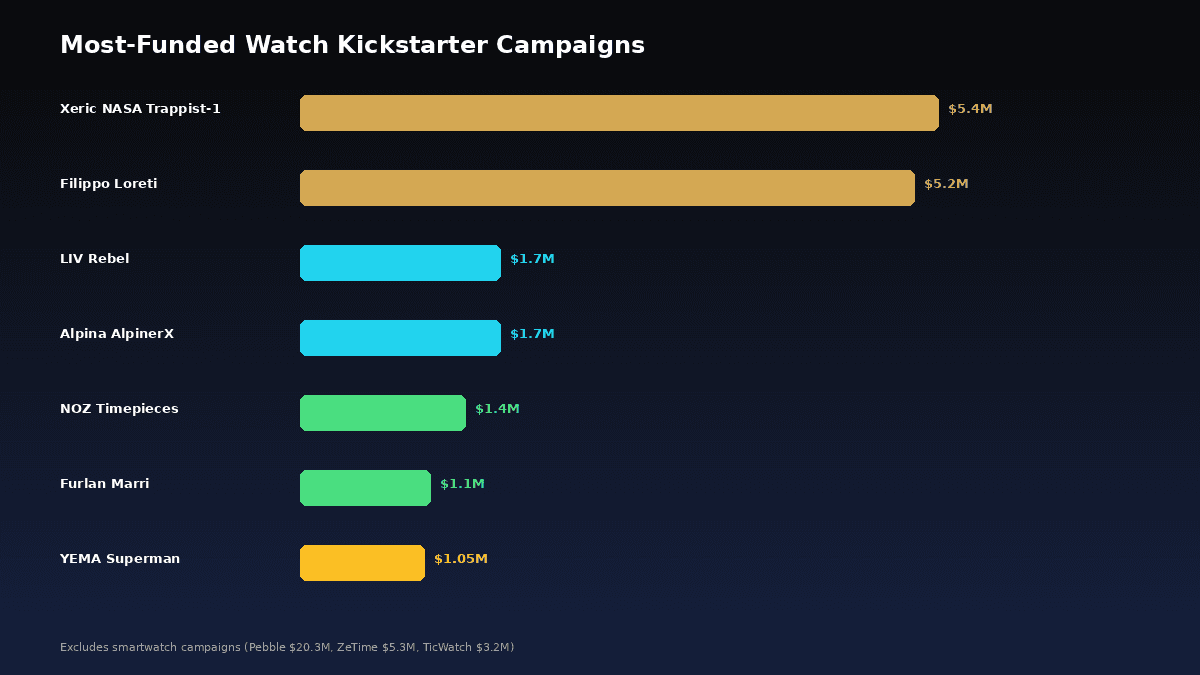
Raw funding totals reveal more about marketing and timing than about watch quality, but they provide useful context for how large the crowdfunded watch market became. Pebble’s $20.3 million remains the high-water mark — a smartwatch campaign from before the Apple Watch existed. Among mechanical and hybrid watches, Xeric, Filippo Loreti, and LIV led in total dollars raised, though backer counts tell a different story about how broadly each product actually appealed.
| Brand | Campaign | Year | Raised | Backers |
|---|---|---|---|---|
| Pebble | Time Smartwatch | 2015 | $20.3M | 78,471 |
| Xeric | NASA Trappist-1 Apollo 11 | 2019 | $5.4M | 17,974 |
| ZeTime (MyKronoz) | Hybrid smartwatch | 2017 | $5.3M | 26,828 |
| Filippo Loreti | Venice / Rome / Milano | 2016 | $5.2M | 18,550 |
| TicWatch (Mobvoi) | S & E | 2017 | $3.2M | 19,251 |
| LIV | Rebel | 2017 | $1.7M | 2,909 |
| Alpina | AlpinerX | 2018 | $1.7M | 2,795 |
| YEMA | Superman Heritage Bronze | 2019 | $1.05M | 1,222 |
| Furlan Marri | Mechaquartz chronograph | 2021 | CHF 1.09M | 2,032 |
Notice the pattern: the largest campaigns by dollar amount were often smartwatches or fashion-forward designs that attracted casual tech buyers. The campaigns that built lasting watch brands — Furlan Marri, YEMA, LIV — raised less money from fewer, more committed backers. That distinction matters when you are evaluating whether a brand’s success on Kickstarter translates into a product worth owning long-term.
Six Kickstarter Brands That Became Legitimate
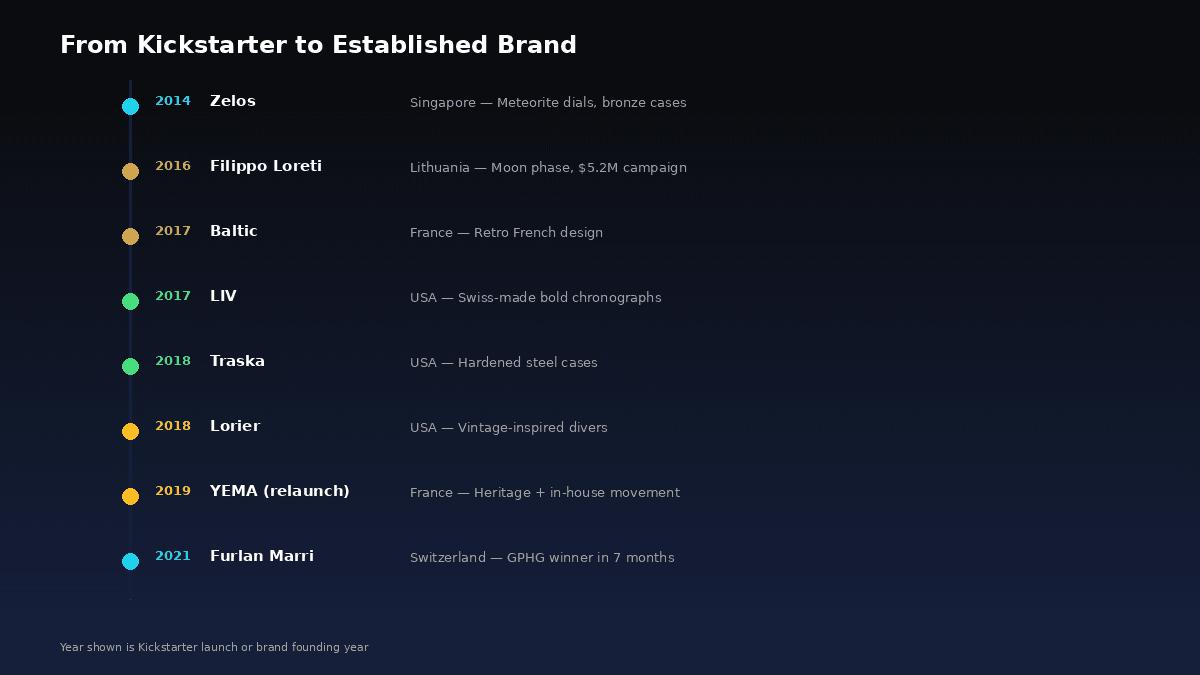
The microbrands below share a common trajectory: each launched or relaunched through Kickstarter, delivered on its promises, and graduated to sustained direct-to-consumer operations with genuine secondary-market demand. None of them is a household name in the way Rolex or Omega is, but within the enthusiast community each has earned a reputation that extends well beyond its crowdfunding origins.
Furlan Marri
The standout success story of the crowdfunded watch world. Founded in Switzerland, Furlan Marri launched its mechaquartz chronograph on Kickstarter in 2021 and raised over CHF 1.09 million from 2,032 backers. Within seven months of that campaign, the brand won the GPHG Horological Revelation Prize — the watch industry’s equivalent of a best-newcomer Oscar. The watches use the Seiko VK64 mechaquartz movement in a 38mm CNC-machined case with sector dials inspired by 1940s chronographs. Kickstarter price was roughly €268; current retail runs $400–$700, and early pieces now trade at two to three times their original campaign price on the secondary market.
Zelos
Founded in Singapore in 2014, Zelos built its reputation on exotic materials: meteorite dials, forged-carbon cases, bronze housings, and Damascus steel bezels. The brand runs limited-edition drops that sell out in minutes, creating genuine secondary-market scarcity. Movements are typically the Miyota 9015 automatic, occasionally the Sellita SW200 on higher-end references. Prices range from $400 to $600 at retail, with popular limited editions trading above that on forums and eBay. If you are used to shopping in this price range, our best watches under $1,000 roundup puts Zelos in context against other brands at similar money.
Traska
A US-based brand founded in 2018, Traska carved out a niche with scratch-resistant hardened steel cases — a material treatment usually found on watches costing several times more. The Freediver and Summiteer lines use Miyota 9015 or Sellita SW200 movements and price between $400 and $600. Build quality and finishing are consistently praised in enthusiast reviews, and the brand’s direct-to-consumer model keeps prices lower than comparable Swiss-movement watches from traditional retailers.
Collector tip: The best microbrands sell out on drop day. If you are buying secondhand, scan the listing photo with Grailr to cross-check the model identification and current asking prices across multiple marketplaces before paying a premium.
Lorier
Also US-based and launched in 2018, Lorier specializes in vintage-inspired designs with a distinctly 1960s aesthetic. The Neptune diver and Falcon chronograph are the best-known models, both using Miyota movements in cases that emphasize clean lines and moderate sizing. Prices range from $400 to $600. Lorier’s appeal lies in its restrained design language — these are watches that draw from mid-century originals without exaggerating proportions or piling on complications — and in consistently good bracelet quality for the price, a common weak point among microbrands.
Baltic
A French brand that launched in 2017 and leans heavily on retro Parisian design heritage. The Aquascaphe diver, Bicompax chronograph, and MR01 micro-rotor are the standout models, priced between $400 and $700 depending on the reference. Baltic uses Miyota movements across most of its lineup and has earned a following for dial design and finishing that punches above its price point. The brand is also one of the few microbrands to introduce its own micro-rotor movement collaboration, which signals genuine long-term ambition beyond repackaged off-the-shelf calibers.
YEMA
The outlier on this list: YEMA is not a startup. It is a French heritage brand founded in 1948 whose Superman and Navygraf dive watches were worn by the French Air Force and Navy. The brand used Kickstarter in 2019 to fund a relaunch of the Superman Heritage in bronze, raising over $1.05 million. What makes YEMA unusual among microbrands is its in-house CMM.20 caliber, developed and assembled in Morteau, France. Prices run $600–$1,500, positioning YEMA between the typical $400–$600 microbrand range and entry-level pieces from Hamilton or Longines. For a comparison with another brand in that range, see our Hamilton Khaki Field guide.
Movements and Build Quality: What’s Actually Inside
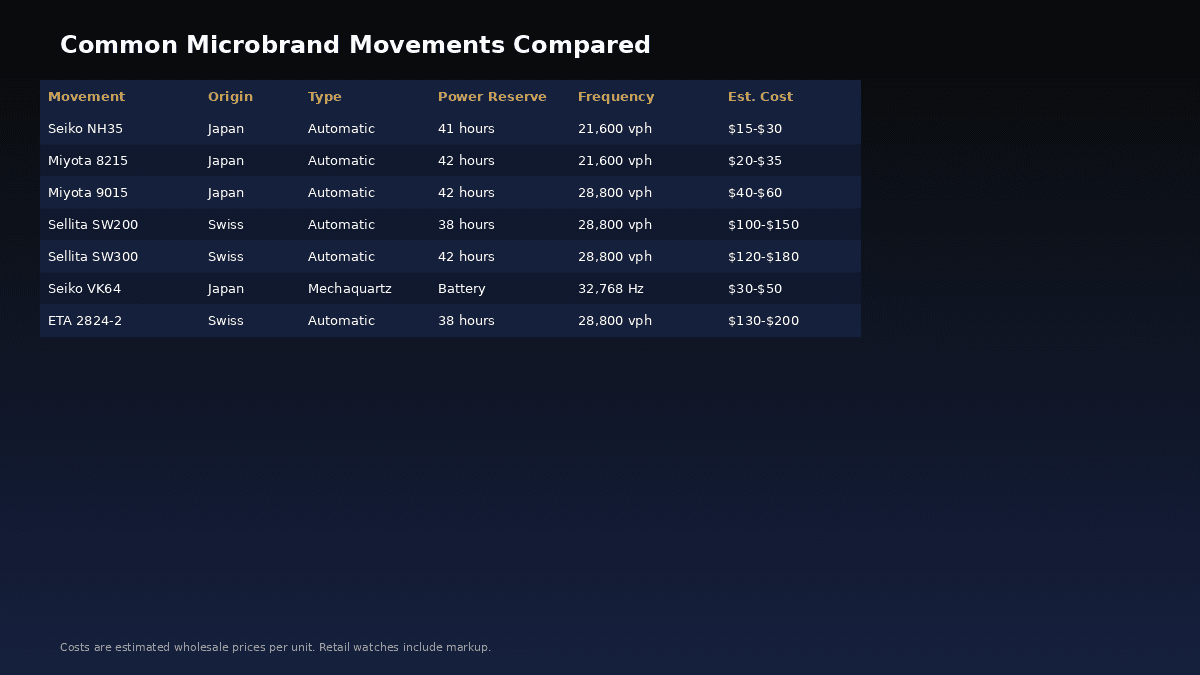
The movement inside a microbrand watch tells you more about the brand’s ambitions and margins than any marketing copy. Most Kickstarter watches use one of four caliber families, each with well-understood strengths and limitations. Understanding which one is inside the watch you are considering — and what it costs the brand at wholesale — helps you judge whether the retail price reflects genuine value or inflated markup on a commodity component.
| Movement | Type | Wholesale Cost | Power Reserve | Typical Use |
|---|---|---|---|---|
| Seiko NH35/NH36 | Japanese automatic | $15–$30 | 41 hr | Sub-$300 watches |
| Miyota 8215 | Japanese automatic | $20–$35 | 42 hr | $200–$400 range |
| Miyota 9015 | Japanese automatic | $35–$50 | 42 hr | $400–$600 microbrands |
| Sellita SW200 | Swiss automatic | $100–$150 | 38 hr | $500+ Swiss-positioned |
| Seiko VK61/VK64 | Mechaquartz | $25–$40 | 3 yr (battery) | Chronographs |
The Miyota 9015 has become the de facto standard for serious microbrands in the $400–$600 range. It offers smooth bidirectional winding, hacks (the second hand stops when you pull the crown to set the time), and a 42-hour power reserve — all in a slim 3.9mm-thick package that allows for reasonable case proportions. Brands using the cheaper Miyota 8215 or Seiko NH35 are not necessarily cutting corners; both are robust, well-proven movements. But if you are paying over $400 for a watch and it runs an NH35 that the brand bought for $20, the remaining $380 needs to be justified by case finishing, crystal quality, bracelet construction, and brand support — not just a nice rendering on the campaign page.
The Sellita SW200 commands a premium because it carries “Swiss Made” credentials and the brand can legally print that designation on the dial if enough of the watch’s value originates in Switzerland. For buyers who care about that label, the SW200 justifies a higher price. For buyers who care about raw reliability and timekeeping accuracy, the Miyota 9015 performs comparably for a third of the movement cost. Our best budget watches guide covers the best value propositions at each movement tier.
Check Any Watch Price in Seconds
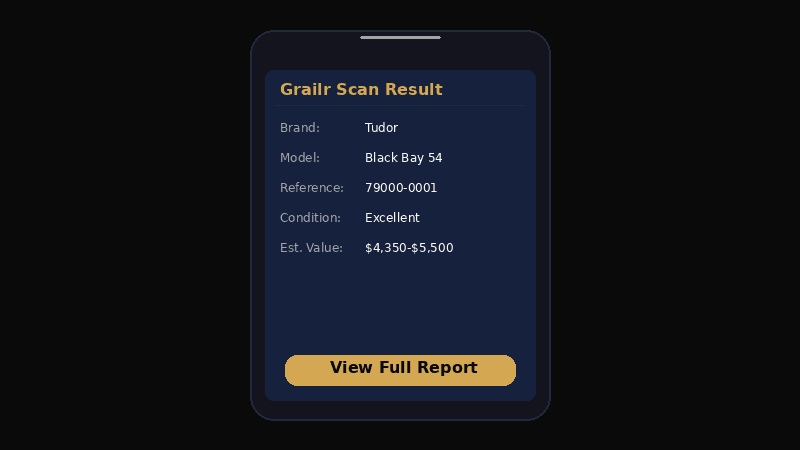
Grailr scans your watch photo and pulls live pricing from Chrono24, eBay, and Jomashop.
- AI identifies brand, model & reference number
- Live market prices from 3+ sources
- Authentication confidence score
Price Tiers and Value Proposition
One of the strongest arguments for microbrand watches is the value proposition at each price tier. Without authorized-dealer margins, marketing overhead, or legacy brand premiums, a Kickstarter graduate can deliver a watch with objectively better specifications than its traditionally distributed competitor at the same price. That gap narrows as prices climb — a $1,500 YEMA competes more closely with a $1,500 Hamilton than a $300 microbrand outclasses a $300 Seiko — but the advantage is real throughout the range.
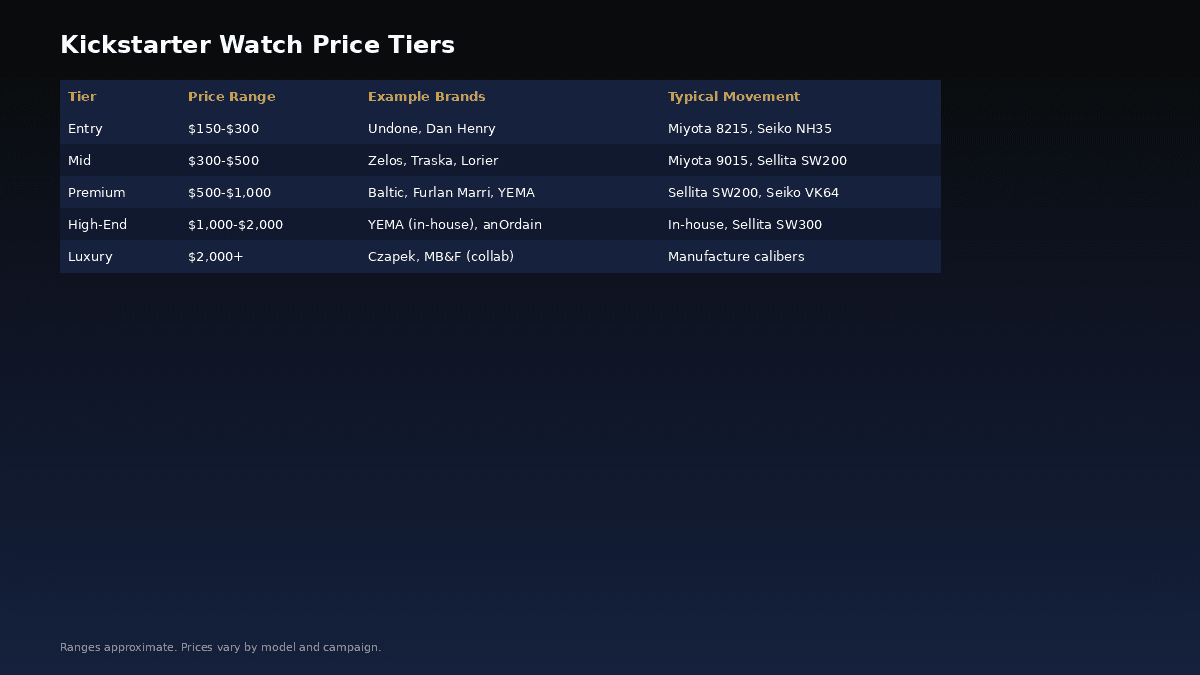
$150–$300: Entry-Level Microbrands
Seiko NH35 or Miyota 8215 movements, mineral or hardlex crystals, basic but functional bracelets. At this tier you are competing directly with Seiko, Orient, and Casio — brands with decades of proven reliability and global service networks. The microbrand advantage here is mainly design differentiation and limited production numbers, not specification superiority.
$400–$700: The Microbrand Sweet Spot
This is where Furlan Marri, Zelos, Traska, Lorier, and Baltic all concentrate. Miyota 9015 or Sellita SW200 movements, sapphire crystals with anti-reflective coating, solid link bracelets or quality straps, and case finishing that approaches what Tissot or Hamilton offers at similar prices. The difference: at a traditional brand, $500 buys an entry-level model. At a microbrand, $500 often buys a watch that the brand specifically designed to punch above its weight.
$700–$1,500: Microbrand Premium Tier
YEMA, upper-range Zelos, and Baltic’s MR01 micro-rotor live here. At this price you can expect Swiss or in-house movements, exhibition casebacks, and finishing details like hand-applied indices and polished bevels. The competition shifts to established brands like Hamilton, Longines, and Mido, where you also get authorized-dealer warranty support and global service availability — which microbrands still struggle to match.
Risks and Red Flags When Backing a Watch
For every Furlan Marri that wins a GPHG prize, there are dozens of Kickstarter watch campaigns that disappoint. Understanding the common failure modes helps you avoid them. The risks are not hypothetical — each one has produced real losses for real backers, and the pattern repeats with every new wave of campaigns.
Rebranded Factory Watches
Some campaigns take a generic watch from a Shenzhen or Dongguan factory catalog, add a custom logo, photograph it with aspirational lifestyle imagery, and present it as a “designed in [Western city]” original. The tell: if the campaign does not name its specific movement caliber, disclose where the case is machined, or show prototype-stage photos of the actual product, the chances are high that you are paying a brand premium on a commodity product available on AliExpress for a fraction of the price.
Delivery Delays and Non-Delivery
A 6–18 month wait is common even for well-run campaigns. Factory scheduling, component shortages, and quality-control failures can push delivery well beyond the stated estimate. Worse, some campaigns never deliver at all — the brand runs out of money during production, the founder loses interest, or manufacturing problems prove unsolvable. Kickstarter pledges are not purchases, and Kickstarter itself does not guarantee delivery or offer refunds.
No Long-Term Warranty or Parts
If the brand folds two years after fulfillment, your warranty is worthless and replacement parts — custom crowns, crystals, bezels, gaskets — may be unobtainable. Established brands maintain parts inventories for decades. A microbrand that exists only as a one-person operation with a factory relationship has no such obligation or infrastructure. This is the hidden cost of buying outside the traditional supply chain.
Inflated Retail Comparisons
Campaign pages routinely compare their $300 watch to a $2,000 Swiss watch and claim you are getting 85% savings. This is almost always misleading. A watch with a $25 Seiko NH35 movement, a mineral crystal, and a stamped-steel bracelet is not comparable to a watch with a $150 Swiss movement, a sapphire crystal, and a solid-link bracelet regardless of how similar the dial layout looks in photographs.
How to Evaluate a Kickstarter Watch Campaign
Before backing any crowdfunded watch, run through these checks. None of them guarantees a good outcome, but together they separate serious brands from opportunistic campaigns.
1. Identify the Movement by Caliber Number
If the campaign says “Japanese automatic movement” without naming the specific caliber (NH35, Miyota 9015, etc.), treat that as a yellow flag. Serious brands are transparent about what powers the watch because they know their audience cares. Vague movement descriptions typically mean the brand is hiding a commodity caliber that would undercut the price they are charging.
2. Check the Creator’s Track Record
Kickstarter shows previous campaigns by the same creator. A brand on its second or third campaign that delivered the first one on time is a dramatically safer bet than a first-time creator with no fulfillment history. Look for backer comments on previous projects — they reveal delivery timing, quality issues, and customer-service responsiveness more honestly than the campaign page ever will.
3. Look for Prototype Photos, Not Renders
A campaign showing only 3D renders or studio photographs of a single polished sample is still in the concept stage. Brands that have working prototypes show them on wrists, under natural light, and from unflattering angles because they have nothing to hide. The gap between a render and a mass-produced product is where most crowdfunded watches disappoint.
4. Verify the Price Against Retail Alternatives
Before backing a $350 Kickstarter watch with a Miyota 8215, check what Seiko, Orient, or Citizen offers at that price with a proven track record and a real warranty. Use Grailr’s watch identification tool to cross-reference any watch photo against live market pricing — it gives you a baseline to judge whether the campaign price is genuinely competitive or just well-marketed.
5. Research the Community Reception
Check r/Watches, Watchuseek, and brand-specific forums for owner reviews. Enthusiast communities are blunt about finishing quality, bracelet rattle, bezel play, and movement accuracy in ways that campaign pages and paid influencer reviews are not. A brand with enthusiastic owner threads is a safer bet than one with only its own marketing to vouch for it.
Frequently Asked Questions
Are Kickstarter watches worth buying in 2026?
Some are. Brands like Furlan Marri, Zelos, Traska, and Lorier have proven themselves with consistent quality, community trust, and secondary-market demand. But many campaigns never delivered at all, and others shipped rebranded Chinese factory watches at inflated prices. Research the brand's track record, movement choice, and post-campaign support before backing.
Which Kickstarter watch brand has the best resale value?
Furlan Marri leads the field. After winning the 2021 GPHG Horological Revelation Prize, its early Kickstarter pieces now trade at two to three times their original campaign price on the secondary market. Zelos limited editions also hold value well, though broader availability keeps most models closer to their retail price.
What movement should I look for in a microbrand watch?
The Seiko NH35 and NH36 are reliable entry-level automatics found in watches under $300. The Miyota 9015 offers smoother winding and a slimmer profile in the $400 to $600 range. The Sellita SW200 is the go-to Swiss option for brands positioning above $500. Seiko VK64 mechaquartz is popular in chronographs for its sweeping hand and quartz reliability.
How long does Kickstarter watch delivery usually take?
Plan for 6 to 18 months after the campaign closes. Some brands deliver on time, but delays of six months or more are common due to factory scheduling, component sourcing, and quality-control revisions. Established microbrands with prior campaigns tend to deliver faster than first-time creators.
Can I return a Kickstarter-backed watch if I do not like it?
Kickstarter pledges are not purchases and carry no automatic return right. Some brands offer voluntary return windows after fulfillment, but this varies. If you buy from a microbrand's own website after it graduates from Kickstarter, standard consumer return policies usually apply.
What happened to the most-funded Kickstarter watch brands?
Results vary widely. Pebble, the most-funded watch campaign ever at $20.3 million, was acquired by Fitbit in 2016 and discontinued. Filippo Loreti is still operating but faces mixed reviews on build quality relative to price. YEMA used Kickstarter to relaunch a genuine heritage brand and now sells through its own retail channels with an in-house movement. The best outcomes belong to brands that used crowdfunding as a launchpad, not a business model.
Related Articles
The Bottom Line
The best Kickstarter watch brands — Furlan Marri, Zelos, Traska, Lorier, Baltic, and YEMA — have moved well beyond their crowdfunding origins into legitimate microbrand territory with real collector demand and secondary-market trading. They offer genuine value in the $400–$700 range, where a direct-to-consumer model lets them deliver better movements, materials, and finishing than you would typically find from a traditional brand at the same price. But for every brand that graduated, dozens of campaigns disappointed, and the risks of non-delivery, vanishing warranty support, and rebranded factory watches remain real for anyone backing a new project. Do your homework on the movement, the creator’s track record, and community reception before pledging — and if you already own a microbrand watch and want to know what it is worth today, scan it with Grailr for a quick market check.
Own a Microbrand Watch?
Grailr uses a photo to suggest a watch identity and an indicative price estimate, with active listings where available. Check the exact reference and condition independently; a photo scan cannot authenticate a watch.
Get an Indicative EstimateSources and price context
- Kickstarter product design category — Campaign pages, backer counts, and funding totals for the watch projects referenced in this guide.
- Furlan Marri official site — Current collection, specifications, and retail pricing for the mechaquartz chronograph range.
These primary sources support the campaign data and brand details noted above. Prices and resale figures elsewhere in this guide are indicative editorial estimates, not a verified transaction dataset or guaranteed returns. Confirm the exact reference, condition, and current quote before buying; asking prices are not completed-sale prices.