15 Best Luxury Watches for Men in 2026: From $2,000 to $100,000 Ranked
From the Tudor Black Bay 58 to the Patek Philippe Nautilus — 15 expert-ranked luxury timepieces for men evaluated on craftsmanship, value retention, and real-world wearability.

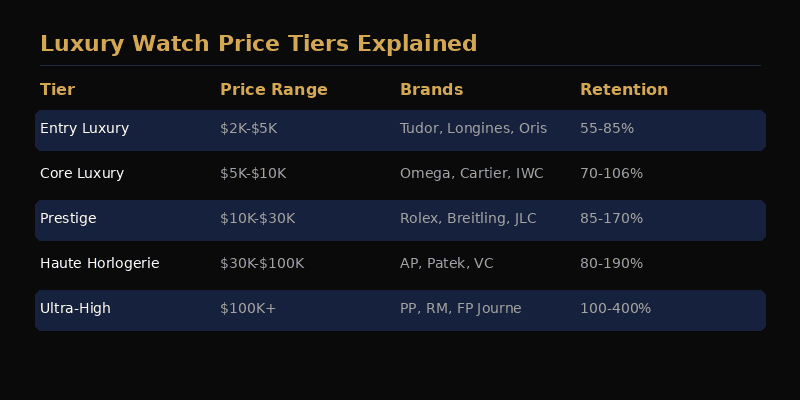
- True luxury watchmaking starts at roughly $2,000 with Tudor and Longines — both offering in-house, COSC-certified movements
- The $5,000–$15,000 range (Rolex, Omega, Cartier, IWC) is the sweet spot for quality, brand prestige, and resale value
- Rolex Submariner ($10,250) is our pick for best overall luxury watch for men — iconic design, 115% value retention
- Haute horlogerie from Patek Philippe, AP, and A. Lange & Söhne starts at $28,000+ and offers hand finishing that mass-produced watches simply cannot match
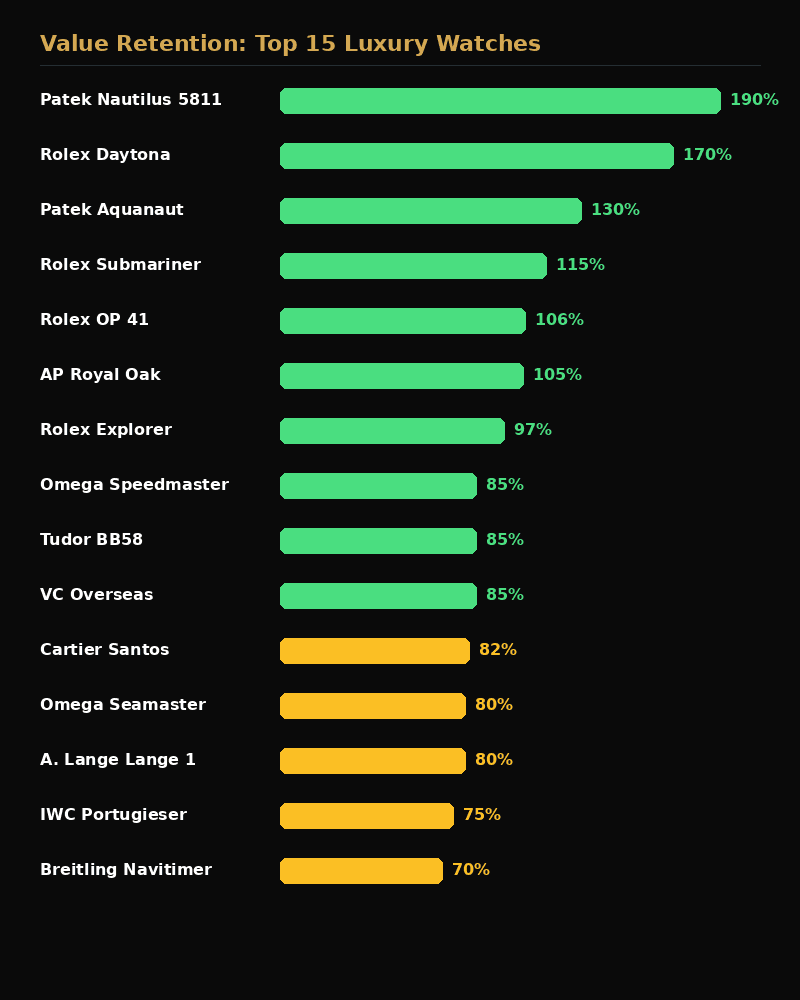
- Value retention ranges from 70% (Breitling) to 190% (Patek Nautilus) — brand and model selection matters enormously
What Makes a Watch “Luxury”?
The word “luxury” gets thrown around loosely in the watch world, so let’s define it precisely. A genuine luxury timepiece for men is distinguished by five pillars: in-house movement manufacturing, superior finishing quality, heritage spanning decades or centuries, premium materials, and demonstrable value retention. Miss one, and you have a nice watch. Hit all five, and you have a luxury watch.
In-house movements are the foundation. When a brand designs, manufactures, and assembles its own calibre — rather than dropping in an off-the-shelf ETA or Sellita — it signals serious horological commitment. Tudor’s MT5402, Rolex’s Cal. 3235, and Patek Philippe’s Cal. 324 S C are all manufactured entirely within each brand’s own facilities.
Finishing quality separates the tiers. Entry-level luxury watches feature machine-applied Geneva stripes and basic bevelling. Step into haute horlogerie territory — Patek Philippe, Vacheron Constantin, A. Lange & Söhne — and you encounter hand-applied finishes that take hundreds of hours per movement. Certifications like the Geneva Seal (Poinçon de Genève) and the Patek Philippe Seal guarantee standards of finishing that go far beyond timekeeping accuracy.
Materials tell you immediately where a watch sits in the hierarchy. Fashion brands use 316L stainless steel. Rolex uses 904L Oystersteel — a super-alloy that’s harder, more corrosion-resistant, and takes a better polish. Move up and you encounter 18k white, yellow, and Everose gold, platinum 950, and high-tech ceramics for bezels and cases. Even the sapphire crystals differ: Patek Philippe’s crystals receive anti-reflective coatings on both sides, while entry-level brands often coat only the inside.
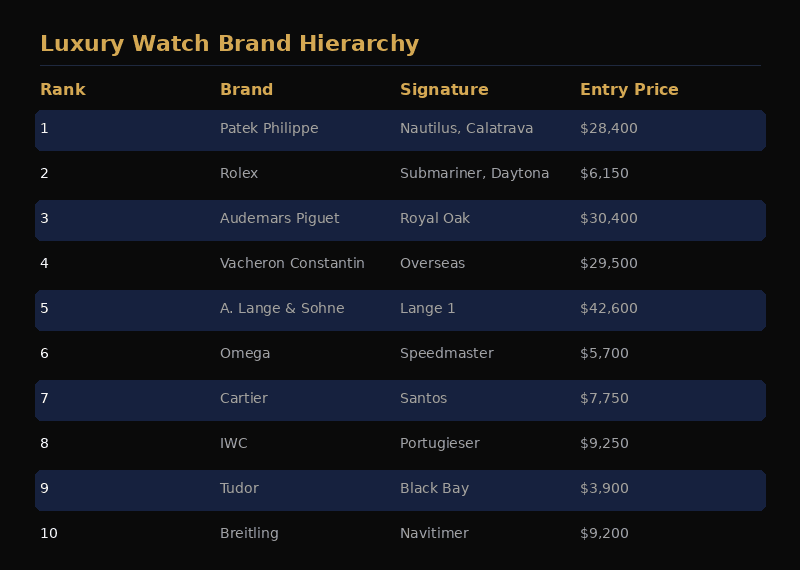
Where does luxury begin? The honest answer is around $2,000. At that threshold, you can access brands like Tudor and Longines that manufacture their own movements and deliver finishing that justifies the premium. True haute horlogerie — the highest expression of watchmaking art — starts at roughly $20,000 with brands like Jaeger-LeCoultre, and reaches its peak with Patek Philippe, Audemars Piguet, Vacheron Constantin, and A. Lange & Söhne. For a broader look at where each brand sits, see our complete list of luxury watch brands.
15 Best Luxury Watches for Men Ranked
Every watch on this list meets our five-pillar luxury criteria. The editorial order considers movement quality, finishing, design heritage, versatility, and value retention. Prices and resale ratios are illustrative editorial comparisons rather than a tracked transaction dataset. Use Grailr’s appraisal tool for an indicative estimate, then research the exact reference separately.
1. Rolex Submariner Date — $10,250
The Submariner defined the luxury dive watch category when it launched in 1953, and the current reference 126610LN remains the benchmark. The 41mm Oystersteel case houses the Cal. 3235 with a 70-hour power reserve, Chronergy escapement, and Parachrom hairspring resistant to shocks and magnetic fields. The Cerachrom ceramic bezel insert is virtually scratch-proof, and 300m water resistance makes it a genuine tool watch. On the secondary market, steel Submariners consistently trade at roughly 115% of retail — making this one of the few luxury watches for men that actually appreciates from the moment you buy it at an authorized dealer. For the full rundown on this icon, read our best Rolex watches for men guide.
2. Patek Philippe Nautilus 5811 — Consult Current Retail
The white-gold Nautilus 5811/1G-001 has a 41mm case and blue sunburst dial. Its self-winding calibre 26-330 S C uses a 21K gold central rotor and has a specified power reserve of 35–45 hours. Patek Philippe currently lists water resistance at 30m. Consult the official reference page for the current regional price and specifications. Compare the full reference against dated secondary-market sales.
3. Rolex Daytona — $16,100
The Cosmograph Daytona is the world’s most coveted chronograph. The current steel reference 126500LN features the Cal. 4131 — Rolex’s latest in-house chronograph movement with a 72-hour power reserve and a column-wheel mechanism for crisp pusher engagement. The 40mm case with Cerachrom tachymeter bezel strikes a perfect balance between dressy and sporty. At $16,100 retail, the steel Daytona commands roughly 170% on the secondary market, making it one of the strongest investment-grade luxury watches available. Waitlists at authorized dealers routinely exceed three years.
4. A. Lange & Söhne Lange 1 — $42,600
If the Nautilus represents luxury sports watchmaking at its apex, the Lange 1 is the pinnacle of luxury dress watches for men. The asymmetric dial layout — with its outsized date, off-centre time display, and power reserve indicator — is one of the most distinctive designs in horology. The 38.5mm case houses the Cal. L121.1, hand-wound with a 72-hour power reserve and a three-quarter plate finished with Glashutte ribbing. Every Lange movement is assembled twice: once to check tolerances, then disassembled and reassembled with final finishing. That level of dedication is unmatched outside of independent watchmaking. Resale sits at roughly 80%, but Lange buyers rarely sell.
5. Audemars Piguet Royal Oak 15500 — $30,400
The Royal Oak shattered every convention when it debuted in 1972 as the world’s first luxury sports watch. The 15500ST carries the Cal. 4302 automatic movement with 70 hours of power reserve and a 41mm case with the iconic octagonal bezel secured by eight hexagonal screws. AP’s finishing on the “Grande Tapisserie” dial involves stamping each tiny square individually with a computer-controlled press, creating a texture that catches light in mesmerizing patterns. At $30,400, the Royal Oak retains roughly 105% of its value on the secondary market — a remarkable achievement for a non-Rolex steel sports watch.
6. Omega Speedmaster Professional — $7,600
The Moonwatch needs no introduction. Qualified by NASA for every crewed space mission since 1965, the current Speedmaster Professional features the Co-Axial Master Chronometer Cal. 3861 — a substantial upgrade over the legendary 1861 it replaced. The 42mm case, hesalite crystal (for purists), and 50-hour power reserve remain faithful to the original design language. METAS certification means it resists magnetic fields up to 15,000 gauss. At $7,600, it’s the most historically significant luxury watch for men at any price, and it retains roughly 85% of its value on the secondary market.
7. Patek Philippe Aquanaut 5167 — $28,400
The Aquanaut is Patek Philippe’s most youthful and wearable offering. The 5167A features a 40mm stainless steel case with a rounded octagonal bezel, embossed dial echoing the Nautilus’s porthole motif, and Patek’s Cal. 324 S C automatic movement. The tropical composite strap is practically indestructible and makes this one of the most comfortable luxury timepieces for men to wear daily. At $28,400 retail, the Aquanaut trades at roughly 130% on the grey market — more accessible than the Nautilus but still firmly in grail territory.
8. Vacheron Constantin Overseas — $29,500
The Overseas is the often-overlooked member of the “luxury steel sports watch” category, and many collectors consider it the most refined of the group. The 41mm case houses the Cal. 5100 with a 60-hour power reserve and Geneva Seal certification — which mandates finishing standards that exceed COSC. The interchangeable bracelet system lets you swap between steel bracelet, leather strap, and rubber strap without tools. At $29,500, it retains roughly 85% on the secondary market. For collectors who want Holy Trinity pedigree without Nautilus or Royal Oak hype pricing, the Overseas is the answer.
9. Rolex Explorer 40 — $7,350
The Explorer is Rolex at its most elemental: time, date-free simplicity, and legendary toughness. Updated to 40mm (ref. 224270), it runs the Cal. 3230 with a 70-hour power reserve. The 3-6-9 dial layout is one of the most legible designs in watchmaking, and the 100m water resistance handles anything short of serious diving. At $7,350, the Explorer retains roughly 97% of retail on the secondary market — just a whisker below retail. It’s the ultimate “one watch” for men who want Rolex quality without a sport-watch statement.
10. Cartier Santos Medium — $7,750
The Santos de Cartier holds a unique distinction: it was the first purpose-built wristwatch, designed in 1904 for Brazilian aviator Alberto Santos-Dumont. The current medium model (35.1mm) houses Cartier’s 1847 MC in-house automatic movement and features the QuickSwitch system for tool-free strap changes. The exposed screws on the bezel give it an industrial-meets-elegant aesthetic that works with everything from a t-shirt to a tuxedo. At $7,750, it retains roughly 82% on the secondary market. The Santos is proof that a 35mm case can carry serious wrist presence when the design is this good.
11. Rolex Oyster Perpetual 41 — $6,150
The purest Rolex you can buy — no date, no bezel complication, just time. The OP 41 runs the Cal. 3230 and comes in striking dial colours including silver, bright blue, turquoise, and candy pink. The coloured dials have pushed secondary market prices to roughly 106% of the $6,150 retail price. For first-time buyers seeking their entry into luxury watches for men, the OP 41 is the cleanest, most versatile starting point in the Rolex lineup.
12. IWC Portugieser Chronograph — $9,250
The Portugieser Chronograph is IWC’s most popular model, and for good reason. The 41mm case houses the in-house Cal. 69355 with a 46-hour power reserve and column-wheel chronograph mechanism. The clean, symmetrical dial with two sub-registers and Arabic numerals has a timeless elegance that feels dressy without being delicate. At $9,250, it retains roughly 75% on the secondary market. The Portugieser is the luxury chronograph for men who want refinement over ruggedness — the antithesis of a tool watch, and all the better for it.
13. Omega Seamaster Diver 300M — $5,700
James Bond’s current watch of choice, the Seamaster Diver 300M delivers Co-Axial Master Chronometer Cal. 8800 performance in a 42mm case with a ceramic bezel and wave-pattern dial. METAS certification guarantees accuracy, anti-magnetism to 15,000 gauss, and water resistance to 300 metres. The helium escape valve at 10 o’clock is functional for saturation divers but serves as a design signature for everyone else. At $5,700, it retains roughly 80% on the secondary market and represents the most accessible entry into serious Swiss luxury dive watchmaking.
14. Tudor Black Bay 58 — $3,900
The Black Bay 58 is the single best entry into luxury watchmaking. At 39mm with a slim 11.9mm thickness, it wears perfectly on virtually any wrist. The MT5402 in-house movement delivers 70 hours of power reserve and COSC chronometer certification. Tudor is Rolex’s sister brand, sharing access to the same steel suppliers and quality-control philosophy, at roughly a third of the price. Resale value sits around 85%, which is outstanding for the sub-$5,000 segment. For a full breakdown of every variant, see our guide to your first luxury watch under $3,000.
15. Breitling Navitimer B01 41 — $9,200
The Navitimer is one of the most recognizable chronographs ever made, dating back to 1952 when it was designed as a functional tool for pilots. The 41mm version (a departure from the traditional 43mm) houses the in-house B01 calibre with a 70-hour power reserve and column-wheel chronograph. The slide-rule bezel is still functional for aviation calculations, though most owners wear it for its complex, layered dial aesthetic. At $9,200, the Navitimer retains roughly 70% on the secondary market. It’s a watch that rewards close inspection — the more you look, the more you see.
Complete Comparison Table
| Watch | Price | Size | Movement | WR | Retention |
|---|---|---|---|---|---|
| Tudor Black Bay 58 | $3,900 | 39mm | MT5402 | 200m | ~85% |
| Omega Seamaster 300M | $5,700 | 42mm | Co-Axial 8800 | 300m | ~80% |
| Rolex Oyster Perpetual 41 | $6,150 | 41mm | Cal. 3230 | 100m | ~106% |
| Rolex Explorer 40 | $7,350 | 40mm | Cal. 3230 | 100m | ~97% |
| Omega Speedmaster Pro | $7,600 | 42mm | Cal. 3861 | 50m | ~85% |
| Cartier Santos Medium | $7,750 | 35.1mm | 1847 MC | 100m | ~82% |
| Breitling Navitimer B01 | $9,200 | 41mm | B01 | 30m | ~70% |
| IWC Portugieser Chrono | $9,250 | 41mm | Cal. 69355 | 30m | ~75% |
| Rolex Submariner Date | $10,250 | 41mm | Cal. 3235 | 300m | ~115% |
| Rolex Daytona | $16,100 | 40mm | Cal. 4131 | 100m | ~170% |
| Patek Philippe Aquanaut | $28,400 | 40mm | Cal. 324 S C | 120m | ~130% |
| Vacheron Overseas | $29,500 | 41mm | Cal. 5100 | 150m | ~85% |
| AP Royal Oak 15500 | $30,400 | 41mm | Cal. 4302 | 50m | ~105% |
| Patek Nautilus 5811 | See official price | 41mm | Cal. 26-330 S C | 30m | Reference-dependent |
| A. Lange Lange 1 | $42,600 | 38.5mm | Cal. L121.1 | 30m | ~80% |
Best Luxury Watches by Category
Different collectors have different priorities. Here are our top picks across six key categories to help you zero in on the right luxury timepiece for men based on what matters most to you.
Best Overall
Rolex Submariner — $10,250. The benchmark luxury sports watch: iconic design, in-house movement, 300m water resistance, and 115% value retention. No other watch checks every box this consistently.
Best Value
Tudor Black Bay 58 — $3,900. In-house COSC movement, Rolex-grade steel quality, 200m water resistance, and 85% retention. The most luxury per dollar spent.
Best Investment
Rolex Daytona — $16,100. At 170% retention, the steel Daytona is less a purchase and more a deposit into an appreciating asset that you can wear on your wrist.
Best Dress Watch
A. Lange & Söhne Lange 1 — $42,600. Double-assembled hand-wound movement, asymmetric dial, and Glashutte finishing that represents the absolute pinnacle of dress watchmaking.
Best Chronograph
Omega Speedmaster Professional — $7,600. The Moonwatch: NASA-qualified, historically unmatched, Co-Axial Master Chronometer certified, and available at the most accessible price of any icon on this list.
Best Sports Watch
Audemars Piguet Royal Oak — $30,400. The watch that created the luxury sports category in 1972. Grande Tapisserie dial, integrated bracelet, and 105% retention make it the ultimate status sports piece.
Check Any Watch Price in Seconds
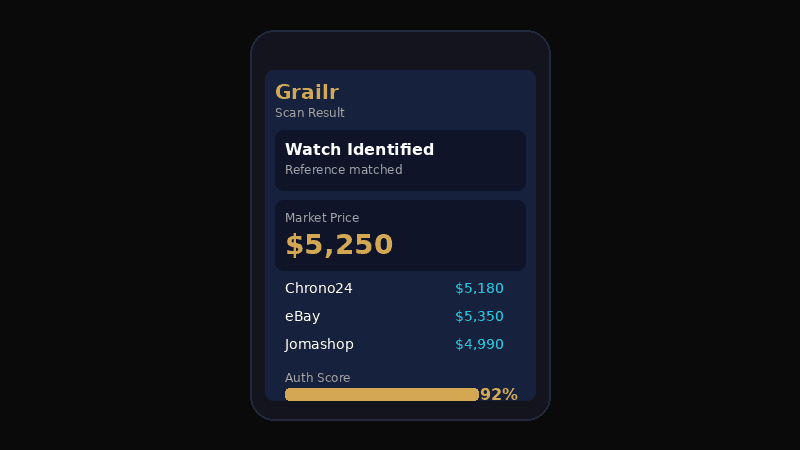
Grailr uses your photo to suggest a watch identification and an indicative price estimate. Active eBay listings, when available, offer asking-price comparisons.
- Grailr suggests brand, model & reference number
- Active eBay asking-price comparisons
- Identification confidence score
Entry-Level Luxury: $2,000–$5,000
The $2,000–$5,000 bracket is where genuine luxury watchmaking begins. This is Tudor, Longines, TAG Heuer, and Oris territory — brands that manufacture or co-develop their own movements and deliver finishing quality that separates them from the mid-range Swiss players like Tissot and Hamilton.
At this price, expect COSC-certified movements with 60–70 hour power reserves, silicon hairsprings that improve anti-magnetic resistance and long-term accuracy, and sapphire crystals with anti-reflective coatings. Cases are typically 316L stainless steel with good finishing — polished and brushed surfaces, solid end-links, and properly machined bracelets that don’t rattle.
Tudor leads the segment with the Black Bay lineup ($3,200–$4,800), offering in-house movements manufactured in Rolex’s Le Locle facility. Longines punches well above its weight with COSC chronometer certification and silicon hairsprings starting at $1,800. TAG Heuer’s Carrera line ($2,800–$4,500) brings in-house chronograph movements to a price point that Rolex and Omega can’t touch.
Brand recognition at this tier is strong but not universal. Tudor is increasingly known in its own right rather than simply as “Rolex’s little brother.” Longines carries the cachet of being the oldest registered trademark in watchmaking (1832). TAG Heuer benefits from decades of motorsport sponsorship. If value retention matters, Tudor leads the pack with 80–90% retention, followed by Longines at 55–65% and TAG Heuer at 50–60%.
Mid-Range Luxury: $5,000–$15,000
This is the sweet spot for luxury watches for men. The $5,000–$15,000 range delivers the best balance of movement quality, brand prestige, finishing, and resale value anywhere in the market. It’s Rolex, Omega, Cartier, IWC, and Breitling territory.
At this level, movements are exclusively in-house, power reserves extend to 70+ hours, and materials step up significantly. Rolex uses 904L Oystersteel, which is harder and more corrosion-resistant than the 316L used by most competitors. Omega’s METAS Master Chronometer certification tests daily rate, water resistance, power reserve, and magnetic resistance to standards that exceed COSC. Cartier and IWC bring column-wheel chronograph mechanisms and proprietary materials to the table.
Resale value in this range is remarkably strong. Rolex models trade between 97% and 170% of retail. Omega Speedmasters hold 85%. Cartier Santos retains 82%. Even IWC and Breitling, which historically suffered steeper depreciation, have stabilized at 70–75% retention as both brands have moved to 100% in-house movements and improved their brand positioning.
For a detailed look at which models in this range hold their money best, see our watches that hold value guide, or snap a photo of any watch you’re considering and let Grailr identify it with indicative pricing.
Ultra-Luxury & Haute Horlogerie: $15,000+
Above $15,000, you enter the realm of haute horlogerie — watchmaking as fine art. The names here are Patek Philippe, Audemars Piguet, Vacheron Constantin, and A. Lange & Söhne, commonly referred to as the “Big Four” of high watchmaking. Rolex’s Daytona also crosses into this territory at $16,100, though Rolex occupies a unique space as a luxury brand that operates at industrial scale.
What justifies spending $30,000–$100,000 on a watch? Three things: hand finishing, complications, and exclusivity. A Patek Philippe Cal. 26-330 S C takes weeks to finish by hand — every bridge is individually bevelled under a microscope, every screw head is polished to a mirror finish, every surface receives Geneva stripes applied one stripe at a time. An A. Lange & Söhne movement is assembled twice: once to verify tolerances, disassembled completely, then reassembled with final cosmetic finishing. These are processes that machines cannot replicate.
Complications — features beyond time display — also escalate at this level. Perpetual calendars that track the date, month, leap year, and moon phase without manual adjustment until 2100. Minute repeaters that chime the time on demand using tiny hammers striking tuned gongs inside the case. Tourbillons that rotate the entire escapement to counteract positional errors. Each of these complications requires months of additional hand-assembly.
Exclusivity is the final factor. Patek Philippe produces an estimated 62,000 watches per year. Audemars Piguet makes roughly 45,000. A. Lange & Söhne produces just 5,000. Compare that to Rolex’s estimated 1.2 million annual production, and you understand why the Big Four command the prices they do — and why waitlists can stretch beyond a decade. For a deeper exploration of the hierarchy, our 20 best high-end watch brands guide ranks every major player.
How to Buy Your First Luxury Watch
Buying your first luxury timepiece is a significant decision, and getting it right matters. Here’s a practical framework that will save you money and regret.
1. Set a Realistic Budget
Never finance a luxury watch. A good rule of thumb: your first luxury watch should be an amount you can save within 6–12 months of dedicated saving. For most first-time buyers, that puts the sweet spot at $3,000–$7,000 — enough for a Tudor Black Bay, Omega Seamaster, or Rolex Oyster Perpetual.
2. Research Before You Visit
Spend at least two weeks researching brands, models, and movements before stepping into a boutique. Read reviews, watch videos, and use Grailr’s scanner to check indicative pricing on any model you’re considering. Understanding the secondary market value tells you exactly how much “depreciation risk” you’re taking on.
3. Try It on Your Wrist
A 41mm Rolex wears completely differently than a 41mm IWC because of lug length, case thickness, and bracelet taper. Visit an authorized dealer or boutique and try on multiple models. Pay attention to how the clasp feels, how the watch sits under a shirt cuff, and whether the weight feels substantial or fatiguing after ten minutes.
4. AD vs Pre-Owned
Authorized dealers (ADs) offer manufacturer warranties, guaranteed authenticity, and the satisfaction of being the first owner. Pre-owned dealers offer 10–30% savings, no waitlists, and access to discontinued models. For Rolex sport models, buying at retail from an AD is financially superior because grey-market prices exceed MSRP. For IWC, Breitling, and Cartier, pre-owned often makes more sense. Always authenticate before purchasing pre-owned.
5. Verify Pricing with Grailr
Whether you’re buying from an AD, a grey dealer, or a private seller, checking the current market price is essential. Grailr’s appraisal tool provides an indicative estimate and active eBay asking prices when available; confirm comparable sold prices separately before negotiating.
Frequently Asked Questions
What is the best luxury watch for men in 2026?
The Rolex Submariner Date at $10,250 is our pick for best overall. It combines an in-house Cal. 3235 movement, 300m water resistance, iconic design, and roughly 115% value retention. For higher budgets, the Patek Philippe Nautilus 5811 and Audemars Piguet Royal Oak ($30,400) are top-tier choices.
What is the cheapest luxury watch worth buying?
The Tudor Black Bay 58 at $3,900 is the best entry into true luxury watchmaking. It features an in-house COSC-certified MT5402 movement, 200m water resistance, and roughly 85% resale retention. Longines models starting around $1,800 also offer excellent value with COSC-certified movements and silicon hairsprings.
Do luxury watches hold their value?
The best luxury watches retain 70–190% of their retail value. Rolex leads with the Submariner at 115% and Daytona at 170%. Patek Philippe Nautilus models reach 190%. However, many mid-tier luxury watches lose 20–30% in the first year. Brands with the strongest retention include Rolex, Patek Philippe, and Audemars Piguet.
Is it better to buy a luxury watch new or pre-owned?
It depends on the model. For Rolex Submariner, Daytona, and Patek Philippe Nautilus, buying new at retail saves money because secondary market prices exceed MSRP. For IWC, Breitling, and Vacheron Constantin, buying pre-owned saves 15–30%. Have pre-owned purchases authenticated by a qualified professional; photo identification alone is insufficient.
What makes a watch ‘luxury’ vs just ‘expensive’?
A true luxury watch is defined by in-house movement manufacturing, superior finishing (hand-polished bevels, Geneva stripes, perlage), premium materials like 904L stainless steel or 18k gold, brand heritage spanning decades, and strong value retention. Price alone does not make a watch luxury — a $5,000 fashion watch with a generic movement is expensive but not luxury in the horological sense.
How much should I spend on my first luxury watch?
Most collectors recommend $3,000–$7,000 for a first luxury watch. This range gives you access to Tudor Black Bay ($3,900), Omega Seamaster ($5,700), Omega Speedmaster ($7,600), and Rolex Oyster Perpetual ($6,150) — all with in-house movements, strong heritage, and solid resale value.
Related Articles
The Bottom Line
The best luxury watch for men in 2026 depends on what you value most. If you want the single most versatile, well-built, and liquid luxury watch on the market, the Rolex Submariner at $10,250 remains the gold standard. If you want maximum craftsmanship per dollar, the Tudor Black Bay 58 at $3,900 delivers in-house movements and Rolex-adjacent build quality at a fraction of the price.
For collectors chasing the absolute pinnacle of watchmaking art, the Patek Philippe Nautilus 5811 and A. Lange & Söhne Lange 1 represent two entirely different expressions of horological mastery — one sporty, one dressy, both unmatched in their category.
Whatever your budget, buy a watch that you genuinely want to wear every day. The best luxury watches are not just investments or status symbols — they’re precision instruments built to last generations, and the right one will bring you satisfaction every time you glance at your wrist.
Considering a Luxury Watch?
Grailr can suggest a model and reference from a clear photo and provide an indicative price estimate. Active eBay listings, when available, show asking prices for comparison. Confirm the reference and condition with the seller; a photo scan does not authenticate a watch.
Scan a Watch NowSources and price context
- Patek Philippe Nautilus 5811/1G-001 — White-gold case, blue dial, dimensions and 26-330 S C movement specifications.
- TUDOR Black Bay 58 — Official 39mm Black Bay 58 variants, materials and configuration-specific prices.
The links identify the specific manufacturer information and marketplace guidance used for this guide. Price ranges and resale percentages in this guide are illustrative, not live quotes or guaranteed returns; compare the exact reference, condition and sale date before relying on them.