Key Takeaways
- The Speedmaster is the only watch qualified by NASA for EVA — it survived tests that destroyed entries from Rolex, Longines, and others.
- The current Caliber 3861 delivers Co-Axial Master Chronometer performance: 50-hour power reserve, 0/+5 sec/day accuracy, and 15,000 gauss magnetic resistance.
- Pre-owned Moonwatch 3861 models trade at $4,200–$5,000 — about 67–79% of the illustrative $6,300 retail figure (not a live price check).
- The hesalite crystal model (ref. 310.30.42.50.01.001) at $6,300 is the “true” Moonwatch. The sapphire sandwich variant adds $850 but shows the movement.
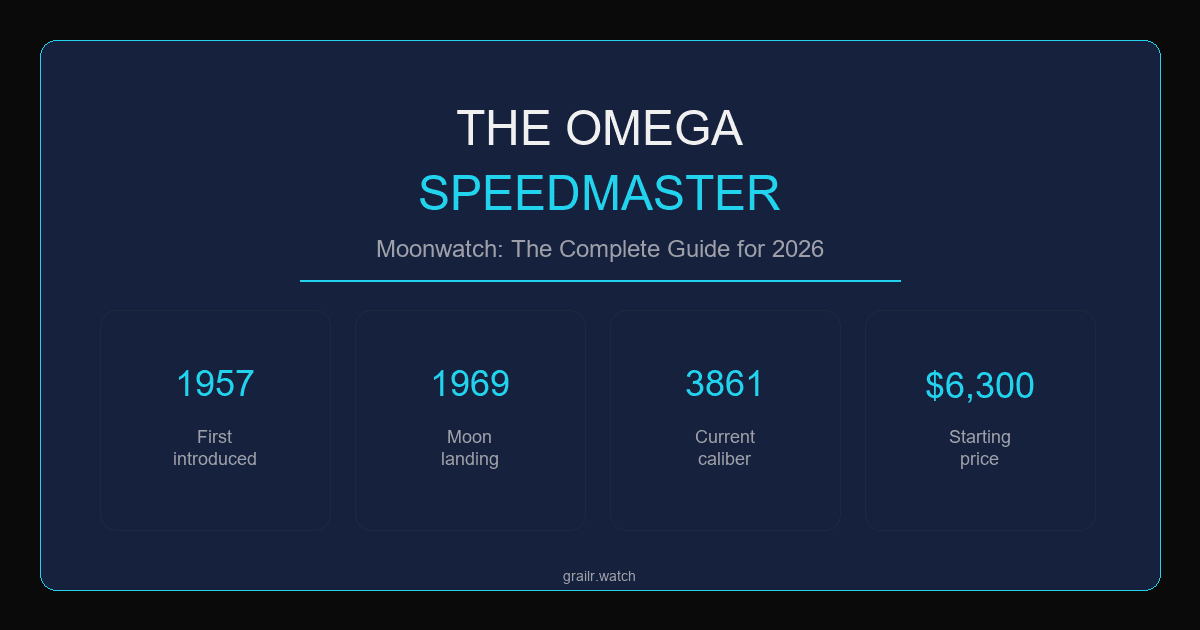
The Omega Speedmaster Professional is one of the most storied watches ever made. First introduced in 1957 as a racing chronograph, it went on to become the only watch qualified by NASA for extravehicular activity — and the first watch worn on the surface of the Moon.
Nearly seven decades later, the Speedmaster remains in continuous production, now powered by the Caliber 3861 — a Co-Axial Master Chronometer movement that brings modern technology to a legendary design. Whether you're buying your first luxury watch or adding a grail piece to your collection, this guide covers everything you need to know about the Moonwatch in 2026.
A Brief History: From Racetrack to Moon
The Speedmaster's journey from motorsport tool to space legend is one of the most remarkable stories in horology. Here's the timeline that matters.
| Year | Milestone |
|---|---|
| 1957 | Speedmaster CK2915 introduced — designed as a racing chronograph with tachymeter bezel |
| 1962 | Walter Schirra wears his personal Speedmaster on Mercury-Atlas 8 — first Omega in space |
| 1965 | NASA tests chronographs from Rolex, Longines, Hamilton, and Omega — only the Speedmaster survives all tests |
| 1969 | Buzz Aldrin wears the Speedmaster on the lunar surface during Apollo 11 — the “Moonwatch” is born |
| 1970 | Apollo 13 crew uses Speedmaster to time 14-second engine burn that brings them safely home |
| 1997 | Caliber 1861 replaces the legendary 861 movement — remains hand-wound as tradition demands |
| 2021 | Major redesign: Caliber 3861 (Co-Axial Master Chronometer) replaces 1861, updated case and bracelet |
| 2022 | MoonSwatch collaboration with Swatch launches — global queues, mainstream hype |
What makes the NASA testing story remarkable: the agency subjected each candidate watch to extreme temperature cycles (0°C to 71°C and −18°C to 93°C), humidity, shock (40g), depressurisation, and vibration. The Rolex stopped. The Longines' crystal popped off. The Omega kept running through everything. That's not marketing — that's engineering.
The Current Lineup: Which Speedmaster Should You Buy?
Omega makes a dizzying number of Speedmaster variants. Here are the ones that matter for most buyers in 2026.
| Model | Key Features | Price |
|---|---|---|
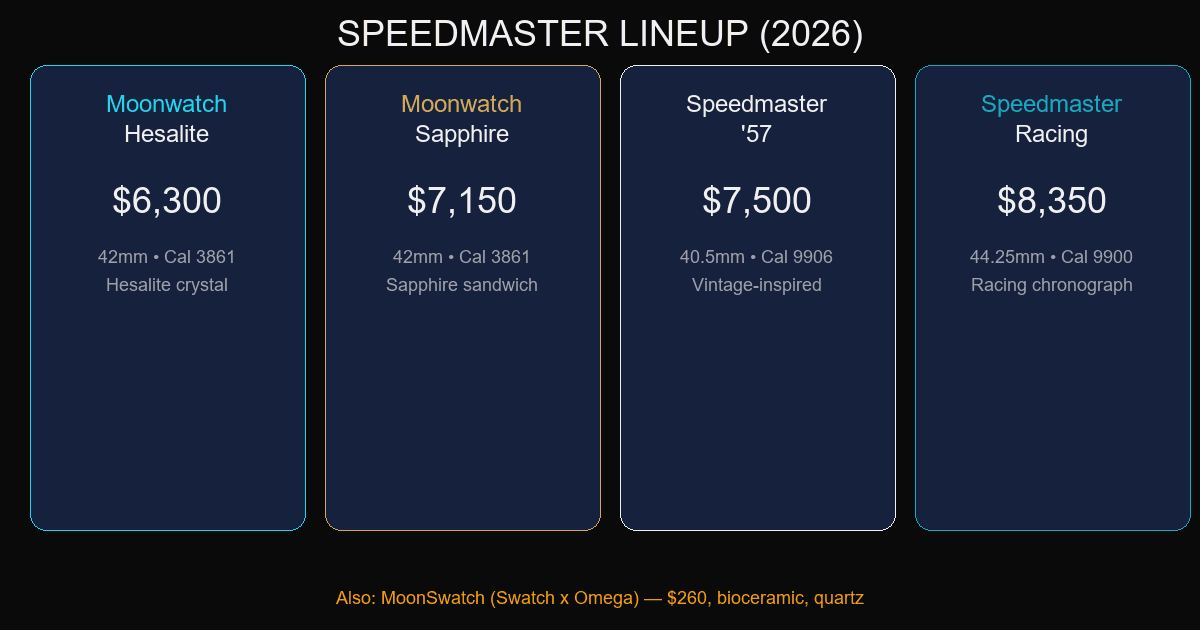
| Moonwatch Hesalite | 42mm, Cal. 3861, hesalite crystal, solid caseback, the “true” Moonwatch | $6,300 |
| Moonwatch Sapphire Sandwich | 42mm, Cal. 3861, sapphire front + caseback, display movement | $7,150 |
| Speedmaster '57 | 40.5mm, vintage-inspired, broad arrow hands, Co-Axial | ~$7,500 |
| Speedmaster Racing | 44.25mm, column-wheel chronograph, racing-dial aesthetic | ~$8,350 |
| 2026 Panda (Steel) | Black-and-white panda-style dial, 42mm, Cal. 3861 | $10,400 |
| 2026 Panda (Gold) | Black-and-white panda dial in Moonshine gold | $49,300 |
| MoonSwatch | Bioceramic case, quartz, Swatch collab, 11 planet variants | $260 |
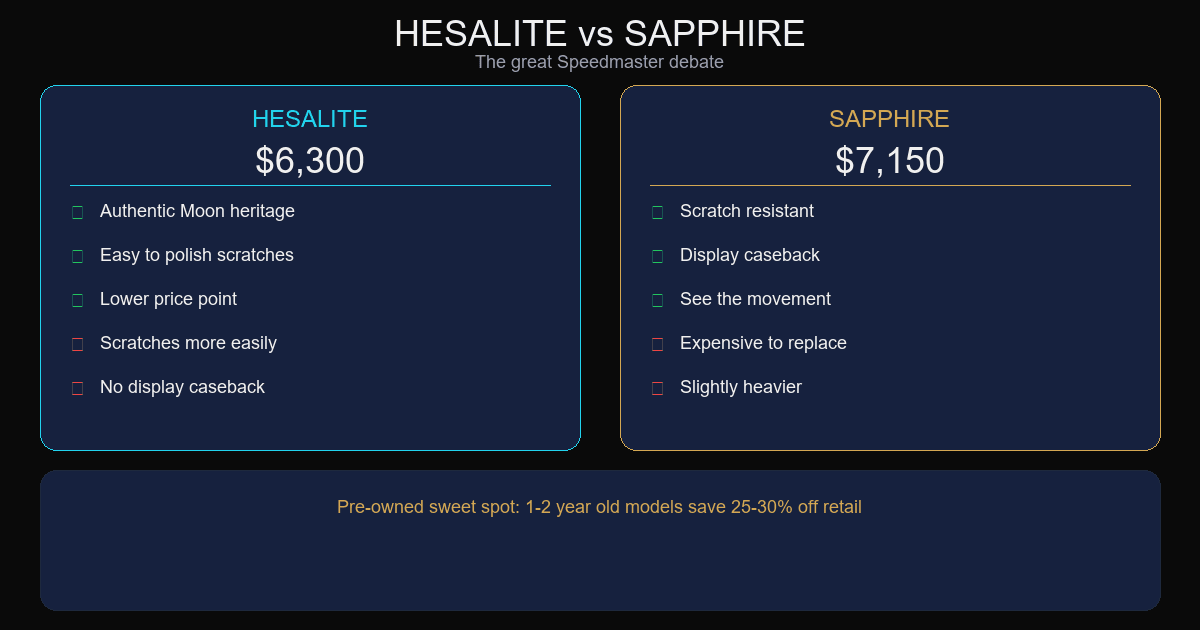
For most buyers, the decision comes down to the $6,300 hesalite Moonwatch or the $7,150 sapphire sandwich. The hesalite is the purist's choice — historically accurate, with a warm, slightly domed crystal that catches light beautifully. The sapphire sandwich lets you see the decorated 3861 movement from both sides.
The Movement: Caliber 3861 Explained
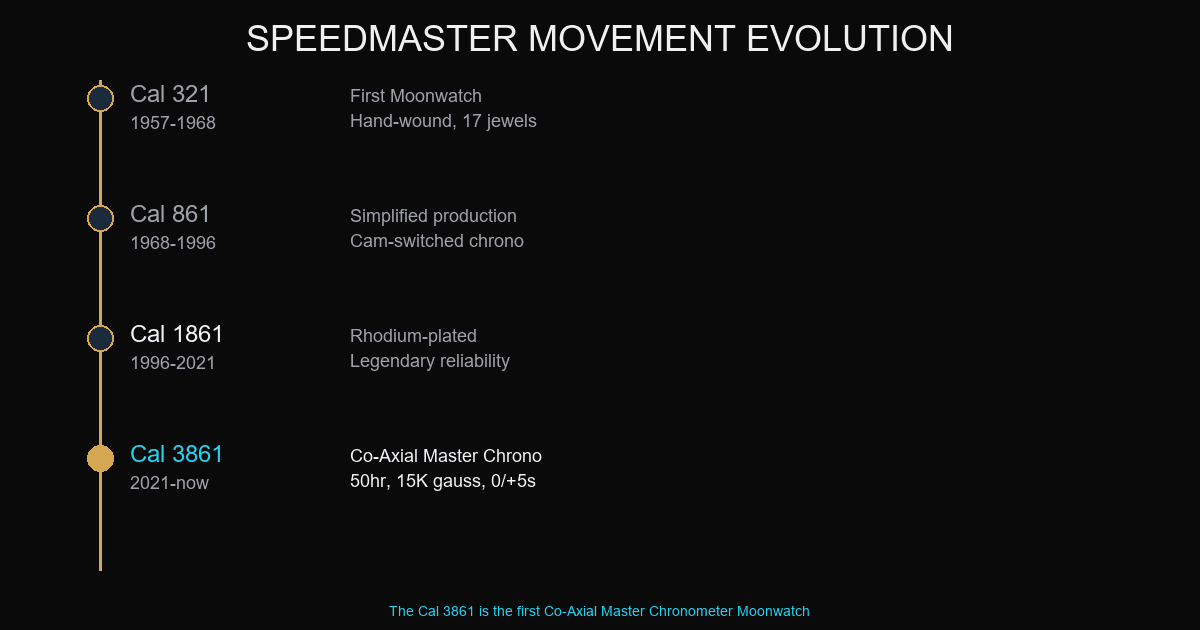
The Caliber 3861, introduced in 2021, represents the biggest mechanical upgrade in the Moonwatch's history. It replaces the hand-wound Caliber 1861 (itself a descendant of the legendary 861 that went to the Moon) with a modern Co-Axial Master Chronometer movement.
| Specification | Caliber 3861 | Caliber 1861 (predecessor) |
|---|---|---|
| Escapement | Co-Axial (reduced friction) | Swiss lever (traditional) |
| Accuracy | 0/+5 sec/day (METAS) | −1/+11 sec/day (COSC) |
| Power reserve | 50 hours | 48 hours |
| Magnetic resistance | 15,000 gauss | ~60 gauss (standard) |
| Frequency | 21,600 vph (3 Hz) | 21,600 vph (3 Hz) |
| Balance spring | Silicon (non-magnetic) | Metallic (susceptible to magnets) |
| Certification | COSC + METAS Master Chronometer | None (hand-wound tradition) |
The 15,000 gauss magnetic resistance is the headline number. In a world where we're surrounded by phones, laptops, tablet covers with magnets, and wireless chargers, this level of shielding means you genuinely never need to think about magnetism affecting your watch's accuracy. The old 1861, by contrast, could be thrown off by a phone case.
The Co-Axial escapement also reduces friction between components, theoretically extending service intervals. Omega recommends servicing every 8 years for Master Chronometer movements, compared to 5–7 years for older calibers. For context on what servicing costs, see our watch service cost guide.
Hesalite vs Sapphire: The Great Debate
This is the single most common question Speedmaster buyers face: do you go with the hesalite crystal (ref. 310.30.42.50.01.001) or the sapphire sandwich (ref. 310.30.42.50.01.002)? Both use the same Caliber 3861 in the same 42mm case. The difference is the crystal — and what it represents.
| Factor | Hesalite (Acrylic) | Sapphire Sandwich |
|---|---|---|
| Price | $6,300 | $7,150 |
| Historical accuracy | Identical to what went to the Moon | Modern interpretation |
| Scratch resistance | Low — scratches easily | Very high — nearly scratch-proof |
| Scratch repair | $10 tube of Polywatch — DIY in minutes | $300–$500 replacement via Omega |
| Movement visibility | Solid caseback (no view) | Sapphire front + caseback (full view) |
| Light behaviour | Warm, slightly domed, vintage character | Flat, crisp, modern clarity |
| Caseback | Engraved seahorse & “Flight-Qualified by NASA” | Display caseback showing decorated 3861 |
The purist argument: The hesalite Speedmaster is the authentic Moonwatch. It's what Buzz Aldrin wore. The slightly domed crystal gives it a vintage warmth that sapphire can't replicate, and the engraved caseback with “Flight-Qualified by NASA for All Manned Space Missions” is a piece of history you carry on your wrist.
The practical argument: The sapphire sandwich costs $850 more but gives you a scratch-proof crystal and a view of one of the best-finished movements in this price range. If you wear your watch daily and don't want to think about micro-scratches, sapphire is the stress-free choice.
Pricing and Value Retention
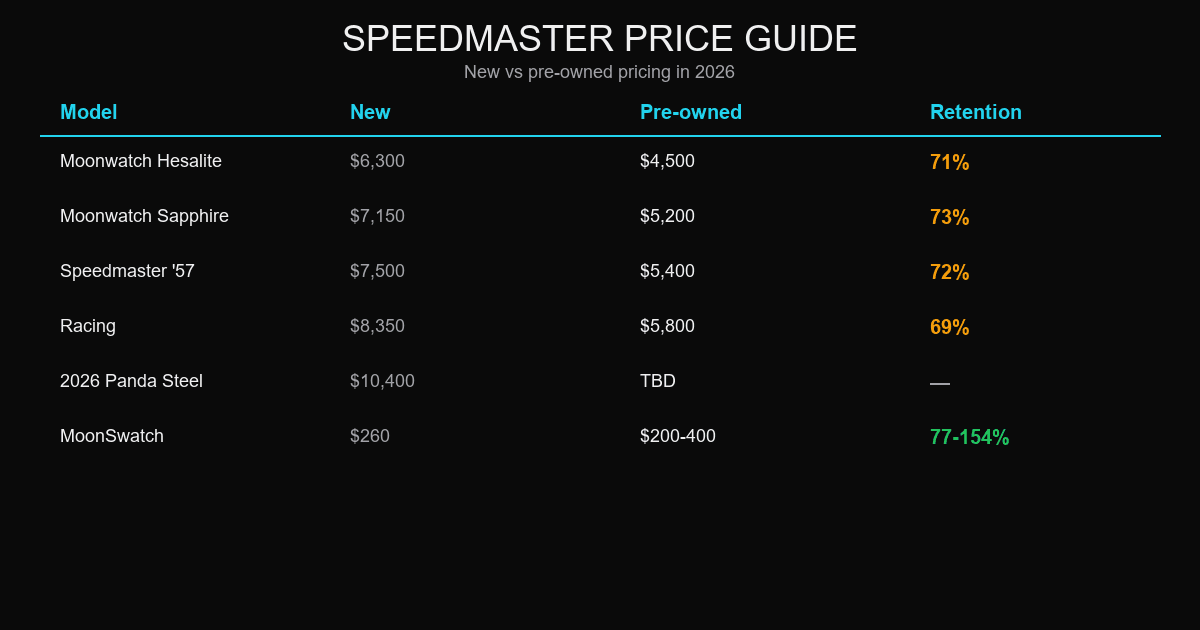
The Speedmaster Professional is one of Omega's strongest performers on the secondary market. Here's how prices look in 2026.
| Model | Retail | Pre-Owned (2026) | Retention |
|---|---|---|---|
| Moonwatch Hesalite (3861) | $6,300 | $4,200–$5,000 | 67–79% |
| Moonwatch Sapphire (3861) | $7,150 | $5,000–$5,800 | 70–81% |
| Speedmaster Racing | ~$8,350 | $5,500–$6,500 | 65–78% |
| Speedmaster '57 | ~$7,500 | $5,000–$5,800 | 67–77% |
| Moonwatch 1861 (discontinued) | N/A (was ~$5,250) | $3,800–$4,500 | Stable |
The illustrative prices in this table imply approximately 67–79% retention for the Hesalite version and 70–81% for the sapphire version. They do not establish that one consistently retains more value. Compare recent sales of the exact reference and condition before drawing a resale conclusion.
For a deeper dive into how Omega compares to Rolex on investment, see our Rolex vs Omega comparison.
The MoonSwatch Effect
In March 2022, Omega and Swatch launched the MoonSwatch — a $260 bioceramic quartz watch styled after the Speedmaster in 11 planet-themed colourways. It caused global queues, resale hysteria, and a massive spike in Speedmaster awareness.
The impact on the “real” Speedmaster has been overwhelmingly positive. Omega reported increased Moonwatch sales following the MoonSwatch launch, as the collaboration introduced millions of new buyers to the Speedmaster design language. Many MoonSwatch owners go on to buy the mechanical Moonwatch within 1–2 years — it's the ultimate gateway drug in watchmaking.
Should you buy a MoonSwatch? At $260, it's a fun, colourful beater watch with genuine Speedmaster DNA. It won't hold value like the mechanical version, and the quartz movement means it's not a “real” chronograph in the horological sense. But as a casual daily wear or a trial run before committing $6,300, it makes perfect sense.
Buying Tips: New vs Pre-Owned
Unlike Rolex, you can walk into any Omega boutique or authorized dealer and buy a Speedmaster the same day. No waitlist, no purchase history games. That said, the pre-owned market offers significant savings for smart buyers.
Buy New From an AD If...
- You want the full 5-year Omega international warranty
- The unboxing experience and full kit matters to you
- You want to negotiate — many ADs offer 5–15% off retail on Omega
Buy Pre-Owned If...
- You want to save 20–35% off retail — sweet spot is 1–2 year old models
- You're comfortable buying from reputable dealers (Chrono24, WatchBox, Bob's Watches)
- You want a discontinued reference (1861 models, limited editions)
Key buying considerations:
- • Hesalite scratches are normal. A $10 tube of Polywatch removes them in minutes. Don't let surface scratches scare you off a pre-owned hesalite model.
- • Sapphire replacement is expensive. If a pre-owned sapphire model has a cracked crystal, budget $300–$500 for Omega repair.
- • The bracelet matters. The 2021+ bracelet (ref. 1298) is significantly improved over older versions. If buying pre-owned, check which bracelet is fitted.
- • Full kit vs watch-only. A complete set (box, papers, cards, warranty) commands a $300–$600 premium over watch-only. Worth it if you plan to resell later.
For first-time buyers on a tighter budget, our first luxury watch under $3,000 guide covers excellent alternatives to consider.
Frequently Asked Questions
Is the Omega Speedmaster a good investment?
The Speedmaster Professional Moonwatch holds 67–79% of its retail value on the secondary market, making it one of the strongest performers in Omega's lineup. Pre-owned 3861 models trade at $4,200–$5,000 against a $6,300 retail. It's not a Rolex-level appreciator, but it's an option to research in the $5,000–$7,000 range.
Should I buy hesalite or sapphire Speedmaster?
Hesalite (acrylic) is the historically authentic choice — it's what went to the Moon. It scratches easily but can be polished with $10 Polywatch. Sapphire sandwich shows the movement, is nearly scratch-proof, but costs $850 more and replacement is expensive. Purists choose hesalite; pragmatists choose sapphire.
What is the difference between Caliber 1861 and 3861?
The 3861 (2021) replaced the 1861 with major upgrades: Co-Axial escapement, Master Chronometer certification with 15,000 gauss magnetic resistance, 50-hour power reserve (up from 48), 0/+5 sec/day accuracy, and a silicon balance spring. The 1861 was a proven workhorse; the 3861 is its modern evolution.
Is the MoonSwatch worth buying?
At $260, the MoonSwatch is a fun gateway to the Speedmaster design language. It uses a quartz movement in bioceramic — it's not a “real” Speedmaster and won't hold value like one. Think of it as a colourful beater or a trial run before committing to the mechanical Moonwatch.
Related Articles
The Bottom Line
The Omega Speedmaster Professional Moonwatch is one of the rare watches that justifies its legend. It's not riding on heritage alone — the 2021 update with Caliber 3861 brought genuinely modern performance (15,000 gauss resistance, Co-Axial escapement, Master Chronometer certification) while respecting the 42mm, hand-wound, three-register chronograph format that went to the Moon in 1969.
At $6,300 retail for the hesalite — or $4,200–$5,000 pre-owned — it's one of the best value propositions in luxury watchmaking. You get a genuine space-rated chronograph, a movement that rivals watches costing twice as much, and a piece of history with resale value that depends on the reference, condition and purchase price.
Whether you buy hesalite or sapphire, new or pre-owned, the Speedmaster Moonwatch belongs in any serious collection. The only question is: do you know what yours is worth today?
Check Any Watch's Value Instantly
Grailr can suggest a model and reference from a clear photo and provide an indicative AI price estimate. Active eBay listings, when available, show asking prices for comparison. Confirm the reference and condition with the seller; a photo scan does not authenticate a watch.
Sources and price context
- OMEGA Moonwatch technical release — The white-dial Moonwatch, 42mm case and calibre 3861.
- OMEGA Moonwatch user manual — Manual winding, calibre identification, care and warranty instructions for the named reference.
The links identify the specific manufacturer information and marketplace guidance used for this guide. Price ranges and resale percentages in this guide are illustrative, not live quotes or guaranteed returns; compare the exact reference, condition and sale date before relying on them.