10 Best Perpetual Calendar Watches in 2026: From $4K to $200K+
The perpetual calendar is watchmaking’s most intellectually satisfying complication — a mechanical brain that tracks every quirk of the Gregorian calendar for the next 74 years without human intervention. This guide covers how the mechanism works, the 10 best perpetual calendar watches you can buy in 2026, real pricing data, and whether they’re worth the investment.
- A perpetual calendar tracks date, day, month, moon phase, and leap year mechanically — no correction needed until March 1, 2100
- Prices range from ~$3,995 (Frederique Constant) to $200,000+ (Patek Philippe Nautilus 5740)
- Best value: JLC Master Ultra Thin Perpetual (~$21,600 retail) and IWC Portugieser Perpetual Calendar (~$31,300)
- Patek Philippe perpetual calendars have the strongest resale, with models like the 5327G holding or exceeding retail value
- Annual calendars (one correction per year) cost 30–50% less and may suit buyers who prioritize simplicity over mechanical ambition
What Is a Perpetual Calendar Watch?
A perpetual calendar is a mechanical complication that automatically distinguishes between months of 28, 29, 30, and 31 days — including the leap year correction every four years — without any manual input from the wearer. Where a standard date watch requires you to advance the date five times a year (at the end of every short month), and an annual calendar requires one correction at the end of February, a perpetual calendar handles everything on its own.
Most perpetual calendar wrist watches display four key indications beyond the time: the date, the day of the week, the month, and the moon phase. Many also include a leap year indicator, which shows the current position in the four-year cycle. The result is a watch face that serves as a complete civil calendar, mechanically programmed to remain accurate until the year 2100.
The complication dates back to the 18th century in pocket watches, but the perpetual calendar wrist watch didn’t arrive until 1925, when Patek Philippe created the first known example. Today, perpetual calendars remain among the most respected complications in watchmaking — a testament to mechanical ingenuity that no smartwatch can replicate in terms of craft.
How a Perpetual Calendar Works
At its core, a perpetual calendar is a mechanical memory. The mechanism uses a system of gears, levers, and cams that “know” how many days are in each month and when February gains an extra day. The key component is a 48-month cam — a precisely shaped wheel that completes one full rotation every four years (48 months). The profile of this cam has varying depths that correspond to months of different lengths: shallow notches for 31-day months, deeper notches for 30-day months, and the deepest notch for February’s 28 or 29 days.
A finger lever rides along the edge of this cam. At midnight on the last day of each month, the lever drops into the cam’s notch. The depth of the drop tells the mechanism whether to advance the date by one, two, or three days to reach the first of the next month. For a 31-day month followed by a 30-day month, the lever advances one extra day. For February in a non-leap year, it skips three days. For February in a leap year, it skips two.
The moon phase display typically uses a disc with 59 teeth, completing one rotation every two lunations (59 days). Since the actual lunar cycle is 29.53 days, this 59-tooth system accumulates an error of only one day every 2.5 years — negligible for practical purposes, though some high-end manufactures use 135-tooth or even 250-tooth moon phase discs for astronomical accuracy.
There is one limitation: the Gregorian calendar omits the leap year in century years not divisible by 400. The year 2000 was a leap year (divisible by 400), but 2100 will not be. Most perpetual calendars cannot account for this rare exception, so they will need a single manual correction on March 1, 2100. A handful of ultra-complicated watches — notably certain Patek Philippe and A. Lange & Söhne grand complications — include a secular perpetual calendar that handles even this edge case, but they remain extraordinarily rare.
The 10 Best Perpetual Calendar Watches in 2026
This list spans from the most affordable mechanical perpetual calendar on the market to the most coveted references from the highest tier of watchmaking. Every price reflects real 2026 retail and secondary market data.
1. Patek Philippe 5327G — $86,530 Retail
The 5327G is the modern face of the Patek perpetual calendar — a 39mm white gold case with a lacquered blue dial, applied Breguet numerals, and officer-style hinged caseback. Inside is the Caliber 324 S Q, an ultra-thin automatic movement with 45-hour power reserve. The dial displays date, day, month, moon phase, and leap year indicator with Patek’s characteristically refined sub-dial layout. The rose gold 5327R offers an identical complication set at the same retail price. Pre-owned examples trade between $85,000 and $95,000 — close to retail, which speaks to the reference’s stability as a store of value. This is the perpetual calendar by which all others are measured.
2. Patek Philippe 5236P — $102,400 Retail
Patek’s most innovative recent perpetual calendar features an in-line date display — day, date, and month arranged horizontally in a single aperture window, reading like a sentence (“Wednesday 8 June”). The 41.3mm platinum case houses the Caliber 31-260 PS QL, an automatic movement developed specifically for this linear display. At $102,400 retail, it’s a collector’s piece that trades at $120,000 or more on the secondary market. The 5236P represents the future of how perpetual calendar complications are displayed.
3. Patek Philippe 5740/1G Nautilus Perpetual Calendar — ~$107,090 Retail
The grail of grails. A perpetual calendar fitted inside the iconic Nautilus case — 40mm in white gold with an integrated bracelet. The ultra-thin Caliber 240 Q powers the complication in a case just 8.42mm thick, making this one of the slimmest perpetual calendar watches ever produced. Retail sits around $107,090, but good luck finding one: secondary market prices regularly exceed $200,000. The 5740 proves that a perpetual calendar doesn’t need a traditional dress watch case to achieve greatness.
4. A. Lange & Söhne Lange 1 Perpetual Calendar — ~$92,000 Retail
Glashutte’s finest perpetual calendar integrates the complication into the asymmetric Lange 1 layout with its signature outsize date. The 41.9mm white gold or pink gold case houses the L021.3, a hand-wound movement with a 50-hour power reserve, visible through a sapphire caseback that reveals Lange’s unmistakable hand-engraved balance cock and three-quarter plate. Moon phase, month, leap year, and day/night indicators share dial space with the retrograde date. Pre-owned examples trade between $80,000 and $90,000 — a genuine opportunity to acquire one of the most beautifully finished perpetual calendars in existence below retail.
5. A. Lange & Söhne Saxonia Perpetual Calendar — ~$82,000 Retail
A more classically proportioned alternative to the Lange 1, the Saxonia Perpetual Calendar features a symmetrical dial layout in a 38.5mm case. The L085.1 SAX-0-MAT automatic movement offers a 46-hour power reserve, and the zero-reset mechanism sets the seconds hand to zero when the crown is pulled — a Lange signature. The month and leap year displays are elegantly integrated around the periphery. For those who prefer traditional dress watch aesthetics with Lange’s peerless finishing, this is the pick.
6. Vacheron Constantin Patrimony Perpetual Calendar — ~$76,000 Retail
Vacheron Constantin’s entry in the perpetual calendar space is characteristically refined. The 41mm white or pink gold Patrimony case houses the Caliber 1120 QP — one of the thinnest perpetual calendar movements ever made at just 4.05mm. Geneva Seal certified, it displays date, day, month, moon phase, and leap year with an openworked moon phase disc that’s hand-finished to Holy Trinity standards. The Patrimony’s ultra-slim profile makes it disappear under a shirt cuff in a way few perpetual calendars can.
7. Blancpain Villeret Quantième Perpétuel — ~$37,400 Retail
Blancpain brings a distinctly classical approach to the perpetual calendar. The 40mm steel or gold Villeret case features a double-stepped bezel and cathedral hands. The in-house Caliber 5954 provides a generous 72-hour power reserve with silicon hairspring. Correctors are built into the case flanks for easy adjustment without a pusher tool. Pre-owned examples can be found between $28,000 and $35,000, making this one of the strongest values in the serious Swiss perpetual calendar category. The Villeret doesn’t chase trends — it simply delivers impeccable classical watchmaking.
8. IWC Portugieser Perpetual Calendar — ~$31,300 Retail
The IWC Portugieser Perpetual Calendar has been the sweet spot of the perpetual calendar market for over two decades. The current reference features a 44.2mm case (steel or gold), the in-house 52615 caliber with a seven-day power reserve and Pellaton winding, and a dial layout that’s become iconic: four sub-dials for day, date, month, and moon phase, with a small seconds at 9 o’clock. IWC’s perpetual calendar system uses digital year programming, which means it requires no pushers to correct — all adjustments are made via the crown. Pre-owned examples trade between $25,000 and $30,000, and the seven-day power reserve means the watch won’t stop over a long weekend if you forget to wind it.
9. Jaeger-LeCoultre Master Ultra Thin Perpetual — ~$21,600 Retail
JLC has been the “watchmaker’s watchmaker” for over a century, and the Master Ultra Thin Perpetual represents extraordinary value. The 39mm steel case (also available in rose gold) houses the Caliber 868, an automatic movement at just 4.72mm thick. The dial is clean and legible despite displaying day, date, month, moon phase, and year. At approximately $21,600, this is the most affordable perpetual calendar from a manufacture that builds movements for Cartier, Hermès, and historically supplied to Patek Philippe and Audemars Piguet. Pre-owned examples between $18,000 and $22,000 make this the connoisseur’s perpetual calendar.
10. Breguet Classique Perpetual Calendar 7327 — ~$52,000 Retail
Breguet invented the perpetual calendar for wristwatches, and the Classique 7327 pays homage to that heritage. The 39mm white gold case features Breguet’s signature engine-turned guilloché dial, Breguet hands, and coin-edge case band. The Caliber 502.3 automatic movement offers a 45-hour power reserve. Date, day, month, moon phase, leap year, and equation of time are all displayed on the guilloché silver dial. Among perpetual calendars, nothing else looks quite like a Breguet — it is watchmaking that traces a direct line to the 18th century.
Perpetual Calendar Comparison Table
| Model | Size | Retail Price | Movement | Complications |
|---|---|---|---|---|
| Patek 5327G | 39mm | $86,530 | Cal. 324 S Q (auto) | PC, moon, leap year |
| Patek 5236P | 41.3mm | $102,400 | Cal. 31-260 PS QL (auto) | In-line PC, moon |
| Patek 5740/1G | 40mm | ~$107,090 | Cal. 240 Q (auto) | PC, moon, leap year |
| Lange 1 PC | 41.9mm | ~$92,000 | L021.3 (manual) | PC, moon, outsize date |
| Saxonia PC | 38.5mm | ~$82,000 | L085.1 (auto) | PC, moon, zero-reset |
| VC Patrimony PC | 41mm | ~$76,000 | Cal. 1120 QP (auto) | PC, moon, ultra-thin |
| Blancpain Villeret QP | 40mm | ~$37,400 | Cal. 5954 (auto) | PC, moon, 72h PR |
| IWC Portugieser PC | 44.2mm | ~$31,300 | Cal. 52615 (auto) | PC, moon, 7-day PR |
| JLC Master UT PC | 39mm | ~$21,600 | Cal. 868 (auto) | PC, moon, ultra-thin |
| Breguet 7327 | 39mm | ~$52,000 | Cal. 502.3 (auto) | PC, moon, EoT |
| FC Slimline PC | 42mm | ~$3,995 | FC-775 (auto) | PC, moon |
Check Any Watch Price in Seconds
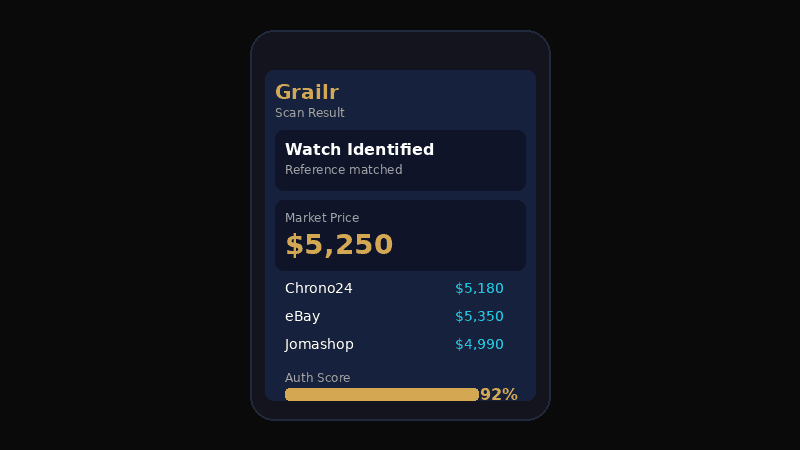
Grailr uses your photo to suggest a watch identification and an indicative price estimate. Active eBay listings, when available, offer asking-price comparisons.
- Grailr suggests brand, model & reference number
- Active eBay asking-price comparisons
- Identification confidence score
Perpetual Calendar vs Annual Calendar
The annual calendar was invented by Patek Philippe in 1996 (Ref. 5035) as a simpler, more affordable alternative to the perpetual calendar. Where a perpetual calendar tracks the full four-year leap cycle and needs no correction until 2100, an annual calendar distinguishes between 30- and 31-day months but does not know about February’s variable length. The result: one manual correction per year, on March 1.
In practical terms, the annual calendar is significantly less complex. A perpetual calendar module typically adds 100–150 components to a base movement; an annual calendar adds 30–50. This translates directly to pricing: a Patek Philippe annual calendar (like the 5205R at ~$44,000) costs roughly 50% of a comparable Patek perpetual calendar. The same ratio holds across most brands — IWC’s Portugieser Annual Calendar sits around $17,000 versus $31,300 for the perpetual.
Which should you choose? If you wear your watch daily, the annual calendar’s single yearly correction is barely an inconvenience, and the savings are meaningful. But if you value mechanical ambition and the idea of a watch that truly thinks for itself, the perpetual calendar is the more impressive achievement. For collectors, the perpetual calendar also tends to hold value better because it represents a higher tier of horological accomplishment.
Most Affordable Perpetual Calendar Watches
The perpetual calendar was once exclusively the domain of six-figure haute horlogerie. That changed in 2016 when Frederique Constant introduced the Slimline Perpetual Calendar at under $4,000, proving that the complication could be democratized without sacrificing mechanical integrity.
Frederique Constant Slimline Perpetual Calendar — ~$3,995 Retail
The FC Slimline Perpetual Calendar is, by a wide margin, the most affordable mechanical perpetual calendar watch on the market. The 42mm steel case houses the in-house FC-775 caliber with a 42-hour power reserve. It displays date, day, month, and moon phase in a classical sub-dial layout. Build quality is solid for the price, and the movement, while not hand-finished to the standards of Swiss haute horlogerie, is reliable and well-engineered. Pre-owned examples trade between $2,500 and $3,500, making this an extraordinary entry point into the world of perpetual calendars. No other brand comes close at this price point.
Jaeger-LeCoultre Master Ultra Thin Perpetual — ~$21,600 Retail
If your budget stretches to ~$20,000, the JLC Master Ultra Thin Perpetual is the best value in serious Swiss perpetual calendars. You get a movement from the company that has produced over 1,300 calibers and historically supplied movements to the highest echelon of Swiss watchmaking. The 39mm case is slim enough for genuine daily wear, and pre-owned prices of $18,000–$22,000 make it accessible relative to its quality tier.
IWC Portugieser Perpetual Calendar — ~$31,300 Retail
At the upper end of “affordable” perpetual calendars, IWC’s Portugieser delivers a seven-day power reserve, Pellaton winding, and one of the most legible perpetual calendar dials in the industry. Pre-owned steel examples between $25,000 and $30,000 represent strong value, especially given IWC’s brand recognition and the model’s well-established secondary market. The new IWC Ingenieur Perpetual Calendar (~$36,000) offers a sportier alternative with similar value positioning.
Investment Value & Resale Data
Perpetual calendar watches occupy an interesting position in the watch investment landscape. Because the complication requires genuine mechanical expertise to design and build, it commands inherent respect from collectors — which translates to more stable resale values compared to simpler time-only or chronograph watches.
Patek Philippe perpetual calendars are the strongest performers. The 5327G holds close to its $86,530 retail, trading between $85,000 and $95,000 pre-owned. The 5740/1G Nautilus, with its sports-watch cachet, regularly exceeds $200,000 — nearly double its ~$107,000 retail. Historically, the now-discontinued 3940 (one of the most beloved Patek perpetual calendars ever made) has appreciated from a $25,000 retail price in the 1990s to $60,000–$80,000+ today, depending on dial variant and condition.
A. Lange & Söhne perpetual calendars are currently undervalued relative to their quality. The Lange 1 Perpetual Calendar, which retails at ~$92,000, can be found pre-owned for $80,000–$90,000 — a modest discount for one of the most superbly finished watches in the world. Collectors who buy now may benefit as Lange continues to gain market recognition, particularly in Asia.
Mid-tier perpetual calendars from IWC, JLC, and Blancpain tend to depreciate 15–30% from retail but stabilize after the initial drop. The IWC Portugieser Perpetual Calendar holds 80–85% of retail value long-term. JLC’s Master Ultra Thin Perpetual holds similarly well, buoyed by the brand’s strong reputation among informed collectors.
The key investment insight: perpetual calendars from top-tier manufactures are among the safest categories to buy pre-owned. The complication’s complexity creates a floor on value — the cost to service, regulate, and restore a perpetual calendar movement means these watches rarely drop below a certain threshold on the secondary market. If you can acquire a Patek, Lange, or Vacheron perpetual calendar at or below retail, history suggests you’re making a sound decision. Use Grailr’s appraisal tool to check current market pricing before any purchase.
Frequently Asked Questions
What is a perpetual calendar watch?
A perpetual calendar watch is a mechanical timepiece that automatically tracks date, day, month, moon phase, and leap year without requiring manual correction for months of different lengths. It accounts for 28-, 29-, 30-, and 31-day months. The next required correction is March 1, 2100.
What is the cheapest perpetual calendar watch?
The Frederique Constant Slimline Perpetual Calendar at approximately $3,995 retail is the most affordable mechanical perpetual calendar. Pre-owned examples trade between $2,500 and $3,500. No other brand offers a genuine mechanical perpetual calendar at this price point.
How often does a perpetual calendar need correction?
A perpetual calendar only needs manual correction at century years not divisible by 400. The next correction date is March 1, 2100, when the Gregorian calendar skips a leap year. Until then, the watch runs autonomously.
What is the difference between a perpetual calendar and an annual calendar?
An annual calendar requires one manual correction per year at the end of February. It distinguishes 30- and 31-day months but does not track leap years. A perpetual calendar handles everything automatically until 2100. Annual calendars are simpler, with 30–50 additional components versus 100–150 for a perpetual calendar, and cost 30–50% less.
Are perpetual calendar watches a good investment?
Perpetual calendars from top manufacturers tend to hold value well. Patek Philippe models like the 5327G trade at or above retail. IWC and JLC perpetual calendars hold 70–85% of retail long-term. The complication’s mechanical complexity creates an inherent value floor that simpler watches lack.
What is the best perpetual calendar watch to buy in 2026?
It depends on budget. Under $5,000: Frederique Constant Slimline PC. Under $25,000: JLC Master Ultra Thin Perpetual. Under $40,000: IWC Portugieser PC or Blancpain Villeret QP. Over $80,000: Patek Philippe 5327G or A. Lange & Söhne Lange 1 Perpetual Calendar.
Related Articles
The Bottom Line
The perpetual calendar is one of the few watch complications that genuinely earns its premium. It represents a mechanical solution to a mathematical problem — encoding 48 months of varying lengths, plus the leap year cycle, into a system of gears and levers that runs for decades without human intervention. Whether you start at $3,995 with a Frederique Constant or reach for the $107,000 Patek Philippe Nautilus 5740, you’re buying a piece of engineering that no quartz watch or smartwatch can replicate in terms of craft and longevity. The best perpetual calendar watches don’t just tell you the date — they demonstrate what mechanical watchmaking is capable of at its highest level.
Considering a Perpetual Calendar Watch?
Grailr can suggest a model and reference from a clear photo and provide an indicative price estimate. Active eBay listings, when available, show asking prices for comparison. Confirm the reference and condition with the seller; a photo scan does not authenticate a watch.
Scan a Watch NowSources and price context
- Patek Philippe Grand Complications — Perpetual-calendar operation, leap-year handling and collection examples.
- Vacheron Constantin collections — Official collection names and links to current reference specifications.
The links identify the specific manufacturer information and marketplace guidance used for this guide. Price ranges and resale percentages in this guide are illustrative, not live quotes or guaranteed returns; compare the exact reference, condition and sale date before relying on them.