Piaget Watches: Every Collection and Price
From the 2mm Altiplano Ultimate Concept to the steel Polo — every Piaget collection compared with in-house movement specs, 2026 pricing and honest resale expectations.
Price context: this guide includes indicative prices from its original publication period. They have not all been refreshed to current quotes. Use the linked primary sources for specifications and policies, and verify prices independently.

- Piaget has manufactured its own movements since 1957 and holds multiple ultra-thin records
- The Altiplano Ultimate Concept at 2mm is the thinnest mechanical watch ever produced in series
- Entry pricing starts around $15,000 for the steel Polo Date on rubber strap
- Resale retention sits between 40–60%, below Rolex and Patek but ahead of fashion brands
A Brief History of Piaget
Georges Edouard Piaget founded his workshop in La Côte-aux-Fées in 1874, initially supplying movements to other Swiss houses. The family kept the business for four generations before joining the Richemont group in 1988, alongside Cartier, Vacheron Constantin and A. Lange & Söhne.
The turning point came in 1957 when Piaget launched the Caliber 9P — a hand-wound movement just 2mm thick. That single caliber set the direction the brand has followed ever since: thinner, always thinner. By 1960 the automatic Caliber 12P arrived at 2.3mm, and the records kept falling through the decades.
Today Piaget operates two manufactures. Movements are still made in La Côte-aux-Fées, while cases, bracelets, gem-setting and final assembly happen at Plan-les-Ouates near Geneva. That vertical integration — designing and producing both the movement and the case under one roof — is what allows the brand to push thickness boundaries that would be impossible if the movement and case were developed separately.
The Altiplano Collection
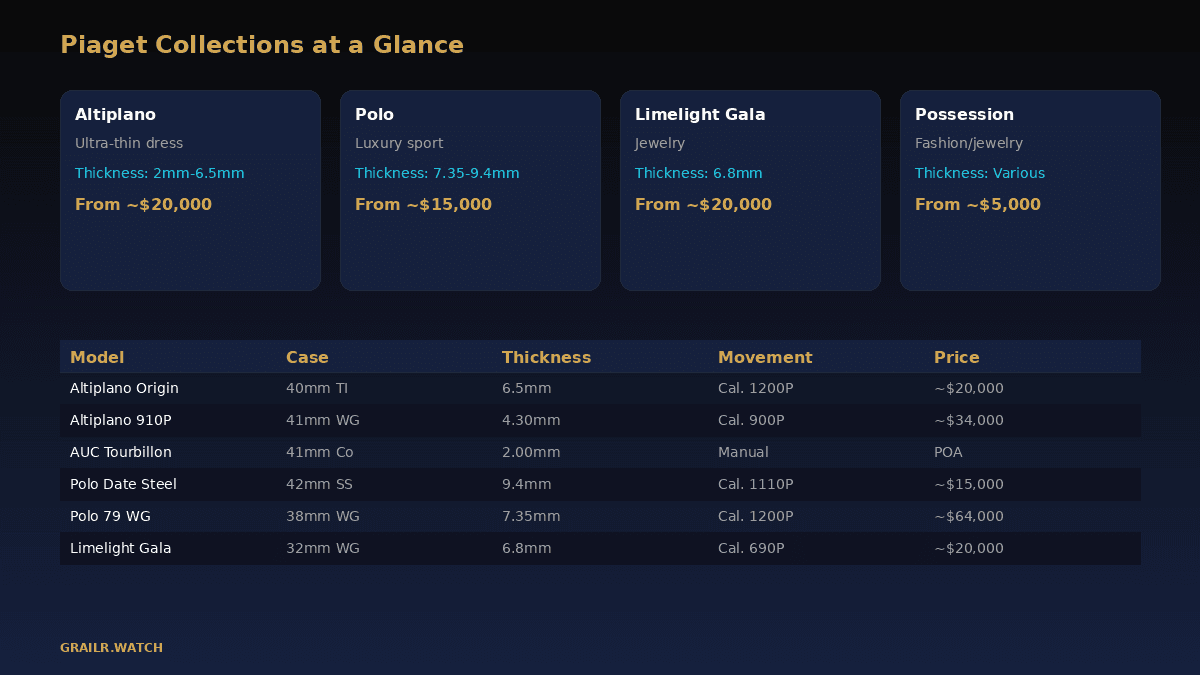
The Altiplano is the heart of Piaget’s identity. Named after a high plateau in the Andes, the collection is defined by one principle: the thinnest possible case holding the thinnest possible movement. If you’re drawn to Piaget for its watchmaking rather than its jewellery, this is where you start.
Altiplano Origin ($20,000–$30,000)
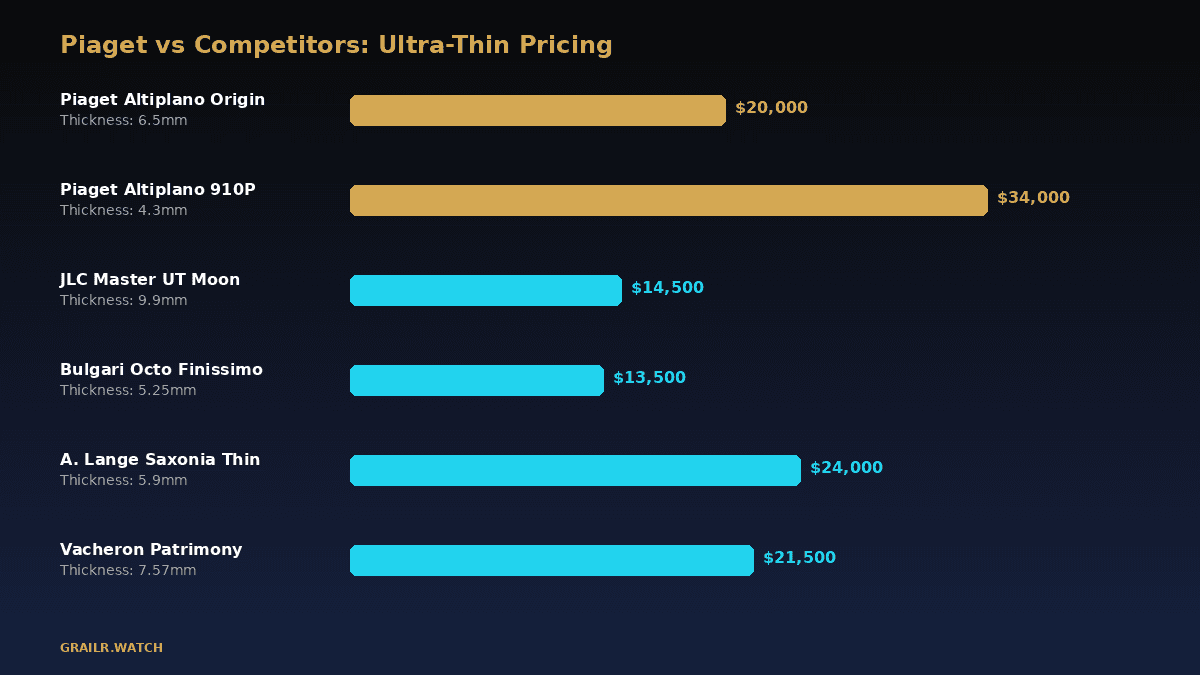
The Origin is the collection’s entry point. Available in 40mm with a hand-wound movement, it offers the classic Altiplano silhouette — a thin bezel, a clean dial with stick indices and a case profile under 7mm — in white gold or rose gold. The hand-wound Caliber 430P measures 2.1mm and delivers approximately 43 hours of power reserve. It’s a purist’s dress watch that disappears under a shirt cuff. For context on how Piaget fits the broader ultra-thin landscape, see our ultra-thin watches guide.
Altiplano 910P ($34,000–$46,300)
The 910P pushes the Altiplano further. At 4.30mm total thickness, the Caliber 910P is an automatic movement where the case itself forms part of the movement architecture. The mainplate is built into the caseback, shaving millimetres that a traditional construction would waste. It runs at 21,600 vph with a 50-hour power reserve. In 2026, a limited Piaget x Wristcheck edition in the 910P format was priced at $46,300 for 30 pieces worldwide.
Altiplano Ultimate Concept (Price on Request)
At 2mm total thickness, the Ultimate Concept is the thinnest mechanical watch ever produced in series. The cobalt alloy case is the mainplate — there is no separate movement container. The barrel, gear train and balance are built directly into the case structure. The 2026 edition added a tourbillon with tiger’s eye hardstone decoration, and even that complication keeps the 2mm profile. Pricing is strictly on request, but comparable haute horlogerie tourbillons from Piaget have been reported north of $700,000.
The Ultimate Concept is not a daily wearer. Its cobalt alloy case is harder than steel but the extreme thinness demands careful handling. It exists to demonstrate what is mechanically possible — and to anchor Piaget’s reputation as the ultra-thin house.
The Polo Collection
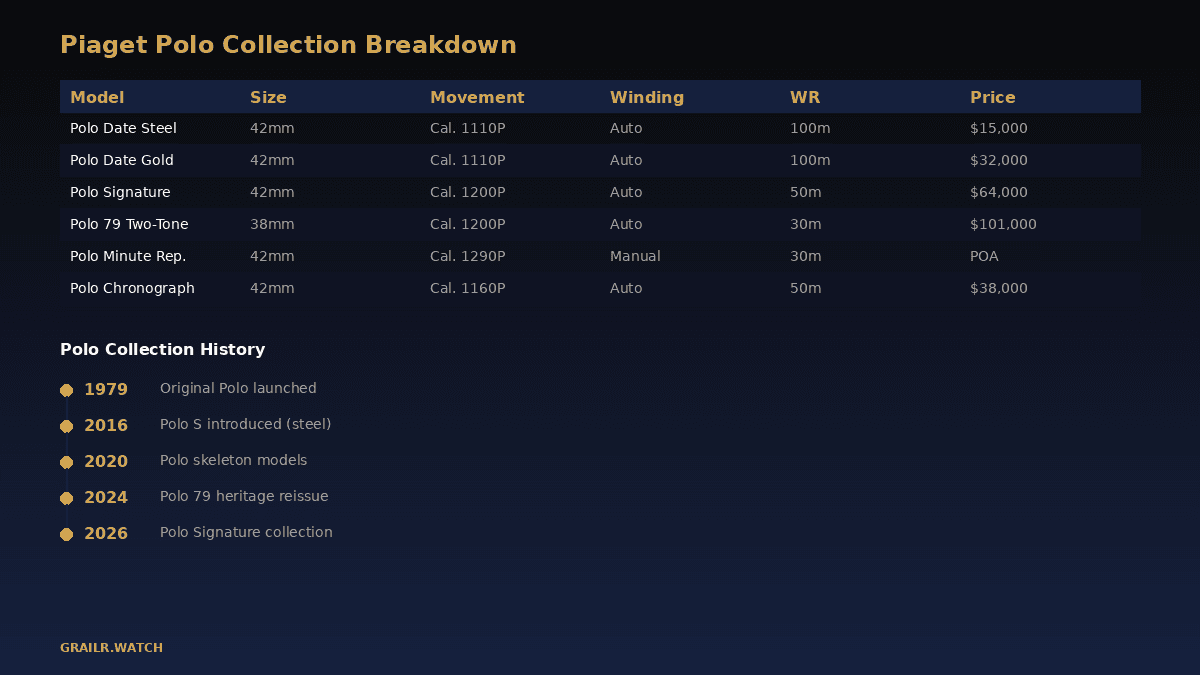
If the Altiplano is Piaget for purists, the Polo is Piaget for people who actually wear their watches to dinner. Launched in 1979 with a distinctive cushion-shaped case integrated into the bracelet, the Polo is Piaget’s answer to the Royal Oak and Nautilus — a luxury sports watch designed to be worn rather than admired through a vitrine.
Polo Date in Steel (from ~$15,000)
The most accessible Piaget you can buy new. The 42mm steel Polo Date on rubber strap starts around €13,800 (approximately $15,000). It runs the in-house Caliber 1110P, an automatic with a date complication and roughly 50 hours of power reserve. The integrated bracelet version costs more, and gold configurations push the price toward $25,000–$40,000.
Polo Signature and Polo 79 ($64,000–$101,000+)
The Polo Signature Date (ref. G0A51036) in precious metal is listed at $64,000. The Polo 79, a heritage reissue that revives the 1979 original’s cushion shape, reaches approximately $101,000 in white gold with a sodalite dial. These are statement pieces — closer in positioning to an AP Royal Oak in precious metal than to the steel Polo Date.
Polo Minute Repeater (Price on Request)
The flagship complication in the Polo case. Piaget’s minute repeater uses cathedral gongs for a richer tone and is finished to haute horlogerie standards. Pricing is upon request, but comparable minute repeaters from Richemont brands typically start above $250,000.
Limelight and Possession
Piaget’s jewellery watch collections cater to a different audience entirely. The Limelight Gala features asymmetric cases set with diamonds, starting around $20,000 in white gold and climbing past $200,000 for full pavé diamond models. These are wearable jewellery first, timepieces second.
The Possession collection is more playful — a rotating bezel inspired by Piaget’s Possession ring. Prices start lower than the Limelight, typically around $10,000–$20,000, making it the most accessible Piaget jewellery watch. Both collections use quartz movements, which keeps cases thin and prices (relatively) contained. For a broader comparison of jewellery watches for women, see our Cartier watches for women guide.
| Collection | Target | Movement | Starting Price |
|---|---|---|---|
| Altiplano Origin | Ultra-thin dress | Hand-wound 430P | ~$20,000 |
| Altiplano 910P | Ultra-thin automatic | Automatic 910P | ~$34,000 |
| Altiplano Ultimate Concept | Record-breaking thin | Manual (case = mainplate) | POA |
| Polo Date (steel) | Luxury sport | Automatic 1110P | ~$15,000 |
| Polo Signature / 79 | Luxury sport (precious) | Automatic (various) | ~$64,000 |
| Limelight Gala | Jewellery watch | Quartz | ~$20,000 |
| Possession | Jewellery / fashion | Quartz | ~$10,000 |
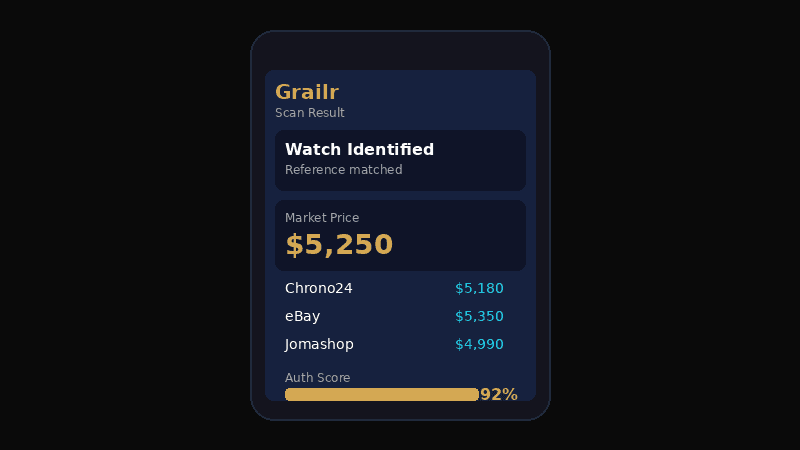
Check Any Watch Price in Seconds
Grailr scans your watch photo and pulls live pricing from Chrono24, eBay, and Jomashop.
- AI identifies brand, model & reference number
- Live market prices from 3+ sources
- Authentication confidence score
In-House Movements: What Powers Each Collection
Piaget is one of the few houses that designs and manufactures both its movements and its cases. That matters because ultra-thin watchmaking requires the movement and case to be engineered together — you cannot simply drop a thinner movement into a standard case and call it done. Here are the key calibers.
| Caliber | Type | Thickness | Power Reserve | Used In |
|---|---|---|---|---|
| 430P | Hand-wound | 2.1mm | ~43 hours | Altiplano Origin |
| 1200P | Automatic | 2.35mm | ~44 hours | Altiplano Automatic |
| 900P | Hand-wound | 3.65mm | ~48 hours | Altiplano 900P |
| 910P | Automatic | 4.30mm (total) | ~50 hours | Altiplano 910P |
| 1110P | Automatic + date | ~3.5mm | ~50 hours | Polo Date |
| Ultimate Concept | Hand-wound | 2.0mm (total) | ~44 hours | Altiplano UC |
The Caliber 1200P at 2.35mm is the world’s thinnest automatic movement — a record Piaget has held since 2010. It uses a peripheral 22k gold rotor that orbits the movement’s edge rather than sitting on top, which is how it stays so flat. For a deeper look at how these calibers compare to competitors like Bulgari and Piaget’s own ultra-thin heritage, the brand’s website offers a useful timeline.
Pricing Across Collections: What to Expect in 2026
Piaget pricing spans a wide range. The steel Polo Date is positioned to compete with watches like the Cartier Santos or Omega Aqua Terra, while the Altiplano in precious metal enters territory shared with A. Lange & Söhne and Vacheron Constantin. Here is a practical pricing map.
Under $20,000
Polo Date (steel/rubber)
The only current-production Piaget in this range. Steel case, in-house automatic, integrated design. Starting around $15,000.
$20,000–$35,000
Altiplano Origin / Limelight Gala
Entry-level precious-metal Altiplano and the starting range for diamond-set Limelight Gala.
$35,000–$70,000
Altiplano 910P / Polo Signature
The technical Altiplano models and precious-metal Polo pieces. This is Piaget’s core range for serious collectors.
$70,000+
Polo 79 / Ultimate Concept / Minute Repeater
Heritage reissues, haute horlogerie complications and full pavé jewellery watches. Most are priced on request.
Resale Value and the Pre-Owned Market
Piaget’s secondary market is smaller and less liquid than Rolex or Patek Philippe. Most models retain 40 to 60 percent of their retail price on the pre-owned market, with precious-metal Altiplano models and limited editions holding value best. The steel Polo, being newer to the market, has less resale history but early signs suggest depreciation similar to other luxury sports watches outside the “big three” of Royal Oak, Nautilus and Overseas.
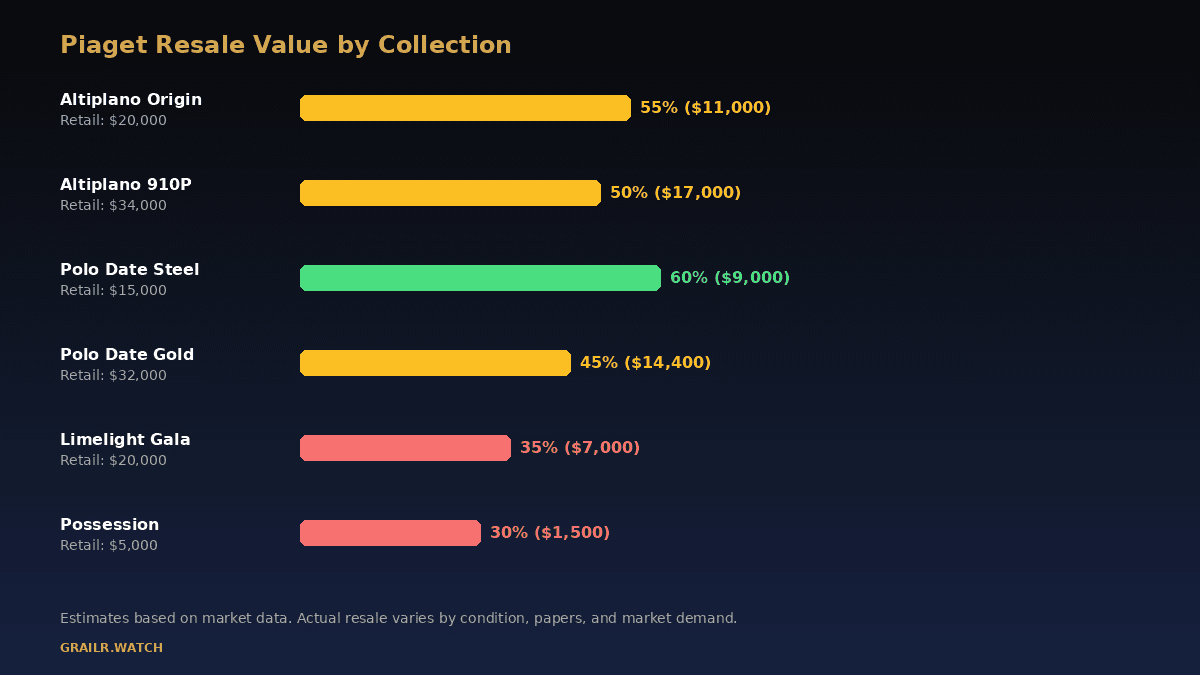
Pre-owned Piaget offers genuine value. A white gold Altiplano from circa 2010 can be found for approximately €11,800 — roughly 55% of its original retail price — and these older references often feature the same hand-wound movements still in production today. The Polo Date in steel is beginning to appear on the secondary market at 15–25% below retail.
If you’re buying pre-owned, verify the watch independently. Piaget’s ultra-thin cases are more vulnerable to damage from drops or poor servicing than a typical sports watch, so condition matters more than usual. Use Grailr’s scanner for an indicative identification and price estimate, then confirm the reference and condition with the seller’s documentation. For a broader look at where to shop, Monochrome Watches regularly covers pre-owned haute horlogerie.
Who Should Buy a Piaget?
Piaget occupies a specific niche. It is not trying to be a tool watch brand, and it does not compete on value retention. What it offers is technical mastery in ultra-thin watchmaking combined with jewellery-grade finishing that few houses can match. The typical Piaget buyer values craftsmanship and elegance over resale spreadsheets.
If your priority is a dress watch that demonstrates serious horological knowledge without the obviousness of a Rolex or the austerity of a Lange, the Altiplano Origin is hard to beat. If you want a luxury sports watch that stands apart from the Nautilus and Royal Oak crowd, the steel Polo Date delivers genuine in-house quality at a lower entry price than its Richemont stablemates.
And if you simply love watches and want to own a piece of a record — the thinnest automatic movement, the thinnest complete watch — there is only one house that holds those titles.
Frequently Asked Questions
What is the cheapest Piaget watch you can buy new?
The most accessible new Piaget is the Polo Date in stainless steel on a rubber strap, starting around $15,000. Gold Altiplano Origin models begin near $20,000.
Why are Piaget watches so thin?
Piaget has specialised in ultra-thin movements since 1957. The Caliber 9P was just 2mm thick, and the brand has broken its own records ever since. The Altiplano Ultimate Concept uses the caseback as the mainplate, achieving a total thickness of just 2mm for the entire watch.
Do Piaget watches hold their value?
Piaget watches typically retain 40 to 60 percent of retail value on the secondary market. That is lower than Rolex or Patek Philippe but better than most fashion brands. Limited editions and precious-metal Altiplano models tend to hold value best.
Is Piaget considered a luxury watch brand?
Yes. Piaget is part of the Richemont group alongside Cartier, Vacheron Constantin and A. Lange and Sohne. The brand manufactures its own movements and cases in La Cote-aux-Fees and Plan-les-Ouates, Switzerland, and prices start above $15,000.
What is the thinnest Piaget watch?
The Altiplano Ultimate Concept at 2mm total thickness is the thinnest Piaget and was the thinnest mechanical watch in the world when launched. Its cobalt alloy case doubles as the movement mainplate.
Where are Piaget watches made?
Piaget movements are made in La Cote-aux-Fees in the Jura mountains, while cases, bracelets and final assembly happen at the Plan-les-Ouates manufacture near Geneva. Both facilities are owned and operated by Piaget.
Related Articles
The Bottom Line
Piaget is not the obvious choice for a first luxury watch — and that is precisely the point. It rewards buyers who value mechanical artistry, ultra-thin engineering and jewellery-grade finishing over brand recognition and resale charts. The Polo Date in steel is a genuine alternative to the usual suspects at $15,000, and the Altiplano offers something no other brand can: a dress watch thinner than the competition’s movement alone. If those qualities speak to you, Piaget is worth every franc.
Considering a Piaget?
Grailr uses a photo to suggest a watch identity and an indicative price estimate, with active eBay listings where available. Check the exact reference and condition independently; a photo scan cannot authenticate a watch.
Scan a Watch NowSources and price context
- Piaget ultra-thin watches timeline — Brand overview of the ultra-thin heritage from the 1957 Caliber 9P to the Altiplano Ultimate Concept.
- Monochrome Watches: Piaget Altiplano Ultimate Concept review — Independent editorial review of Piaget’s record-breaking 2mm watch with pricing context.
These primary sources support the specific history, specification or policy points noted above. Prices and resale percentages elsewhere in this guide are indicative editorial figures, not a verified transaction dataset or guaranteed returns. Confirm the exact reference, region, condition and current quote before buying; asking prices are not completed-sale prices.