The Best Shock-Resistant Watches at Every Price
From a $70 Casio square to a $2,600 oil-filled Sinn — every tier of shock resistance compared with real specs, materials and the ISO standard behind the label.
Price context: this guide includes indicative prices from its original publication period. They have not all been refreshed to current quotes. Use the linked primary sources for specifications and policies, and verify prices independently.

- ISO 1413 is the international standard — a watch must survive a pendulum impact equal to a 1–metre drop and keep running within its accuracy spec
- Casio G-Shock dominates the category from $70 to $600, with resin hollow-core cases that absorb energy before it reaches the module
- Sinn, Ball and Marathon prove that mechanical movements can be shock resistant too, using reinforced jewel settings and case engineering
- Victorinox tested the INOX against 130 individual stress scenarios including an 8–metre drop and a 64–ton tank driving over it
- Material choice matters: resin absorbs impact through deformation, titanium is lightweight and strong, and tegimented steel resists both shock and scratches
What Makes a Watch Shock Resistant
Every watch faces the same threat: a sudden deceleration that transfers energy through the case into the movement, bending a balance staff, cracking a jewel or shifting a rotor out of alignment. The question is how much force the watch can absorb before something breaks. ISO 1413:2016 answers that with a standardised test: a pendulum machine strikes the watch from a height that simulates a free fall onto a hardwood surface from one metre. The strike hits both the case side and the crystal face. If the watch keeps running within its rated accuracy tolerance afterward, it passes.
That one-metre threshold sounds modest, but it represents the most common real-world impact scenario — a watch sliding off a bathroom counter, bouncing off a doorframe, or taking a direct knock during manual work. Most conventional dress watches and many fashion watches would fail this test because their movements sit in rigid contact with the case, so any force transfers directly to the most fragile components: the balance wheel pivot, the hairspring and the escape wheel teeth.
Watch manufacturers use three principal engineering strategies to pass ISO 1413 and exceed it. The first is isolation: mounting the movement on shock absorbers or a floating module so that the case can deform or flex without transmitting energy directly to the calibre. This is Casio’s approach with G-Shock, and it works so well that the platform has survived drops from construction sites, falls from aircraft, and — in a widely documented test — being strapped to a hockey puck. The second strategy is reinforcement: making the movement itself tougher through thicker balance staffs, reinforced jewel settings like Incabloc or KIF, and heavier rotors that resist displacement. This is the approach used by Swiss and German mechanical watchmakers such as Sinn, Ball and Marathon. The third strategy is absorption: filling the entire case cavity with a medium that distributes force evenly, which is what Sinn does with its hydro-filled UX line where silicone oil surrounds the dial and movement.
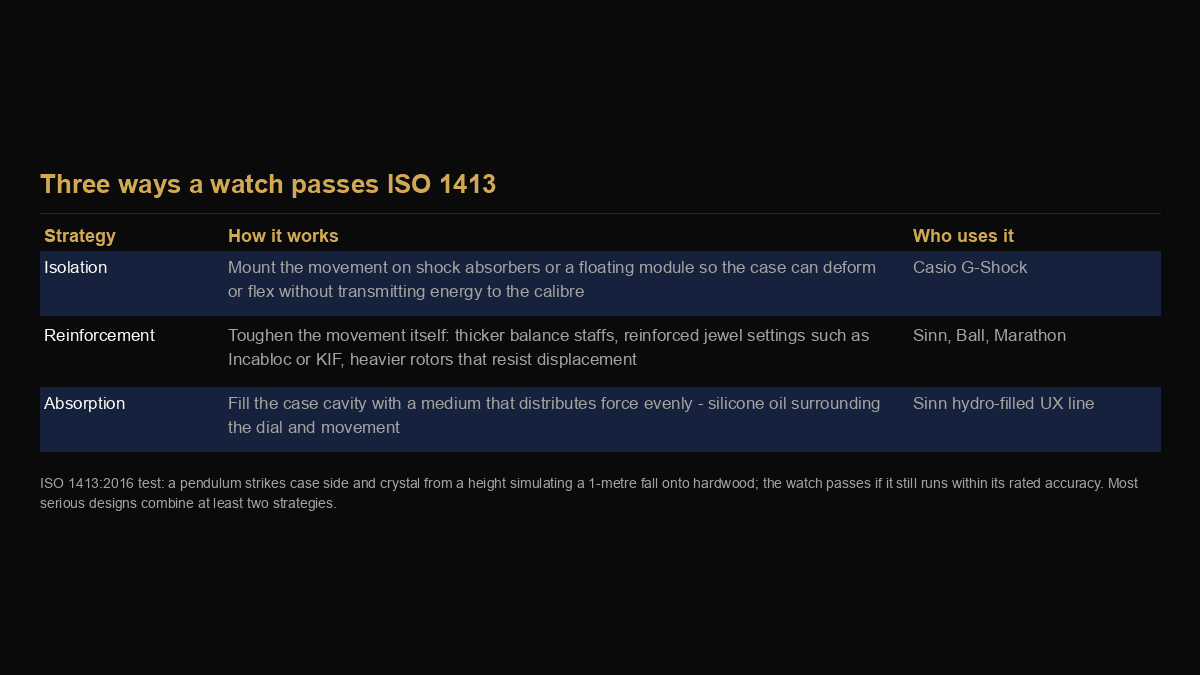
In practice, most serious shock-resistant watches combine at least two of these strategies. A G-Shock uses isolation plus absorption through its resin case. A Sinn 856 UTC uses reinforcement plus tegimented steel that hardens the case surface. Understanding which approach a watch uses helps you match it to your actual environment, because a resin G-Shock handles blunt impacts better than a steel watch, while a hardened steel Sinn handles abrasion and edge impacts that would gouge a resin case.
Shock Resistance Tiers: Budget to Professional
Not all shock-resistant watches protect against the same forces. A $70 Casio square and a $2,500 Ball Engineer Hydrocarbon both carry the “shock resistant” label, but their engineering, materials and intended environments are very different. The table below breaks the market into four practical tiers based on construction approach, tested performance and price range.
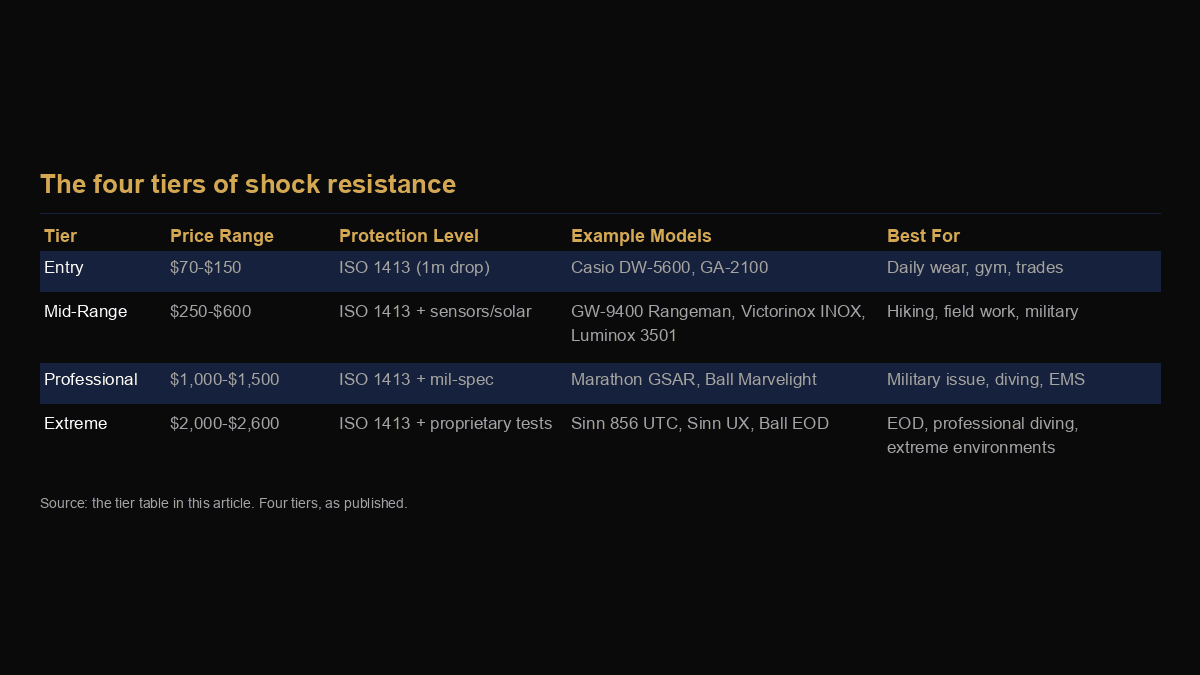
| Tier | Price Range | Protection Level | Example Models | Best For |
|---|---|---|---|---|
| Entry | $70–$150 | ISO 1413 (1m drop) | Casio DW-5600, GA-2100 | Daily wear, gym, trades |
| Mid-Range | $250–$600 | ISO 1413 + sensors/solar | GW-9400 Rangeman, Victorinox INOX, Luminox 3501 | Hiking, field work, military |
| Professional | $1,000–$1,500 | ISO 1413 + mil-spec | Marathon GSAR, Ball Marvelight | Military issue, diving, EMS |
| Extreme | $2,000–$2,600 | ISO 1413 + proprietary tests | Sinn 856 UTC, Sinn UX, Ball EOD | EOD, professional diving, extreme environments |
The jump from entry to mid-range adds solar charging, sensor suites or hardened steel cases, all of which improve field utility without fundamentally changing the protection mechanism. The jump to professional introduces Swiss and German mechanical movements with reinforced shock-absorber jewels, sapphire crystals and tritium gas-tube lume that never needs charging. The extreme tier adds proprietary case treatments and, in Sinn’s case, entirely novel engineering like silicone oil filling. Whether the jump is worth it depends on whether you need a watch that simply survives impacts or one that survives while looking like a proper wristwatch and housing a mechanical calibre. If your primary concern is pure impact survival and you don’t care about movement type, a $100 G-Shock is genuinely hard to beat. If you want that same resilience paired with a mechanical heart and professional-grade legibility in darkness, you’re looking at the $1,000+ tier. For help estimating what any watch in your collection is worth, try Grailr’s free appraisal tool.
The Best G-Shock Models for Durability
Casio introduced the G-Shock in 1983 with a single mission: build a watch that survives a 10–metre drop. The original DW-5000C used a five-layer protection structure — an outer resin bezel, a urethane inner bumper, a floating module mount, a cushioned case back and a recessed crystal — that isolated the quartz movement from nearly any force the wearer could subject it to. Forty years and more than 140 million units later, that hollow-core architecture remains the foundation of every G-Shock ever made.
What has changed is what Casio layers on top of that foundation. Entry models still use a basic quartz module with a mineral crystal and a CR2016 battery. Mid-range models add Tough Solar charging, Multi-Band 6 atomic time correction and triple-sensor suites for altitude, barometric pressure and compass heading. The top tier — the full-metal GMW-B5000 and the MR-G line — wraps the same module in stainless steel or titanium with sapphire crystals and Bluetooth connectivity, pushing the platform into territory that overlaps with traditional watch collecting. If you are exploring other rugged options for underwater use, our best scuba diving watches guide covers the dive-specific side of durability.
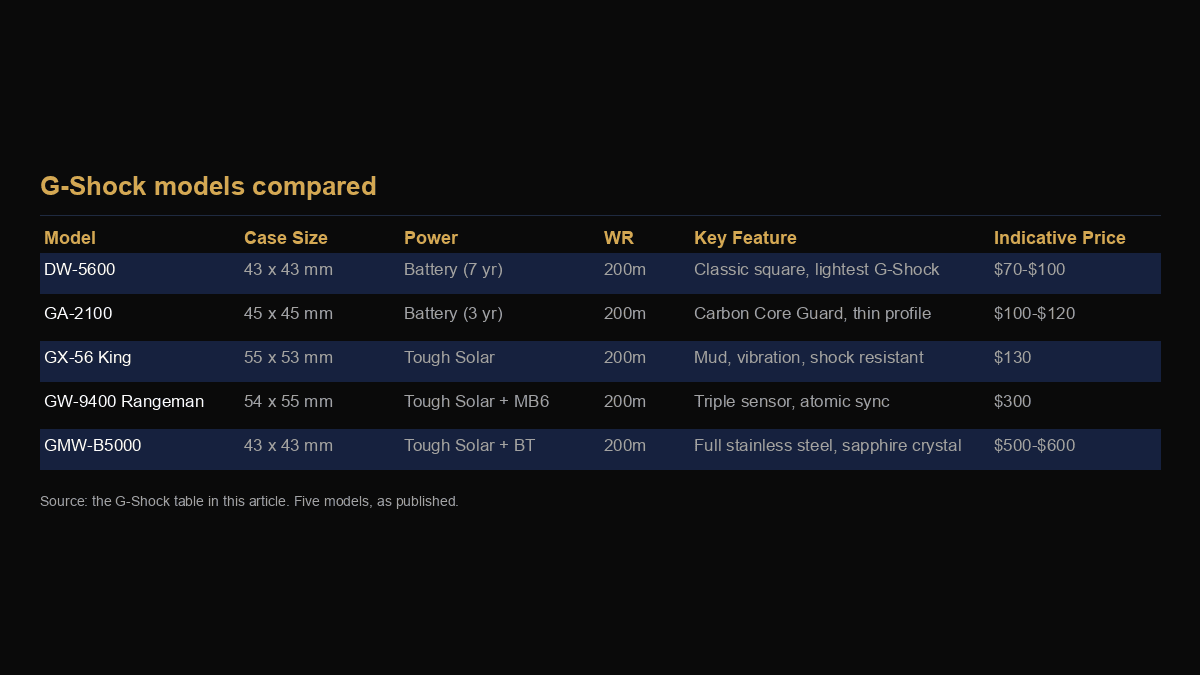
| Model | Case Size | Power | Water Resistance | Key Feature | Indicative Price |
|---|---|---|---|---|---|
| DW-5600 | 43 × 43 mm | Battery (7 yr) | 200m | Classic square, lightest G-Shock | $70–$100 |
| GA-2100 | 45 × 45 mm | Battery (3 yr) | 200m | Carbon Core Guard, thin profile | $100–$120 |
| GX-56 King | 55 × 53 mm | Tough Solar | 200m | Mud, vibration, shock resistant | $130 |
| GW-9400 Rangeman | 54 × 55 mm | Tough Solar + MB6 | 200m | Triple sensor, atomic sync | $300 |
| GMW-B5000 | 43 × 43 mm | Tough Solar + BT | 200m | Full stainless steel, sapphire crystal | $500–$600 |
The DW-5600 remains the rational choice for pure shock resistance per dollar. It weighs just 53 grams, fits under a shirt cuff and runs for seven years on a single battery. The GA-2100 “CasiOak” trades some battery life for a thinner, more contemporary profile and Casio’s Carbon Core Guard structure, which wraps the module in a carbon-fibre-reinforced resin shell. The GX-56 King adds solar charging and the largest footprint in the lineup, which distributes impact energy over more surface area. The Rangeman is the outdoor specialist: its altimeter, barometer and compass make it a legitimate field instrument, and Multi-Band 6 syncs the time from one of six radio stations worldwide. The GMW-B5000 is the collector’s piece — the same 3459 module as the DW-5600 wrapped in full stainless steel with a sapphire crystal and Bluetooth connectivity, all while retaining genuine shock resistance through an internal fine-resin buffer that cushions the module inside the metal case.
Beyond G-Shock: Tool Watches Built for Impact
If you want shock resistance without the resin-digital aesthetic, several Swiss and German watchmakers build mechanical and quartz watches that meet or exceed ISO 1413 while looking like traditional timepieces. These are tool watches in the original sense: instruments designed for professionals who need legibility, reliability and durability in environments where a conventional watch would fail.
Sinn
Frankfurt-based Sinn builds watches for German federal police, military pilots and mine-clearance teams. The Sinn 856 UTC (around $2,200) uses tegimented steel — a proprietary surface-hardening process that raises the Vickers hardness of standard surgical steel from roughly 200 HV to over 1,200 HV, making it nearly as scratch-resistant as ceramic while retaining the toughness of steel. Inside, the ETA 2893-2 movement runs with Sinn’s DIAPAL oil-free escapement, which eliminates the lubrication that degrades fastest under thermal and mechanical stress. The Sinn UX (around $2,600) takes a different approach entirely: the case is filled with silicone oil that surrounds the dial and movement, eliminating the air gap where condensation forms and distributing any impact force evenly across the entire calibre rather than concentrating it at the jewel bearings. The UX is pressure-rated to 5,000 metres and is the standard-issue dive watch for the German Navy’s combat swimmers.
Ball Watch Company
Ball certifies every watch it sells to ISO 1413. Its signature feature is self-powered micro gas tubes — sealed borosilicate capsules filled with tritium gas that glow constantly for roughly 25 years without needing light exposure or battery power. The Engineer Hydrocarbon EOD (around $2,500) was designed for explosive ordnance disposal teams and survives a claimed 10–metre fall, three times the ISO 1413 threshold. It carries 300 metres of water resistance, an anti-magnetic Faraday cage and a patented crown protection system. The Engineer III Marvelight (around $1,500) is a more wearable daily option that keeps the tritium tubes and ISO 1413 compliance in a 40mm case.
Marathon
Marathon holds active contracts with the U.S., Canadian and other NATO militaries. Its watches are built to MIL-PRF-46374G, the U.S. military specification for wrist instruments, which includes shock, vibration, temperature and humidity testing beyond what ISO 1413 requires. The GSAR (around $1,100) is a 41mm automatic diver rated to 300 metres with tritium gas tubes and a fibre-reinforced composite case that is lighter and more impact-absorbent than steel. The GPM (General Purpose Mechanical, around $250) is the entry point: a 34mm fiberglass-cased field watch with tritium lume and a hand-wound Swiss movement, essentially the same watch issued to infantry units. For more picks in this price range, see our best watches under $1,000 guide.
Victorinox INOX and Luminox
The Victorinox INOX (around $400) took a different marketing approach to shock resistance: rather than citing a single standard, Victorinox subjected it to 130 individual homologation tests including an 8–metre drop, a 64–ton tank driving over it, exposure to a washing machine and immersion in boiling water. The watch uses a standard Swiss quartz movement in a 43mm stainless steel case with a proprietary bumper system, and its real-world durability record among military and outdoor users is strong. Luminox builds its Original Navy SEAL 3501 (around $350) with a carbon compound case that is lighter than steel and more rigid than resin, paired with tritium gas tubes and 200 metres of water resistance. It was adopted by Navy SEAL instructors in 1994, and the carbon compound construction gives it genuine resistance to both impact and salt-water corrosion.
Check Any Watch Price in Seconds
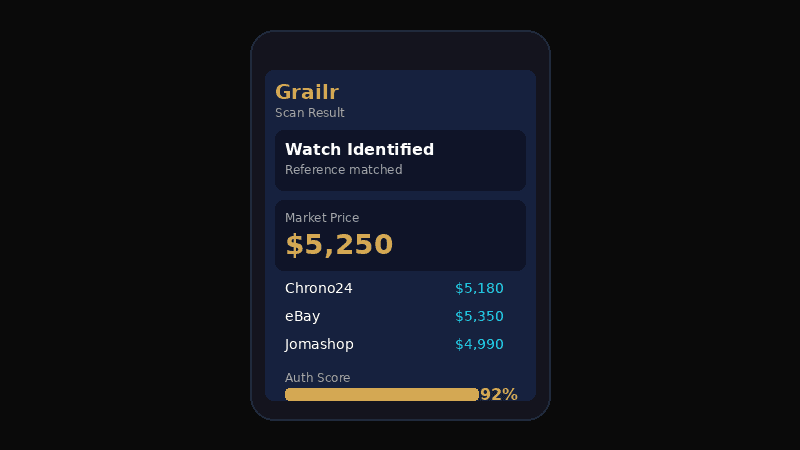
Grailr scans your watch photo and pulls live pricing from Chrono24, eBay, and Jomashop.
- AI identifies brand, model & reference number
- Live market prices from 3+ sources
- Authentication confidence score
Materials That Survive Impact
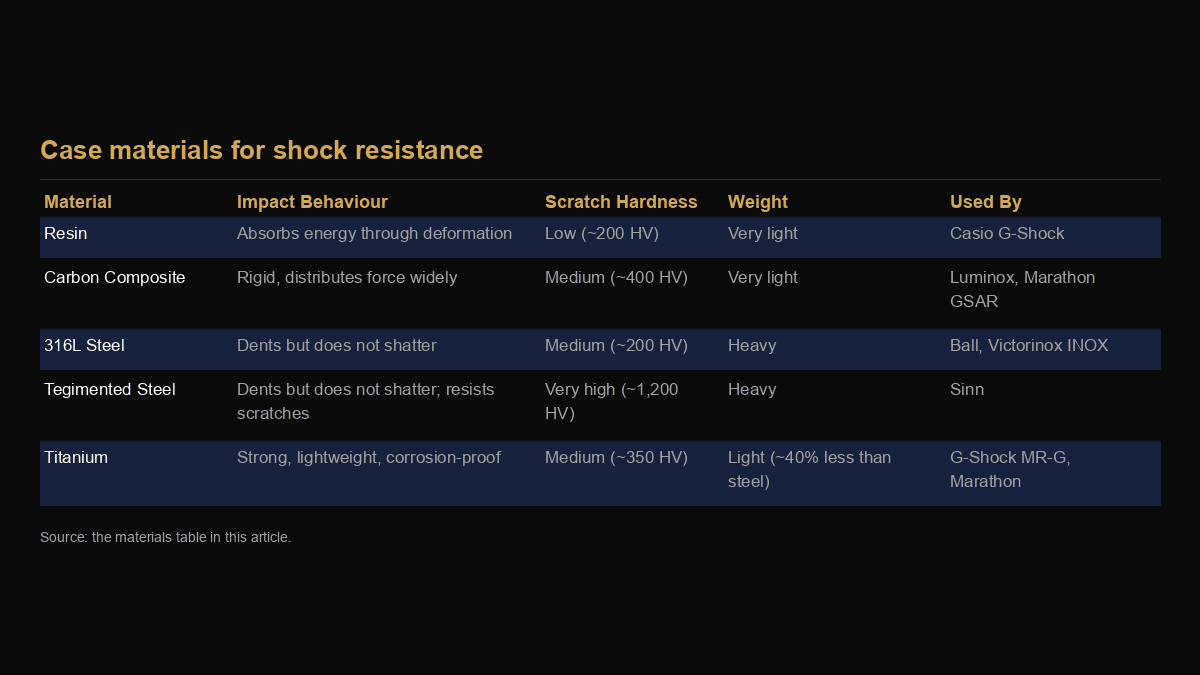
The case material is the first line of defence in any shock-resistant watch. Different materials handle impact energy in fundamentally different ways, and the right choice depends on whether you need the watch to absorb a blunt hit, resist scratching, stay lightweight or do all three. Our best watches for men guide covers material options across the broader market, but the table below focuses specifically on how each material performs under impact.
| Material | Impact Behaviour | Scratch Hardness | Weight | Used By |
|---|---|---|---|---|
| Resin | Absorbs energy through deformation | Low (~200 HV) | Very light | Casio G-Shock |
| Carbon Composite | Rigid, distributes force widely | Medium (~400 HV) | Very light | Luminox, Marathon GSAR |
| 316L Steel | Dents but does not shatter | Medium (~200 HV) | Heavy | Ball, Victorinox INOX |
| Tegimented Steel | Dents but does not shatter; resists scratches | Very high (~1,200 HV) | Heavy | Sinn |
| Titanium | Strong, lightweight, corrosion-proof | Medium (~350 HV) | Light (~40% less than steel) | G-Shock MR-G, Marathon |
Resin remains the single best shock-absorbing material because it deforms on impact and springs back, converting kinetic energy into heat and flex rather than transmitting it to the movement. Its weakness is surface durability: resin scratches easily and eventually develops a matte, worn appearance. Carbon composite offers similar weight savings with higher rigidity, which means it distributes force over a wider area rather than absorbing it through deformation — better for edge impacts and point-loading, but less forgiving on a flat drop. Standard 316L stainless steel is the workhorse of the watch industry and performs adequately under ISO 1413, but it scratches easily and is the heaviest common option. Sinn’s tegimented process solves the scratch problem without adding weight, but the treatment adds several hundred dollars to the price. Titanium splits the difference: roughly 40% lighter than steel, highly corrosion-resistant and strong enough for professional use, though it scratches more visibly than tegimented steel and can be harder to polish.
For most buyers, the practical question is whether you value weight, scratch resistance or impact absorption most. If you want all three, the two best options are a titanium G-Shock MR-G (expensive but comprehensive) or a carbon composite Marathon (lighter, military-proven, but limited styling). If you’re willing to accept weight, a tegimented Sinn delivers the best combination of impact and scratch resistance in a single material. To check the current market value of a shock-resistant watch you already own, scan it with Grailr.
Price vs Protection: What You Actually Get
The relationship between price and pure shock resistance is surprisingly flat. A $70 Casio DW-5600 and a $2,600 Sinn UX both survive the same ISO 1413 impact test. What changes as you spend more is everything around the shock resistance: movement type (quartz vs mechanical), crystal material (mineral vs sapphire), case finishing (moulded resin vs machined and hardened steel), lume technology (phosphorescent paint vs tritium gas tubes) and additional functionality (basic timekeeping vs UTC complications, altimeters and depth gauges).
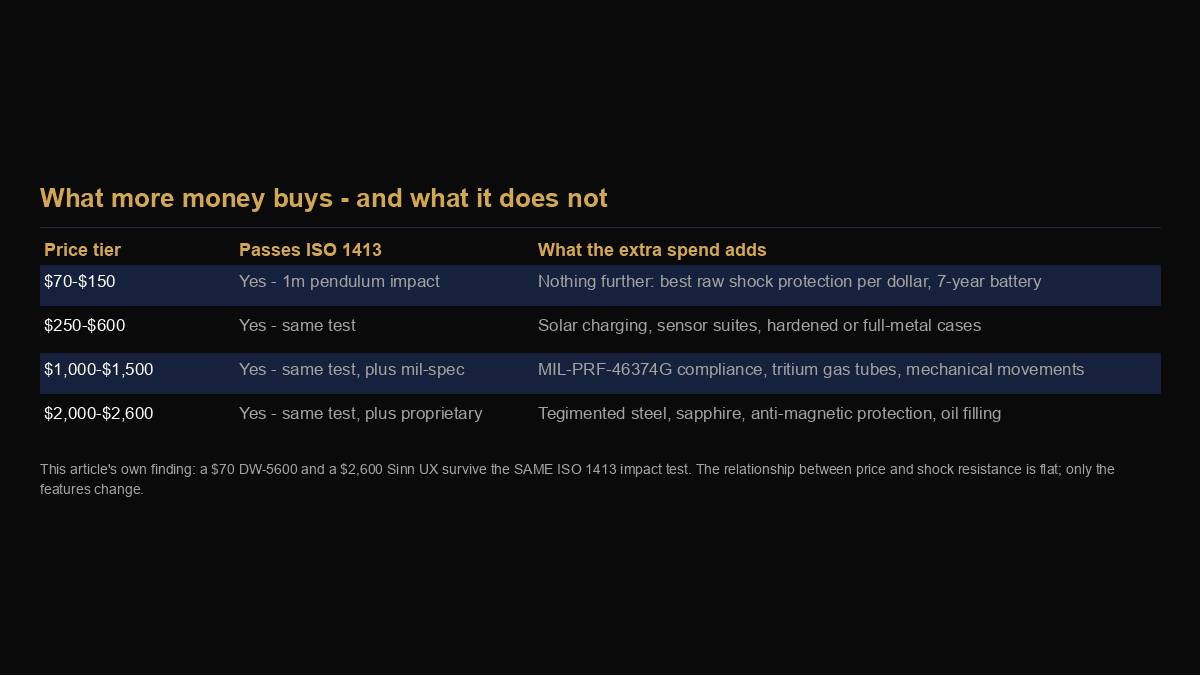
At the $70–$150 tier, G-Shock delivers the best raw shock protection per dollar. The resin hollow-core design is genuinely difficult to break, and Casio’s seven-year battery life means you can strap a DW-5600 to your wrist and forget about it. The trade-off is aesthetics: resin cases look like what they are, and a digital display won’t pass muster in a business-casual office.
At $250–$600, you gain real versatility. The Victorinox INOX at $400 is a steel-cased Swiss quartz watch that passes 130 stress tests, looks professional and wears comfortably at 43mm. The Luminox 3501 at $350 adds tritium lume and a carbon compound case. And G-Shock’s own Rangeman at $300 adds a triple sensor suite, solar charging and atomic time sync — turning a shock-resistant watch into a genuine field instrument. Our best budget watches guide covers more options at this price point.
At $1,000–$2,600, you are paying for mechanical movement finishing, sapphire crystals, tritium gas tubes, anti-magnetic protection and case materials that resist both impact and abrasion. The Marathon GSAR at $1,100 is the most affordable entry to military-spec mechanical shock resistance. The Ball Engineer III Marvelight at $1,500 adds dress-watch proportions. And the Sinn 856 UTC and UX at $2,200–$2,600 represent the ceiling of what current watch engineering can do with shock resistance, anti-magnetism and environmental sealing in a single package. Whether any of that is worth the premium over a G-Shock depends on whether you value the watch as a pure tool or as something you also want to wear, collect and maintain as a mechanical instrument.
Frequently Asked Questions
What does shock resistant mean on a watch?
Is G-Shock the most shock-resistant watch?
Can a mechanical watch be shock resistant?
What is ISO 1413 for watches?
Are shock-resistant watches also water resistant?
How much should I spend on a shock-resistant watch?
Related Articles
Best Scuba Diving Watches
The toughest dive watches rated to 200m and beyond.
Best Watches for Men 2026
Every style and budget covered in one guide.
Best Budget Watches
Great watches for under $200 that punch above their price.
Best Watches Under $1,000
Serious watchmaking without the five-figure price tag.
The Bottom Line
Shock resistance is one of the few watch specifications where the cheapest option genuinely performs as well as the most expensive one — at least on the specific metric of surviving an impact. A $70 DW-5600 and a $2,600 Sinn UX both pass ISO 1413. What separates them is everything else: the movement, the materials, the finishing, the lume, the long-term collectability. If you need a watch that will take a beating at work and you don’t care about aesthetics, buy the DW-5600 and stop reading. If you want that same resilience in a watch that looks like a proper timepiece, wears like an instrument and houses a mechanical movement you can service for decades, the $1,000–$2,600 tier is where the serious options live. Use Grailr’s watch identification tool to verify any model before you buy.
Not Sure What Your Watch Is Worth?
Snap a photo and Grailr tells you the brand, model, reference number and current market value in seconds.
Scan Your Watch Free