AP Royal Oak Prices in 2026: Every Model from Jumbo to Offshore Valued
Current retail and market prices for every Audemars Piguet Royal Oak model in 2026 — Jumbo Extra-Thin, Selfwinding, Chronograph, and Offshore — with indicative price ranges, historical context, and buying guidance for the post-correction market.
Price context: this guide includes indicative prices from its original publication period. They have not all been refreshed to current quotes. Use the linked primary sources for specifications and policies, and verify prices independently.

Key Takeaways
- Royal Oak prices corrected 40–50% from the March 2022 speculative peak but steel models still trade well above retail
- The Jumbo Extra-Thin 16202ST commands the highest premiums at 50–65% above its $33,200 retail price
- Blue dials outperform every other color across all Royal Oak references — expect to pay $5,000–10,000 more for blue
- The Offshore Diver is the best-value entry point to the Royal Oak family, trading near or slightly below retail
- AP produces only ~45,000 watches per year total — supply constraints remain the fundamental price driver
The State of AP Royal Oak Prices in 2026
The Audemars Piguet Royal Oak market in 2026 looks nothing like it did four years ago. In early 2022, the luxury watch market experienced a speculative frenzy that pushed Royal Oak prices to absurd levels. A steel 15500ST with a blue dial — a watch that retailed for roughly $23,000 at the time — was changing hands for over $110,000 on the secondary market. The 16202ST Jumbo touched $90,000. Offshore chronographs that had sat on dealer shelves for years were suddenly commanding double retail.
That bubble burst, and it burst hard. Between March 2022 and late 2023, Royal Oak secondary market prices corrected by 40–50% across the board. The correction was driven by several factors: rising interest rates made speculative capital more expensive, the crypto downturn reduced the buying power of a key collector demographic, and a general market realization that watches — like any collectible — can’t sustain four-digit annual returns indefinitely.
But here’s the important nuance: even after the correction, most steel Royal Oak models still trade significantly above retail. The market didn’t crash back to retail — it returned to rational premiums. A 15500ST blue dial that peaked at $110,000 now trades around $52,000. That’s still 86% above its original retail price. The correction removed the speculation; it didn’t erase the fundamental demand.
In 2026, Royal Oak prices have stabilized. The volatility is gone, the flip-for-profit crowd has moved on, and what remains is genuine collector demand meeting constrained supply. AP produces roughly 45,000 watches per year — a fraction of Rolex’s million-plus output — and the Royal Oak accounts for an estimated 75% of total production. That means roughly 33,000–34,000 Royal Oaks enter the market annually, spread across dozens of references, dial colors, and materials. For a watch with global demand, that’s remarkably scarce.
For a deeper look at AP’s full product lineup across all collections, see our comprehensive Audemars Piguet price guide. This article focuses specifically on the Royal Oak family — every major reference, its retail price, what it actually costs on the open market, and where the value sits today.
Royal Oak Jumbo Extra-Thin: The Icon’s Current Value
The Royal Oak “Jumbo” Extra-Thin is the purist’s Royal Oak — the direct descendant of Gerald Genta’s original 1972 Reference 5402. The current production model, the Reference 16202, replaced the beloved 15202 in 2022 to mark the Royal Oak’s 50th anniversary. It retains the 39mm case diameter and ultra-thin profile that define the Jumbo, but houses the new Calibre 7121 — a successor to the legendary 2121 movement that powered the Jumbo for decades.
At just 8.1mm thick (the movement itself is only 3.2mm), the Jumbo wears like no other Royal Oak. It sits flat on the wrist, slides under a shirt cuff effortlessly, and delivers a wearing experience that’s closer to a dress watch than a sports watch. The Cal. 7121 brings modern performance — a 55-hour power reserve, compared to the 2121’s 40 hours — while maintaining the original’s proportions and the exhibition caseback that lets you admire the 22K gold rotor.
16202ST Pricing Snapshot
The blue dial “Grande Tapisserie” variant of the 16202ST remains the most sought-after, trading at $50,000–$55,000 on platforms like Chrono24 and through pre-owned dealers. That’s a 51–66% premium over retail — substantial, but far more rational than the 170%+ premiums seen during the 2022 peak. Black, silver, and green dial variants trade in the $42,000–$46,000 range, still representing meaningful premiums of 27–39% above retail.
For collectors eyeing the discontinued 15202ST, expect to pay even more. The final-generation Jumbo with the historic Cal. 2121 has become a modern collectible in its own right. “A-series” examples of the original 1972 Ref. 5402 — the very first Royal Oaks — now command $200,000–$400,000 at auction, a testament to how deeply this design resonates with serious collectors.
The Jumbo is the Royal Oak for the collector who values historical significance and wearing comfort above all else. If you want the watch that started the luxury steel sports watch revolution, this is it. Use Grailr’s identification tool to suggest a Jumbo model, then confirm its reference and dial variant independently before purchasing — the price differences between variants can be $10,000 or more.
Royal Oak Selfwinding 41mm: 15500 vs 15510 Prices
The Royal Oak Selfwinding 41mm is the volume model — the watch most people picture when they think “Royal Oak.” The current production reference is the 15510ST, which replaced the immensely popular 15500ST in 2022. Both share the same 41mm case diameter and time-and-date complication, but the 15510ST houses the newer Cal. 4302 with a 70-hour power reserve (up from the 15500’s Cal. 4302 predecessor, the 3120, which offered 60 hours).
The market dynamics between these two references tell the story of the post-correction Royal Oak market. The 15500ST blue dial peaked at approximately $110,000 in March 2022 — nearly five times its retail price. Today it trades around $52,000. That’s a gut-wrenching 53% decline for anyone who bought at the top, but it’s still 86% above the watch’s original retail price. For early buyers and long-term holders, the 15500ST has been an exceptional store of value.
The current-production 15510ST blue dial trades at $45,000–$50,000 on the secondary market against a retail price of approximately $28,600. That’s a premium of 57–75% — still significant, but reflective of a market that’s pricing based on genuine demand rather than speculative mania. Black and grey dial variants trade at $35,000–$42,000, offering a more accessible entry to the current-production Selfwinding.
One pattern worth noting: the 15500ST, despite being discontinued, trades at a higher premium than its successor in blue. This is partly collector sentiment (the 15500 is seen as the “last of the old guard”) and partly the simple math of a fixed supply meeting sustained demand. As 15500ST examples age and fewer enter the resale market in pristine condition, this premium may widen further.
The newer 15550ST — a 37mm version of the Selfwinding — has also gained traction. Retailing at approximately $28,200 (steel), it trades at a more modest premium and appeals to collectors who prefer the proportions of the original 39mm Jumbo but want the convenience of an automatic movement with date function. For sizing guidance and a comparison of every Royal Oak reference, see our comprehensive Royal Oak buying guide.
Check Any Watch Price in Seconds
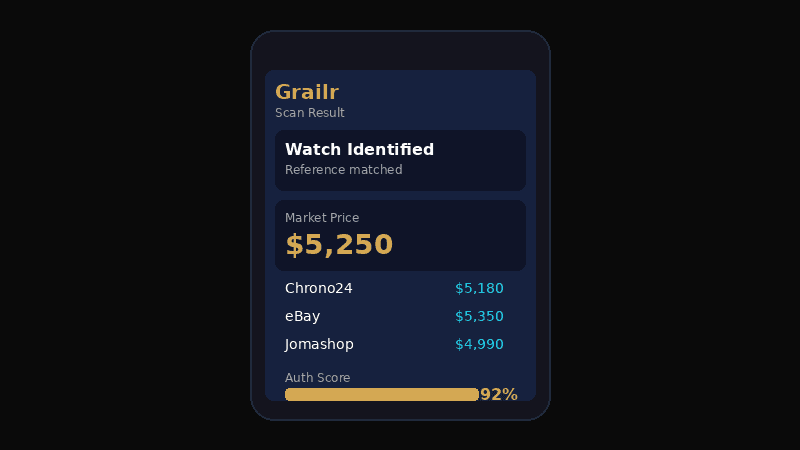
Grailr uses a photo to suggest a watch identity and an indicative price estimate, with active eBay listings where available. Check the exact reference and condition independently; a photo scan cannot authenticate a watch.
- Grailr suggests brand, model & reference
- Active eBay listings where available
- Identification confidence, not authentication
Royal Oak Chronograph: 26240 Market Value
The Royal Oak Chronograph is where mechanical complexity meets the iconic octagonal case. The current-production Reference 26240ST replaced the 26331ST and represents a significant upgrade: it houses the in-house Cal. 4401, a flyback chronograph movement that AP developed and manufactured entirely within its Le Brassus manufacture. Flyback functionality — the ability to reset and restart the chronograph without stopping it first — is a genuine complication, and having it in an integrated, column-wheel design marks the 26240 as a serious chronograph rather than a decorative one.
At 41mm with a slightly thicker case profile than the Selfwinding (necessary to accommodate the chronograph works), the 26240ST retails at approximately $36,500 in steel. On the secondary market, the blue dial variant trades at $55,000–$65,000 — a premium of 51–78% above retail. That’s a significant ask, but consider what you’re getting: an in-house flyback chronograph in an integrated-bracelet design from one of the Big Three manufacture houses. Comparable complexity from Patek Philippe (the 5170 or 5172) costs considerably more.
The 26240ST’s dial design also evolved from its predecessor. The subdials sit in recessed registers with contrasting finishing, and the pushers integrate more seamlessly into the case shape. AP refined the bracelet taper as well, improving comfort on the wrist — a detail that matters more than you might expect on a watch you wear daily.
For buyers who want Royal Oak DNA with genuine horological depth, the Chronograph is the sweet spot. It costs roughly $8,000 more at retail than the Selfwinding but delivers substantially more mechanical content. The secondary market premium is higher in absolute dollars, but the percentage premium is comparable. If you can secure one at retail, the Chronograph may be the best “value” in the current Royal Oak lineup — a term used loosely when discussing $36,500 watches, but accurate in relative terms.
Royal Oak Offshore: What They’re Actually Worth
The Royal Oak Offshore has always been the polarizing sibling. Launched in 1993 by Emmanuel Gueit, the Offshore took Genta’s refined octagonal design and supersized it into a bold, aggressive tool watch. Early criticism was fierce — some dealers reportedly refused to stock it — but the Offshore found its audience and eventually became a cultural phenomenon in its own right, particularly in the hip-hop and entertainment worlds.
In 2026, the Offshore lineup centers on the 42mm case size (down from the imposing 44mm of earlier generations). The Reference 26238ST and its variants offer the Offshore Chronograph with the in-house Cal. 4404 flyback movement. Retail pricing ranges from $36,700 to $45,000 for steel models, depending on bezel material and strap configuration.
The secondary market for Offshores is far more varied than the standard Royal Oak line. Pricing ranges from $30,000 to $80,000 depending heavily on the specific reference, material combination, and whether it’s a limited edition. Standard steel chronograph variants trade in the $35,000–$55,000 range. Limited editions and special materials (ceramic, forged carbon, titanium) can command significant premiums when they capture collector interest, or trade below retail when they don’t.
The Royal Oak Offshore Diver represents the most accessible entry to the Offshore family. At 42mm with 300m water resistance, the Diver retails at $29,000–$32,000 and trades at approximately $25,000–$35,000 on the secondary market. Some references trade below retail — a rarity in the Royal Oak world — making the Diver an interesting proposition for buyers who want genuine AP ownership without paying a secondary market premium.
The Offshore’s value proposition depends entirely on your perspective. If you want the strongest resale performance and the most liquid asset, the standard Royal Oak is the better buy. If you want a bolder design with genuine tool-watch credentials, don’t mind potentially modest depreciation, and prefer the wearing experience of a larger, more muscular watch, the Offshore delivers something the standard Royal Oak simply can’t. For more context on which watches retain value over time, read our guide to watch brands that hold value.
Royal Oak Price Comparison: Every Model at a Glance
The table below summarizes current retail and secondary market pricing for every major Royal Oak reference in steel. All market prices reflect mid-2026 data for watches in excellent condition with box and papers.
| Model | Reference | Size | Retail | Market Price | Premium |
|---|---|---|---|---|---|
| Jumbo Extra-Thin (Blue) | 16202ST | 39mm | $33,200 | $50,000–$55,000 | +51–66% |
| Jumbo Extra-Thin (Other) | 16202ST | 39mm | $33,200 | $42,000–$46,000 | +27–39% |
| Selfwinding (Blue) | 15510ST | 41mm | $28,600 | $45,000–$50,000 | +57–75% |
| Selfwinding (Blue, Disc.) | 15500ST | 41mm | ~$23,000* | ~$52,000 | +126%* |
| Chronograph (Blue) | 26240ST | 41mm | $36,500 | $55,000–$65,000 | +51–78% |
| Offshore Chrono | 26238ST | 42mm | $36,700–$45,000 | $35,000–$55,000 | –5% to +22% |
| Offshore Diver | Various | 42mm | $29,000–$32,000 | $25,000–$35,000 | –14% to +9% |
*15500ST retail reflects original MSRP before discontinuation. Premium calculated against original retail price. All market prices are for steel models with box and papers in excellent condition, sourced from Chrono24, WatchBox, and dealer listings as of May 2026.
How the 2022 Correction Changed Royal Oak Pricing
Understanding where Royal Oak prices are today requires understanding what happened between 2020 and 2023. The pandemic-era luxury watch boom was driven by a convergence of factors that had never previously aligned: stimulus payments, crypto wealth creation, social media hype (particularly from watch influencers and NFT culture), restricted travel spending being redirected to luxury goods, and ultra-low interest rates that made speculative capital essentially free.
Royal Oaks became one of the hottest speculative assets in the watch market. The 15500ST, in particular, became a meme-level investment play. Stories circulated of buyers acquiring watches at retail, walking outside the boutique, and immediately reselling for three to four times what they had paid. Grey market dealers were paying cash premiums to anyone who could source Royal Oaks at retail. The line between “watch collector” and “watch trader” effectively dissolved.
The correction that followed was inevitable. Between March 2022 and December 2023, the WatchCharts Overall Market Index dropped by over 30%. Royal Oaks corrected even more sharply because they had been among the most inflated models. The 15500ST blue dial fell from $110,000 to roughly $48,000 before stabilizing around $52,000 in 2024–2025. The 16202ST Jumbo dropped from its peak near $90,000 to the $50,000–$55,000 range where it sits today.
What the correction revealed is instructive: the watches with genuine collector demand held up far better than those driven purely by speculation. The Jumbo, with its historical significance and wearing quality, retained stronger premiums. The Selfwinding, as the volume model that had attracted the most speculative interest, corrected more sharply. And the Offshore, which had been dragged up by the rising tide rather than genuine demand, corrected to near or below retail in many references.
The lesson for 2026 buyers is clear: buy Royal Oaks because you want to wear them, not because you expect them to appreciate. At current premiums of 30–75% above retail, steel Royal Oaks remain excellent stores of value compared to almost any other luxury purchase. But expecting 2022-style returns is unrealistic, and buying purely for investment exposes you to the same correction risk that burned speculators four years ago. For a broader analysis of watch investing principles, see our luxury watches investment guide.
How to Buy an AP Royal Oak: AD vs Grey Market vs Pre-Owned
Buying a Royal Oak in 2026 means navigating three distinct channels, each with its own trade-offs. AP’s ongoing transition to direct retail has simplified some aspects of the purchase process but complicated others.
AP Houses & Boutiques (Retail): Audemars Piguet has been steadily eliminating third-party authorized dealers in favor of company-owned boutiques called “AP Houses.” This gives AP complete control over the purchase experience but also means that access to popular references is managed through relationships rather than inventory. Walking into an AP House and buying a steel Royal Oak off the shelf is essentially impossible for new customers. The Offshore Diver and some Chronograph references are more readily available, and building purchase history with these models can eventually open doors to the Selfwinding and Jumbo allocations.
Grey Market Dealers (New, Unworn): These are dealers who source unworn watches outside the official retail channel and sell them at market prices. For popular Royal Oak references, this means paying a significant premium over retail — but getting the watch immediately rather than waiting years. Reputable grey market dealers include Davidsw, Takuya Watches, and established Chrono24 sellers with strong transaction histories. The key risk here is authenticity: always verify the reference number, movement serial, and documentation independently. Grailr’s scanner can suggest a model and an indicative price estimate; confirm the reference and price independently.
Pre-Owned Platforms & Dealers: Chrono24, WatchBox, Crown & Caliber, and Bob’s Watches offer the broadest selection of Royal Oaks, including discontinued references that are no longer available through any other channel. Pre-owned watches in excellent condition with original box and papers typically command a 5–10% premium over watches without documentation. AP’s own Certified Pre-Owned program offers manufacturer-inspected watches with a 2-year warranty — pricing runs higher than the open market, but the warranty adds genuine peace of mind for a five-figure purchase.
Authentication is non-negotiable. Royal Oak counterfeits have become increasingly sophisticated, particularly for the 15510ST and 16202ST. The “Grande Tapisserie” dial pattern is one of the hardest elements to replicate accurately — under magnification, fake dials show irregular depths and spacing. The finishing on the bracelet links, the crispness of the hexagonal bezel screws, and the quality of the applied AP logo are also reliable authentication tells. Use Grailr’s appraisal tool for an indicative price estimate, then compare independent offers before committing.
For a complete walkthrough of every model and how AP reference numbers decode, see our dedicated Royal Oak buying guide. And for a broader look at which high-end watches offer the best value across brands, our high-end watches guide covers the top 20 luxury brands in detail.
Frequently Asked Questions
How much does an AP Royal Oak cost in 2026?
The Royal Oak Selfwinding 41mm (15510ST) retails for approximately $28,600 and trades at $45,000–$50,000 on the secondary market for the blue dial. The Jumbo Extra-Thin 16202ST retails at $33,200 and commands $50,000–$55,000 pre-owned in blue. Prices vary significantly by dial color and condition.
Are AP Royal Oak prices going up or down in 2026?
Royal Oak prices have stabilized in 2026 after a significant correction from the March 2022 peak. Steel models still trade well above retail, but premiums have moderated from the speculative highs. The 15500ST blue dial dropped from $110,000 to around $52,000 — still 86% above its original retail price.
Which Royal Oak holds its value best?
The Royal Oak Jumbo Extra-Thin (16202ST) holds value best, trading at 50–65% above retail depending on dial color. Blue dials consistently outperform other colors across every Royal Oak reference. Steel models universally outperform gold and two-tone variants on the secondary market.
Is the AP Royal Oak Offshore worth buying?
The Offshore offers the most accessible entry to the Royal Oak family, with diver models trading near or slightly below retail. For collectors who prioritize value retention, the standard Royal Oak line outperforms the Offshore. But for buyers who want a sportier, larger watch with genuine tool-watch capabilities, the Offshore Diver at $29,000–$32,000 retail is compelling.
Can you buy an AP Royal Oak at retail price?
Technically yes, but practically it depends on the model. Steel Royal Oak models have multi-year waitlists at AP Houses and boutiques. Offshore Diver models and some Offshore Chronograph variants are more readily available. Building purchase history with AP through more accessible models improves your chances of being offered in-demand references.
Why are AP Royal Oak watches so expensive?
AP produces only about 45,000 watches per year total — a fraction of Rolex’s output. The Royal Oak’s integrated bracelet requires extensive hand-finishing, with each link individually satin-brushed and polished. The case’s octagonal bezel and eight hexagonal screws demand precision machining. Combined with the 1972 design heritage and extreme scarcity, these factors justify the pricing.
Related Articles
The Bottom Line
The AP Royal Oak market in 2026 has found its equilibrium. The speculative fever of 2022 is firmly in the rearview mirror, and what remains is a market driven by genuine collector demand, constrained supply, and the enduring appeal of one of the greatest watch designs ever created. Gerald Genta’s octagonal masterpiece continues to command premiums that most luxury goods can only dream of — and for good reason.
For buyers in 2026, the playbook is straightforward: blue dials cost more but hold value better, the Jumbo commands the highest premiums, the Selfwinding offers the broadest selection, and the Offshore Diver is the underappreciated entry point. Steel outperforms gold on the secondary market. Discontinued references tend to appreciate once supply dries up. And authentication is absolutely critical given the price levels involved.
Whether you’re buying your first Royal Oak or adding another reference to a growing collection, the most important step is confirming what you’re getting and what it’s actually worth. Dealers, listings, and sellers will tell you what they think the watch is worth. Your job is to verify independently — check the reference, confirm the market price across multiple sources, and authenticate before committing.
Know What Your Royal Oak Is Worth
Grailr uses a photo to suggest a watch identity and an indicative price estimate, with active eBay listings where available. Check the exact reference and condition independently; a photo scan cannot authenticate a watch.
Scan Your Watch NowSources and price context
- Audemars Piguet Royal Oak history — Documents the 1972 launch and later collection developments.
- eBay Product Research documentation — Explains sold-price research, including accepted Best Offers; separate from Grailr listing results.
These primary sources support the specific history, specification or policy points noted above. Prices and resale percentages elsewhere in this guide are indicative editorial figures, not a verified transaction dataset or guaranteed returns. Confirm the exact reference, region, condition and current quote before buying; asking prices are not completed-sale prices.