15 Best Sports Watches for Runners in 2026
From the $15 Casio F-91W to the $5,350 Omega Speedmaster — every traditional sports watch a runner could want, tested and ranked by price, durability, and wearability.
Price context: this guide includes indicative prices from its original publication period. They have not all been refreshed to current quotes. Use the linked primary sources for specifications and policies, and verify prices independently.

- The Casio G-Shock GBD-200 ($99) is the best all-around sports watch for runners — shock-proof, 200m WR, 58g, with a built-in step counter
- For analog style, the Seiko Prospex Speedtimer SSC813 ($400) delivers a solar chronograph in a 39mm case at just 90g
- Running puts extreme stress on watch movements — quartz, solar, and digital watches handle impact far better than automatics
- Every watch on this list has at least 100m water resistance for sweat, rain, and post-run showers
What Makes a Great Running Watch?
Running is one of the harshest environments you can subject a watch to. Every footstrike sends a shock wave up your arm, sweat is corrosive, UV exposure is constant, and temperature swings between cold morning air and body heat stress gaskets and seals. Not every watch can handle it — and some that technically can aren’t comfortable to wear while doing it.
We evaluated 15 watches across five criteria that matter most to runners: shock resistance (can the movement survive thousands of impacts?), water resistance (sweat, rain, and the occasional water fountain splash), weight (anything over 100g gets annoying after 10km), legibility (can you read split times in bright sunlight?), and strap security (will it stay put at pace?).
This guide focuses exclusively on traditional wristwatches — digital and analog timepieces that tell time, run a stopwatch, and survive a beating. If you want GPS tracking and heart rate monitoring, you’re looking at a different category entirely. What we cover here are watches you can wear from the track to the office to a casual dinner without changing anything on your wrist.
The Best Sports Watches for Runners: Quick Ranking
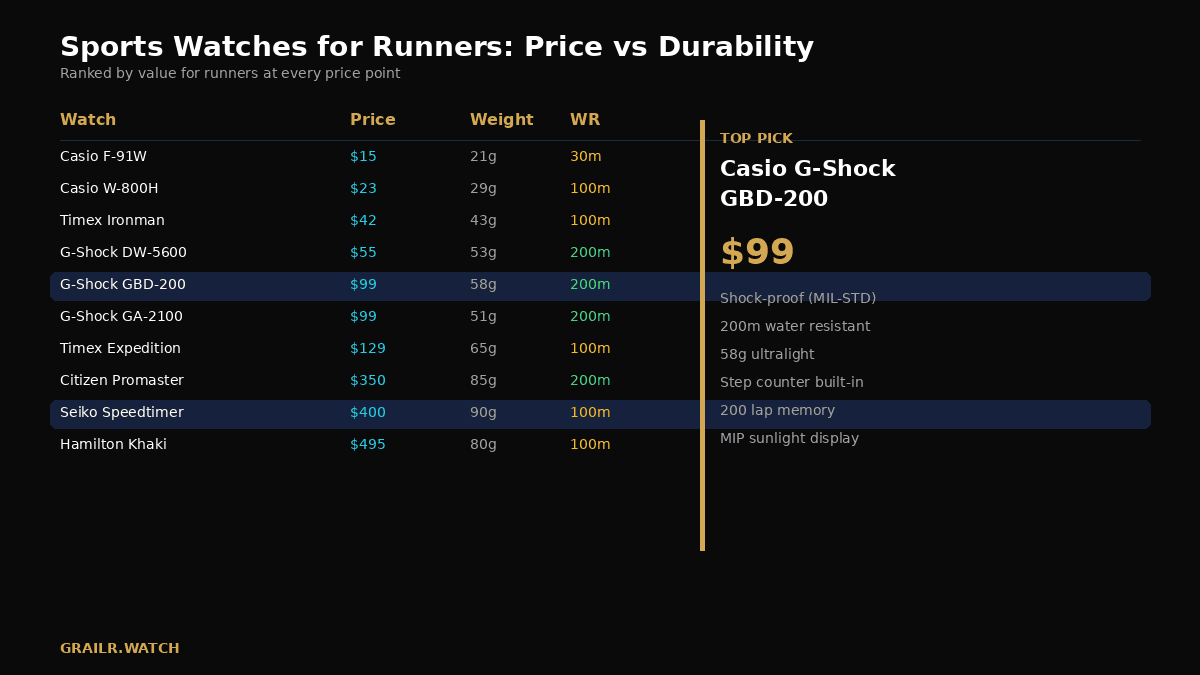
| Watch | Price | Size | Weight | WR | Best For |
|---|---|---|---|---|---|
| Casio F-91W | $15 | 33mm | 21g | 30m | Ultralight racing |
| Casio W-800H | $23 | 36mm | 29g | 100m | Budget all-rounder |
| Timex Ironman Classic 30 | $42 | 38mm | 43g | 100m | Lap memory |
| Casio G-Shock DW-5600 | $55 | 42mm | 53g | 200m | Durability icon |
| Casio G-Shock GBD-200 | $99 | 45mm | 58g | 200m | Best overall |
| Timex Expedition North | $129 | 41mm | 65g | 100m | Trail running |
| Casio G-Shock GA-2100 | $99 | 44mm | 51g | 200m | Ana-digi style |
| Citizen Promaster Tough | $350 | 42mm | 85g | 200m | Eco-Drive toughness |
| Seiko Prospex Speedtimer SSC813 | $400 | 39mm | 90g | 100m | Best analog |
| Tissot PRX Powermatic 80 | $675 | 40mm | 125g | 100m | Style + sport |
| Seiko Prospex SRPE93 | $525 | 42mm | 100g | 200m | Auto diver |
| Hamilton Khaki Field Auto | $495 | 38mm | 80g | 100m | Swiss field watch |
| Sinn 556 I | $1,630 | 38mm | 75g | 200m | Tool watch |
| Tudor Pelagos FXD | $4,275 | 42mm | 95g | 200m | Titanium luxury |
| Omega Speedmaster Reduced | $5,350 | 39mm | 110g | 50m | Iconic chrono |
Under $100: The Runner’s Workhorses
Casio F-91W — $15
The lightest watch on this list at just 21 grams. The F-91W has a stopwatch, daily alarm, auto-calendar, and an LED backlight. At $15, it’s essentially disposable — and yet the build quality is surprisingly solid. The resin case and strap shrug off sweat, the battery lasts seven years, and the quartz module keeps time to ±30 seconds per month. The only downside is the 30m water resistance rating, which means it’ll survive sweat and light rain but isn’t swim-proof. For dedicated track sessions where you just need a stopwatch on your wrist, nothing beats it.
Casio W-800H — $23
The upgrade from the F-91W for runners who want proper water resistance. The W-800H delivers 100m WR, a 1/100-second stopwatch, 10-year battery life, and a larger 36mm case with better legibility. At 29 grams, you genuinely forget it’s on your wrist. The dual time function is handy for travellers who run in different time zones. This is our pick for runners who want something cheap enough to abuse without guilt but robust enough to handle any weather.
Timex Ironman Classic 30 — $42
The Ironman has been a runner’s staple since 1986, and the Classic 30 remains the gold standard for budget lap timers. It stores 30 lap/split times, has a 100-hour chronograph, three alarms, and Timex’s Indiglo backlight that illuminates the entire dial evenly. At 43 grams and 100m water resistance, it handles everything from track intervals to trail runs in the rain. The resin strap is comfortable for long runs and the large digits are easy to read at pace.
Casio G-Shock DW-5600 — $55
The original “square” G-Shock from 1983, still in production and still virtually indestructible. The DW-5600 passes ISO 764 shock resistance testing (withstands drops from 1.2m onto a hardwood surface), has 200m water resistance, a stopwatch with split time, and Casio’s iconic resin armour construction. At 53 grams, it’s lighter than most running shoes. This is the watch you reach for when conditions are genuinely awful — mud runs, obstacle races, trail running in monsoon rain. It will outlast you.
Casio G-Shock GBD-200 — $99 (Our Top Pick)
Our pick for the best overall sports watch for runners. The GBD-200 takes everything great about the G-Shock platform and adds a built-in step counter, daily step goal tracking, a vibration alert, and Bluetooth connectivity for syncing workout data to your phone. The 45mm case sits flat on the wrist thanks to its slim 14.8mm profile, and at 58 grams it’s barely noticeable during long runs. The MIP display (memory-in-pixel) stays visible in direct sunlight without a backlight — critical for outdoor running. You get 200m water resistance, 2-year battery life, and a stopwatch with 200 lap memories. It does everything a runner needs without crossing into smartwatch territory.
$100 – $500: The Sweet Spot
Casio G-Shock GA-2100 “CasiOak” — $99
The GA-2100 earned the “CasiOak” nickname for its octagonal bezel that echoes a much more expensive watch. It’s an ana-digi design — analog hands for quick time reading plus a digital display for stopwatch functions. At 51 grams with 200m water resistance and full G-Shock protection, it’s as capable as the DW-5600 but looks significantly more refined. Runners who want a G-Shock they can wear beyond the track will appreciate the slimmer 11.8mm case profile.
Timex Expedition North — $129
Built for trail runners and outdoors enthusiasts, the Expedition North features a 41mm titanium case, sapphire crystal (at this price!), and a 100m water resistance rating. The automatic movement variant weighs just 65 grams thanks to the titanium construction. Indiglo backlight, clean dial legibility, and a fabric strap that breathes during hot runs make it a compelling choice for runners who prefer analog aesthetics but need field-grade durability. The sapphire crystal is a real differentiator — it won’t scratch from trail debris the way acrylic or mineral glass will.
Citizen Promaster Tough — $350
Citizen’s answer to the G-Shock, but with Eco-Drive solar technology. The Promaster Tough features a Super Titanium case that’s 40% lighter than steel and five times harder, Duratect surface hardening, 200m water resistance, and a solar cell that means you’ll never change a battery. The 42mm case sits low at 11mm thick and weighs a comfortable 85 grams. For runners who log serious mileage and don’t want to think about battery life or babying their watch, this is the set-and-forget choice.
Seiko Prospex Speedtimer SSC813 — $400 (Best Analog)
The best analog chronograph for runners. The SSC813 runs on Seiko’s V192 solar movement, which means perpetual power from any light source and a 6-month power reserve in the dark. The 39mm stainless steel case keeps it compact, the tachymeter bezel adds utility for pace calculation, and the chronograph measures elapsed time with a running seconds hand. At 90 grams on the bracelet, it’s light enough for daily running while looking sharp enough for the office. The panda dial in white and black is particularly legible in all lighting conditions.
Hamilton Khaki Field Auto — $495
The Khaki Field is a Swiss-made field watch with genuine military DNA — Hamilton supplied watches to the US military in both World Wars. The 38mm version uses the H-10 automatic movement with an 80-hour power reserve, sapphire crystal, and 100m water resistance. On a NATO strap, it weighs about 80 grams and sits flat on the wrist. It’s not designed specifically for running, but its legibility, durability, and lightweight profile make it a genuinely excellent value for runners who want a single watch for everything from 5K to dinner.
Check Any Watch Price in Seconds
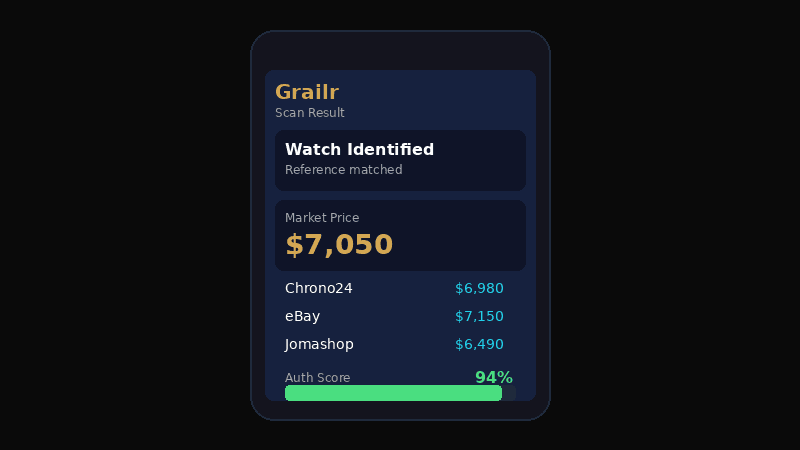
Grailr uses a photo to suggest a watch identity and an indicative price estimate, with active eBay listings where available. Check the exact reference and condition independently; a photo scan cannot authenticate a watch.
- Grailr suggests brand, model & reference
- Active eBay listings where available
- Identification confidence, not authentication
$500 – $2,000: Enthusiast Picks
Seiko Prospex “Turtle” SRPE93 — $525
The Turtle is a 42mm automatic diver with 200m water resistance and Seiko’s 4R36 movement (41-hour power reserve, hand-winding, hacking). The cushion case sits surprisingly flat for a diver, and at 100 grams on the silicone strap it’s manageable for shorter runs. The unidirectional bezel lets you track intervals in a pinch, and the lume is genuinely exceptional — Seiko’s LumiBrite is visible for hours in low light. This is the automatic option for runners who want diver-grade durability without the bulk of a Submariner.
Tissot PRX Powermatic 80 — $675
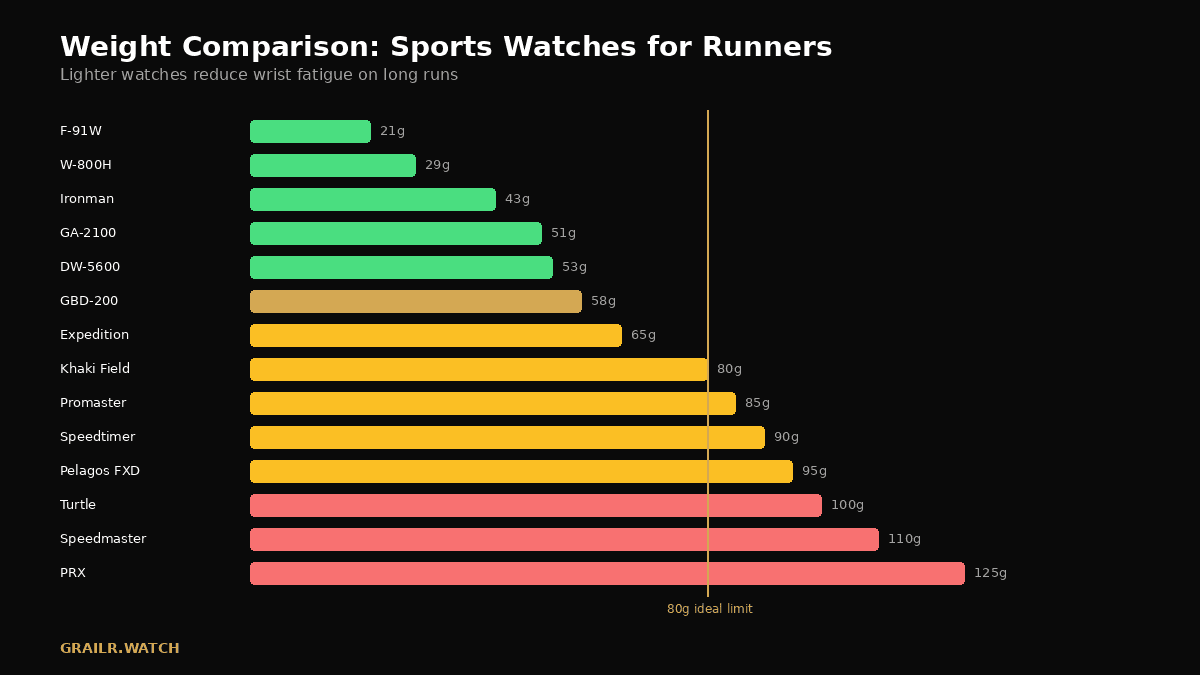
The PRX is technically a sports-luxury watch, but its integrated bracelet, 100m water resistance, and 40mm case make it a viable choice for runners who want one watch for everything. The Powermatic 80 movement delivers an 80-hour power reserve, meaning you can take it off Friday and it’ll still be running Monday morning. At 125 grams, it’s the heaviest watch we’d recommend for running — anything heavier starts bouncing on the wrist. The brushed steel construction handles sweat without issue.
Sinn 556 I — $1,630
German engineering at its finest. The Sinn 556 I is a 38.5mm tool watch built to DIN 8330 standards with 200m water resistance, anti-magnetic protection to 80,000 A/m, and Sinn’s proprietary Ar-dehumidifying technology that prevents fogging. The Sellita SW200-1 movement is robust and serviceable, and the entire package weighs just 75 grams on the leather strap. For runners who appreciate precision engineering and want a watch that’s genuinely built for abuse, the 556 I is about as good as it gets under $2,000. The bead-blasted finish hides scratches beautifully.
$2,000+: Luxury Sports Watches for Runners
Tudor Pelagos FXD — $4,275
Tudor’s fixed-bezel diver is made from grade 2 titanium, which means the 42mm case weighs just 95 grams — less than most 40mm steel watches. The MT5602 movement is COSC-certified with a 70-hour power reserve, and the case back is solid titanium with a Marine Nationale striping motif. For runners who want genuine horological credibility on their wrist during a marathon, the Pelagos FXD is light enough to run with and tough enough to survive anything you throw at it. The matte finish is completely anti-reflective, which means zero glare during outdoor runs.
Omega Speedmaster Reduced — $5,350
The Speedmaster Reduced (currently the 38mm Co-Axial references) gives you the Omega Speedmaster heritage in a 39mm case that’s genuinely wearable for running. The hesalite crystal on some references is more scratch-prone but also more shatter-resistant than sapphire — a real consideration for trail runners. At 110 grams, it’s at the upper end of what we’d recommend for regular running, but for occasional race-day wear where you want something special on your wrist at the finish line, nothing else on this list has the same gravitas. It went to the moon, after all.
Quartz vs Automatic for Running: The Honest Truth
Every watchmaker will tell you modern automatic movements can handle running — and technically, they’re right. The ETA 2824, Sellita SW200, and Seiko 4R36 all survive impact testing well above what running produces. But there’s a difference between surviving and thriving.
Automatic movements use a delicate balance wheel oscillating 28,800 times per hour. Each footstrike sends a micro-shock through the movement, and over thousands of miles, this accumulated stress can affect accuracy and increase service frequency. It’s not catastrophic — plenty of runners wear Rolex Submariners daily without issues — but it’s a factor to consider.
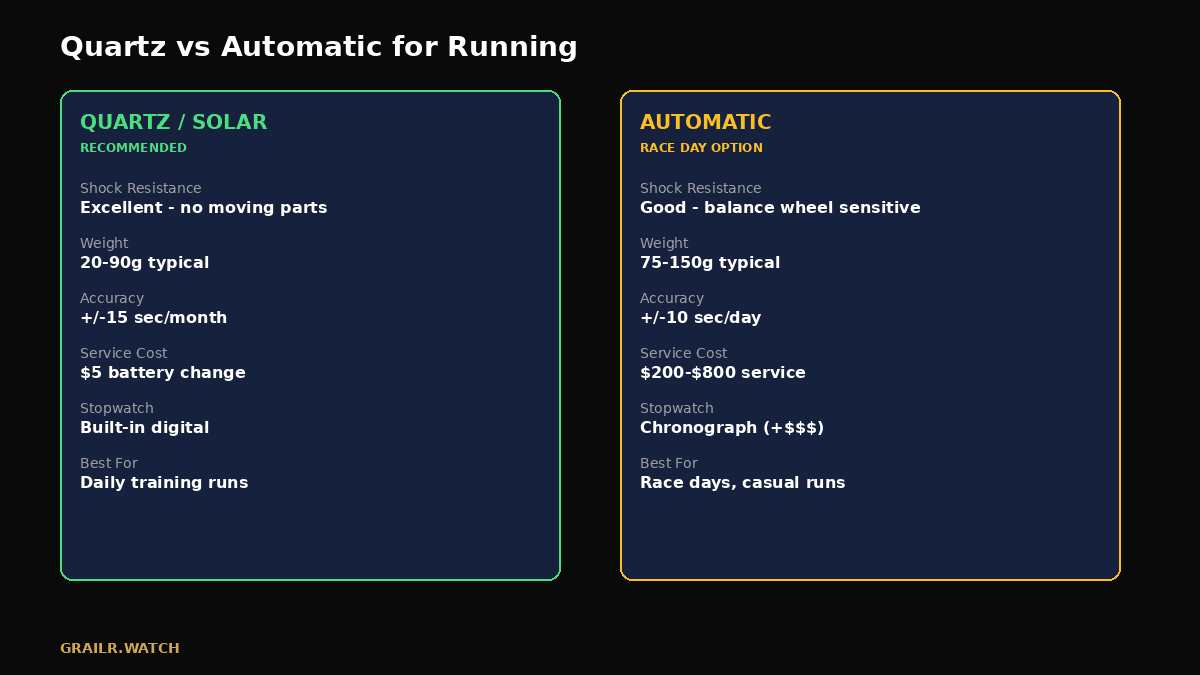
| Factor | Quartz / Solar | Automatic |
|---|---|---|
| Shock resistance | Excellent | Good |
| Weight | 20–90g typical | 75–150g typical |
| Accuracy | ±15 sec/month | ±10 sec/day |
| Service cost | $5 battery | $200–$800 |
| Stopwatch function | Built-in (digital) | Chronograph (+$$$) |
| Emotional appeal | Moderate | High |
Our recommendation: use a quartz or digital watch for daily training runs, and save the automatic for race days and casual runs where the experience of wearing a mechanical watch matters more than pure practicality.
5 Things to Check Before Running With a Watch
1. Crown Position
Always push the crown fully in before running. A partially pulled crown breaks the water resistance seal and can let sweat into the case. If your watch has a screw-down crown, tighten it.
2. Strap Fit
The watch should fit snugly enough that it doesn’t slide around, but not so tight it restricts circulation. On a metal bracelet, you should be able to fit a pinky finger underneath. On resin or rubber, one finger-width of play is ideal. Loose watches bounce and chafe.
3. Weight Limit
Under 80 grams is ideal for daily running. 80–120g is manageable for shorter distances. Over 120g, you’ll feel the bounce and it can interfere with natural arm swing. Our top pick, the G-Shock GBD-200, hits the sweet spot at 58g.
4. Rinse After Every Run
Sweat is corrosive. Rinse your watch under lukewarm tap water after every run, especially around the case back, crown, and bracelet links. This prevents salt buildup that can corrode gaskets and degrade water resistance over time.
5. Annual Service Check
If you run with an expensive watch regularly, have the water resistance tested annually. Any watchmaker can do a pressure test for $20–$30 — cheap insurance against a costly water damage repair.
Our Top Picks by Runner Type
Casual Jogger
Casio W-800H — $23
Light, cheap, reliable. 100m WR handles sweat and rain. 10-year battery means zero maintenance.
Serious Runner
Casio G-Shock GBD-200 — $99
Step counter, 200 lap memory, shock-proof, 58g. The complete runner’s toolkit.
Trail Runner
Citizen Promaster Tough — $350
Super Titanium, solar powered, 200m WR. Built for the elements, no battery changes ever.
Watch Enthusiast Who Runs
Seiko Speedtimer SSC813 — $400
Solar chronograph with serious horological cred. 39mm, 90g, and beautiful enough to collect.
Frequently Asked Questions
What is the best watch for running?
For most runners, the Casio G-Shock GBD-200 ($99) is the best all-around choice with shock resistance, 200m water resistance, a step counter, and a stopwatch. For runners who want a traditional analog look, the Seiko Prospex Speedtimer SSC813 ($400) offers a solar-powered chronograph in a lightweight 39mm case.
Can I run with an automatic watch?
Yes, but with caveats. Modern automatic movements can handle the impact of running, but repeated wrist shock over many miles can stress the movement over time. Quartz, solar, or digital watches are better suited for daily running because they have no delicate balance wheel to worry about.
Are Casio G-Shocks good for running?
G-Shocks are excellent for running. They are shock-resistant to military standards, water-resistant to 200m, extremely lightweight (the GBD-200 weighs just 58g), and have built-in stopwatches with lap memory. They are the go-to choice for runners who want durability without worrying about damaging an expensive watch.
What features should a running watch have?
A good running watch should have a reliable stopwatch or chronograph, water resistance of at least 100m for sweat and rain, shock resistance, a lightweight case under 80g, good legibility in bright sunlight, and a secure bracelet or strap that won't bounce on your wrist.
Is a chronograph or digital watch better for running?
Digital watches are more practical for running because they show elapsed time at a glance and store multiple lap splits. Analog chronographs look better off the track but are harder to read mid-run. For dedicated runners, digital is the practical choice. For runners who also want a versatile everyday watch, a chronograph offers more style.
Related Articles
The Bottom Line
The best sports watch for runners is the one that disappears on your wrist. For most people, that’s the Casio G-Shock GBD-200 at $99 — it has everything a runner needs and nothing they don’t. If you want analog style, the Seiko Speedtimer SSC813 at $400 delivers solar power and a chronograph in a beautiful 39mm package. And if budget is everything, the $23 Casio W-800H proves you don’t need to spend serious money to get a serious running watch. Use Grailr’s appraisal tool to check prices on any watch before you buy.
Considering a Watch Purchase?
Grailr uses a photo to suggest a watch identity and an indicative price estimate, with active eBay listings where available. Check the exact reference and condition independently; a photo scan cannot authenticate a watch.
Scan a Watch NowSources and price context
- Citizen Eco-Drive explanation — Supports the guide’s light-powered Citizen discussion, not an unlimited battery-life promise.
- Seiko water-resistance guidance — Distinguishes swimming and diving suitability; water resistance requires ongoing maintenance.
These primary sources support the specific history, specification or policy points noted above. Prices and resale percentages elsewhere in this guide are indicative editorial figures, not a verified transaction dataset or guaranteed returns. Confirm the exact reference, region, condition and current quote before buying; asking prices are not completed-sale prices.