
Key Takeaways
- Eco-Drive converts any light into energy — no battery replacement ever needed
- The Promaster Diver BN0151 ($200) is the best-value ISO-certified dive watch you can buy
- Blue Angels models ($350–$650) offer aviation chronograph complications at a fraction of Swiss prices
- Super Titanium models are 40% lighter and 5x harder than stainless steel
Citizen’s Eco-Drive technology has quietly become one of the most impressive achievements in modern watchmaking. While Swiss brands compete for headlines with tourbillons and minute repeaters priced at six figures, Citizen solved a problem that actually matters to everyday watch wearers: they eliminated the battery. Completely.
Since 1976, Eco-Drive watches have used solar cells hidden beneath the dial to convert any light — sunlight, office fluorescents, even the glow from a bedside lamp — into electrical energy stored in a rechargeable lithium-ion cell. The result is a watch that never needs a battery change, never needs winding, and keeps running for months in total darkness on a single charge. Over four million Eco-Drive watches are sold every year, eliminating four million disposable battery changes annually.
This guide covers every Eco-Drive collection available in 2026, breaks down the 10 best models with real pricing, explains Citizen’s Super Titanium technology, and gives you an honest assessment of whether Eco-Drive deserves a place in your watch collection.
What Is Eco-Drive and How Does It Work?
Eco-Drive is Citizen’s proprietary light-powered watch technology. Beneath the dial sits an array of amorphous silicon solar cells that absorb light passing through the dial material. This light energy is converted into electrical current and stored in a rechargeable lithium-ion cell — not a disposable battery, but a power cell designed to last the lifetime of the watch.
The technology first appeared in 1976 when Citizen introduced the world’s first light-powered analogue watch. At the time, the concept seemed almost impossible: a watch that ran on light alone, with no disposable battery, no manual winding, and no rotor spinning inside the case. Nearly 50 years later, Eco-Drive has been refined to the point where a fully charged watch can run for six months or more in complete darkness — and some models with power-save modes stretch that to seven years.
What sets Eco-Drive apart from cheap solar watches is its ability to charge from virtually any light source. Direct sunlight charges the cell fastest — roughly 3 hours for a full charge near a window — but standard indoor lighting works too. An office with fluorescent or LED overhead lights provides enough energy to keep an Eco-Drive running indefinitely, even if you never step outside. The solar cells are engineered to be highly efficient at converting low-intensity indoor light, which is something most generic solar panels cannot do well.
The environmental argument is straightforward: with over four million Eco-Drive watches sold annually, that’s four million watch batteries that don’t end up in landfills each year. Each traditional quartz watch consumes roughly 8–12 batteries over a 20-year lifespan. Multiply that by millions of watches and the impact is substantial.
Every Eco-Drive Collection Explained
Citizen organises its Eco-Drive lineup into distinct collections, each targeting a different use case and price point. Here’s what you need to know about each one.
Promaster — $200–$650
Citizen’s professional-grade tool watch line, split into three sub-families: Diver, Sky, and Land. The Promaster Diver series includes ISO 6425-certified dive watches with 200m water resistance — the same certification standard applied to Rolex Submariners and Omega Seamasters, but at a fraction of the price. The BN0151 ($200) is the collection’s bestselling model and arguably the best-value dive watch on the market. On the aviation side, the Blue Angels partnership has produced icons like the Navihawk CA4667-53L ($350) with its slide-rule chronograph bezel and the Skyhawk A-T JY8078-52L ($650) with radio-controlled atomic timekeeping and world-time functionality. The Land models offer rugged field watches with compasses and altimeters for outdoor use.
Corso — $200–$400
Citizen’s dress and everyday collection. Corso watches prioritise clean dials, slim profiles, and versatile aesthetics that work with both a suit and a weekend outfit. Most models feature date complications, polished cases, and leather or two-tone bracelet options. The Corso BM7100-59E ($225) in gold-tone is one of the most popular dress watches under $250. If you need a reliable daily wearer that looks sharp at a dinner or a business meeting, Corso is where you start.
Chandler — $150–$250
Military and field-inspired watches with rugged canvas or nylon straps, day-date complications, and highly legible dials. The Chandler BM8180-03E ($150) is a perennial favourite among watch enthusiasts as a no-nonsense field watch. Its 37mm case, olive canvas strap, and clean dial give it a utilitarian charm that punches well above its price. For buyers who want a quality watch on a budget, the Chandler lineup is hard to beat.
PCAT (Perpetual Calendar A-T) — $350–$500
Citizen’s radio-controlled atomic timekeeping line. PCAT watches sync with atomic clock signals from broadcasting stations in the US, UK, Germany, China, and Japan — meaning the time is accurate to within one second per 100,000 years. The perpetual calendar automatically accounts for leap years and varying month lengths through the year 2100. You literally never need to set the date or time. The CB5880-54L ($425) is the standout model, combining radio-controlled accuracy with a chronograph and a deep blue dial.
Attesa — $400–$800
Originally a Japan-exclusive line, the Attesa collection is now available globally. These watches combine Citizen’s Super Titanium construction with GPS satellite timekeeping or radio-controlled accuracy. The Attesa AT8185-62E ($600) is the highlight — a Super Titanium chronograph with radio-controlled timekeeping that weighs noticeably less than comparable stainless-steel watches. If you want the lightest, hardest Eco-Drive with serious tech under the dial, Attesa is the collection to explore.
Satellite Wave — $500–$1,200
Citizen’s flagship technology showcase. Satellite Wave watches connect directly to GPS satellites orbiting the earth to determine your exact location and set the correct time zone automatically — no radio signal needed, no phone pairing required. This works anywhere on the planet with a view of the sky, from a mountainside in Patagonia to a boat in the middle of the Pacific. Most models feature Super Titanium cases with Duratect coating. The CC4004-58E ($1,100) is the flagship — a GPS-enabled, Super Titanium chronograph that represents the pinnacle of Eco-Drive technology.
Eco-Drive vs Automatic vs Quartz
Choosing a watch movement type is one of the most important decisions in buying a watch. Here’s how Eco-Drive stacks up against traditional automatic (mechanical) and standard quartz movements. For a deeper comparison between automatic and quartz specifically, see our automatic vs quartz guide.
| Feature | Eco-Drive | Automatic | Quartz |
|---|---|---|---|
| Accuracy | ±15 sec/month | ±5–10 sec/day | ±15 sec/month |
| Power source | Light (any source) | Wrist movement | Disposable battery |
| Battery life | Never (rechargeable) | N/A | 2–5 years |
| Maintenance | None | Service every 5–10 years | Battery swap every 2–5 years |
| Price range | $100–$1,200 | $200–$50,000+ | $10–$500 |
| Best for | Hassle-free daily wear | Watch enthusiasts | Budget buyers |
The accuracy gap is the most telling number. An automatic watch drifts 5–10 seconds per day — that’s up to five minutes per month. Eco-Drive and standard quartz both deliver ±15 seconds per month, and radio-controlled Eco-Drive models (PCAT, Attesa, Satellite Wave) are accurate to fractions of a second indefinitely. If keeping precise time matters to you, Eco-Drive wins decisively over mechanical movements.
Where automatic watches win is in the emotional and collector space. There’s something deeply satisfying about a mechanical movement — the sweep of the seconds hand, the visible craftsmanship through an exhibition caseback, the knowledge that hundreds of tiny components are working in concert on your wrist. Eco-Drive doesn’t offer that romance, and it doesn’t pretend to. It’s an engineering solution, not a horological art piece.
Check Any Watch Price in Seconds
Grailr uses a photo to suggest a watch identity and an indicative price estimate, with active eBay listings where available. Check the exact reference and condition independently; a photo scan cannot authenticate a watch.
- Grailr suggests brand, model & reference
- Active eBay listings where available
- Identification confidence, not authentication

The 10 Best Citizen Eco-Drive Watches Right Now
These are the standout Eco-Drive models worth buying in 2026, selected for their value, build quality, and real-world usability. All prices are current US retail.
1. Promaster Diver BN0151-09L
$200The blue-dial Promaster Diver is Citizen’s bestselling Eco-Drive and one of the most recommended watches in any price category. It carries a genuine ISO 6425 dive certification with 200m water resistance — the same standard that governs dive watches costing 10x more. The 44mm stainless-steel case wears comfortably thanks to short lug-to-lug distance, and the unidirectional rotating bezel has a solid, reassuring click action. The blue polyurethane strap is grippy and durable, though many owners upgrade to a steel bracelet or NATO strap. For $200, there is simply no better-value certified dive watch on the market.
2. Promaster Diver BN0150-28E
$200The black-dial twin of the BN0151. Same ISO 6425 certification, same 200m depth rating, same Eco-Drive caliber — just in a stealthier all-black colourway that pairs with everything from a wetsuit to a business-casual outfit. The black version tends to show less wear on the dial over time and is the slightly more versatile everyday option. Both the 09L (blue) and 28E (black) represent the absolute floor of what a proper dive watch can cost.
3. Blue Angels Navihawk CA4667-53L
$350The Blue Angels Navihawk is an aviation chronograph with a circular slide-rule bezel for performing in-flight calculations — fuel consumption, rate-of-climb, unit conversions, and more. The deep blue dial with the Blue Angels logo at 12 o’clock has genuine wrist presence, and the chronograph sub-dials are legible despite the information density. At $350, it delivers pilot-watch complications that Swiss brands like Breitling charge $5,000+ for. Is it finished to the same level? No. Does it tell time just as accurately? Yes — more accurately, actually.
4. Blue Angels Skyhawk A-T JY8078-52L
$650The flagship Blue Angels model and one of the most feature-packed watches at any price point. Atomic timekeeping syncs to radio signals for perpetual accuracy. World time displays all 43 time zones. A 1/100-second chronograph, perpetual calendar, dual alarms, and a slide-rule bezel round out the package. The 46mm titanium case is substantial but light on the wrist thanks to Super Titanium construction. For pilots, frequent travellers, or anyone who loves aviation aesthetics, the Skyhawk A-T is a technological tour de force for $650.
5. Corso BM7100-59E
$225A gold-tone dress watch that looks far more expensive than it is. The Corso BM7100-59E features a champagne dial, gold-plated stainless-steel case, and matching bracelet with a fold-over clasp. The date window at 3 o’clock is the only complication — keeping the dial clean and elegant. At 41mm, it wears appropriately for a dress piece without feeling undersized. This is the watch you buy when you need something for weddings, job interviews, and nice dinners without spending dress-watch money.
6. Chandler BM8180-03E
$150The Chandler BM8180 is a military-inspired field watch that has earned cult status among budget watch enthusiasts. The 37mm stainless-steel case is paired with an olive green canvas strap, day-date display, and a highly legible dial with both 12-hour and 24-hour markings. It’s one of the few watches at this price that genuinely improves with age — the canvas strap develops character, and the compact case size works for almost any wrist. At $150, it’s the cheapest way into a genuinely good Eco-Drive.
7. PCAT CB5880-54L
$425The Perpetual Calendar Atomic Timekeeping model syncs with atomic clock radio signals from broadcasting stations on four continents. The perpetual calendar is programmed through the year 2100 — it automatically adjusts for months with 28, 30, or 31 days, and handles leap years without any input. The deep blue dial with subtle texture catches light well, and the chronograph sub-dials add visual interest without cluttering the face. You never set the time. You never set the date. You just wear it.
8. Promaster Tough BN0211-50E
$350The Promaster Tough takes Citizen’s Super Titanium technology and wraps it in a purpose-built adventure watch. The case is 40% lighter than stainless steel and 5x harder on the surface thanks to Duratect coating, making it virtually scratch-proof for outdoor use. 200m water resistance handles everything from swimming to recreational diving. The 42mm case size is conservative by modern standards, wearing comfortably under jacket cuffs while still being legible at a glance. For hikers, climbers, and outdoor professionals, this is the Eco-Drive to own.
9. Attesa AT8185-62E
$600The Attesa line was Japan-only for years, and this model shows why Japanese collectors loved it. Full Super Titanium construction with Duratect coating gives you a watch that weighs almost nothing on the wrist but shrugs off daily scratches and impacts. Radio-controlled atomic timekeeping keeps it perpetually accurate. The chronograph is crisp, the dial finishing is a step above typical Citizen quality, and the integrated titanium bracelet has a premium feel that belies the $600 price tag. This is the Eco-Drive for buyers who want something approaching luxury-watch quality.
10. Satellite Wave GPS CC4004-58E
$1,100The pinnacle of Eco-Drive technology. The Satellite Wave connects directly to GPS satellites to determine your precise location and set the correct time zone automatically — no phone, no radio signal, no manual adjustment. It works anywhere on earth with a view of the sky. The Super Titanium case with Duratect MRK coating is featherweight and virtually indestructible. The perpetual calendar, chronograph, and dual-time display add genuine utility. At $1,100, it’s Citizen’s most expensive Eco-Drive — and the one that most convincingly demonstrates how far light-powered technology has come.
Super Titanium: Citizen’s Secret Weapon
While Eco-Drive gets the marketing spotlight, Citizen’s Super Titanium technology is arguably just as impressive — and far less understood by casual buyers.
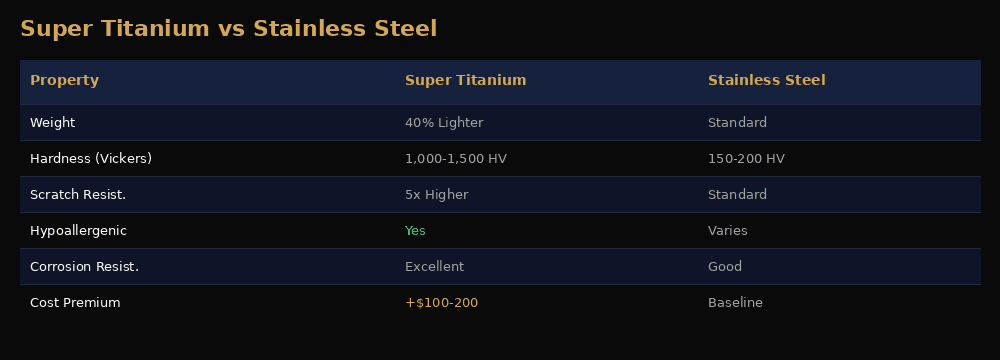
Standard titanium is already a compelling watch material: it’s roughly 40% lighter than stainless steel, hypoallergenic (ideal for sensitive skin), and naturally corrosion-resistant. The problem is that regular titanium is relatively soft and scratches easily — more easily than steel, in fact. That’s why many titanium watches look beaten up within months of regular wear.
Citizen solved this with Duratect, a surface-hardening technology that makes the titanium’s outer layer approximately five times harder than untreated stainless steel. The process involves ion plating and gas hardening at the molecular level, creating a surface that resists scratches from keys, desk edges, doorframes, and all the other daily hazards that destroy conventional watch finishes.
The result is a watch case that’s simultaneously lighter, harder, and more skin-friendly than steel. You feel the weight difference immediately when you pick up a Super Titanium watch — it almost feels too light, like something is missing. On the wrist all day, that weight reduction eliminates fatigue entirely. Super Titanium is available across the Promaster Tough, Attesa, and Satellite Wave collections, and it’s the single best reason to spend above the $300 mark in Citizen’s lineup.
Is Citizen Eco-Drive Worth It?
Let’s be direct: Citizen Eco-Drive offers the best value proposition in watches. That’s not hyperbole — it’s a function of what you get versus what you pay and what you never have to spend afterward.
Consider the total cost of ownership. A $200 Promaster Diver BN0151 will run accurately for decades with zero maintenance costs. No battery swaps ($15–$30 each, every 2–3 years), no servicing ($200–$500 per service on a mechanical watch), no winder needed when you’re not wearing it. Over a 20-year period, a $200 Eco-Drive genuinely costs $200. A $200 quartz watch costs $200 plus $100–$200 in batteries. A $500 automatic costs $500 plus $400–$1,000 in servicing.
The range is impressive. At $150, the Chandler BM8180 delivers a capable field watch. At $200, the Promaster Diver gives you a genuine ISO-certified dive watch. At $350, the Blue Angels Navihawk offers aviation chronograph complications. At $650, the Skyhawk A-T packs atomic timekeeping and world time into Super Titanium. At $1,100, the Satellite Wave GPS represents genuine technological innovation. There’s an Eco-Drive for virtually every use case and budget.
The honest downsides: Eco-Drive watches don’t offer the mechanical romance that watch enthusiasts crave. There’s no sweeping seconds hand driven by a mainspring. There’s no exhibition caseback revealing intricate gears and jewels. The resale value is low compared to Swiss luxury brands — most Eco-Drive models retain 30–50% of retail on the secondary market, whereas a watch that holds its value from Rolex or Omega might retain 70–95%.
Eco-Drive is ideal for: daily beaters you don’t want to baby, travel watches that auto-adjust across time zones, professionals who need reliable timekeeping without fuss, buyers who want maximum function per dollar, and anyone who simply doesn’t want to think about maintaining their watch. If you’re building a watch collection, an Eco-Drive makes an excellent everyday rotation piece alongside more special mechanical watches.
Frequently Asked Questions
How long does a Citizen Eco-Drive battery last?
A Citizen Eco-Drive uses a rechargeable lithium-ion cell that never needs replacing. On a full charge, most models run 6–12 months in complete darkness. Some newer models with power-save mode can last up to 7 years without any light exposure at all. Under normal wear — even indoor office lighting — the cell stays topped up indefinitely. Citizen rates the rechargeable cell for 20+ years of use before any degradation.
Can Citizen Eco-Drive charge from indoor light?
Yes. Eco-Drive solar cells are engineered to convert any light source into electrical energy — sunlight, LED bulbs, fluorescent office lighting, even a desk lamp. Indoor charging is slower than direct sunlight, but regular exposure to normal room lighting is more than enough to keep the watch running continuously. A few hours near a window once a week will maintain a full charge.
Is Citizen Eco-Drive better than automatic?
It depends on your priorities. Eco-Drive is more accurate (±15 sec/month vs ±5–10 sec/day for automatics), requires zero maintenance, and never needs a battery swap or winding. Automatic watches offer the romance of a mechanical movement, visible craftsmanship, and stronger collector appeal. For pure reliability and value, Eco-Drive wins. For horological passion and resale value, automatic wins.
What is the best Citizen Eco-Drive watch to buy?
The Promaster Diver BN0151-09L ($200) is the best overall value — an ISO 6425-certified dive watch with 200m water resistance and a striking blue dial. For aviation enthusiasts, the Blue Angels Skyhawk A-T ($650) is the flagship. For dress wear, the Corso BM7100-59E ($225) is elegant and affordable. For maximum technology, the Satellite Wave GPS CC4004-58E ($1,100) offers GPS timekeeping in a Super Titanium case.
Do Citizen Eco-Drive watches hold their value?
Eco-Drive watches are not strong value holders on the secondary market. Most models retain 30–50% of retail when sold pre-owned, which is typical for quartz-based watches and mid-range brands. However, the zero maintenance cost means your total cost of ownership over 10–20 years is extremely low. Eco-Drive watches are excellent value propositions for daily wear, not investment pieces.
Related Articles
The Bottom Line
Citizen Eco-Drive watches represent the most practical, lowest-maintenance way to own a quality timepiece. The technology is proven — nearly 50 years of continuous refinement since 1976 — and the range covers everything from a $150 military field watch to a $1,100 GPS satellite-connected chronograph in Super Titanium.
The Promaster Diver BN0151 at $200 is the collection’s crown jewel: an ISO-certified dive watch that embarrasses competitors costing five times as much. The Blue Angels lineup brings aviation complications to earth at prices that make Swiss pilot watches look absurd. And Super Titanium models deliver a wearing experience — featherlight, scratch-proof, hypoallergenic — that you genuinely cannot get from any other brand at these prices.
Eco-Drive won’t give you the soul of a mechanical movement or the resale cachet of a Swiss luxury brand. What it will give you is a watch that works flawlessly, every single day, for decades, without ever asking for anything in return except a little light. For most people, most of the time, that’s exactly what a watch should do.
Curious What Your Watch Is Worth?
Whether it’s a Citizen Eco-Drive, a vintage Seiko, or a Swiss luxury piece — snap a photo and Grailr will identify a likely model and provide an indicative price estimate, with active eBay listings where available for comparison.
Appraise Your WatchSources and price context
- Citizen Eco-Drive explanation — Confirms light-powered operation; charging and reserve depend on the model.
These primary sources support the specific history, specification or policy points noted above. Prices and resale percentages elsewhere in this guide are indicative editorial figures, not a verified transaction dataset or guaranteed returns. Confirm the exact reference, region, condition and current quote before buying; asking prices are not completed-sale prices.