Doxa SUB 200 Buying Guide: Specs, Prices and History
The SUB 200, SUB 200T, SUB 300 and SUB 300T compared — with real pricing, movement specs, and the dive-watch heritage behind every model.
Price context: this guide includes indicative prices from its original publication period. They have not all been refreshed to current quotes. Use the linked primary sources for specifications and policies, and verify prices independently.

- The Doxa SUB 200 starts around $1,120 and delivers genuine dive-watch heritage with an ETA 2824-2 automatic movement
- Every SUB 200 has 200 m water resistance, a 120-click unidirectional bezel, and a box sapphire crystal
- The SUB 300 doubles the depth rating and adds COSC certification for roughly $2,890 — about twice the price
- Five signature colorways — Sharkhunter, Professional, Aquamarine, Divingstar, Caribbean — link back to 1967 originals
A Brief History of Doxa Dive Watches
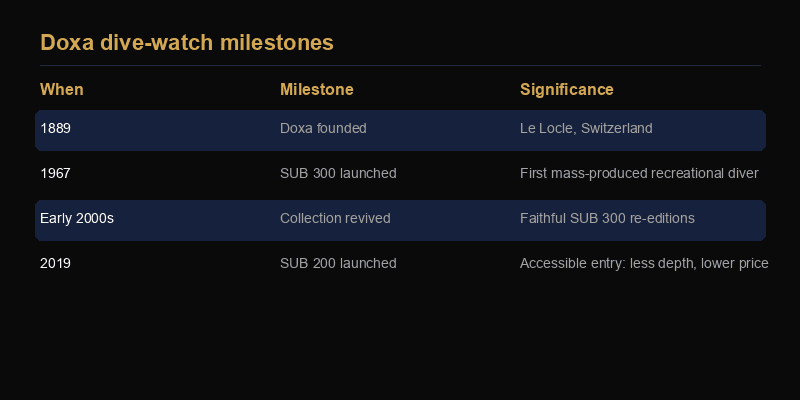
Doxa was founded in Le Locle, Switzerland, in 1889, but the brand’s place in horological history was sealed in 1967 with the SUB 300. That watch is widely credited as the first mass-produced dive watch purpose-built for recreational divers rather than military units. It introduced the “no decompression” rotating bezel — a colour-coded scale that let divers read safe bottom times at a glance — and set the template that every dive bezel since has followed in some form.
The 1967 original also gave the world the signature Doxa orange dial. The colour was not decorative: orange offered the best legibility at depth under artificial light. That engineering choice became the brand’s visual identity, and the Professional colourway still uses the same shade today.
After changing hands several times, Doxa was acquired by the Jenny family and then by the Maier Group. The modern collection was revived in the early 2000s with faithful re-editions of the SUB 300, followed by the SUB 200 in 2019 — a more accessible entry point into the lineup that kept the vintage design DNA while trimming the depth rating and price. That combination of real heritage, Swiss automatic movements, and sub-$2,000 pricing has made the SUB 200 one of the most talked-about dive watches in the enthusiast community.
Doxa SUB 200: Full Specs and What You Get
The SUB 200 is the entry point of the modern Doxa dive collection. At 42 mm across, 14 mm thick, and 46 mm lug-to-lug, it wears closer to a 40 mm watch on most wrists because the lugs curve sharply downward. The case is 316L stainless steel with a solid screw-down caseback and a screw-down crown that sits slightly inset without crown guards, keeping the profile clean. The crown features Doxa’s painted orange fish logo — a neat vintage touch.
The bezel is a 120-click unidirectional rotating design with a sapphire insert and lumed markers at the quarter-hour positions. It’s precise, grippy, and satisfying to use, though the bezel lume fades faster than the dial lume in practice. The crystal is a domed box sapphire that catches light beautifully and adds a subtle vintage distortion at steep angles — a deliberate design choice that references the acrylic crystals of the 1960s originals.
Inside is the ETA 2824-2 automatic movement: 25 jewels, 28,800 vph, 38-hour power reserve, and a date complication at three o’clock. It’s a workhorse caliber used across hundreds of Swiss watches, which means servicing is straightforward and affordable anywhere in the world. The rotor is custom-decorated with the Doxa logo. This is a standard-grade ETA, not an elaboré or top-grade version, which is one of the main specification differences between the SUB 200 and the COSC-certified SUB 300.
The standard bracelet is a beads-of-rice design with small, articulating links that drape comfortably over the wrist. It’s one of the highlights of the watch — smooth, comfortable, and a direct callback to vintage dive bracelets from the 1960s. The clasp is a stamped design with micro-adjust holes; it works, but a milled clasp would elevate the feel. Doxa also offers rubber strap options for an additional $250.
Water resistance is rated at 200 metres, which is more than sufficient for recreational scuba diving. The watch meets ISO 6425 diver’s watch standards, so the rating is not just marketing — it has been tested under the conditions the standard requires.
Every SUB 200 Colorway Explained
Doxa names each colourway after a diving role from the original 1967 SUB 300 lineup. The colours are not just cosmetic — they were originally chosen because each offered specific legibility advantages underwater. The five core colours remain consistent across the SUB 200 and SUB 300 collections:
| Colorway | Dial Colour | Original Purpose | Popularity |
|---|---|---|---|
| Professional | Orange | Maximum depth visibility | Most iconic |
| Sharkhunter | Black | Low-visibility stealth | Best seller |
| Aquamarine | Turquoise | Tropical water contrast | Rising |
| Divingstar | Yellow | Murky water visibility | Niche |
| Caribbean | Blue | Warm-water diving | Steady |
The Professional (orange) is the one collectors associate with Doxa — it is the brand’s signature. The Sharkhunter (black) is the best seller because it is the most versatile for daily wear. The Aquamarine (turquoise) has surged in popularity over the past two years, riding the broader market trend toward coloured dials. The Divingstar (yellow) and Caribbean (blue) are less common but hold steady appeal among collectors who want something distinctive.
All five colourways share the same “fauxtina” cream-toned lume on the hands and indices — a deliberate patina effect that gives the watch a vintage character straight out of the box. Super-LumiNova provides the actual glow, though multiple reviewers note the lume is adequate rather than outstanding. If night diving is your priority, the SUB 300’s lume application is somewhat stronger.
SUB 200 vs SUB 300: Which One to Buy
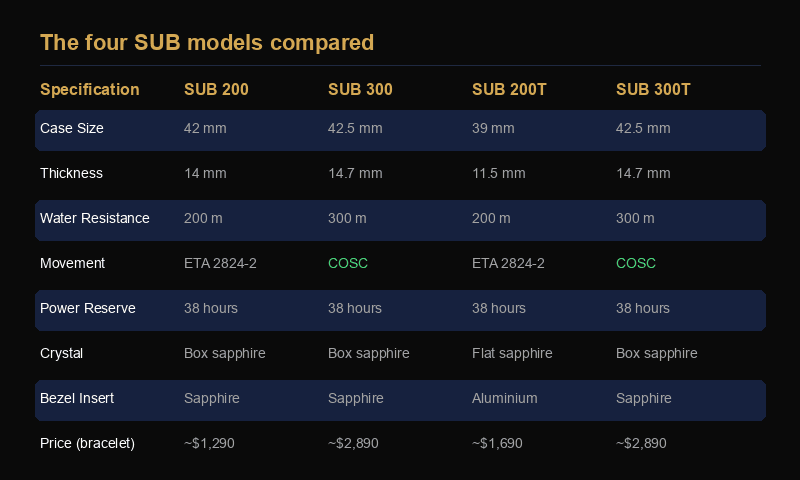
This is the central question for most Doxa buyers. The SUB 200 and SUB 300 share the same design language, the same colourway options, and the same beads-of-rice bracelet, but they differ in three meaningful ways: depth rating, movement certification, and price. Here is a direct comparison:
| Specification | SUB 200 | SUB 300 | SUB 200T | SUB 300T |
|---|---|---|---|---|
| Case Size | 42 mm | 42.5 mm | 39 mm | 42.5 mm |
| Thickness | 14 mm | 14.7 mm | 11.5 mm | 14.7 mm |
| Water Resistance | 200 m | 300 m | 200 m | 300 m |
| Movement | ETA 2824-2 | COSC Chronometer | ETA 2824-2 | COSC Chronometer |
| Power Reserve | 38 hours | 38 hours | 38 hours | 38 hours |
| Crystal | Box sapphire | Box sapphire | Flat sapphire | Box sapphire |
| Price (bracelet) | ~$1,290 | ~$2,890 | ~$1,690 | ~$2,890 |
| Bezel Insert | Sapphire | Sapphire | Aluminium | Sapphire |
For recreational divers, 200 metres is more than enough — most recreational dive certifications max out at 40 metres. The extra 100 metres on the SUB 300 matters mainly for saturation divers and as a safety margin that few wearers will ever test. The COSC certification on the SUB 300 guarantees accuracy to –4/+6 seconds per day; the standard ETA in the SUB 200 is typically accurate to –10/+20 seconds per day out of the box, though individual examples often beat that.
The practical advice: if you want the Doxa experience at the best value, buy the SUB 200. If you want the historically significant model with a certified movement and you are comfortable spending nearly $2,900, the SUB 300 is the one that connects directly to the 1967 original. Both are excellent watches. The SUB 200 is the better buy for most people.
Check Any Watch Price in Seconds
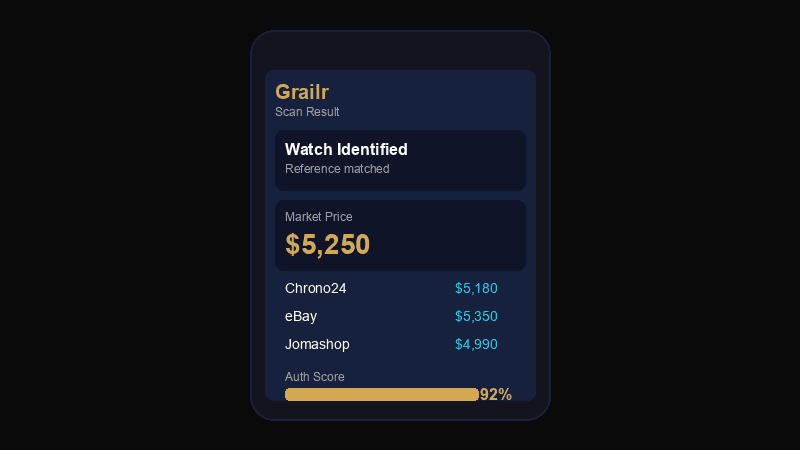
Grailr scans your watch photo and pulls live pricing from Chrono24, eBay, and Jomashop.
- AI identifies brand, model & reference number
- Live market prices from 3+ sources
- Authentication confidence score
Sizing and Wearability
On paper, 42 mm and 14 mm thick sounds like a chunky watch. In practice, the SUB 200 wears surprisingly well on wrists from about 6.5 inches and up. The key is the 46 mm lug-to-lug measurement: the lugs are short and curved, so the watch hugs the wrist rather than overhanging the edges. Most reviewers compare the wearing experience to that of a 40 mm watch from brands with longer, flatter lugs.
The beads-of-rice bracelet contributes significantly to the comfort. Its small, individually articulating links conform to the wrist shape in a way that flat-link bracelets cannot match. The stamped clasp, while functional, is the one weak point — it works fine, but does not have the solid, snappy feel of a milled clasp. The micro-adjust holes help dial in the fit, and the bracelet is easy to size without special tools.
One quirk: the lug width is 19 mm, which is non-standard. Most watches at this size use 20 mm or 22 mm. This means aftermarket strap options are limited. Doxa offers its own rubber straps, but if you like swapping straps frequently, this is worth knowing before you buy. Alternatively, a 20 mm strap can be squeezed in with slight overhang on some aftermarket options.
For wrists under 6.5 inches, the SUB 200T at 39 mm is a purpose-built solution. It shaves 3 mm off the diameter and drops to 11.5 mm thick, making it comfortable as a daily wearer even on a 6-inch wrist. The trade-off is a flat sapphire crystal instead of the box sapphire, and an aluminium bezel insert instead of sapphire. Those are meaningful downgrades if you value the vintage crystal distortion and scratch resistance, but acceptable if wrist fit is the priority.
Pricing and Resale Value
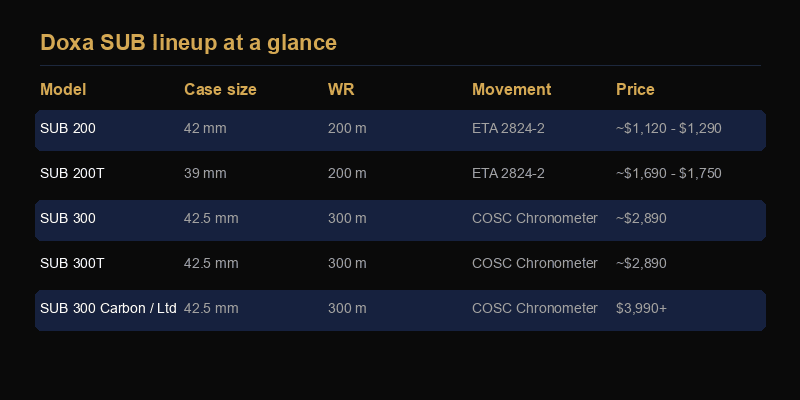
The Doxa SUB 200 is one of the best values in the sub-$2,000 Swiss dive watch category. Here is what you can expect to pay at each level of the collection:
SUB 200 (base)
~$1,120 – $1,290
Steel bracelet, standard colourway. The Professional (orange) on bracelet is approximately $1,290; other variants start around $1,120 on leather or rubber.
SUB 200T
~$1,690 – $1,750
The 39 mm version with flat sapphire crystal. Priced higher than the base SUB 200 despite fewer premium features, reflecting its newer release and strong demand.
SUB 300 Professional
~$2,890
COSC-certified, 300 m WR, the heritage model. On the beads-of-rice bracelet. This is the watch that carries the 1967 legacy forward.
SUB 300 Carbon / Limited
$3,990+
Carbon-cased or collaboration editions. These hold value best due to limited production runs and collector demand.
On the secondary market, the SUB 200 depreciates moderately. Pre-owned examples in good condition trade from about $825 to $1,000 on watch forums and marketplaces, which represents roughly 35–40% depreciation from new retail. That is typical for a sub-$2,000 Swiss watch and comparable to what you would see from Tissot, Hamilton, or Oris in the same price bracket. Limited-edition models — particularly the Clive Cussler collaborations and Carbon editions — hold value significantly better and occasionally trade above their original retail price.
If resale value is a primary concern, the SUB 200 is not an investment watch — very few watches under $3,000 are. But the depreciation is predictable and the buy-in is low enough that you are paying for the wearing experience rather than speculating on future value. Use Grailr’s appraisal tool to check current market values before buying pre-owned.
How the SUB 200 Stacks Up Against Competitors
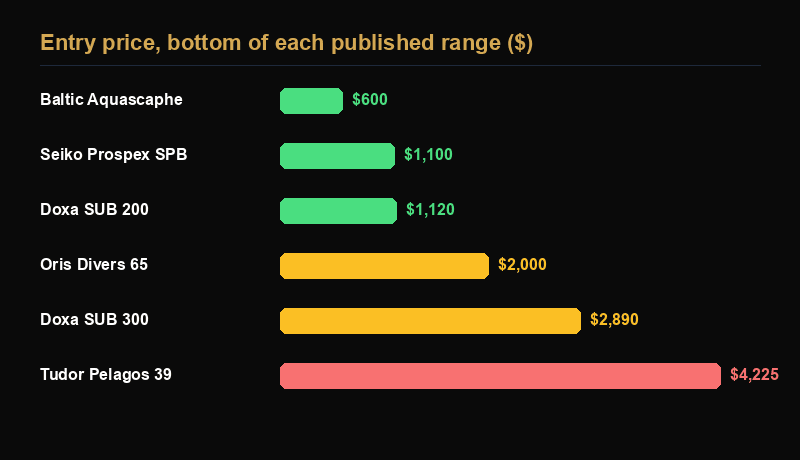
The sub-$2,000 dive watch market is extremely competitive. Here is how the Doxa SUB 200 compares with the models most often cross-shopped against it:
Baltic Aquascaphe (~$600 – $700)
The Aquascaphe undercuts the SUB 200 by half and offers similar vintage-dive aesthetics with a Miyota 9039 automatic. It’s 39 mm and wears beautifully on smaller wrists, but it runs a Japanese movement instead of Swiss, and the overall finishing is a step down from Doxa. A great alternative if budget is the priority.
Seiko Prospex SPB (~$1,100 – $1,400)
Seiko’s Prospex line offers the 6R35 movement with a 70-hour power reserve — nearly double the Doxa’s 38 hours. Build quality is excellent, and models like the SPB143 (“Baby MM”) have a strong following. The trade-off: the Seiko is a modern tool watch, not a retro-styled one, and it lacks the historical dive-watch pedigree of Doxa.
Oris Divers 65 (~$2,000)
The closest competitor in spirit: a Swiss-made vintage-style diver with proven caliber options. At roughly $2,000, it costs more than the SUB 200 but less than the SUB 300, and it offers a wider range of sizes (36 mm, 38 mm, 40 mm). The Oris is better finished overall, but it lacks the dive-tool heritage that makes a Doxa a Doxa.
Tudor Pelagos 39 (~$4,225)
Significantly more expensive, but worth mentioning because the Pelagos 39 is the titanium benchmark in dive watches. It offers an in-house COSC movement, titanium case, 200 m WR, and Rolex-grade finishing. If your budget stretches above $4,000, it is the next tier up from the Doxa SUB 300.
The SUB 200’s unique advantage is its heritage. No other watch under $1,500 can claim a direct lineage to the first mass-produced recreational dive watch. If that history matters to you — and for many collectors, it is the entire point — the SUB 200 has no real competition at its price. If you are shopping purely on specs, the Seiko SPB offers more movement for the money. Identify any of these watches with Grailr to compare current market prices side by side.
Frequently Asked Questions
What movement does the Doxa SUB 200 use?
The SUB 200 uses a standard-grade ETA 2824-2 automatic movement with 25 jewels, 28,800 vph, and a 38-hour power reserve. The SUB 300 upgrades to a COSC-certified chronometer version of a similar caliber.
How much does a Doxa SUB 200 cost?
The SUB 200 starts around $1,120 for the base model and ranges up to roughly $1,750 depending on the variant. The Professional model on bracelet is around $1,290. Pre-owned examples trade from about $825.
Is the Doxa SUB 200 a good dive watch?
Yes. With 200 m water resistance, a unidirectional 120-click bezel with sapphire insert, screw-down crown and caseback, and Super-LumiNova, the SUB 200 meets every standard for recreational diving. Its lume is adequate but not the strongest in this price range.
What is the difference between the Doxa SUB 200 and SUB 300?
The SUB 300 is rated to 300 m (versus 200 m), carries a COSC-certified chronometer movement, has a thicker case profile, and costs roughly twice as much at around $2,890. The SUB 200 offers the same design DNA at a lower price with a standard-grade ETA movement.
Does the Doxa SUB 200 hold its value?
The SUB 200 depreciates moderately on the secondary market, with pre-owned examples trading around $825 to $1,000. Limited editions and special collaborations tend to hold their value better. It is not an investment watch, but the depreciation is predictable.
What size wrist does the Doxa SUB 200 suit?
The SUB 200 measures 42 mm across but wears closer to 40 mm thanks to its compact lug-to-lug of 46 mm. It suits wrists from about 6.5 inches up. For smaller wrists, the SUB 200T at 39 mm is a better fit.
Related Articles
The Bottom Line
The Doxa SUB 200 is one of the few watches under $1,500 with a genuine claim to dive-watch history. It is not the best-specced watch in its price range — the Seiko Prospex SPB offers a longer power reserve, and the Oris Divers 65 offers better finishing — but no competitor can match its heritage or its character. The orange Professional on the beads-of-rice bracelet is one of the most distinctive watches you can wear for the money. If you want a Swiss automatic diver with real provenance, the SUB 200 is the watch to buy. If COSC certification and the direct 1967 lineage matter, step up to the SUB 300.
Considering a Doxa?
Grailr uses a photo to suggest a watch identity and an indicative price estimate, with active eBay listings where available. Check the exact reference and condition independently; a photo scan cannot authenticate a watch.
Scan a Watch NowSources and price context
- Doxa SUB 200 collection page — Official specifications, colourway options and current retail pricing for the full SUB 200 lineup.
- aBlogtoWatch Doxa SUB 200 review — Independent hands-on review covering case dimensions, bracelet quality, movement performance and lume.
These primary sources support the specific specification and pricing points noted above. Prices and resale percentages elsewhere in this guide are indicative editorial figures, not a verified transaction dataset or guaranteed returns. Confirm the exact reference, region, condition and current quote before buying; asking prices are not completed-sale prices.