Jacob & Co Watches: Every Collection and Price
From the Five Time Zone that started a cultural moment to the Astronomia that rewrote what a tourbillon could look like — every Jacob & Co collection explained with real pricing.

- Jacob & Co ranges from ~$4,800 (Five Time Zone quartz) to $18 million (the Billionaire)
- The Astronomia’s triple-axis tourbillon is one of the most visually dramatic complications in modern watchmaking
- Five Time Zone models are the most accessible entry point, with pre-owned examples from roughly $1,300
- Resale varies dramatically by collection — Five Time Zone loses 50–70%, while limited Astronomia editions can hold or exceed retail
Who Is Jacob & Co?
Jacob Arabo founded Jacob & Co in 1986 as a jewelry workshop on West 47th Street in Manhattan’s Diamond District. The brand stayed small until the late 1990s, when hip-hop artists discovered Arabo’s diamond-setting work. Within a few years, the “Jacob the Jeweler” name had become a cultural reference point — namechecked in songs by Notorious B.I.G., Jay-Z, and Kanye West.
The pivot to watchmaking came in 2002 with the Five Time Zone, a bold 47 mm quartz watch with five independent sub-dials, each set to a different time zone. It was not a haute horlogerie statement — it was a style statement, and it sold on that basis. Retailers could not keep them in stock. The design became so widely copied that it effectively created its own sub-genre of fashion watches.
Since then, Jacob & Co has moved aggressively upmarket. The brand now produces genuinely complex mechanical watches — triple-axis tourbillons, musical complications, and engine-block-inspired movements — manufactured in Geneva with proprietary calibres. The celebrity roots remain (the brand still has high-profile ambassadors), but the horological credibility is real. Whether the prices make sense depends on what you want from a watch, and we will walk through that collection by collection.
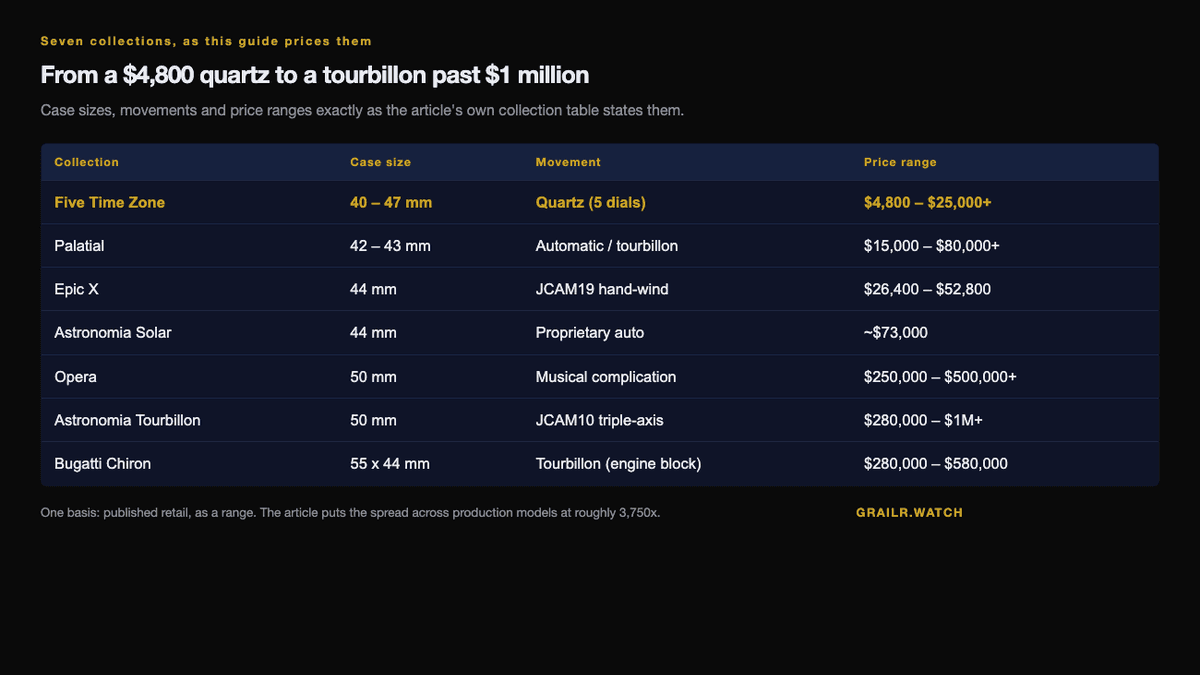
Every Collection Explained
Five Time Zone ($4,800–$25,000+)
The watch that started it all. The Five Time Zone places five independent quartz sub-dials around a central mother-of-pearl or pavé dial, each displaying a different city’s time. The standard case is 40 mm (a 47 mm version also exists), and materials range from stainless steel to 18K gold with factory-set diamonds. It remains Jacob & Co’s entry point: a steel quartz model retails from approximately $4,800, while diamond-set gold variants push past $25,000.
On the secondary market, older steel Five Time Zone models trade from roughly $1,300 to $5,000 depending on condition and configuration. That makes them far more accessible than any other Jacob & Co product, and they remain the volume driver of the brand’s pre-owned market.
Epic X ($26,400–$52,800)
The Epic X is Jacob & Co’s sports-watch platform and its most visible pivot toward serious horology. The 44 mm case (titanium, carbon fibre, or ceramic) frames a skeletonised dial that shows the proprietary JCAM19 hand-winding calibre. The movement runs at 28,800 vph with a 48-hour power reserve. Standard models retail from about $26,400; the chronograph version, which adds a column-wheel mechanism, reaches $52,800. Limited editions in precious metals or with baguette-diamond bezels climb further.
Astronomia ($73,000–$1 million+)
The Astronomia is the centrepiece of Jacob & Co’s haute horlogerie ambitions and the reason serious collectors pay attention to the brand. A gravitational triple-axis tourbillon rotates through 360 degrees inside a sapphire-crystal dome, accompanied by rotating elements — a lacquered globe, a diamond sphere, and a time display — all orbiting the central axis. The effect is part orrery, part kinetic sculpture.
The entry point is the Astronomia Solar at approximately $73,000. The Astronomia Tourbillon, which adds the full triple-axis complication, starts around $280,000. High-jewelry versions set with baguette diamonds exceed $1 million, and the one-of-a-kind Astronomia Tourbillon Baguette has carried an asking price above $1.5 million.
Palatial ($15,000–$80,000+)
The Palatial is Jacob & Co’s classical dress-watch line. It encompasses a range of complications — moon phase, tourbillon, and flying tourbillon variants — in round cases sized 42–43 mm. Prices start around $15,000 for a three-hand automatic and climb past $80,000 for the Palatial Flying Tourbillon Minute Repeater. These are the quietest watches Jacob & Co makes, and they rarely appear in the brand’s marketing.
Opera ($250,000–$500,000+)
The Opera houses a musical complication: a miniature cylinder mechanism that plays a melody when activated by a pusher. The most famous version is the Opera Godfather, which plays the movie’s theme. These are strictly limited, hand-assembled in Geneva, and priced from roughly $250,000. They sit alongside the Astronomia at the top of the brand’s complication hierarchy.
Bugatti Chiron Tourbillon ($280,000–$580,000)
A collaboration with the Bugatti hypercar brand. The movement is built to resemble a miniature W16 engine block, with a tourbillon visible through the case side. The 55 mm × 44 mm tonneau case wears on a strap shaped to the wrist. The base titanium version retails around $280,000; sapphire-crystal editions have been listed above $580,000.
| Collection | Case Size | Movement | Price Range |
|---|---|---|---|
| Five Time Zone | 40–47 mm | Quartz (5 dials) | $4,800–$25,000+ |
| Epic X | 44 mm | JCAM19 hand-wind | $26,400–$52,800 |
| Astronomia Solar | 44 mm | Proprietary auto | ~$73,000 |
| Astronomia Tourbillon | 50 mm | JCAM10 triple-axis | $280,000–$1M+ |
| Palatial | 42–43 mm | Automatic / tourbillon | $15,000–$80,000+ |
| Opera | 50 mm | Musical complication | $250,000–$500,000+ |
| Bugatti Chiron | 55 × 44 mm | Tourbillon (engine block) | $280,000–$580,000 |
Pricing Across the Range
Jacob & Co pricing spans a wider range than almost any other watch brand. The gap between the cheapest and most expensive current-production models is roughly 3,750× — from a $4,800 quartz Five Time Zone to the $18 million Billionaire. For context, the equivalent ratio at Rolex is about 14× (Oyster Perpetual 36 to Rainbow Daytona).
That breadth matters because it means the brand attracts two very different buyers. One wants a recognisable name on a fashion-forward quartz watch for under $10,000. The other wants a six-figure mechanical complication that no other brand makes. The horological value proposition is much stronger in the second group — the Astronomia and Opera complications genuinely have no direct equivalents from the established Swiss houses.
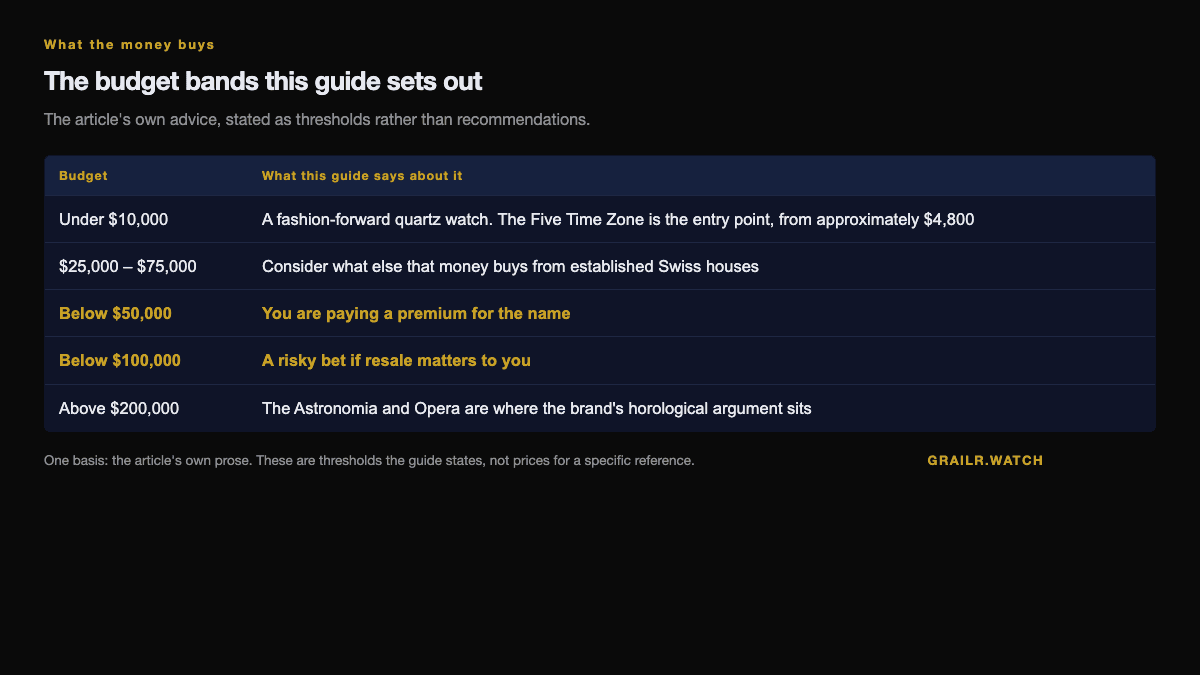
If your budget sits between $25,000 and $75,000, consider what else that money buys: a pre-owned Audemars Piguet Royal Oak, a new Omega Speedmaster Moonshine Gold, or a Jaeger-LeCoultre Reverso Hybris Mechanica. The Epic X is visually striking but gives up the resale safety net those brands provide. Above $200,000, the Astronomia and Opera stand more on their own — the complications are unique enough that direct alternatives barely exist.
Check Any Watch Price in Seconds
Grailr scans your watch photo and pulls live pricing from Chrono24, eBay, and Jomashop.
- AI identifies brand, model & reference number
- Live market prices from 3+ sources
- Authentication confidence score

Astronomia Deep Dive
The Astronomia is the reason Jacob & Co commands attention in horological circles. Introduced in 2014, it was one of the first watches to turn the tourbillon into a three-dimensional spectacle rather than a flat complication visible through a case back. The entire movement — tourbillon cage, time display, and orbiting elements — rotates 360° every 10 minutes inside a domed sapphire crystal.
The proprietary JCAM10 calibre is hand-wound with approximately 60 hours of power reserve. It runs at 21,600 vph (3 Hz) and uses a double-axis tourbillon in its standard form, with the triple-axis version reserved for higher-tier models. The movement consists of 342 components and is assembled in Jacob & Co’s Geneva atelier. Jacob & Co’s official Astronomia page shows the full current lineup.
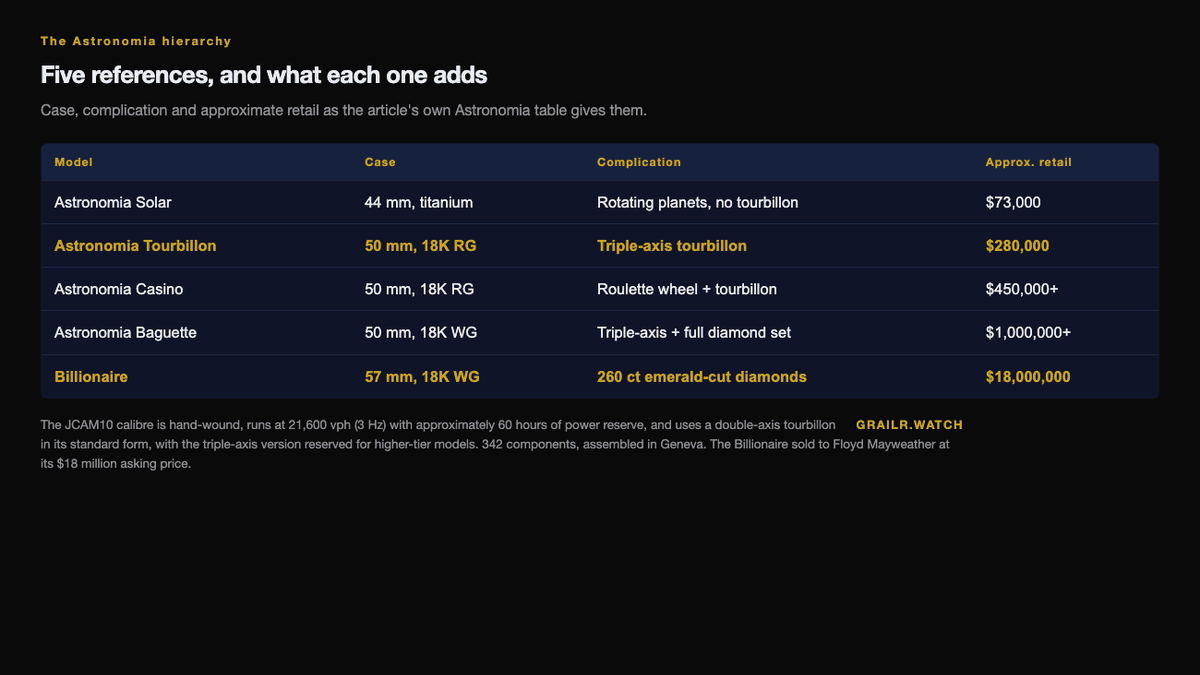
| Model | Case | Complication | Approx. Retail |
|---|---|---|---|
| Astronomia Solar | 44 mm, titanium | Rotating planets, no tourbillon | $73,000 |
| Astronomia Tourbillon | 50 mm, 18K RG | Triple-axis tourbillon | $280,000 |
| Astronomia Casino | 50 mm, 18K RG | Roulette wheel + tourbillon | $450,000+ |
| Astronomia Baguette | 50 mm, 18K WG | Triple-axis + full diamond set | $1,000,000+ |
| Billionaire | 57 mm, 18K WG | 260 ct emerald-cut diamonds | $18,000,000 |
The Astronomia is not a watch for people who already own everything from Patek Philippe and Audemars Piguet. It is a watch that attracts people who want something those brands do not make — a mechanical spectacle that moves, rotates, and commands attention from across a room. Whether that justifies six or seven figures is a question only the buyer can answer.
Resale and Investment Reality
Jacob & Co’s resale performance varies more by collection than almost any other brand. The Five Time Zone, despite being the brand’s icon, depreciates heavily: expect to recover roughly 30–50% of retail on a standard steel model. Diamond-set versions fare slightly better in absolute dollars but still lose a significant percentage. The brand’s celebrity association cuts both ways — it drives initial demand but makes fashion-cycle depreciation steeper.
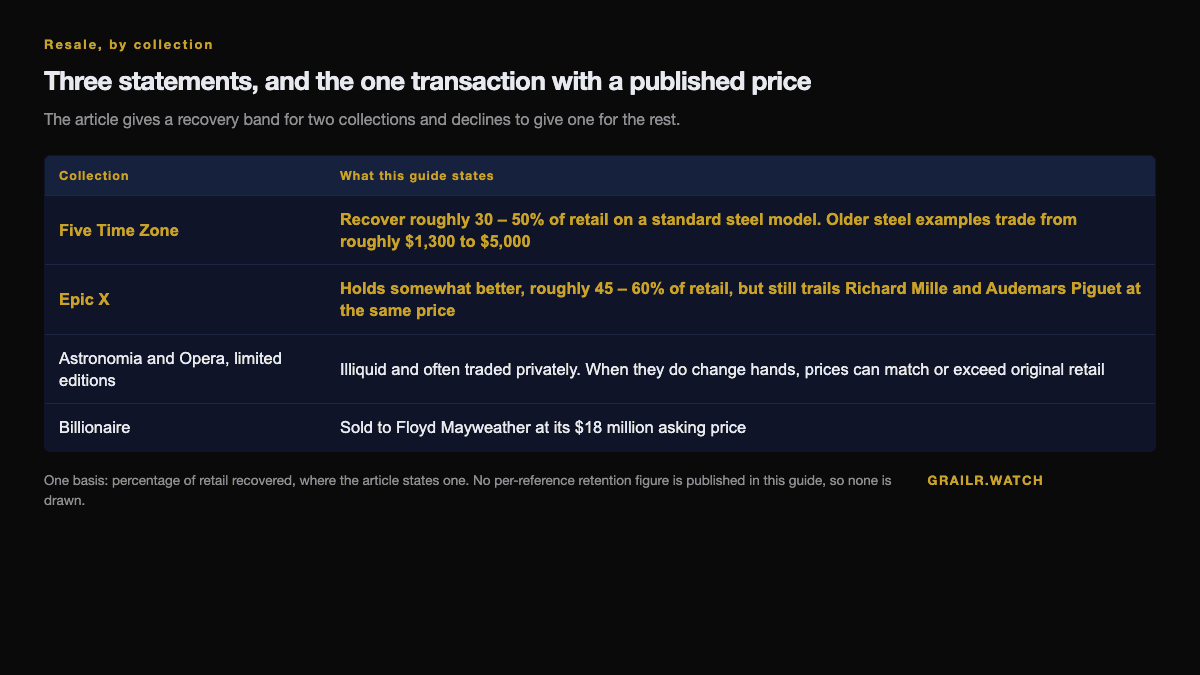
The Epic X holds somewhat better — roughly 45–60% of retail — because the mechanical movement and sportier design give it a longer shelf life. But it still trails the resale performance of comparable-priced watches from Richard Mille or Audemars Piguet.
At the haute horlogerie tier, the picture changes. Limited-edition Astronomia and Opera pieces are illiquid — transactions are rare and often private — but when they do change hands, prices can match or exceed original retail. The Billionaire sold to Floyd Mayweather at its $18 million asking price, and unique Astronomia commissions have been reported at auction above their original quotes.
The practical advice: if resale matters to you, Jacob & Co is a risky bet below the $100,000 mark. If you are buying a six- or seven-figure Astronomia because you genuinely want a mechanical sculpture for your wrist, the resale question is less relevant — these are passion purchases, not investments. Use Grailr’s indicative value tool to check current market positioning before committing.
How to Buy a Jacob & Co Watch
New from an authorised dealer. Jacob & Co sells through its own boutiques in New York, Dubai, Geneva, and other major cities, plus authorised retailers like Watches of Switzerland and Bucherer. The advantage is a factory warranty (typically two years) and the certainty of receiving a genuine product. The disadvantage is that discounting is rare on new models, and many Astronomia and Opera references are made to order with lead times measured in months.
Pre-owned. The secondary market is where most Five Time Zone and Epic X purchases happen. Chrono24 and specialist dealers carry a wide selection. Always verify authenticity — the Five Time Zone was heavily counterfeited during its peak popularity in the 2000s. Use Grailr’s authentication confidence score as a starting point, and insist on original box and papers when possible.
At auction. High-value Astronomia and Opera pieces occasionally appear at Christie’s and Sotheby’s. Auction is the only reliable price-discovery mechanism for unique or one-of-a-kind references, and buyer’s premiums (typically 20–26%) need to be factored into the total cost.
What to check. On any Jacob & Co watch, verify the serial number against the warranty card, inspect diamond-set models under magnification for replaced stones, and confirm the movement is the correct calibre for the reference. The brand’s wide model range means condition and completeness vary significantly on the secondary market. Grailr’s watch identification tool can help confirm the model and reference from a photograph.
Frequently Asked Questions
What is the cheapest Jacob & Co watch?
Are Jacob & Co watches worth the money?
Do Jacob & Co watches hold their value?
What movement does the Jacob & Co Astronomia use?
Where can I buy a Jacob & Co watch?
What is the most expensive Jacob & Co watch ever made?
Related Guides
Richard Mille Watch Guide
Every RM collection with specs, pricing and resale data.
High-End Watches Guide
The top luxury watch brands compared for 2026.
Audemars Piguet Price Guide
AP pricing across Royal Oak, Offshore and Code 11.59.
Floyd Mayweather Watch Collection
Every piece in Mayweather's collection from Jacob & Co to Patek.
The Bottom Line
Jacob & Co is not for everyone, and the brand knows it. The Five Time Zone remains a recognisable, accessible entry point with celebrity cachet — but the real horological story is higher up the range. The Astronomia and Opera complications are genuinely unique in modern watchmaking, and if the theatricality appeals to you, no other brand makes anything comparable.
Just go in with clear expectations. Below $50,000, you are paying a premium for the name and the design — not for resale safety. Above that threshold, the mechanical complexity begins to justify the price on its own merits. Know which buyer you are before you write the cheque.
Not Sure What Your Watch Is Worth?
Upload a photo and let Grailr identify the model, pull live market prices, and give you an authentication confidence score — in seconds.
Scan Your Watch Free