Best Left-Handed Watches: Destro Models, Pricing, and What to Know
A left-handed watch places the crown at nine o’clock for right-wrist wear — here is every serious option from budget to luxury, with the pricing and resale data to match.
Price context: this guide includes indicative prices from its original publication period. They have not all been refreshed to current quotes. Use the linked primary sources for specifications and policies, and verify prices independently.

- Left-handed (destro) watches place the crown at 9 o’clock, making them comfortable for right-wrist wear
- The market spans roughly $450 (Gruppo Ardito Lince) to over $15,000 pre-owned (Rolex GMT-Master II “Sprite”)
- Tudor’s Pelagos LHD and Rolex’s 126720VTNR are the two strongest resale performers in the category
- Destro watches originated with military divers who wore watches on the right wrist to clear equipment
- You do not need a dedicated destro to be left-handed — most people wear a standard watch on either wrist without issues
What Makes a Watch Left-Handed?
On a standard wristwatch the crown sits at the 3 o’clock position — the right side of the case. That placement assumes you wear the watch on your left wrist and wind or set it with your right hand, which works perfectly for the roughly 90% of the population that is right-handed. For the other 10%, or for anyone who prefers to wear a watch on the right wrist, the crown-right layout creates a specific problem: the crown and any crown guards press into the back of the hand during wrist extension, which ranges from mildly annoying at a desk to genuinely uncomfortable during physical work or sport.
A left-handed watch — often called a “destro” watch, from the Italian word for “right,” referring to right-wrist wear — solves this by moving the crown to the left side of the case, typically at 9 o’clock. With the crown on the opposite side, nothing digs into the hand when the wrist flexes, and setting the time feels natural because your left hand now does the winding.
The distinction matters most on watches with prominent crowns or crown guards, like Panerai’s Luminor line with its signature lever bridge, or dive watches with oversized screw-down crowns. On a thin dress watch with a recessed crown, the discomfort gap between left and right placement narrows considerably. That is why the destro market skews heavily toward tool watches and dive watches rather than formal pieces: the crown is bigger, the guard is more pronounced, and the wearer is more likely to be doing something active that bends the wrist repeatedly.
Military Origins of Destro Watches
The destro concept did not start as a consumer convenience — it started as a military requirement. Combat divers and special-forces operators have historically worn watches on the right wrist to keep the crown and case away from equipment strapped to the left forearm: compass boards, depth gauges, weapon-mounted accessories, and parachute rigging all sit in positions that conflict with a protruding crown on the left wrist. Moving the watch to the right wrist and the crown to the left side of the case cleared that interference without giving up quick time checks during an operation.
Panerai’s connection to the Italian Navy’s Decima Flottiglia MAS during the mid-twentieth century is the most famous example. The brand produced oversize dive instruments with luminous dials for frogmen who needed to read time and elapsed minutes underwater, in poor visibility, at a glance. The Luminor’s crown-protect bridge — a lever that locks the crown down against water pressure — became particularly relevant in a destro layout because a protruding bridge on the wrong side of the wrist can catch on equipment or restrict movement at exactly the wrong moment.
Tudor’s Pelagos LHD continued the tradition when it arrived in 2016. The “LHD” designation stands for “Left Hand Drive,” and the watch was developed with similar military-adjacent use in mind: professional divers and military personnel who needed a robust, titanium-cased tool on the right wrist. More recently, Rolex entered the category with the 2022 GMT-Master II ref. 126720VTNR — the green-and-black “Sprite” — placing its crown at 9 o’clock for the first time on a modern GMT-Master. The military justification has largely given way to collector interest and personal preference, but the design logic remains the same.
Best Left-Handed Watches Compared
| Model | Case | Crown | Water Resist. | Retail | Pre-Owned |
|---|---|---|---|---|---|
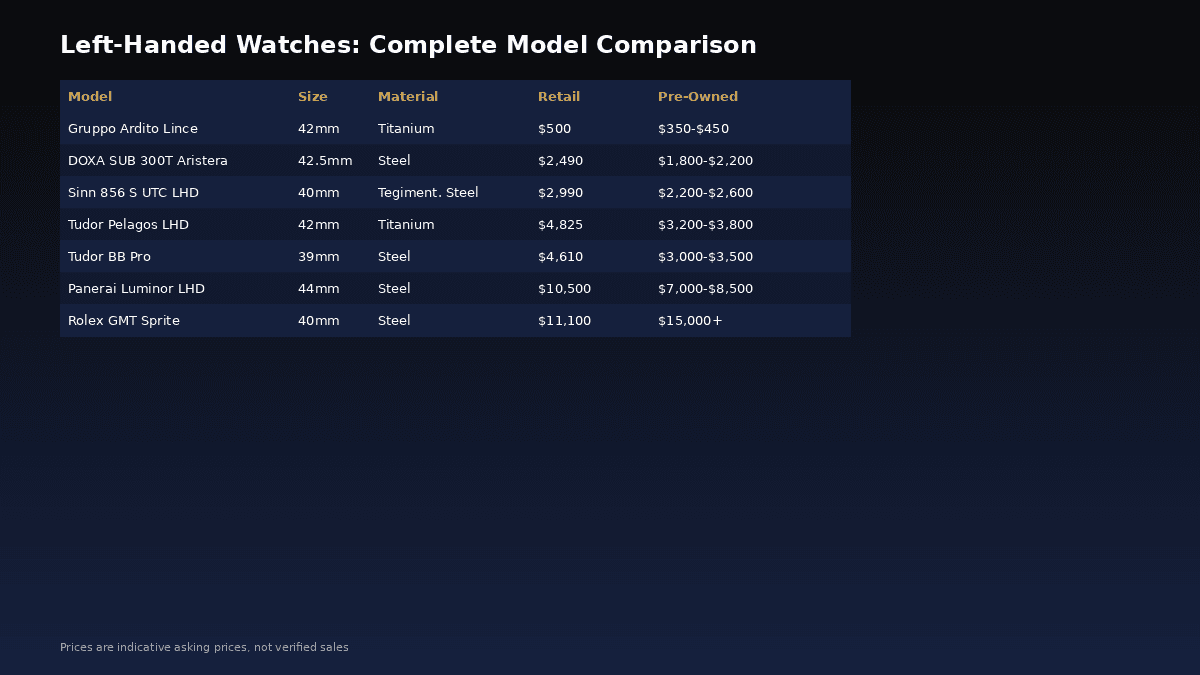
| Gruppo Ardito Lince Blue | Ti, field | 8 o’clock | 100m | $450–$600 | — |
| DOXA SUB 300T Aristera | 42.5mm SS | 9 o’clock | 300m | $2,490 | $1,800–$2,100 |
| Sinn 856 S UTC LHD | 40mm teg. SS | 9 o’clock | 200m | $2,990 | $2,200–$2,600 |
| Tudor Pelagos LHD | 42mm Ti | 9 o’clock | 500m | $4,825 | $3,200–$3,800 |
| Panerai Luminor LHD | 44–47mm SS | 9 o’clock | 300m | $10,500–$14,800 | $7,000–$10,000 |
| Rolex GMT-Master II “Sprite” | 40mm SS | 9 o’clock | 100m | $11,100 | $15,000–$17,000 |
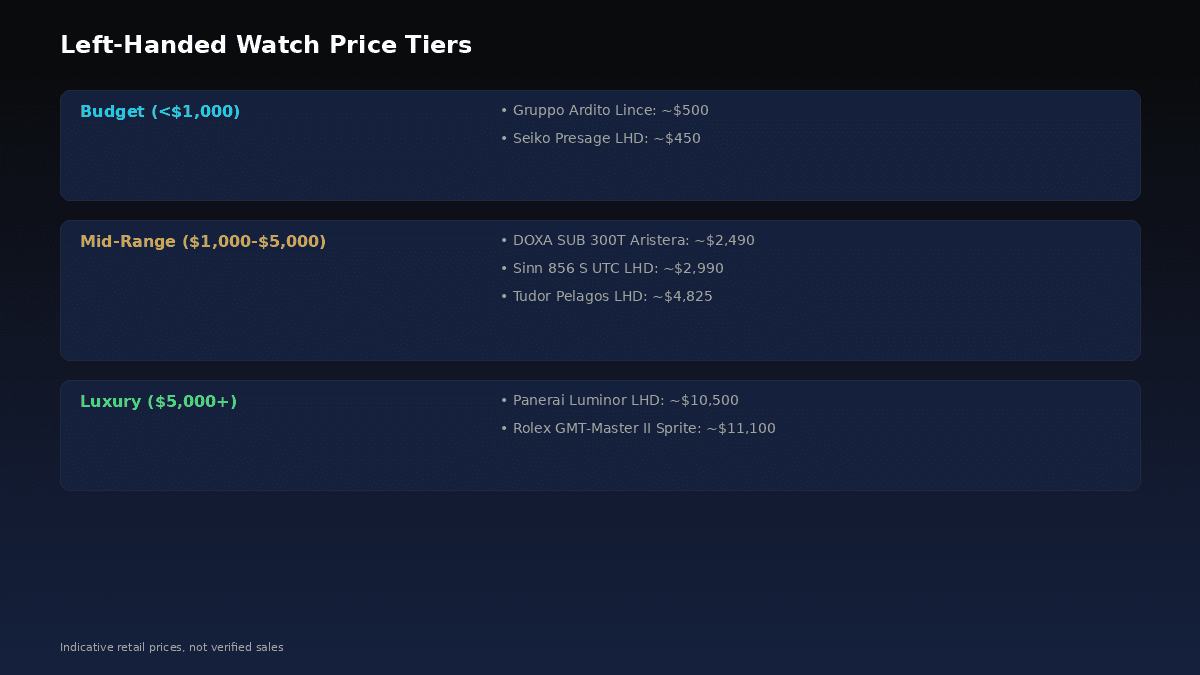
Budget: Gruppo Ardito Lince Blue — ~$450–$600
The most affordable serious destro option on the market. The Lince Blue uses a titanium case with a screw-down crown positioned at 8 o’clock rather than 9, which pushes it even further from the back of the hand. It is a field watch rather than a diver, rated to 100m, and it does not carry the brand recognition of the Swiss names on this list — but for a left-handed wearer who wants the ergonomic benefit without spending thousands, it delivers the essentials. Pre-owned availability is limited since it is a microbrand with small production runs.
Mid-Range: Tudor Pelagos LHD (25610TNL) — ~$4,825
Tudor’s purpose-built left-hand-drive diver is the category benchmark for most buyers. A 42mm titanium case, 500m of water resistance, the in-house MT5612-LHD caliber with a 70-hour power reserve, and a self-adjusting titanium bracelet — all in a left-crown configuration built from the ground up rather than simply mirroring an existing dial. Pre-owned pricing between $3,200 and $3,800 makes it the strongest value proposition in the mid-range. For a deeper look at the full Pelagos lineup, including the standard crown-right models, see our dedicated guide.
Luxury: Rolex GMT-Master II “Sprite” (126720VTNR) — ~$11,100
The first modern Rolex with its crown at 9 o’clock. The green-and-black “Sprite” bezel sits on a 40mm Oystersteel case running the Caliber 3285, with a Jubilee bracelet and the full GMT two-time-zone function. Because it is both a genuine destro and a sought-after Rolex sports reference, it trades well above its $11,100 retail price — pre-owned examples typically sell for $15,000 to $17,000, making it one of the few watches in any category where the secondary market consistently exceeds list price. For context on how the Sprite fits alongside the Pepsi and Batman, see our Rolex GMT colour guide.
Check Any Watch Price in Seconds
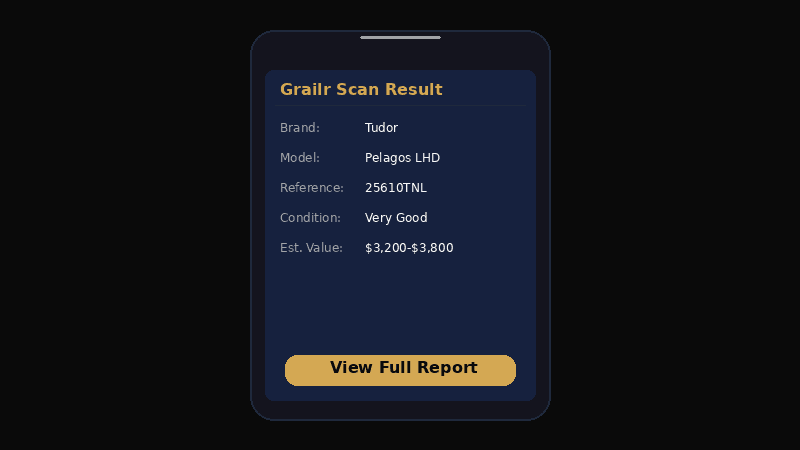
Grailr scans your watch photo and pulls live pricing from Chrono24, eBay, and Jomashop.
- AI identifies brand, model & reference number
- Live market prices from 3+ sources
- Authentication confidence score
Crown Position and Daily Comfort
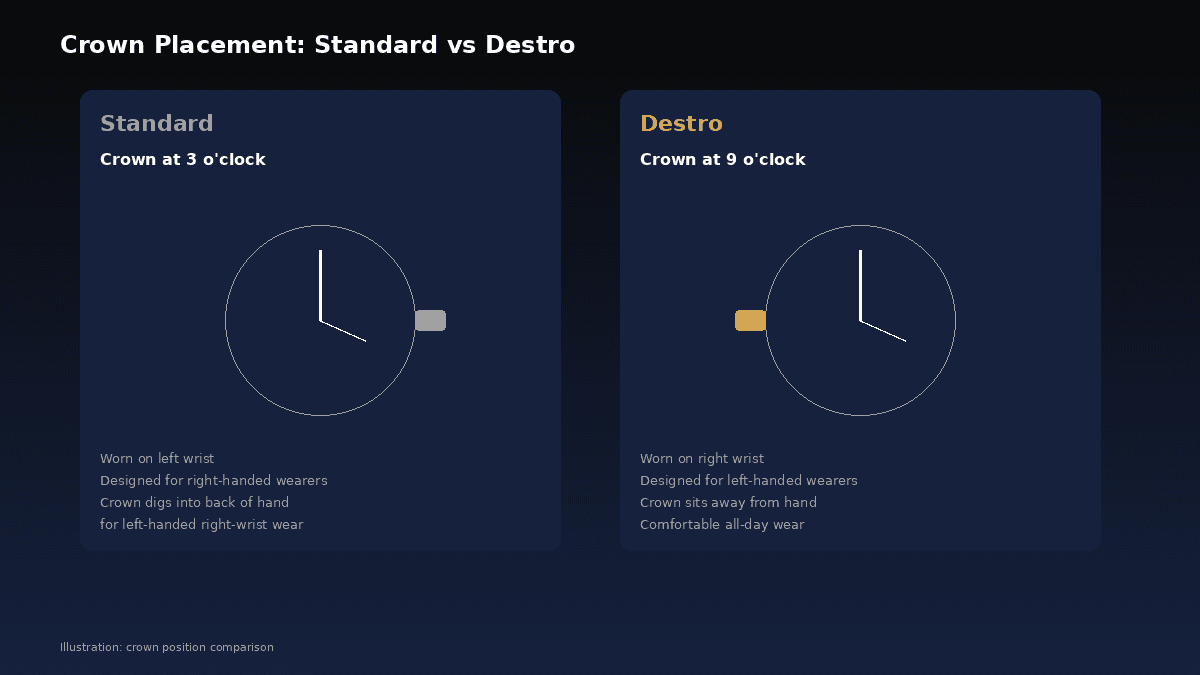
The comfort difference between a crown at 3 and a crown at 9 is most noticeable during activities that flex the wrist sharply backward — push-ups, cycling on drop handlebars, typing on a low keyboard, or gripping tools with a firm hold. In each case the back of the hand moves toward the crown side of the case, and a protruding crown digs into the skin or bone. On watches with a screw-down crown and no crown guard, the protrusion is usually small enough that many wearers never notice. On watches with a significant crown guard, like Panerai’s Luminor lever bridge, the difference is pronounced.
Not every destro places the crown at exactly 9 o’clock. The Gruppo Ardito Lince positions it at 8, pulling it further from the back of the hand at the cost of a slightly less conventional look. Tudor and Rolex keep to 9, which preserves the symmetrical dial layout most wearers expect. Panerai’s crown guard at 9 is the most visually distinctive configuration — the bridge mechanism is both larger and more angular than a bare crown, so the destro version changes the watch’s entire aesthetic profile rather than just its ergonomics.
If you are not sure whether crown placement will bother you, try wearing your current watch on the opposite wrist for a week. If the crown creates discomfort, a destro will solve it. If you barely notice, you may not need a dedicated left-hand-drive model at all — though you may still want one for the military heritage or the collector appeal.
Resale and Value Retention
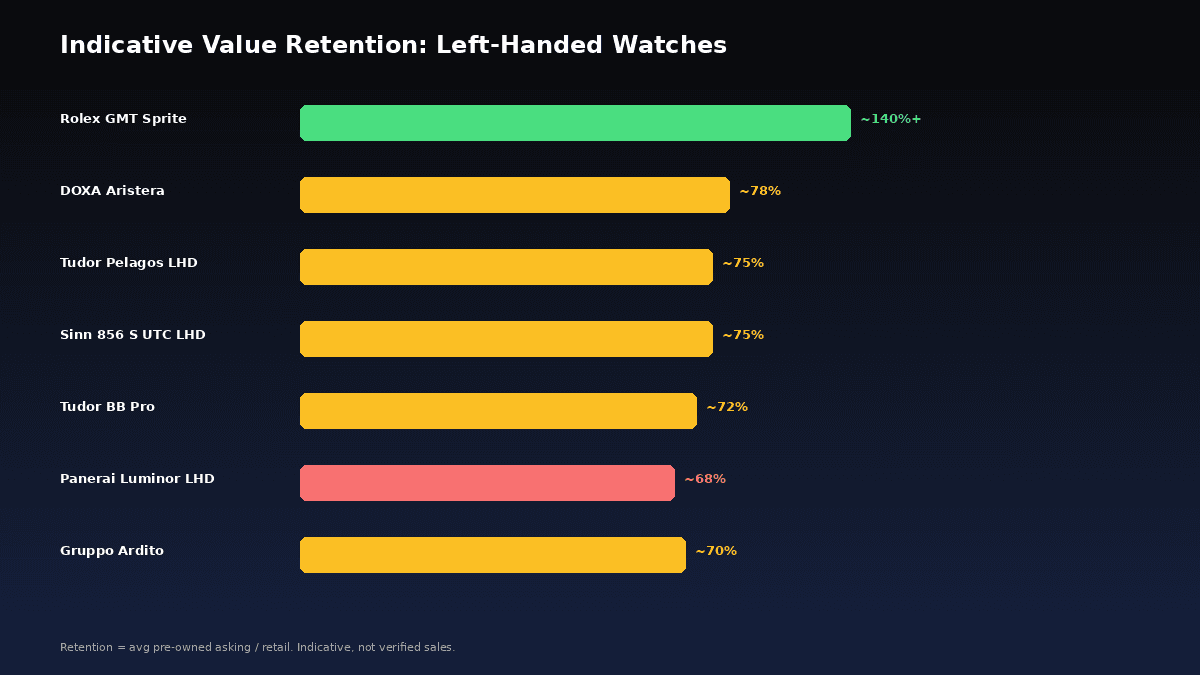
| Model | Retail | Typical Pre-Owned | Indicative Retention |
|---|---|---|---|
| DOXA SUB 300T Aristera | $2,490 | $1,800–$2,100 | 70–80% |
| Tudor Pelagos LHD | $4,825 | $3,200–$3,800 | 70–80% |
| Panerai Luminor LHD | $10,500–$14,800 | $7,000–$10,000 | 55–70% |
| Rolex GMT-Master II “Sprite” | $11,100 | $15,000–$17,000 | 130–150%+ |
The Rolex “Sprite” is the clear outlier. It is one of a small number of current-production watches that consistently trade above retail, driven by collector demand for the first modern left-handed Rolex GMT and the general scarcity of Rolex sports models at authorized dealers. That premium is not guaranteed to last indefinitely — if Rolex increases production or the secondary market softens, the spread above retail will narrow — but it has held since the watch’s 2022 introduction.
Tudor’s Pelagos LHD and the DOXA Aristera sit in a more typical range: 70–80% retention, which means buying pre-owned limits your exposure to further depreciation. Panerai’s destro models show the widest spread in the group, reflecting both higher retail prices and a deeper discount curve that Panerai sees across much of its catalog on the secondary market.
If resale matters to you, the Sprite is the strongest performer but also the highest entry price. The Tudor LHD offers the best balance of accessible pricing and solid retention. In either case, verify current asking prices before assuming any indicative percentage will hold at the time you sell — these are starting points for research, not locked-in returns. For broader context on which brands hold value, see our guide to the best watches for men in 2026.
Do You Actually Need a Destro?
Honest answer: probably not, unless the crown on your current watch actively bothers you on the right wrist. Millions of left-handed people worldwide wear standard crown-right watches daily without complaint, either on their left wrist (where the crown is irrelevant to hand comfort) or on their right wrist (where many crowns are small enough not to interfere). The destro solves a real ergonomic problem, but the severity of that problem depends on the specific watch, the specific activity, and the specific wrist.
Where a destro makes the strongest case is in active use: scuba diving, military fieldwork, manual trades, and endurance sports where the wrist flexes repeatedly under load. In those settings a protruding crown at 3 o’clock on the right wrist is not a minor annoyance — it can cause skin irritation over hours and catch on gloves, straps, or equipment. If that describes your typical wear, a purpose-built destro is a genuine upgrade in daily comfort.
For casual and desk-job wear, the decision is more about preference and collecting interest than strict necessity. Destro watches carry a niche appeal — the military backstory, the unusual crown placement, the smaller production runs — that attracts collectors independently of left-handedness. There is nothing wrong with buying one purely because you like how it looks and what it represents, even if you could comfortably wear a standard watch. Just do not overpay for a feature you may not functionally need; the Grailr scanner can pull current asking prices for any destro listing to help you gauge fair value before committing.
Frequently Asked Questions
What is a left-handed (destro) watch?
A left-handed or destro watch places its crown on the left side of the case, typically at 9 o’clock, instead of the standard 3 o’clock position. This makes it more comfortable to wear on the right wrist, where the crown does not dig into the back of the hand.
Can left-handed people just wear a regular watch?
Yes. Many left-handed people wear a standard crown-right watch on their right wrist without major issues. A destro watch improves comfort by moving the crown away from the hand, but it is not strictly necessary for everyday wear.
What is the best left-handed watch under $5,000?
The Tudor Pelagos LHD (25610TNL) is widely considered the strongest option under $5,000. It offers a 42mm titanium case, 500m water resistance, an in-house MT5612-LHD movement with 70-hour power reserve, and pre-owned prices typically between $3,200 and $3,800.
Why does the Rolex GMT-Master II Sprite trade above retail?
The GMT-Master II 126720VTNR is the first left-handed Rolex GMT in modern production, which makes it a collector piece on top of the standard GMT waitlist scarcity. Pre-owned prices run 130 to 150 percent or more of the $11,100 retail price, driven by limited supply and strong demand.
Does Panerai make left-handed watches?
Yes. Panerai has produced several Luminor models with the crown guard on the left side, including the PAM01655 and PAM00557. Their cases range from 44mm to 47mm, and the distinctive crown-protect bridge makes Panerai one of the most recognizable names in left-handed watch design.
Are destro watches harder to resell?
Not necessarily, but the buyer pool is smaller. Models from major brands like Rolex, Tudor and Panerai hold value well because collectors specifically seek them. Niche or microbrand destro watches may take longer to sell because fewer buyers are looking for that exact configuration.
Related Articles
The Bottom Line
Left-handed watches solve a genuine ergonomic problem for right-wrist wearers — and they carry a military heritage and collector cachet that makes them interesting even if you don’t strictly need one. The Tudor Pelagos LHD is the easiest recommendation for most buyers: titanium build, 500m depth rating, strong resale, and pre-owned prices that make the value case straightforward. The Rolex “Sprite” sits at the other end of the spectrum as both the most prestigious and the most expensive destro in current production. Whatever you choose, verify the exact reference, condition and current market price before committing — a photo and a listing headline are a starting point, never a guarantee.
Found a Left-Handed Watch You Like?
Grailr uses a photo to suggest a watch identity and an indicative price estimate, with active eBay listings where available. Check the exact reference and condition independently; a photo scan cannot authenticate a watch.
Get an Indicative EstimateSources and price context
- Tudor Pelagos collection — Official specifications for the Pelagos LHD, including case dimensions, the MT5612-LHD movement and water resistance.
- Panerai Luminor collection — Official specifications for left-handed Luminor references, including the crown-protect bridge, case sizes and movement details.
These primary sources support the specifications noted above. Prices and resale percentages elsewhere in this guide are indicative editorial figures, not a verified transaction dataset or guaranteed returns. Confirm the exact reference, region, condition and current quote before buying; asking prices are not completed-sale prices.