Rolex GMT Pepsi vs Batman vs Sprite: Which One to Buy in 2026
The Pepsi just became a legend. Rolex discontinued the 126710BLRO in early 2026, and secondary market prices have already surged past $25,000. Meanwhile the Batman holds steady as the everyday GMT, and the Sprite remains the most polarizing watch in the lineup. If you’re choosing between these three — or deciding whether the Pepsi is still worth chasing at its new price floor — this is the only comparison you need.
Key Takeaways
- Rolex discontinued the Pepsi (126710BLRO) in early 2026 — existing models now trade at $25,000+ used and $40,000+ unworn
- The Batman (126710BLNR) is the best all-rounder: still in production at ~$12,000 retail, trades at $17,000-21,000 on the secondary market
- The Sprite (126720VTNR) is the most accessible at $15,700-17,000, but the left-handed crown is a love-it-or-hate-it feature
- All three share the same Cal. 3285 movement, 40mm case, and 70-hour power reserve — the difference is pure aesthetics
- The Pepsi discontinuation makes it the strongest long-term investment play, while the Sprite offers the best entry price
The GMT-Master II Lineup in 2026: What Changed
The biggest news in the Rolex world this year is not a new release — it’s a departure. In early 2026, Rolex quietly discontinued the GMT-Master II “Pepsi” (ref. 126710BLRO), the red-and-blue bezel icon that traced its lineage directly to the original 1955 GMT-Master ref. 6542. The Pepsi has been replaced by a new reference, and authorized dealers no longer have the 126710BLRO in their allocation pipeline.
For collectors and would-be buyers, this changes the calculus entirely. The Pepsi was already the hardest steel GMT to get at retail, with waitlists stretching 5–7 years. Now it is impossible to get at retail — period. Every 126710BLRO in existence is the final production run, and the market has responded accordingly: prices have jumped from the $19,000–20,000 range to $25,000+ for used examples and north of $40,000 for unworn pieces with complete boxes and papers.
Simultaneously, Rolex implemented a price increase across the professional range in January 2026. The retail MSRP for the Batman and Sprite rose from $11,800 to approximately $12,000. The Root Beer Rolesor (126711CHNR) climbed to around $18,150. These are modest increases in isolation, but they compound with years of steady hikes that have pushed the entry price for a steel GMT-Master II well above the $10,000 mark.
For a broader look at every GMT-Master II reference — including vintage models, full gold configurations, and the complete history — see our complete GMT-Master II guide. This article zeroes in on the three steel models that 90% of buyers are actually choosing between.
Pepsi (126710BLRO): The Icon That Just Became a Legend
The red-and-blue Cerachrom bezel is not just a color scheme — it is the GMT-Master’s DNA. When Pan Am pilots strapped on the original ref. 6542 in 1955, the red half represented daylight hours and the blue half represented night. That functional logic became the most recognizable bezel in watchmaking, and Rolex’s 2018 decision to bring it back in ceramic (after a decade limited to metal bezels) was one of the most anticipated launches in modern Rolex history.
The last Pepsi — ref. 126710BLRO — featured the Cal. 3285 movement with 70 hours of power reserve, the Chronergy escapement, and a paramagnetic blue Parachrom hairspring. It was offered on both Jubilee and Oyster bracelets, though the Jubilee was the more common configuration and the one most associated with the modern Pepsi’s identity. The Cerachrom bezel achieved its red-to-blue gradient through a proprietary process that made each insert subtly unique in how the colors blended at the 6 and 18 markers.
Now that it’s discontinued, the math is simple: supply is fixed and demand is not. Every 126710BLRO that surfaces on the secondary market is one fewer available for future buyers. The trajectory mirrors what happened when Rolex discontinued the “Hulk” Submariner (116610LV) in 2020 — prices climbed steadily as the reality of finite supply set in. The Pepsi’s heritage advantage is even stronger than the Hulk’s, which suggests the premium has room to grow.
Current market snapshot (May 2026): Used 126710BLRO examples in good condition trade at ~$25,000. Unworn with full box and papers: $35,000–$40,000+. The last retail MSRP before discontinuation was approximately $12,000 after the January increase — meaning unworn examples now carry a 200%+ premium over what was already an unobtainable retail price.
Should you buy a Pepsi at $25,000+? Only if you understand that you are paying a collector’s premium for a watch that will never be made again in this form. If you want the GMT-Master II experience without the heritage tax, the Batman and Sprite deliver the same movement, the same case, and the same functionality — at significantly lower market prices.
Batman (126710BLNR): The Subtle Daily Driver
If the Pepsi is the movie star, the Batman is the workhorse. Introduced in 2013 as the first-ever black-and-blue GMT bezel, the Batman carved out its own identity by being everything the Pepsi is not: understated, versatile, and dressed for any occasion. The black-and-blue Cerachrom insert pairs with a navy suit as naturally as it does with a weekend polo shirt, and that chameleonic quality has made it one of the most popular Rolex professional models of the past decade.
The current reference — 126710BLNR — was updated in 2019 with the Cal. 3285 movement, bringing it in line with the Pepsi’s 70-hour power reserve and Chronergy escapement. It is available on both Oyster and Jubilee bracelets. Watch forums sometimes call the Jubilee version the “Bruce Wayne” — the logic being that the dressier bracelet suits the billionaire alter ego while the rugged Oyster suits the Dark Knight. It is the same reference number either way; the nickname is purely community-driven.
The case for the Batman in 2026: It is still in production, which means the AD path remains open (if lengthy). Retail sits at approximately $12,000, and secondary market prices range from $17,000 to $21,000 depending on bracelet style and condition. That 45–75% premium is significant, but it is a fraction of what the Pepsi commands. For buyers who want a GMT-Master II to actually wear — not to park in a safe — the Batman offers the best balance of prestige, versatility, and value.
The Batman also benefits from what might be called “Pepsi spillover.” Some collectors who were waiting for a Pepsi allocation at their AD have been redirected to the Batman, and many discover they prefer its subtlety. If you are on the Rolex waitlist and your AD offers a Batman, take it seriously. You may find it is the watch you wanted all along.
Sprite (126720VTNR): The Left-Handed Disruptor
The Sprite arrived in 2022 and immediately divided opinion. A green-and-black Cerachrom bezel was distinctive enough on its own, but the real conversation starter was the crown: Rolex placed it at 9 o’clock instead of the traditional 3 o’clock position, creating the first left-handed (“destro”) GMT-Master II. The date window sits at 9 as well, mirroring the entire dial layout. It is, visually, a different animal from the Pepsi and Batman.
The destro design was originally intended for left-handed wearers who wear their watch on the right wrist — moving the crown to 9 o’clock prevents it from digging into the back of the hand. But many right-handed wearers have adopted the Sprite precisely because of how differently it wears. On the left wrist, the crown tucks away unobtrusively, creating a cleaner profile than a traditional 3 o’clock crown. It genuinely changes the wearing experience, and once you notice it, you cannot unnotice it.
The value proposition: At $15,700–$17,000 on the secondary market, the Sprite carries the lowest premium of the three steel GMTs — roughly 33% above its ~$12,000 retail price. It shares the same Cal. 3285 movement, the same 40mm Oystersteel case, the same 100m water resistance, and the same COSC Superlative Chronometer certification (±2 seconds per day). You are getting identical horological substance for a lower market price.
The catch? The left-handed crown is polarizing. Some buyers find it ergonomically superior; others find it disorienting. If you have not handled a Sprite in person, do so before committing. The photos do not convey how different it feels on the wrist — and that difference is either the Sprite’s greatest strength or its dealbreaker, depending entirely on your preference.
Head-to-Head: Pepsi vs Batman vs Sprite
All three watches share the same engine. The differences are aesthetic, logistical, and financial. Here is the full breakdown:
| Spec | Pepsi (126710BLRO) | Batman (126710BLNR) | Sprite (126720VTNR) |
|---|---|---|---|
| Bezel Color | Red & Blue | Black & Blue | Green & Black |
| Crown Position | 3 o’clock (right) | 3 o’clock (right) | 9 o’clock (left) |
| Status (2026) | Discontinued | In production | In production |
| Last Retail MSRP | ~$12,000 | ~$12,000 | ~$12,000 |
| Market Price (Used) | $25,000+ | $17,000–$21,000 | $15,700–$17,000 |
| Unworn Market Price | $35,000–$40,000+ | $22,000–$26,000 | $18,000–$20,000 |
| Premium Over Retail | 110–230%+ | 45–75% | ~33% |
| AD Wait Time | N/A (discontinued) | 6–18 months | 3–12 months |
| Movement | Cal. 3285 | Cal. 3285 | Cal. 3285 |
| Power Reserve | 70 hours | 70 hours | 70 hours |
| Case Size | 40mm | 40mm | 40mm |
| Water Resistance | 100m | 100m | 100m |
| Bracelet Options | Jubilee / Oyster | Jubilee / Oyster | Jubilee / Oyster |
| Bezel Material | Cerachrom (ceramic) | Cerachrom (ceramic) | Cerachrom (ceramic) |
| Best For | Collectors, investors | Daily wear, versatility | Individuality, value |
What about the Root Beer? The GMT-Master II Root Beer (126711CHNR) deserves a mention. Its brown-and-black bezel on a two-tone Rolesor case (Oystersteel and Everose gold) retails at ~$18,150 and trades at $17,000–$19,000 on the secondary market — meaning it often sells at or slightly below retail. It is the dressiest GMT and the easiest to obtain from an AD (1–3 month wait or walk-in availability). If you want a GMT-Master II without paying a premium and without waiting years, the Root Beer is the pragmatic choice.
But this article focuses on the steel trio because that is where the decisions are hardest and the stakes are highest. Steel GMTs are the ones with the waiting lists, the premiums, and the discontinuation drama.
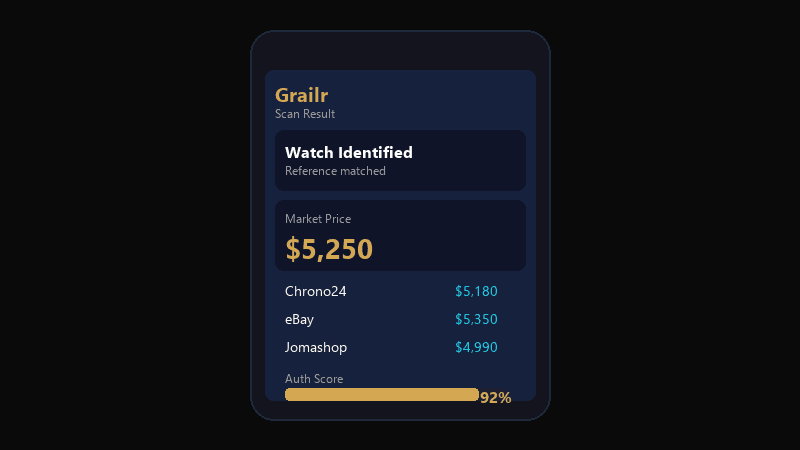
Verify Any GMT-Master II Price Instantly
Before you pay a premium, scan any GMT listing with Grailr. Our AI identifies the exact reference and shows you what it’s really worth.
- AI identifies the exact GMT reference & bezel variant
- Active eBay listings when available
- Identification confidence, not proof of authenticity
Which GMT Should You Actually Buy?
The “best” GMT depends entirely on what you want from it. Here is the decision framework, stripped of the hype:
Buy the Pepsi if…
You want a piece of Rolex history that will never be produced again. You can stomach paying $25,000+ and are comfortable holding it long-term. You see the GMT-Master II as a collectible first and a wearable watch second. The red-and-blue bezel speaks to you emotionally, not just intellectually.
Buy the Batman if…
You want the most versatile GMT-Master II for daily wear. You want the option to pursue the AD path (6-18 month wait). You prefer understated elegance over head-turning color. You want the best balance of resale strength and wearability. You’re choosing between a GMT and a Submariner as your one Rolex.
Buy the Sprite if…
You want the lowest entry price into the steel GMT-Master II family. The left-handed crown intrigues you (and you’ve tried it on). You want something that stands out at a watch meetup. You’re a left-handed wearer looking for genuine ergonomic benefit. You want the shortest AD wait time among the steel models.
One more scenario worth addressing: if this is your first serious watch, the Batman on a Jubilee bracelet is the safest recommendation. It works with everything, it holds value exceptionally well, and it does not require explaining to non-watch people why the crown is on the wrong side or why you paid five figures for a watch with a soda brand nickname. If you are looking for your first Rolex, the Batman is consistently among the strongest choices in the entire catalog.
And if budget is the primary constraint, do not overlook the Omega Seamaster GMT or the Tudor Black Bay GMT. Both offer true GMT complications with in-house movements at a fraction of the Rolex price — and both are available to walk in and buy today.
Market Pricing & Investment Outlook
The Pepsi discontinuation has reshaped the investment calculus for all three models. Here is where the money is heading:
Pepsi trajectory: The 126710BLRO is now on the same path as every discontinued Rolex icon before it. The “Hulk” Submariner (116610LV) climbed from $14,000 to $20,000+ in the two years after discontinuation, and it did not have the Pepsi’s heritage cachet. Expect the 126710BLRO to stabilize in the $25,000–$30,000 range for used examples in the near term, with potential to push higher over 3–5 years as collector sentiment solidifies around “last of the line” narratives. Unworn pieces will command ever-increasing premiums as the pool shrinks.
Batman stability: The 126710BLNR has traded in the $17,000–$21,000 range with remarkable consistency since 2023, weathering the broader luxury watch correction better than most Rolex references. As long as it remains in production, prices will likely hold this band. The risk scenario is Rolex significantly increasing production — but the brand has historically been conservative about supply adjustments.
Sprite upside: At $15,700–$17,000, the Sprite carries the lowest premium of any steel GMT. Some of that discount is genuine — the left-handed crown limits the addressable buyer pool. But the Sprite is only three years old, and community sentiment has been warming steadily. If Rolex ever discontinues the 126720VTNR (or if the left-handed design becomes fashionable among mainstream collectors), today’s prices will look like a bargain.
For a broader perspective on whether watches make good financial assets, see our luxury watches investment guide with real ROI data across brands and models.
How to Get One at Retail
The Pepsi is off the table — no AD will offer you a 126710BLRO because it no longer exists in the pipeline. For the Batman and Sprite, the authorized dealer path remains the most cost-effective way to buy, even if it requires patience and strategy.
Batman (126710BLNR)
Typical wait: 6–18 months
Difficulty: Hard
Sprite (126720VTNR)
Typical wait: 3–12 months
Difficulty: Moderate-Hard
Root Beer (126711CHNR)
Typical wait: 1–3 months
Difficulty: Moderate
Pepsi (126710BLRO)
Typical wait: N/A
Difficulty: Discontinued
Build purchase history first. The single most effective strategy at any Rolex AD. Buy a Datejust, an Oyster Perpetual, or an Explorer first — this proves you are a genuine customer, not a flipper looking to immediately resell a professional model at a profit. Many ADs will not put you on the GMT list without at least one prior purchase. See our best entry-level Rolex guide for smart starting points.
Be flexible on configuration. If you tell your AD you only want a Batman on Jubilee, you are competing against maximum demand for minimum supply. Being open to the Oyster bracelet — or being open to the Sprite — increases your odds meaningfully. Some ADs will offer the less-requested configuration first as a test of your sincerity.
Consider the Sprite specifically. Wait times for the 126720VTNR are generally shorter than the Batman, reportedly 3–12 months versus 6–18 months in most markets. If you want a steel GMT-Master II at retail and time is a factor, the Sprite offers the fastest path.
Going secondary? Authenticate everything. The GMT-Master II is one of the most counterfeited Rolex models due to its high premiums. Before buying any pre-owned GMT, use our authentication guide and verify the reference, serial number, and movement with an independent source. A $200 authentication service is cheap insurance on a $20,000 watch.
Frequently Asked Questions
Is the Rolex GMT Pepsi discontinued?
Rolex GMT Pepsi vs Batman — which is the better buy in 2026?
How much is a Rolex GMT-Master II in 2026?
What is the Rolex GMT Sprite and why is the crown on the left?
What is the wait time for a Rolex GMT-Master II at an AD?
Is the Rolex GMT-Master II a good investment?
What is the difference between the Rolex GMT Batman and Bruce Wayne?
The Bottom Line
The Pepsi, Batman, and Sprite are three variations on one of the greatest travel watches ever made. They share the same beating heart — the Cal. 3285 — and the same fundamental purpose: telling you what time it is in two places at once. The differences are bezel color, crown position, market price, and now, production status.
The Pepsi’s discontinuation has transformed it from a hard-to-get luxury into a genuine collector’s piece with an upward price trajectory. The Batman remains the most rational choice for daily wear and the model most likely to satisfy buyers across every use case. And the Sprite, with its lower premium and distinctive character, is the sleeper pick for buyers who prioritize value and individuality.
Whichever you choose, verify the reference, check the market price, and make sure you are paying what the watch is actually worth — not what someone’s listing says it is worth.
Related Articles
Found Your GMT-Master II?
Grailr can suggest a model and reference from a clear photo and provide an indicative AI price estimate. Active eBay listings, when available, show asking prices for comparison. Confirm the reference and condition with the seller; a photo scan does not authenticate a watch.
Scan a GMT-Master II NowSources and price context
- Rolex GMT-Master II — The GMT family and its official model configurations.
- Rolex buying guidance — Authorised retail channels and the manufacturer guarantee.
The links identify the specific manufacturer information and marketplace guidance used for this guide. Price ranges and resale percentages in this guide are illustrative, not live quotes or guaranteed returns; compare the exact reference, condition and sale date before relying on them.