Loupe This: How the Watch Auction Platform Works
Fees, the inspection process, no-reserve auctions, and how Loupe This compares to Christie’s, Chrono24, and eBay for buying and selling watches.
- Loupe This is an online watch auction house that physically inspects every piece before listing it
- Buyers pay a 10% hammer premium — roughly half to a third of the 20–26% charged by traditional houses
- Most lots go to auction with no reserve, so hammer prices reflect real-time market demand
- Founded by Eric Ku, Justin Gruenberg, and former Sotheby’s executive Sam Hines
- Use Grailr’s value estimate before bidding to check whether a lot’s current bid is in line with the broader market
What Is Loupe This?
Loupe This is an online watch auction house launched in 2021 by Eric Ku and Justin Gruenberg. Ku is the founder of Ten Past Ten Timepieces and Los Angeles Watchworks and is widely considered one of the leading vintage-watch authorities in the United States. Gruenberg is a second-generation watch and jewelry dealer and the founder of The Keystone, a watch industry consultancy. In 2022, Sam Hines — formerly Global Head of Watches at Sotheby’s — joined as a cofounder and shareholder.
The premise is straightforward, as Time+Tide noted when the platform launched. Traditional auction houses like Christie’s, Sotheby’s, and Phillips run twice-yearly cataloged sales, charge buyer premiums of 20–26%, and can hold a consigned watch for months before it reaches the block. Online platforms like Chrono24 and eBay offer speed but rarely take physical possession of the watches they list. Loupe This sits in the middle: it physically receives, inspects, and photographs every watch, then runs rolling weekly no-reserve auctions with a 10% buyer premium.
The result is a platform that combines the authentication confidence of a physical auction house with the frequency and accessibility of an online marketplace. For collectors, that means fresh inventory every week and the peace of mind that every lot has been vetted by a team with decades of combined horological experience.
How the Auction Process Works
For Sellers
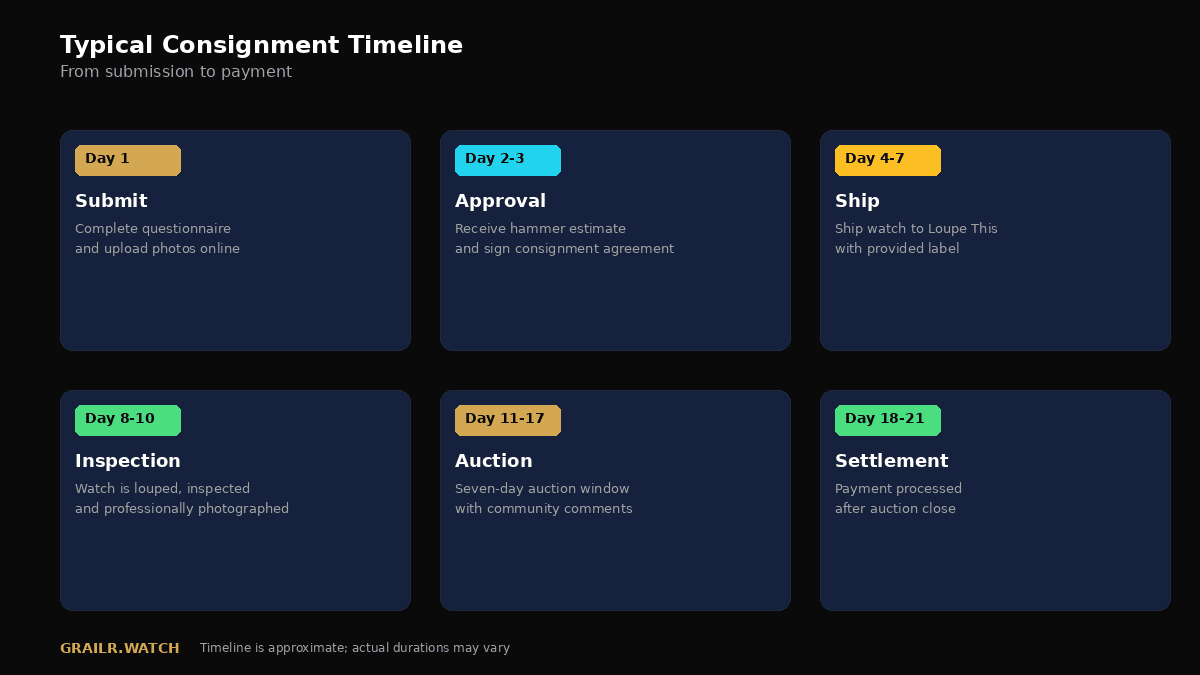
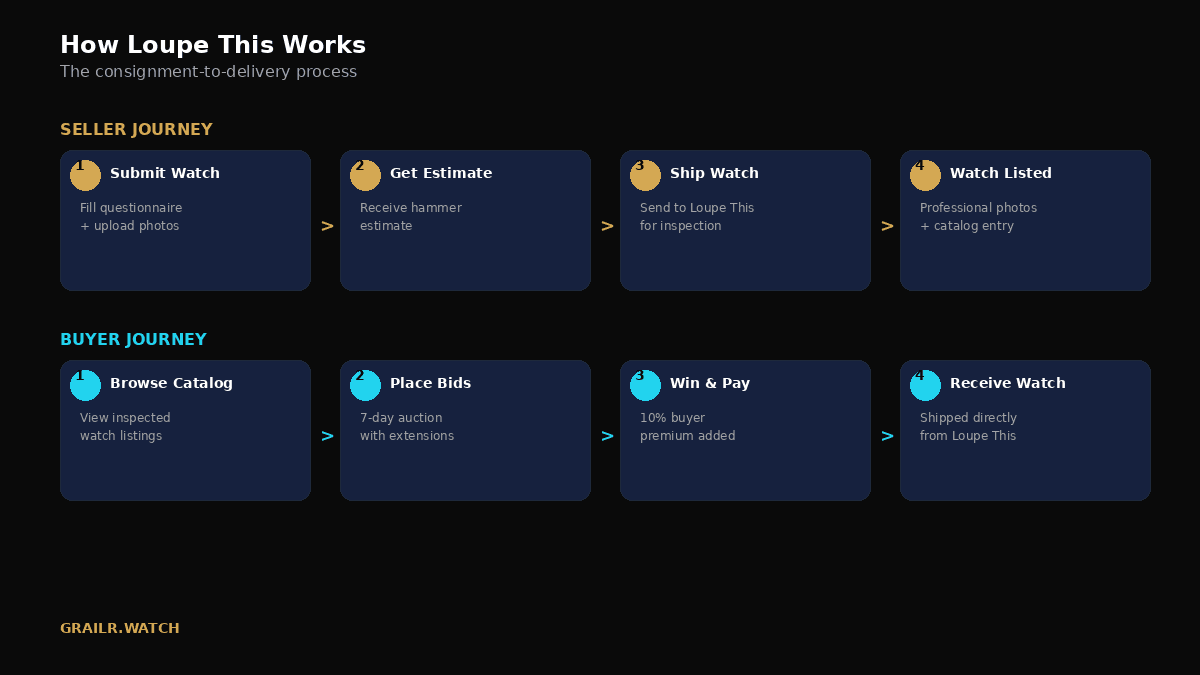
Consignment begins with a simple online questionnaire and a set of photos. Loupe This reviews the submission, sends back a hammer estimate, and — if both sides agree — issues a consignment agreement that the seller signs electronically. The seller then ships the watch to Loupe This (shipping is covered by the consignment fee). Once the watch arrives, the team inspects it, writes condition notes, and produces high-resolution imagery for the listing.
The turnaround from shipping to listing is deliberately fast. Unlike traditional houses that may hold a piece for three to six months ahead of a seasonal catalog, Loupe This aims to have consigned watches listed within weeks. That speed matters for sellers who want liquidity without the long wait of a cataloged sale.
For Buyers
Buyers register on the platform for free. Each listing includes detailed photographs, condition notes, and a description written by the Loupe This team. Registered members can comment on lots and ask questions, which the team answers publicly — creating a layer of community due diligence that most auction platforms lack.
Auctions run for seven days. If a bid is placed in the final moments, the closing time extends by two minutes per late bid. This anti-sniping rule prevents last-second bids from robbing a lot of its true market price. Most watches are offered with no reserve, meaning the highest bid wins regardless of the amount. The buyer pays the hammer price plus a 10% premium.
Fees for Buyers and Sellers
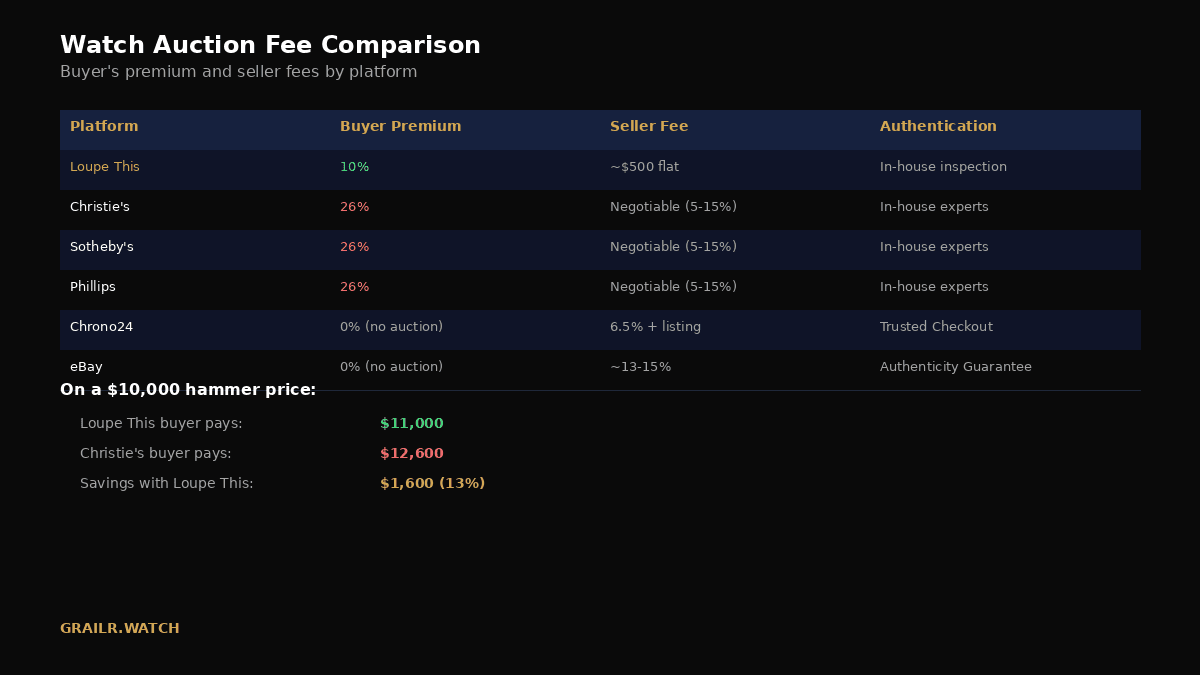
Fee structure is one of Loupe This’s sharpest selling points. The buyer premium is 10%, which is roughly a third of what Christie’s, Sotheby’s, and Phillips charge. Sellers pay a flat consignment fee that covers inbound shipping, inspection, photography, and the listing itself. The consignment fee was reported at $500 when the platform launched; check loupethis.com for the current rate.
| Platform | Buyer Premium | Seller Fee | Physical Inspection |
|---|---|---|---|
| Loupe This | 10% | Flat consignment fee | Yes — every lot |
| Christie’s | 20–26% | Negotiated commission | Yes |
| Sotheby’s | 20–26% | Negotiated commission | Yes |
| Phillips | 20–26% | Negotiated commission | Yes |
| Chrono24 | None (buyer service fee varies) | Listing fee or commission | Optional (Trusted Checkout) |
| eBay | None | ~13–15% seller fee | No |
To put those numbers in context: a watch that hammers at $10,000 costs the buyer $11,000 total on Loupe This, versus $12,000–$12,600 at a traditional house. That $1,000–$1,600 difference is enough to cover a full service on many movements. For sellers, the flat consignment fee is predictable and avoids the percentage-based commission negotiation that can be opaque at larger houses.
Inspection and Authentication
Every watch that passes Loupe This’s initial screening is shipped to the company, where the team inspects it under magnification — the “loupe” in the name is literal. The inspection covers case condition, dial originality, movement function, bracelet stretch, and completeness of accessories (box, papers, warranty cards). Detailed condition notes and high-resolution imagery accompany every listing.
This physical-custody model is the single biggest difference between Loupe This and peer-to-peer platforms like Chrono24 or eBay. On those platforms, the seller photographs their own watch and writes their own description. Condition claims are only as reliable as the seller’s honesty and photographic skill. On Loupe This, the condition assessment comes from the platform’s own team, led by professionals whose reputations are staked on accuracy.
For additional peace of mind before bidding, Grailr’s authentication tools can help you cross-reference a listing against known reference details. And Grailr’s value estimate gives you a fast market-price check so you know whether a lot’s current bid is reasonable before you raise your paddle.
Check Any Watch Price in Seconds
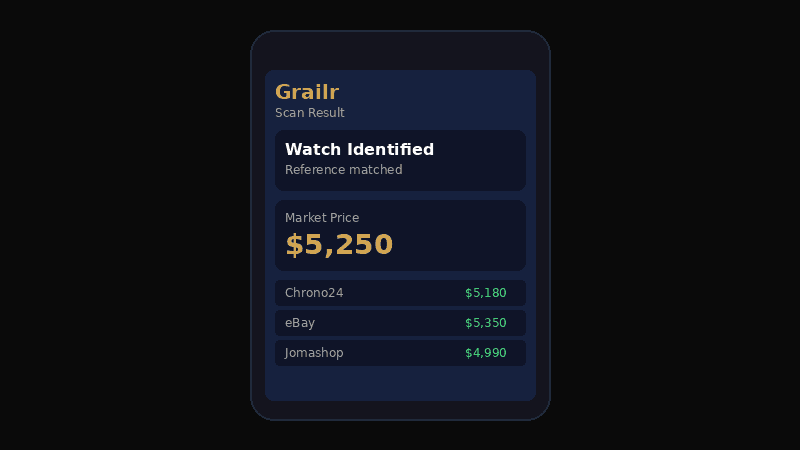
Grailr scans your watch photo and pulls live pricing from Chrono24, eBay, and Jomashop.
- AI identifies brand, model & reference number
- Live market prices from 3+ sources
- Authentication confidence score
Loupe This vs Traditional Auction Houses
Christie’s, Sotheby’s, and Phillips remain the prestige venues for seven-figure watches. If you are consigning a unique or museum-grade piece, the cataloged-sale format, printed catalogs, and global reach of those houses is difficult to replicate. But for the vast majority of watches changing hands — pieces valued between $3,000 and $50,000 — the traditional model has real drawbacks.
Frequency. Traditional houses run major watch auctions two to four times a year. That means a consigned piece may sit for months before it reaches a buyer. Loupe This runs weekly auctions, so a seller can list and sell within a few weeks of first contact.
Cost. A 26% buyer premium on a $15,000 hammer price adds $3,900 to the buyer’s total cost. On Loupe This, that same $15,000 hammer price incurs a $1,500 premium. The $2,400 saved is not trivial — it is the cost of a full service at many independent watchmakers.
Access. Getting a watch accepted into a Christie’s or Phillips sale often requires a relationship with a specialist or a piece that meets the catalog’s theme. Loupe This has a lower barrier to entry: if the watch meets the team’s quality and condition standards, it can be listed. That makes it a practical option for collectors selling a single piece rather than a full collection. For more on choosing the right channel for your watch, see our watch marketplace guide.
Loupe This vs Online Marketplaces
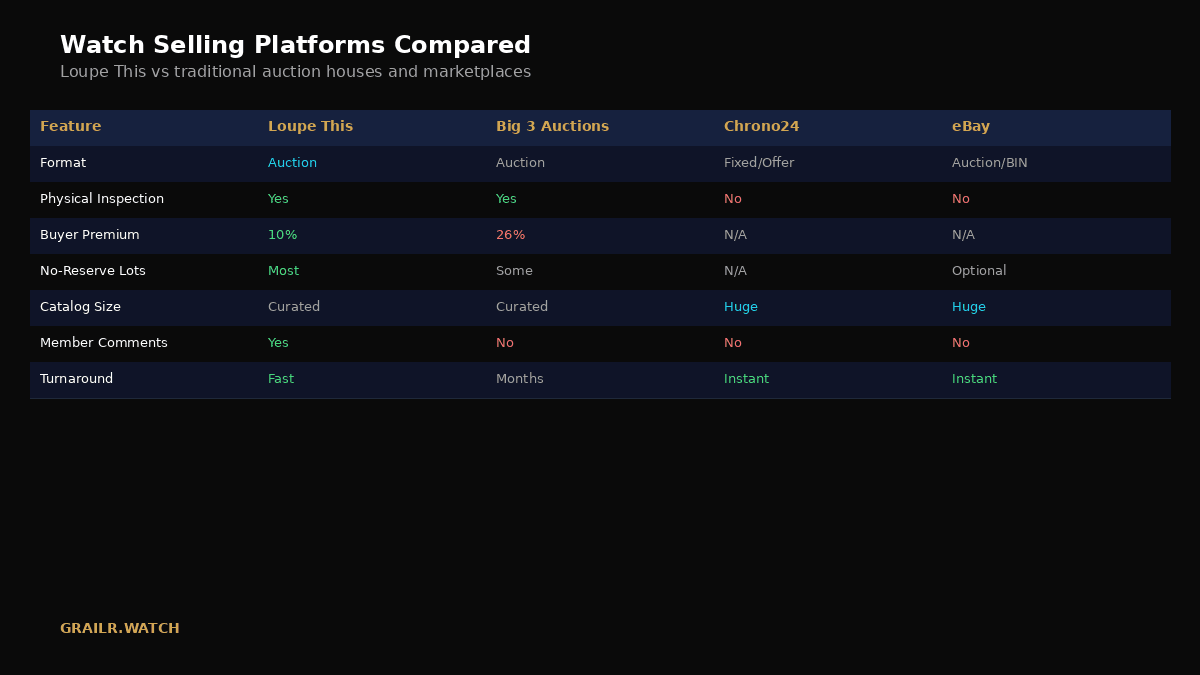
On the other end of the spectrum sit Chrono24 and eBay — platforms that handle enormous volume but generally do not take physical possession of the watches they list. This creates a different trade-off: wider selection and instant listing versus reduced authentication certainty.
| Feature | Loupe This | Chrono24 | eBay |
|---|---|---|---|
| Physical inspection | Every lot | Trusted Checkout only | No |
| Sale format | 7-day no-reserve auction | Fixed price or negotiation | Auction or Buy It Now |
| Buyer cost | Hammer + 10% | Listed price + service fee | Listed price + tax |
| Catalog size | Curated (dozens per week) | 500,000+ active listings | Millions of listings |
| Community interaction | Comments on lots | Limited | None |
| Anti-sniping | 2-min extension | N/A (fixed price) | No extension |
Chrono24’s Trusted Checkout program routes payment through escrow and can include an inspection, but the majority of Chrono24 transactions still ship directly from seller to buyer without physical vetting. eBay’s Authenticity Guarantee program covers watches over $2,000 but uses third-party inspection centers rather than in-house watch specialists.
Where Loupe This falls short compared to these platforms is selection. A buyer looking for a specific reference in a specific condition will find far more options on Chrono24, which lists hundreds of thousands of watches at any given time. Loupe This is curated by design — that curation is its quality signal, but it also means the watch you want may not be listed this week or this month. Before bidding on any platform, scan the watch with Grailr to get an instant market-price reference.
Tips for Buyers on Loupe This
1. Set a ceiling before the auction starts. No-reserve auctions can create a rush of late bidding. Decide your maximum total cost (hammer plus 10% premium plus any applicable sales tax) before the first bid and stick to it. Use Grailr’s indicative value estimate to anchor that ceiling against current market data.
2. Read the condition notes carefully. Loupe This writes detailed descriptions and publishes high-resolution photos. Look for dial refinishing, polished case edges, replacement hands, and bracelet stretch. If something is unclear, use the comment feature to ask — questions and answers are visible to all registered members.
3. Compare against completed sales. A no-reserve auction can produce a bargain or an overbid depending on who is in the room. Cross-reference the lot against recently completed sales on Chrono24 and pre-owned dealer pricing to gauge whether the current bid is above or below the market.
4. Factor in service costs. Auction watches rarely come freshly serviced. Budget an additional $300–$1,200 for a movement service depending on the caliber and brand. A Rolex full service through an authorized service center currently runs around $800–$1,100; a Patek Philippe service starts above $1,500. Our Rolex appraisal guide covers what to expect.
5. Understand the no-reserve risk. No reserve works in the buyer’s favor when a lot attracts little interest — the piece can sell well below market value. But it also means that bidding wars can push prices above what the same watch sells for on a fixed-price platform. The two-minute anti-sniping extension gives every bidder time to respond, which tends to push final prices closer to true market value.
6. Check whether the watch retains value. Not every watch that sells well at auction holds its price over time. Some pieces trade on hype cycles. Our guide to watches that hold value covers which brands and references have consistent resale floors.
Who Is Loupe This Best For?
Sellers who want speed and a predictable fee. If you have a single watch worth $3,000 to $50,000 and do not want to wait six months for a cataloged sale or negotiate a commission with a traditional house, Loupe This offers a fast, transparent path to market. The flat consignment fee removes uncertainty about selling costs.
Buyers who value authentication and lower premiums. If you are comfortable with a curated selection (rather than browsing thousands of listings) and want every lot professionally inspected before you bid, Loupe This fills a gap that neither the big houses nor the open marketplaces fully cover.
Collectors who enjoy the auction format. The seven-day window, member comments, and no-reserve format create something closer to the energy of a live auction than a fixed-price listing. For experienced collectors, that format is part of the appeal — and the lower premium means more of the hammer price goes to the seller, which can attract better consignments.
What to Watch Out For
No reserve means no floor. A seller consigning a watch to Loupe This accepts the risk that it could sell below the expected market value if bidding is light. This is rare for desirable references but not impossible. If you need a guaranteed minimum, a traditional house’s reserve option or a fixed-price listing on Chrono24 may be a better fit.
Curated means limited. Loupe This does not accept every watch submitted for consignment. Watches that do not meet the team’s standards for condition, desirability, or market demand may be declined. If you are selling a less-common brand or a watch with significant wear, a platform with broader acceptance criteria may move it faster.
Buyer’s premium is still a cost. Ten percent is competitive, but it is not zero. On a $20,000 hammer price, that is $2,000. Factor it into your total acquisition cost alongside any service, insurance, and tax obligations. For watches you need help identifying, Grailr can confirm the reference before you commit.
Frequently Asked Questions
What is Loupe This?
What are the fees on Loupe This?
Does Loupe This authenticate every watch?
How long does a Loupe This auction last?
Are all watches sold without a reserve?
How does Loupe This compare to Chrono24?
Related Articles
The Bottom Line
Loupe This occupies a genuine gap in the watch market. It is more transparent and affordable than a traditional auction house, and more authenticated and curated than an open marketplace. The 10% buyer premium, physical inspection of every lot, and rolling weekly auctions make it a compelling option for both buyers and sellers dealing in the $3,000–$50,000 range where most collector-grade watches trade.
It is not a universal solution. Sellers who need a price floor should look at reserve-based options. Buyers who want the widest possible selection will still browse Chrono24. And anyone dealing at the seven-figure level will still gravitate to Christie’s or Phillips for the global audience. But for the collector buying or selling one good watch at a time, Loupe This is worth having on the list — alongside a Grailr value estimate to confirm the price is right.
Know What a Watch Is Worth Before You Bid
Upload a photo and get a market-price estimate in seconds. Works for any brand, any reference.
Scan a Watch Now