Nice Watches at Every Price: What to Buy in 2026
From $50 Casios to $10,000 Rolexes — the nicest watches you can buy at every budget, ranked by design, build quality and long-term value.
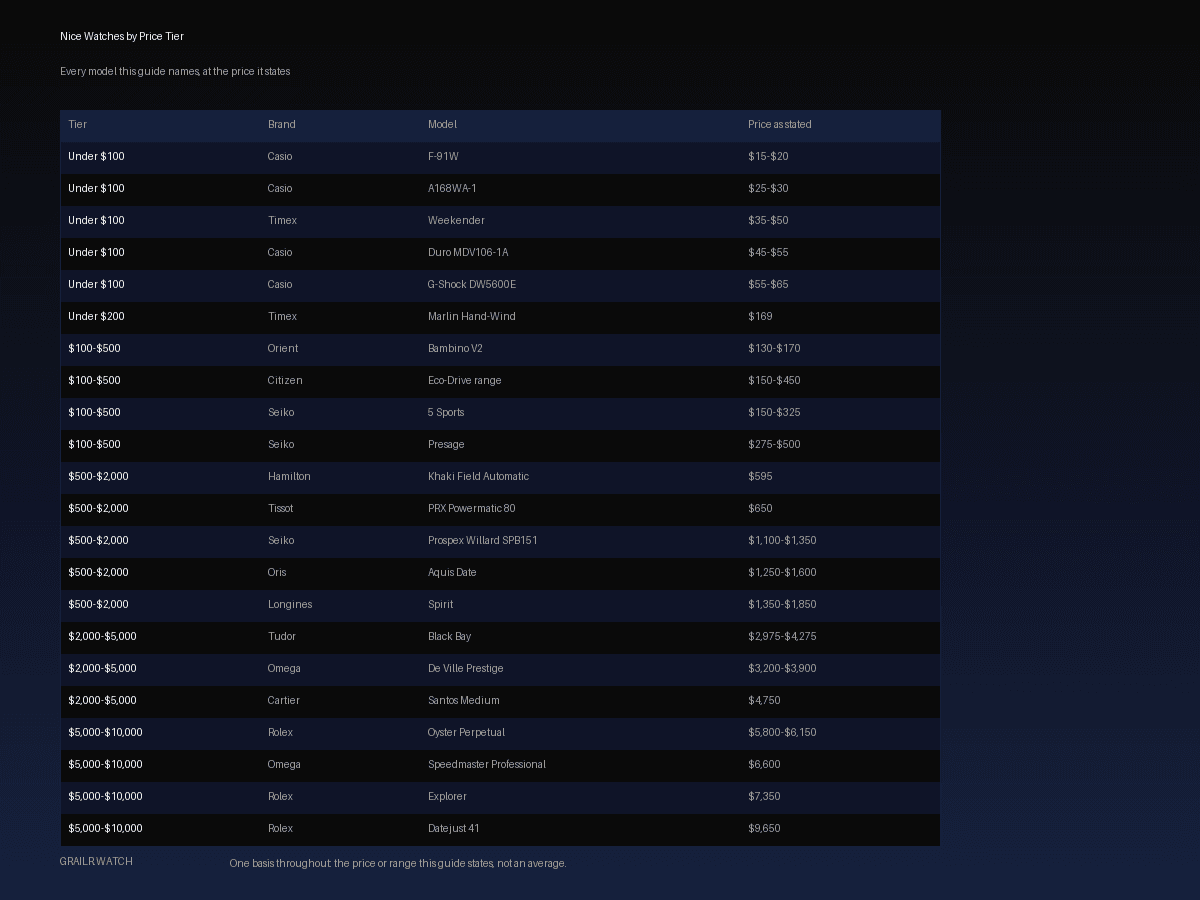
Price context: this guide includes indicative prices from its original publication period. They have not all been refreshed to current quotes. Use the linked primary sources for specifications and policies, and verify prices independently.

- You can buy a genuinely nice watch for $50 — the Casio A168WA and Timex Weekender prove it every day
- The $300–$700 range offers the biggest jump in quality: sapphire crystals, automatic movements and applied indices
- Above $2,000, you’re paying for in-house movements, COSC certification and stronger resale value
- The single nicest everyday watch for most budgets: Tissot PRX Powermatic 80 at $650
What Actually Makes a Watch “Nice”
Walk into any watch forum and you’ll find endless debates about movements, heritage and complications. But when most people say they want a nice watch, they mean something simpler: a watch that looks good on the wrist, feels well-made when you pick it up, and doesn’t embarrass you when someone asks what you’re wearing.
Three things separate nice watches from cheap-looking ones, regardless of price. First, finishing — alternating brushed and polished surfaces catch the light and give a watch visual depth. A $130 Orient Bambino does this. A $50 fashion-brand quartz watch usually does not. Second, dial detail — applied metal indices (physically attached to the dial) look sharper than printed markers at every price point. Third, proportions — a case that sits flat on the wrist without overhanging your wrist bones looks expensive whether it costs $80 or $8,000.
Price buys you better materials (sapphire crystal, 316L or 904L steel, ceramic bezels), more accurate movements, and stronger resale value. But the nicest watch at any given price is the one that gets those three fundamentals right. That’s what this guide is built around.
Nice Watches Under $100
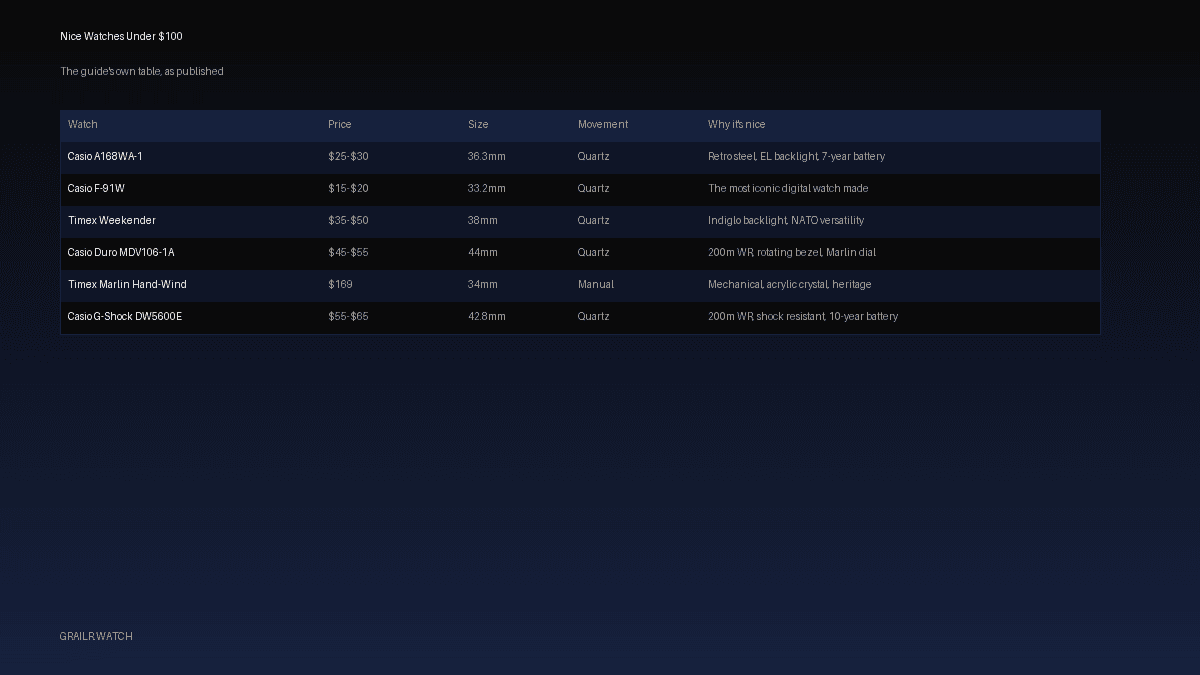
The idea that you need to spend four figures on a nice watch is simply wrong. The watches below prove that good design, decent build quality and genuine character can live under a hundred dollars. These are the watches that watch enthusiasts actually respect at this price, not the fashion-brand options that look fine in photos and fall apart in a year.
| Watch | Price | Size | Movement | Why It’s Nice |
|---|---|---|---|---|
| Casio A168WA-1 | $25–$30 | 36.3mm | Quartz | Retro stainless steel, EL backlight, 7-year battery |
| Casio F-91W | $15–$20 | 33.2mm | Quartz | The most iconic digital watch ever made |
| Timex Weekender | $35–$50 | 38mm | Quartz | Indiglo backlight, NATO strap versatility |
| Casio Duro MDV106-1A | $45–$55 | 44mm | Quartz | 200m WR, rotating bezel, Marlin dial |
| Timex Marlin Hand-Wind | $169 | 34mm | Manual | Mechanical movement, acrylic crystal, heritage design |
| Casio G-Shock DW5600E | $55–$65 | 42.8mm | Quartz | 200m WR, shock resistant, 10-year battery |
The Casio Duro deserves special mention. At roughly $50, it offers a 200-metre water resistance rating, a unidirectional rotating bezel, and a dial layout that earned it the nickname “Marlin” among collectors. Bill Gates was photographed wearing one. It doesn’t have a sapphire crystal or an automatic movement, but it looks and feels like a watch three times its price.
For something dressier, the Timex Marlin Hand-Wind at $169 pushes the budget but gives you a mechanical movement, a domed acrylic crystal with vintage character, and a 34mm case that sits beautifully under a shirt cuff. It’s the nicest dress watch you can buy for under $200. For more picks in this range, see our best budget watches guide.
$100–$500: The Sweet Spot for Beginners
This is where nice watches start getting genuinely impressive. For $130–$500, you can buy a watch with an automatic movement, applied indices, and build quality that would have cost $1,000 a decade ago. Japanese manufacturers — Seiko, Orient and Citizen — dominate this tier because they produce their own movements in-house and pass the savings on.
Seiko Presage ($275–$500)
The Presage line is where Seiko shows what it can do with dial craft. The “Cocktail Time” models feature textured dials inspired by cocktails — the ice-blue “Frozen Margarita” and deep-blue “Blue Moon” are the most popular. Inside sits the 4R35 or 4R36 automatic movement with a 41-hour power reserve. The case finishing alternates brushed flanks with polished bevels, and the applied hour markers catch light in a way that makes the watch look far more expensive than its $300–$425 price tag. The 38.5mm “Sharp Edged” models use the upgraded 6R35 movement with a 70-hour power reserve.
Orient Bambino ($130–$200)
Orient is a Seiko subsidiary that produces its own calibres. The Bambino Version 2, at $130–$170, is arguably the nicest dress watch under $200: a 40.5mm case, domed mineral crystal, applied indices, and an in-house F6724 automatic movement. The small-seconds Version 4 is the collector favourite. It won’t have the finishing of a $500 Seiko Presage, but on a leather strap with a suit, nobody would guess the price.
Citizen Eco-Drive ($150–$450)
If you want a nice watch you never have to think about, Citizen’s Eco-Drive technology converts any light into electrical energy — no battery changes, no winding. The Citizen Corso ($200–$300) is the cleanest everyday option, with a sapphire crystal and 100m water resistance. The Promaster Diver BN0151-09L ($200) is a genuinely capable dive watch with a 200m rating and ISO 6425 certification. Both look and feel nicer than any quartz fashion watch at twice the price.
Seiko 5 Sports ($150–$325)
The Seiko 5 Sports line brought the beloved SKX diver aesthetic into a modern 42.5mm case with the 4R36 automatic movement. The SRPD models at $175–$275 offer day-date, 100m water resistance, and a rotating bezel. The watches under $1,000 guide covers more options in this range, but for pure wrist presence at $200, the Seiko 5 is hard to beat.
$500–$2,000: Serious Watchmaking Starts Here
Cross the $500 line and you enter the territory of sapphire crystals as standard, Swiss-made automatic movements with 80-hour power reserves, and finishing that holds up under a loupe. This is where the nicest everyday watches live — pieces you can wear to the office, the beach and a dinner without changing.
Tissot PRX Powermatic 80 ($650)
The Tissot PRX Powermatic 80 is the single most recommended “first nice watch” in the enthusiast community, and for good reason. The integrated bracelet design echoes the 1970s sports-watch aesthetic of watches costing ten times more. Inside, the Powermatic 80 movement delivers an 80-hour power reserve with Nivachron hairspring for improved antimagnetic resistance. Available in 35mm and 40mm, with dial options in blue, green, black and ice-blue. The quartz version starts at $325 if you want the same look on a tighter budget.
Hamilton Khaki Field Automatic ($595)
Hamilton occupies a unique position: an American heritage brand making Swiss watches with ETA and in-house H-10 movements. The Khaki Field Auto uses the H-10 calibre with an 80-hour power reserve, sapphire crystal, and 100m water resistance. At 38mm, it’s the ideal size for most wrists. The black dial with Arabic numerals is a design that has looked nice since 1940 and will still look nice in 2040.
Longines Spirit ($1,350–$1,850)
Longines punches well above its price. The Spirit collection uses COSC-certified movements with silicon hairsprings — a spec you normally find at twice the price. The 40mm three-hand model ($1,350) and 42mm Zulu Time GMT ($1,850) are both nicely finished with alternating brushed and polished surfaces on the case and bracelet. For a detailed breakdown, see our watches under $2,000 guide.
Oris Aquis Date ($1,250–$1,600)
Oris is an independent Swiss manufacture — one of the few that has never been absorbed into a luxury conglomerate. The Aquis Date is their flagship diver: 300m water resistance, ceramic bezel insert, and the Calibre 400 in-house movement with a five-day power reserve. Available in 36.5mm, 39.5mm and 41.5mm. The finishing is excellent, with sharply defined case edges and a quick-change bracelet system.
Seiko Prospex “Willard” SPB151 ($1,100–$1,350)
Seiko’s reissue of Captain Willard’s Vietnam-era dive watch is one of the nicest tool watches at any price. The cushion case is 42.7mm but wears smaller thanks to short lugs. It uses the 6R35 movement (70-hour power reserve) and has 200m water resistance. The matte black dial with Lumi Brite has a seriousness that few watches in this range can match.
$2,000–$5,000: Entry-Level Luxury
At this level, you’re buying watches from brands with genuine manufacture capability — in-house movements, proprietary alloys, and decades of R&D behind the finishing. The jump from $1,500 to $3,000 buys you noticeably better case finishing, more refined movements, and much stronger resale value. These are the nicest watches most people will ever need.
Tudor Black Bay ($2,975–$4,275)
Tudor is Rolex’s sister brand, and it shows. The Black Bay 58 ($3,575) uses the in-house MT5402 COSC-certified movement with a 70-hour power reserve, housed in a 39mm steel case with 200m water resistance. The finishing — a satin-brushed case with polished chamfers — is superb for the money. The standard Black Bay in 41mm ($3,575) adds a date window. For the entry point, the Tudor 1926 ($2,100) offers an ETA-based automatic with COSC certification at a lower price, though without the dive-watch heritage.
Omega De Ville Prestige ($3,200–$3,900)
The entry point to Omega ownership. The De Ville Prestige 40mm with the Co-Axial Master Chronometer movement retails around $3,900 and delivers the full Omega spec: METAS-certified accuracy to 0/+5 sec/day, antimagnetic resistance to 15,000 gauss, and a finishing standard that holds up against watches costing twice as much. The quartz Prestige starts at $3,200 for a smaller budget entry. Pre-owned examples from 2020–2024 can be found for $1,800–$2,800, making it one of the best value propositions in the used market.
Cartier Santos Medium ($4,750)
If “nice” to you means timeless elegance rather than sporty capability, the Santos Medium is one of the most beautiful watches ever designed. The square case with exposed screws has looked modern since 1904. The current model uses a quick-switch bracelet/strap system that swaps in seconds. It’s not a tool watch — 100m water resistance and no dive bezel — but it may be the nicest-looking watch on this entire list. Our affordable watches guide covers more options in this segment.
$5,000–$10,000: The Icons
Past $5,000, you’re buying watches that most people recognise on sight. These are the icons — the designs that defined what a luxury watch looks like. The movements are refined, the materials are premium, and the resale value is significantly stronger than anything below this line.
Rolex Oyster Perpetual ($5,800–$6,150)
The entry point to the most recognised watch brand in the world. The Oyster Perpetual 36 at $5,800 and the 41 at $6,150 are time-only watches — no date, no complications. They run the Cal. 3230 with a 70-hour power reserve, Superlative Chronometer certification (±2 sec/day), and the same Oystersteel used in every Rolex from here to the $80,000 Platinum Daytona. The coloured dials (turquoise, candy pink, yellow) trade above retail on the secondary market.
Omega Speedmaster Professional ($6,600)
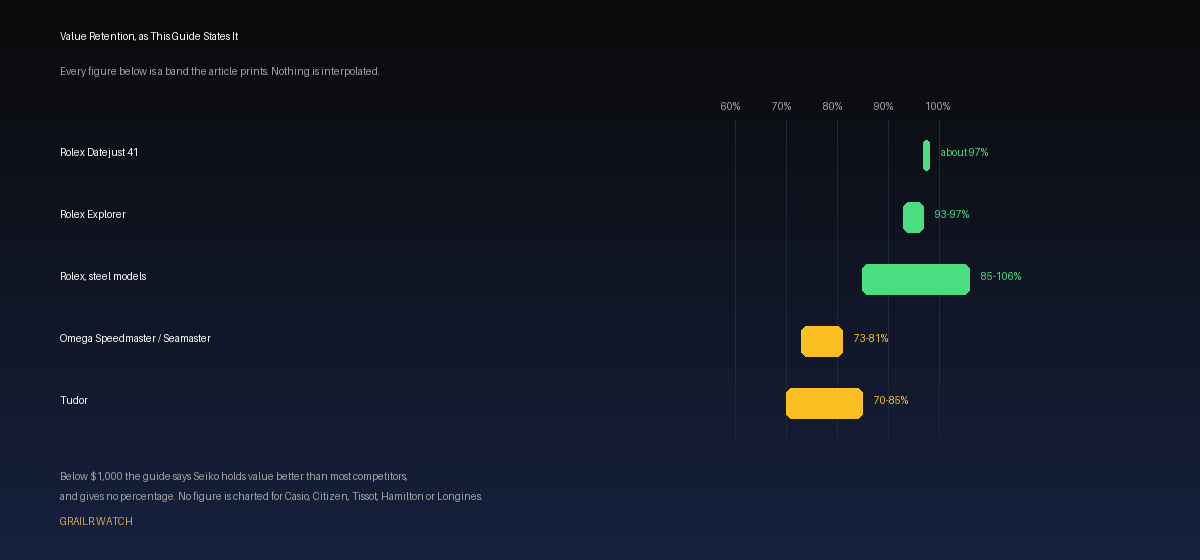
The Moonwatch. The first watch on the Moon in 1969, and still in production with the hand-wound Cal. 3861 Co-Axial Master Chronometer movement. The 42mm hesalite crystal version is the purist’s choice; the sapphire sandwich version shows the movement through the caseback. At $6,600, it’s one of the most historically significant watches you can buy, and it holds roughly 73–81% of retail value on the secondary market.
Rolex Explorer ($7,350)
Available in 36mm and 40mm, the Explorer is Rolex’s adventure watch with roots in the 1953 Everest expedition. The black dial with 3-6-9 Arabic numerals is one of the most iconic dial designs in watchmaking. Same Cal. 3230, same 70-hour power reserve, same ±2 sec/day accuracy. It trades at roughly 93–97% of retail, making it one of the strongest value holders in the entry-level luxury segment.
Rolex Datejust 41 ($9,650)
The most popular Rolex ever made, and arguably the most recognisable luxury watch silhouette in the world. The 41mm case on a Jubilee bracelet with a fluted bezel is the definitive dress-sport watch. The Cal. 3235 delivers 70 hours of power reserve and the Cyclops magnifier over the date window is the detail that tells the world you’re wearing a Rolex. At $9,650 in steel, it retains roughly 97% of its value on the secondary market.
How to Choose the Right Nice Watch
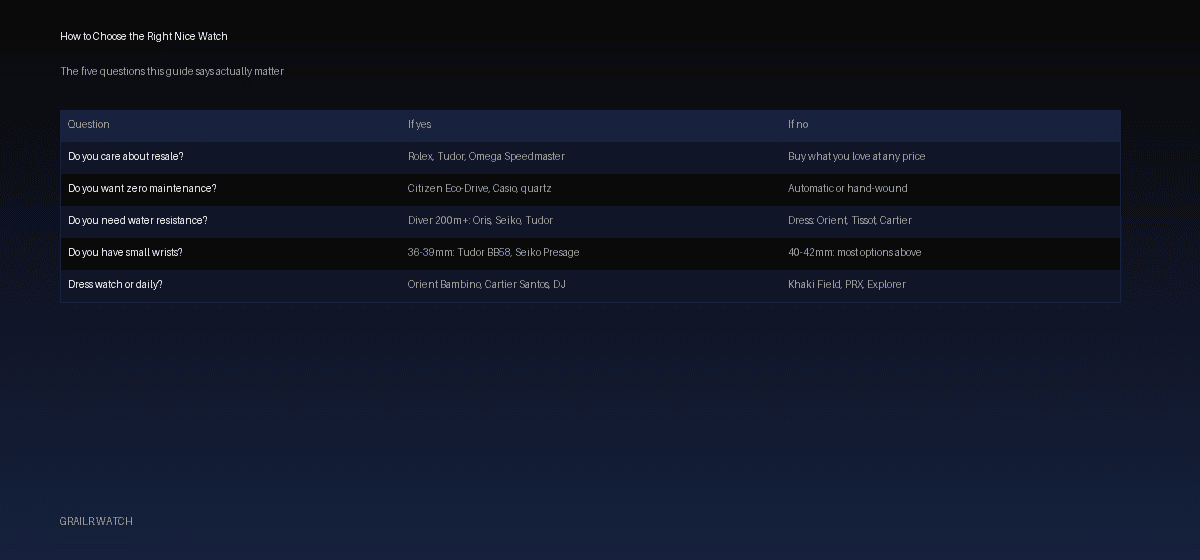
With so many genuinely nice watches available at every price, the choice can feel overwhelming. Here are the five questions that actually matter:
| Question | If Yes | If No |
|---|---|---|
| Do you care about resale? | Rolex, Tudor, Omega Speedmaster | Buy what you love at any price |
| Do you want zero maintenance? | Citizen Eco-Drive, Casio, quartz | Automatic or hand-wound |
| Do you need water resistance? | Diver (200m+): Oris, Seiko, Tudor | Dress watch: Orient, Tissot, Cartier |
| Do you have small wrists (<6.5”)? | 36–39mm: Tudor BB58, Seiko Presage | 40–42mm: most options above |
| Is this a dress watch or daily? | Orient Bambino, Cartier Santos, DJ | Khaki Field, PRX, Explorer |
The most important rule: try it on before you buy. Watches wear differently depending on your wrist shape, and a 40mm watch from one brand can feel like a 42mm from another. Visit an authorised dealer or a reputable pre-owned shop and see how the watch sits on your wrist in person. No amount of research replaces that moment.
If you’re buying pre-owned, use Grailr’s scanner to check fair market pricing before committing. A suggested identification is not proof of authenticity — always verify the reference, condition and provenance independently.
Frequently Asked Questions
What is the nicest watch you can buy under $200?
The Orient Bambino Version 2 at $130–$170 is widely considered the nicest-looking watch under $200. It has a domed mineral crystal, 40.5mm case, in-house automatic movement, and a dress-watch design that looks far more expensive than it is.
Are nice watches worth the money?
It depends on what you value. A $300 Seiko Presage with an in-house automatic movement and hardlex crystal will keep accurate time for decades with minimal servicing. A $5,000 Tudor adds a COSC-certified chronometer, sapphire crystal and 70-hour power reserve. Both are worth the money for different buyers.
What makes a watch look nice versus cheap?
Three things separate a nice-looking watch from a cheap one: finishing (polished and brushed surfaces versus flat stamped metal), dial detail (applied indices versus printed markers), and crystal quality (sapphire or hardlex versus basic mineral glass). Case thickness also matters — a slim profile sits better on the wrist.
Which nice watch brands hold their value best?
Rolex leads with 85–106% value retention on most steel models. Tudor holds 70–85%. Omega Speedmaster and Seamaster retain roughly 73–81% of retail. Below $1,000, Seiko holds value better than most competitors, though no watch in this range should be treated as an investment.
Should I buy a quartz or automatic nice watch?
If you want accuracy and low maintenance, quartz is the practical choice — a Citizen Eco-Drive never needs a battery. If you value craftsmanship and the mechanical tradition, an automatic like the Tissot PRX Powermatic 80 offers a sweeping seconds hand, exhibition caseback, and 80-hour power reserve. Neither is objectively better.
What is the best nice watch for everyday wear?
The Tissot PRX Powermatic 80 ($650) and Hamilton Khaki Field Auto ($595) are the two most recommended everyday watches under $1,000. Both have sapphire crystals, 100m water resistance, and automatic movements. Above $2,000, the Tudor Black Bay 36 ($2,975) is a strong all-rounder with 150m water resistance and a 70-hour power reserve.
Related Articles
The Bottom Line
A nice watch is not defined by its price tag. The $50 Casio Duro on a NATO strap looks nicer than most $500 fashion-brand watches because Casio got the fundamentals right: good proportions, legible dial, honest materials. As you move up in price, you get better finishing, more refined movements and stronger resale — but the core principle stays the same. Buy the nicest watch you can afford at your budget, wear it with confidence, and don’t let anyone tell you it isn’t enough. The best watch is the one that makes you check the time just to look at your wrist.
Sources and price context
- Seiko Presage collection — Official specifications and current retail pricing for all Presage models.
- Tissot PRX collection — Official specifications, sizing and retail pricing for all PRX models including Powermatic 80.
These primary sources support the specific specification and pricing points noted above. Prices and resale percentages elsewhere in this guide are indicative editorial figures, not a verified transaction dataset or guaranteed returns. Confirm the exact reference, region, condition and current quote before buying; asking prices are not completed-sale prices.