Best Omega Watches for Men in 2026
Speedmaster, Seamaster, Aqua Terra, Constellation and De Ville — every current Omega men’s collection ranked with real pricing and resale data.
Price context: this guide includes indicative prices from its original publication period. They have not all been refreshed to current quotes. Use the linked primary sources for specifications and policies, and verify prices independently.

- Omega offers more in-house, METAS-certified calibres than any other brand in the $3,000–$10,000 range
- The Speedmaster Moonwatch Professional ($6,600–$8,000) remains the strongest single pick for heritage, quality and resale
- The Aqua Terra 38mm ($6,400) is the best all-round daily wearer, bridging sport and dress
- Pre-owned Omega prices sit 25–40% below retail — the secondary market offers genuine value for patient buyers
Why Omega Still Matters
Omega occupies a position in watchmaking that no other brand replicates. It sits one tier below Rolex in most pricing hierarchies, yet its technical credentials — Co-Axial escapement, silicon balance springs, METAS Master Chronometer certification — are objectively superior to anything in its price bracket and competitive with brands charging twice as much. Every men’s Omega sold today runs an in-house movement, which was not true even a decade ago.
The brand’s heritage is unmatched at this price point. The Speedmaster went to the moon. The Seamaster has been James Bond’s watch since 1995. The Constellation has been in continuous production since 1952. These are not marketing stories — they are historical facts that underpin the brand’s resale value and cultural relevance.
In 2026, Omega’s lineup spans five main collections for men, priced from the De Ville Prestige at $3,200 to limited-edition Speedmasters pushing $10,000+. This guide covers every one, with real pricing, movement specifications and secondary-market data, so you can decide which Omega is worth your money.
Speedmaster Collection
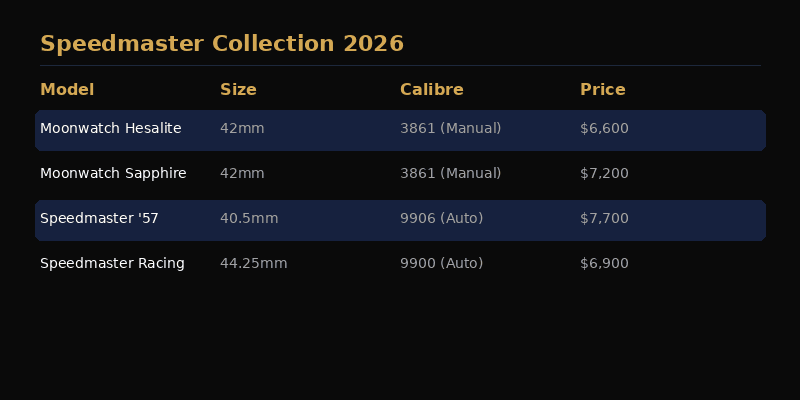
Moonwatch Professional ($6,600–$8,000)
The Moonwatch Professional is Omega’s most iconic watch and the single model most people associate with the brand. The current version runs the manual-wind Calibre 3861 — a Co-Axial Master Chronometer upgrade of the legendary 1861 that went to the moon. The 42mm steel case comes in two variants: the Hesalite crystal on bracelet ($6,600) or sapphire sandwich on bracelet ($7,200–$7,400). A sapphire caseback version ($8,000) lets you see the decorated movement.
The 3861 delivers 50-hour power reserve, resistance to magnetic fields up to 15,000 gauss, and METAS-certified accuracy of 0 to +5 seconds per day. The Hesalite crystal version is the purist’s choice — it scratches more easily than sapphire but has the same warm, slightly distorted look as the original moonwatch. Pre-owned current-gen examples trade around $5,200–$5,800, while previous-generation 1861-powered models sell for $4,200–$5,000.
Speedmaster ’57 ($7,700–$8,400)
The Speedmaster ’57 is a dressier chronograph with a 40.5mm case and the automatic Co-Axial Master Chronometer Calibre 9906. It offers 60-hour power reserve and a bi-compax layout that reads as more refined than the Moonwatch’s tri-compax design. Available on bracelet or leather strap, with dial options including blue, green, black and burgundy. The smaller case and thinner profile make it the better choice if your wrist is under 17cm or you prefer a watch that tucks under a shirt cuff.
Speedmaster Racing ($6,900–$7,300)
The Racing variant adds a tachymeter on the dial instead of the bezel and uses the automatic Calibre 9900 with 60-hour power reserve. The 44.25mm case is the largest Speedmaster, so try it on before buying — it wears substantially bigger than the 42mm Moonwatch. The Racing is the pick for buyers who want the Speedmaster DNA with a more modern, motorsport-inspired aesthetic. Pre-owned examples trade around $5,500–$6,200.
Seamaster Diver 300M & Planet Ocean
Seamaster Diver 300M ($5,900–$6,300)
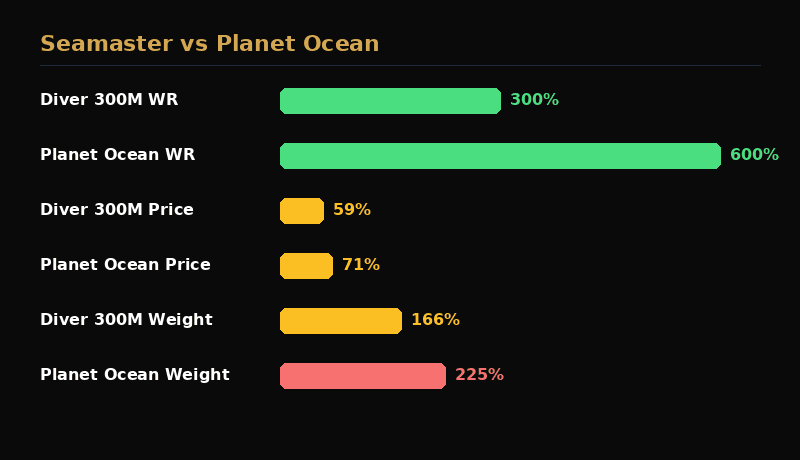
The Seamaster Diver 300M is Omega’s most commercially successful model. The current generation uses the 42mm ceramic-bezel case with the Co-Axial Master Chronometer Calibre 8800. The wave-pattern dial is a signature design element that references the original 1993 model. Water resistance is 300m, the helium escape valve is automatic, and the bracelet features a diver’s extension clasp. Black, blue and green dials are available in steel; two-tone and Sedna gold variants push past $10,000.
On the secondary market, pre-owned 300M models from the current generation trade around $4,200–$4,900 — a 20–30% discount from retail that makes this one of the best-value luxury dive watches available. The previous generation (2018–2022) with the same movement can be found for $3,800–$4,400.
Planet Ocean 600M ($7,100–$7,600)
The Planet Ocean is the Seamaster for people who want a more serious dive tool. The 43.5mm case is thicker and heavier, water resistance doubles to 600m, and the ceramic bezel has a liquidmetal® dive scale. The Calibre 8900 provides 60-hour power reserve. This is a large, heavy watch — 225g on bracelet — that reads as unambiguously sporty. Pre-owned examples trade around $5,200–$5,800. The 39.5mm version ($6,800) is a better fit for smaller wrists but is harder to find on the secondary market.
Seamaster Aqua Terra
Aqua Terra 38mm ($6,400)
The Aqua Terra 38mm is, in this guide’s opinion, the single best everyday Omega for most men. The 38mm case with 150m water resistance bridges sport and dress perfectly — it sits flat under a cuff but handles a weekend at the lake. The teak-pattern dial is subtle, distinctive and hides hairline scratches well. The Co-Axial Master Chronometer Calibre 8800 provides 55-hour power reserve and ±5 seconds per day accuracy.
At $6,400 on bracelet, the 38mm AT undercuts the Speedmaster Moonwatch while offering a more versatile wearing experience. Pre-owned examples trade around $4,600–$5,000. If you can only own one Omega, the 38mm Aqua Terra is the pragmatic choice.
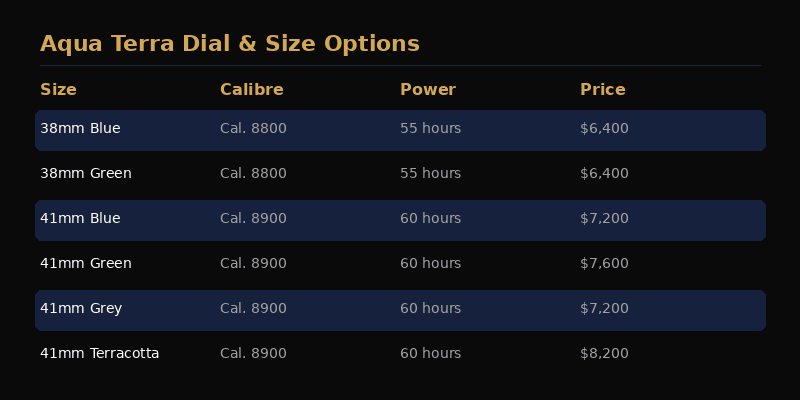
Aqua Terra 41mm ($7,200–$8,200)
The 41mm Aqua Terra adds a date window at 6 o’clock and the Calibre 8900 with 60-hour power reserve. The larger case reads as more modern, and the dial colour range is wider — including green, blue, grey, silver, and a striking terracotta. At $7,200–$8,200 depending on dial and strap, it costs $800–$1,800 more than the 38mm. The size difference on wrist is noticeable: the 41mm wears like a sports watch, while the 38mm wears like a dress-sport hybrid. Pre-owned 41mm examples trade around $5,200–$6,000.
Constellation & De Ville
Constellation 41mm ($7,200–$10,900)
The Constellation is Omega’s dress-sport flagship, recognisable by its claws on the bezel and the star medallion on the caseback. The 41mm version runs the Co-Axial Master Chronometer Calibre 8900 and comes in steel ($7,200–$7,600), two-tone ($8,500–$9,200), and Sedna gold ($10,900). The integrated bracelet gives it a refined, jewellery-like presence on the wrist. Resale is weaker than the sport models — pre-owned steel versions trade at 45–55% of retail — which makes the secondary market particularly attractive for Constellation buyers.
De Ville Prestige 40mm ($3,200–$5,200)
The De Ville Prestige is the entry point to Omega ownership. The 40mm case runs the Co-Axial Master Chronometer Calibre 8800 with 55-hour power reserve, and prices start at $3,200 on leather strap. Two-tone and steel bracelet versions climb to $4,500–$5,200. This is a pure dress watch: 30m water resistance, thin profile, and a clean dial with minimal complications.
The De Ville depreciates the most of any current Omega, with pre-owned examples at $1,800–$2,800 depending on metal and condition. That makes it the best value for buyers who want an Omega with in-house movement and don’t care about resale. The movement inside is the same as in watches costing twice as much.
Head-to-Head Comparison
| Model | Size | Movement | Retail | WR |
|---|---|---|---|---|
| De Ville Prestige 40 | 40mm | Auto (Cal. 8800) | $3,200–$5,200 | 30m |
| Seamaster Diver 300M | 42mm | Auto (Cal. 8800) | $5,900–$6,300 | 300m |
| Aqua Terra 38 | 38mm | Auto (Cal. 8800) | $6,400 | 150m |
| Speedmaster Moonwatch | 42mm | Manual (Cal. 3861) | $6,600–$8,000 | 50m |
| Speedmaster Racing | 44.25mm | Auto (Cal. 9900) | $6,900–$7,300 | 100m |
| Planet Ocean 600M | 43.5mm | Auto (Cal. 8900) | $7,100–$7,600 | 600m |
| Aqua Terra 41 | 41mm | Auto (Cal. 8900) | $7,200–$8,200 | 150m |
| Constellation 41 | 41mm | Auto (Cal. 8900) | $7,200–$10,900 | 50m |
| Speedmaster ’57 | 40.5mm | Auto (Cal. 9906) | $7,700–$8,400 | 100m |
Check Any Omega Price in Seconds
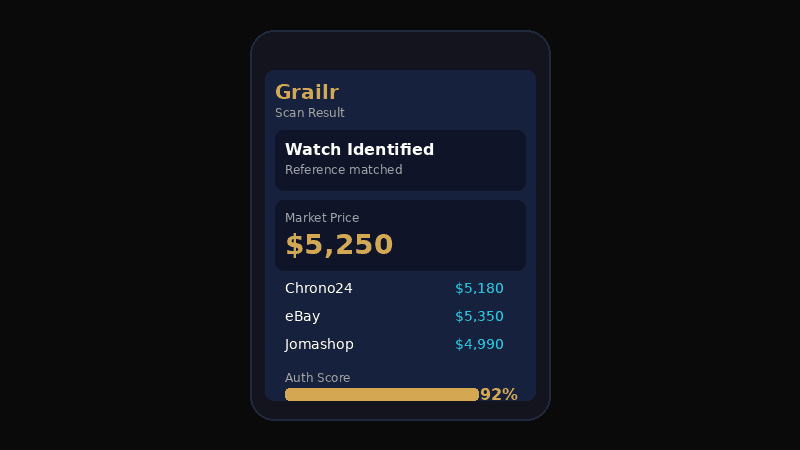
Grailr scans your watch photo and pulls live pricing from Chrono24, eBay, and Jomashop.
- AI identifies brand, model & reference number
- Live market prices from 3+ sources
- Authentication confidence score
Resale & Value Retention
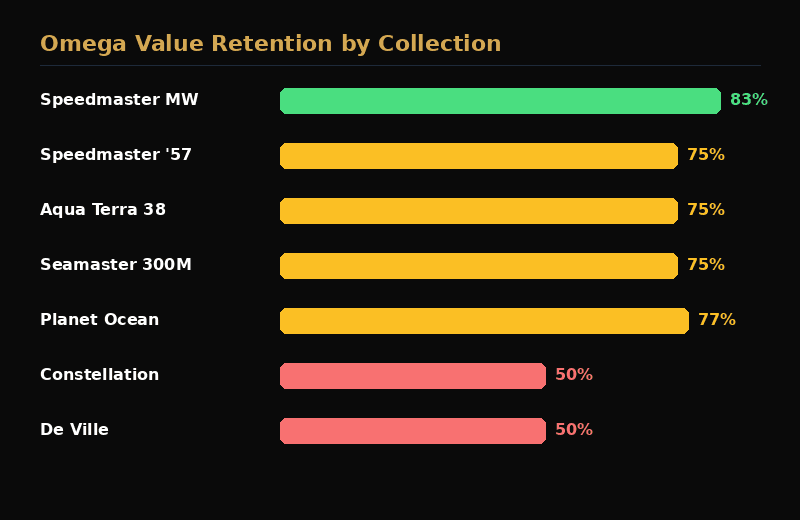
Omega holds value better than most brands in its price range but trails Rolex significantly. The Speedmaster Moonwatch is the standout, retaining 70–80% of retail on the secondary market. Sport models (Seamaster, Aqua Terra) sit in the 60–70% range. Dress models (Constellation, De Ville) drop further to 45–55%. The flip side of that depreciation is that pre-owned Omega offers exceptional value — you get the same in-house movement and build quality for 25–40% less than retail.
| Model | Retail | Pre-Owned | Retention |
|---|---|---|---|
| De Ville Prestige 40 | $3,200 | $1,800–$2,800 | 56–88% |
| Seamaster Diver 300M | $5,900 | $4,200–$4,900 | 71–83% |
| Aqua Terra 38 | $6,400 | $4,600–$5,000 | 72–78% |
| Speedmaster Moonwatch | $6,600 | $5,200–$5,800 | 79–88% |
| Planet Ocean 600M | $7,100 | $5,200–$5,800 | 73–82% |
| Constellation 41 Steel | $7,200 | $3,200–$4,000 | 44–56% |
| Speedmaster ’57 | $7,700 | $5,400–$6,200 | 70–81% |
How to Buy an Omega
Authorised Dealer vs Grey Market
Omega ADs rarely discount beyond 5–10%, but you get the full 5-year international warranty and the option to pay with a credit card for buyer protection. Grey-market dealers (Jomashop, AuthenticWatches) sell for 15–25% below retail but void the Omega warranty. Given the pre-owned price spread, grey market only makes sense if you value the unworn condition over the savings you could get buying pre-owned with the original warranty card.
Pre-Owned Buying Tips
Request the original warranty card, box, and receipt. The warranty card’s serial number should match the caseback. Verify the reference number against the COSC database if the seller claims chronometer certification. Use Grailr’s scanner to check the reference number and indicative pricing from a photograph — verify the result against the seller’s documentation independently.
Service Costs
An Omega service through the official service centre costs $600–$900 for a three-hand automatic and $900–$1,200 for a chronograph. Independent watchmakers charge $350–$600 but void any remaining warranty. Co-Axial movements are designed for 5–8 year service intervals, making them cheaper to maintain long-term than older Omega calibres.
Frequently Asked Questions
What is the cheapest Omega watch for men?
The Omega De Ville Prestige 40mm starts around $3,200 on a leather strap, making it the most affordable current-production men's Omega. Pre-owned Aqua Terras and older Seamaster 300M models can be found from $2,200-$2,800 on the secondary market.
Is the Omega Speedmaster still worth buying in 2026?
Yes. The 2021-onwards Speedmaster with the Co-Axial Master Chronometer 3861 calibre is a genuine improvement over the older 1861 movement: METAS certification, better magnetic resistance and a 50-hour power reserve versus 48. Pre-owned examples of the previous generation are also strong value at $4,500-$5,500.
Do Omega watches hold their value?
Omega retains 55-75% of retail on the secondary market, depending on model and condition. The Speedmaster Moonwatch Professional holds the best at around 70-80%. The Seamaster Diver 300M holds 60-70%. De Ville and Constellation models depreciate more steeply at 45-55%.
What is the difference between Co-Axial and Master Chronometer?
Co-Axial refers to Omega's escapement design, which reduces friction and extends service intervals. Master Chronometer adds METAS certification: resistance to magnetic fields up to 15,000 gauss, daily accuracy of 0 to +5 seconds, and water resistance testing on the finished watch, not just the case.
Which Omega is best for everyday wear?
The Seamaster Aqua Terra 38mm or 41mm is the best all-rounder. It has 150m water resistance, a dressy enough profile for business attire, and the teak-pattern dial hides scratches well. The Seamaster Diver 300M is better if you need serious water resistance but reads more casual.
How often should an Omega watch be serviced?
Omega recommends a full service every 5-8 years for Co-Axial Master Chronometer movements, up from 3-5 years for older calibres. The Co-Axial escapement's lower friction extends service intervals. Budget $600-$900 for a standard three-hand service through Omega's official service centres.
Related Articles
The Bottom Line
Omega offers the most technically advanced watches in the $3,000–$10,000 range, and the secondary market makes them even more compelling. The Speedmaster Moonwatch Professional is the crown jewel for heritage and resale. The Aqua Terra 38mm is the best daily wearer. The Seamaster Diver 300M is the strongest value proposition, especially pre-owned. And the De Ville Prestige is the entry point that gives you the same movement as watches at double the price. Whatever your budget and style, there is an Omega for you — and each one is built to last decades with proper care.
Considering an Omega?
Grailr uses a photo to suggest a watch identity and an indicative price estimate, with active eBay listings where available. Check the exact reference and condition independently; a photo scan cannot authenticate a watch.
Scan a Watch NowSources and price context
- Omega Speedmaster Moonwatch Professional — Official movement, case and water-resistance specifications.
- COSC — Contrôle Officiel Suisse des Chronomètres — Chronometer certification standards and testing procedures.
These primary sources support the specific specification points noted above. Prices and resale percentages elsewhere in this guide are indicative editorial figures, not a verified transaction dataset or guaranteed returns. Confirm the exact reference, region, condition and current quote before buying; asking prices are not completed-sale prices.