Oris Big Crown Pointer Date Buying Guide
A pilot’s watch from 1938 that still earns its place on the wrist — with a central date hand, cathedral numerals and a Swiss automatic movement for under $3,500.
Price context: this guide includes indicative prices from its original publication period. They have not all been refreshed to current quotes. Use the linked primary sources for specifications and policies, and verify prices independently.

- The Big Crown Pointer Date has been in continuous production since 1938 — one of the longest-running watch designs still on sale
- Current lineup spans 29mm, 36mm and 40mm with prices from roughly $2,050 to $3,400
- The central pointer date is a genuine complication that sets this watch apart from every other sub-$4,000 automatic
- Pre-owned older references trade from $850 to $1,700, making it one of the strongest values in Swiss watchmaking
History: 88 Years of the Pointer Date
Oris introduced the Big Crown Pointer Date in 1938, just four years after the brand began making wristwatches. The oversized crown was a practical concession to pilots who needed to wind and set their watches while wearing flight gloves. The pointer date — a central hand that sweeps around the dial edge to indicate the day of the month — was a legibility improvement over the small date windows that other manufacturers would not widely adopt until the 1950s.
What makes the Pointer Date remarkable is not any single technical breakthrough but its continuity. While most watch designs from the 1930s have been retired, redesigned beyond recognition, or revived as limited-edition tributes, the Big Crown Pointer Date has remained in the Oris catalogue in some form for eighty-eight consecutive years. The cathedral hands, the fluted bezel, the Arabic numerals and the oversized crown have all survived intact through dozens of reference changes.
Oris itself was founded in 1904 in Hölstein, in the Swiss Jura region. Until 1982 the company produced its own movements, but the quartz crisis forced a shift to modified third-party calibres. In 2014 Oris returned to in-house movement production with the Calibre 110, though the Big Crown line continues to use modified Sellita-based movements — a pragmatic choice that keeps the retail price accessible. The brand positions itself as an “independent Swiss watchmaker” and is not part of the Swatch Group, LVMH or Richemont conglomerates, which gives it more flexibility in pricing and distribution.
Today the Big Crown family includes the Pointer Date, the ProPilot and the Original. The Pointer Date remains the most recognisable and the most collected, largely because of that central date hand — a feature that is mechanically more complex than a standard date window and visually unlike anything else at the price point.
The 2026 Lineup: 29mm, 36mm and 40mm
Oris currently offers the Big Crown Pointer Date in three case sizes, each aimed at a different wrist and style. All three share the signature design language — oversized crown, fluted bezel, cathedral hands and central pointer date — but differ in movement, dimensions and price.
40mm — The Classic
The 40mm is the core model and the one most people picture when they hear “Big Crown Pointer Date.” It uses the Calibre Oris 754 (or the updated 754-1) with a 38–41 hour power reserve. Available with a black, blue, green or silver dial on either a leather strap or a stainless steel bracelet. The bracelet version retails at approximately $3,407, while the leather variant sits a few hundred dollars lower. At 12mm thick and 48mm lug-to-lug, it wears like a typical mid-size sports watch — present on the wrist but not overbearing.
36mm — The Versatile Mid-Size
The 36mm uses the same Calibre 754 family and offers the same dial and strap options in a more compact package. It suits wrists between 15cm and 18cm comfortably, and its thinner profile (roughly 11.5mm) slips under a shirt cuff more easily than the 40mm. Retail pricing starts around $2,050 on leather. For buyers who want a watch that moves between field, office and dinner without drawing attention to itself, the 36mm is often the best choice in the range.
29mm — The 2026 Addition
Launched at Geneva Watch Days 2026, the 29mm is Oris’s answer to the growing demand for smaller watches. It uses the new Calibre Oris 534 with a 42-hour power reserve — actually longer than the larger models — and is offered with black or rose-gold-toned dials. Pricing starts at 1,950 CHF (approximately $2,200) on leather and 2,150 CHF (approximately $2,450) on bracelet. The 29mm is sized for slender wrists but also works as a second watch for collectors who prefer a dressier proportion.
| Model | Case Size | Calibre | Power Reserve | Retail (Bracelet) |
|---|---|---|---|---|
| Big Crown Pointer Date | 40mm | Oris 754 / 754-1 | 38–41 h | ~$3,400 |
| Big Crown Pointer Date | 36mm | Oris 754 | ~38 h | ~$2,350 |
| Big Crown Pointer Date | 29mm | Oris 534 | 42 h | ~$2,450 |
Movement and the Pointer Date Complication
The mechanical heart of the 36mm and 40mm models is the Calibre Oris 754, which is based on the widely respected Sellita SW 200-1 automatic. Oris modifies it in-house to add the pointer date mechanism — a module that converts the standard date disc output into the rotation of a central hand. The result is a movement with hours, minutes, running seconds, an instantaneous date change at midnight and a date corrector accessible through the crown.
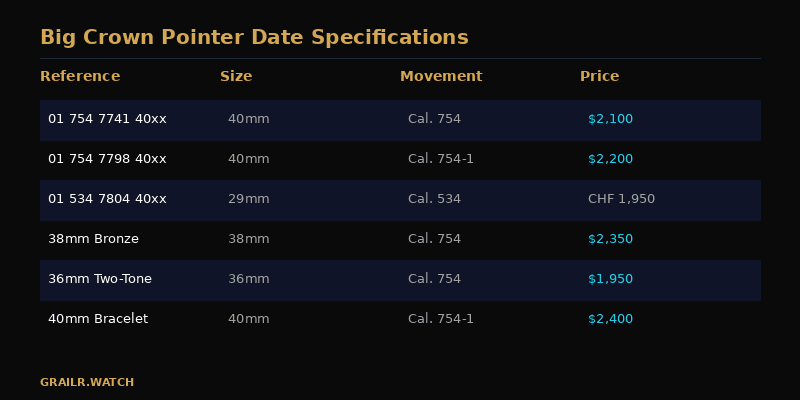
The 754 beats at 28,800 vibrations per hour (4 Hz) with 26 jewels and includes a fine-timing regulator, hacking seconds and bidirectional winding. The base SW 200-1 is an ETA 2824-2 equivalent, meaning parts and service are widely available — a practical advantage over proprietary movements when a ten-year overhaul comes due. The updated 754-1 variant extends the power reserve from 38 to 41 hours, a modest but welcome improvement that means a Friday-evening wind can last until Sunday morning if you let the watch sit.
The 29mm model introduces the Calibre Oris 534, a new-for-2026 movement that fits the smaller case diameter. It delivers a 42-hour power reserve, slightly exceeding even the 754-1, and drives the same central pointer date complication. Beyond the case-back engravings and a few Geneva Watch Days press releases, Oris has not published detailed specifications for the 534 at the time of writing.
What makes the pointer date complication worth caring about? Mechanically, it requires an additional wheel train and a longer hand than a windowed date, which adds cost and complexity to an otherwise mid-range movement. Visually, it transforms the dial: instead of a tiny aperture at three o’clock, you get a slim red-tipped hand that sweeps around 31 date numerals printed on the chapter ring. It is readable at a glance from any angle, and it gives the dial a sense of activity that a date window simply cannot match. At this price point, no other Swiss brand offers a comparable date display on a mechanical watch.
Check Any Watch Price in Seconds
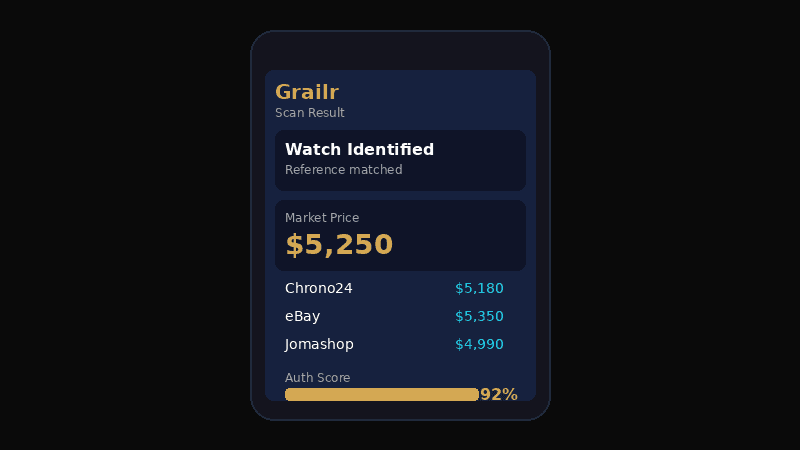
Grailr scans your watch photo and pulls live pricing from Chrono24, eBay, and Jomashop.
- AI identifies brand, model & reference number
- Live market prices from 3+ sources
- Authentication confidence score
Retail Pricing and Pre-Owned Values
One of the strongest arguments for the Big Crown Pointer Date is its price-to-complication ratio. A new 40mm on bracelet costs roughly $3,400 — less than a Hamilton Khaki Field with an in-house movement and significantly less than the entry-level offerings from Longines or Tissot’s Powermatic range when you factor in the pointer date complication.
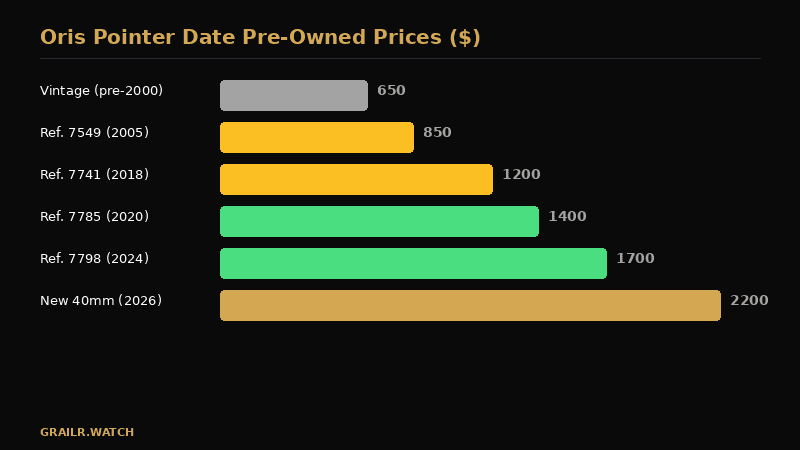
On the pre-owned market, the Big Crown Pointer Date follows the pattern typical of independent Swiss brands in this price range: a meaningful first-owner depreciation of 40–60%, followed by a stable floor that holds for years. Older references from the 2010s trade between $850 and $1,700 depending on condition, age and whether the original bracelet is included. That makes it one of the strongest value plays in the sub-$1,000 pre-owned market — a Swiss-made automatic with a real complication and a design history that predates most of its competitors’ parent companies.
The 36mm and the newer 29mm have not been on the market long enough to establish reliable pre-owned pricing, but they will likely follow the same curve. Oris does not restrict supply or maintain waitlists, so secondary-market premiums are essentially non-existent. If you find one you like, the only question is whether to buy new for the full two-year warranty or save 40% on a well-kept example from the previous generation.
Sizing and Wrist Presence
Getting the size right matters more than usual with the Big Crown Pointer Date because the pointer date chapter ring adds visual weight. A 40mm case with a date ring around its perimeter reads closer to 42mm from a design standpoint. The fluted bezel adds another millimetre or so of perceived width. On wrists under 16.5cm, the 36mm is almost always the better choice.
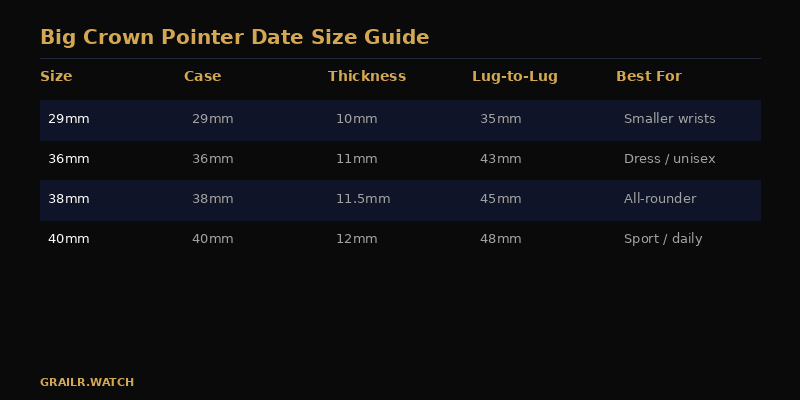
| Dimension | 29mm | 36mm | 40mm |
|---|---|---|---|
| Case Diameter | 29mm | 36mm | 40mm |
| Thickness | ~10mm | ~11.5mm | ~12mm |
| Lug-to-Lug | ~36mm | ~44mm | ~48mm |
| Lug Width | 14mm | 18mm | 20mm |
| Water Resistance | 5 bar | 5 bar | 5 bar |
| Best Wrist Size | 13–15.5cm | 15–18cm | 17–20cm |
A tip for first-time buyers: if you can try on only one size, make it the 36mm. It is the most versatile of the three and works across the widest range of wrist sizes and clothing styles. The 40mm is a better choice if you prefer a sportier look or have a wrist over 17.5cm. The 29mm is ideal for wrists under 15.5cm or as a dressy complement to a larger daily wearer.
How It Compares to the Competition
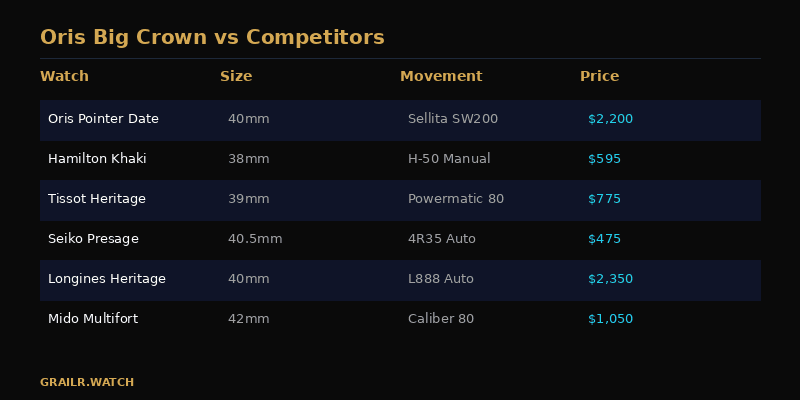
The Big Crown Pointer Date occupies a specific niche: Swiss automatic, heritage design, genuine complication, under $3,500. Several watches overlap on one or two of those criteria, but none hit all four. Here is how the closest competitors stack up.
The Hamilton Khaki Field Mechanical (from roughly $525) undercuts the Oris by more than $1,500 and offers an impressive 80-hour power reserve, but it is a hand-wound three-hander with no date complication and a plainer dial. Read our Hamilton Khaki Field guide for a deep comparison.
The Tissot PRX Powermatic 80 (from roughly $675) is the current darling of the entry-level Swiss automatic market, but it is a retro-styled integrated-bracelet watch with a standard date window. It lacks the complication, the aviation heritage and the hand-finished bezel of the Oris.
The Longines Spirit 40mm (from roughly $2,500) is a COSC-certified chronometer with a silicon hairspring and 72-hour power reserve. It is objectively the more technically advanced watch, but it does not have a pointer date, and its field-watch styling is more generic. If accuracy certification matters to you, the Longines wins; if design distinction matters, the Oris does.
The Seiko Presage enamel-dial range (from roughly $500–$1,200) offers beautiful dials and reliable 4R or 6R movements, but Seiko does not produce a central pointer date. For a broader look at watches in this price range, the Oris stands out for its uniqueness rather than its raw specifications.
Buying Tips
1. Check the Calibre Version
The 754-1 has a 41-hour reserve versus 38 hours for the original 754. Both are reliable, but the extra three hours of reserve can matter over a weekend. The calibre number is engraved on the case-back or listed on the reference card.
2. Bracelet vs Leather
The bracelet adds roughly $300 to the price and cannot be retrofitted easily because the end links are reference-specific. If you think you might want a bracelet later, buy it now. Aftermarket straps in 18mm or 20mm are widely available if you start with leather.
3. Buy Pre-Owned for the Best Value
Oris watches depreciate 40–60% in the first few years. A three-year-old 40mm in good condition can be found for $1,200–$1,500, which is less than half of the current retail price for an essentially identical watch. Use Grailr’s scanner to check any listing before committing.
4. Avoid Confusing References
Oris reference numbers are long (e.g. 01 754 7798 4064-07 8 20 06) and the Big Crown family includes ProPilot and Original models that look similar but are different watches. Always match the reference number to the Oris website before buying, especially on the secondary market.
5. Service Costs Are Reasonable
Because the 754 is based on the Sellita SW 200-1, any competent independent watchmaker can service it. Expect to pay $200–$350 for a full service every five to seven years — significantly less than Omega, Tudor or Rolex service costs.
Frequently Asked Questions
How much does an Oris Big Crown Pointer Date cost?
The 40mm on bracelet retails for approximately $3,400, the 36mm on leather starts around $2,050, and the new 29mm lists at 1,950 CHF on leather or 2,150 CHF on bracelet. Pre-owned older references trade from roughly $850 to $1,700.
What movement does the Oris Big Crown Pointer Date use?
The 36mm and 40mm use the Calibre Oris 754 (or 754-1), a modified Sellita SW 200-1 with the pointer date module. It beats at 28,800 vph with 26 jewels and a 38–41 hour power reserve. The 29mm uses the new Calibre 534 with a 42-hour reserve.
Is the Oris Big Crown Pointer Date a good first watch?
Yes. It offers a Swiss automatic movement, a genuine complication, and a design heritage back to 1938 for under $2,100 on leather. Few watches at this price match its combination of history, mechanical interest and wearability.
What sizes does the Big Crown Pointer Date come in?
Three sizes: 29mm (new for 2026), 36mm, and 40mm. The 36mm suits most wrists and is the best all-rounder. The 40mm suits larger wrists or sportier tastes, and the 29mm is ideal for smaller wrists or a dressier look.
Is the Big Crown Pointer Date water resistant enough for swimming?
No. It is rated at 5 bar (50 metres), which covers rain, hand-washing and accidental splashes but not swimming or diving. For water activities, consider the Oris Aquis line.
How does the pointer date complication work?
Instead of a small date window, a central hand sweeps around the chapter ring to point at the current date. It advances instantaneously at midnight. The mechanism uses an additional wheel train on top of the base automatic calibre.
Related Articles
The Bottom Line
The Oris Big Crown Pointer Date is one of those rare watches that justifies itself on almost every axis. The design is eighty-eight years old and still distinctive. The complication is mechanically genuine, not a marketing exercise. The price is accessible, and the pre-owned market makes it even more so. It is not the most accurate watch at this price (the Longines Spirit has it beat on paper), and it is not the toughest (5 bar will not survive a pool). But for a watch that delivers real value, genuine character and a daily-wearable size, the Big Crown Pointer Date has no equal under $3,500. Buy the 36mm if you want versatility, the 40mm if you want presence, and a pre-owned example if you want the best deal in the lineup.
Spotted an Oris You Like?
Grailr uses a photo to suggest a watch identity and an indicative price estimate, with active eBay listings where available. Check the exact reference and condition independently; a photo scan cannot authenticate a watch.
Scan a Watch NowSources and price context
- Oris Big Crown collection page — Official specifications, dial options and retail pricing for all current Big Crown models.
- Watchbase Calibre Oris 754 — Technical details for the movement including beat rate, jewel count and power reserve.
These primary sources support the specific history, specification or policy points noted above. Prices and resale percentages elsewhere in this guide are indicative editorial figures, not a verified transaction dataset or guaranteed returns. Confirm the exact reference, region, condition and current quote before buying; asking prices are not completed-sale prices.