Patek Philippe vs Audemars Piguet: Prices and Resale
Published 17 September 2026 · 12 min read

Key Takeaways
- Patek Philippe retail prices run roughly 20–40% higher than equivalent Audemars Piguet references, but AP’s total revenue is actually slightly larger thanks to higher unit volume in the Royal Oak family.
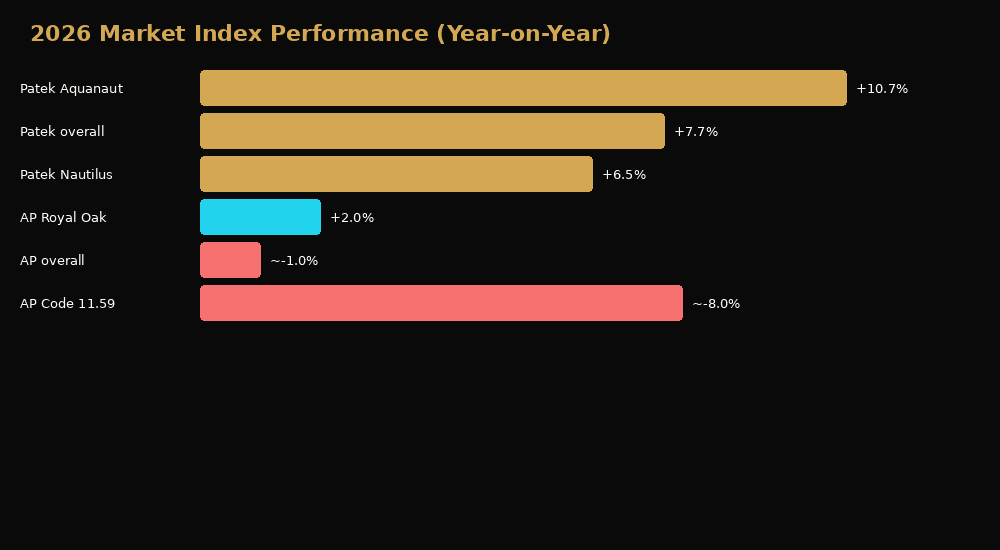
- Secondary-market data favours Patek in 2026: the overall Patek index is up roughly 7.7% year-on-year while the AP index sits roughly flat, though individual Royal Oak references still command strong premiums.
- Entry into Patek starts around $37,500 (Calatrava 6119G) versus roughly $27,000–$29,000 for the AP Code 11.59, making AP the more accessible brand at the entry level.
- Both brands produce under 75,000 watches per year and remain family-controlled, but their design philosophies and secondary-market trajectories are quite different.
Patek Philippe and Audemars Piguet are the two pillars of independent Swiss haute horlogerie. Both are family-controlled, both produce fewer than 75,000 watches per year, and both have created timepieces that routinely sell for multiples of retail on the secondary market. Yet the two houses differ sharply in design language, pricing structure and resale trajectory.
Patek Philippe generated roughly CHF 2.5 billion in revenue in 2025, producing an estimated 72,000 watches. Audemars Piguet reached approximately CHF 2.6 billion on roughly 53,000 pieces — meaning AP’s average revenue per watch is actually lower, but its total haul is marginally larger. The numbers expose a fundamental difference: Patek spreads across dress, sport and complication families while AP concentrates heavily on variations of the Royal Oak.
This guide compares the two brands model by model — retail prices, pre-owned values, production context and resale trajectories — so you can decide which house deserves space on your wrist (and in your portfolio). All prices are in USD and current as of September 2026. For deeper dives into either brand, see our Patek Philippe price guide and Audemars Piguet price guide.
Brand DNA: Tradition vs Design Innovation
Patek Philippe, founded in 1839, has built its identity around the idea that you never truly own a Patek — you merely look after it for the next generation. The brand maintains an archive of every watch it has made and will service any Patek, regardless of age. That lifetime-stewardship promise underpins the brand’s extraordinary resale premiums.
Audemars Piguet, established in 1875 in Le Brassus, took a different gamble in 1972 when Gérald Genta designed the Royal Oak — a luxury watch in stainless steel at a time when steel meant cheap. That single design decision created the luxury sports-watch category and still accounts for the vast majority of AP’s revenue five decades later.
The distinction matters for buyers. Patek’s breadth — Calatrava dress watches, Nautilus and Aquanaut sport pieces, grand complications, perpetual calendars — means the collection covers nearly every wrist and occasion. AP’s concentration on the Royal Oak family (Royal Oak, Royal Oak Offshore, Royal Oak Concept) plus the newer Code 11.59 gives it a narrower but intensely focused product line. When you buy AP, you are usually buying some expression of the Royal Oak’s octagonal bezel and integrated bracelet.
Both houses finish movements to the highest Geneva standards and both use in-house calibres exclusively in their core collections. Patek applies the Patek Philippe Seal, which covers the entire watch (not just the movement) and mandates accuracy within −3/+2 seconds per day. AP relies on a mix of the Qualité Fleurier certification and its own internal quality protocols, depending on the model.
Entry-Level Models: Calatrava vs Code 11.59
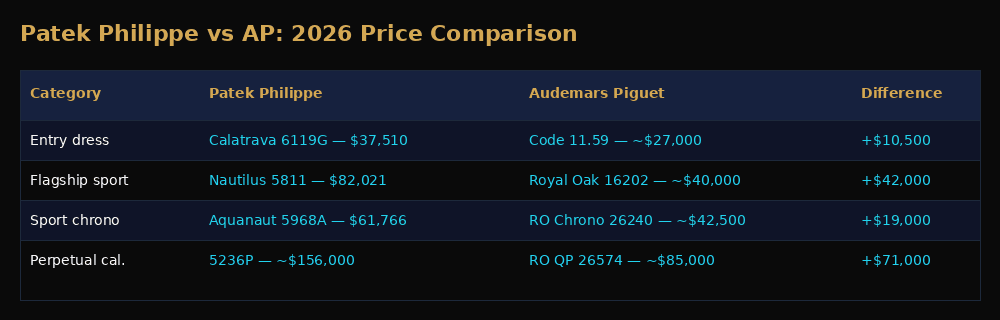
The most affordable current-production Patek Philippe is the Calatrava, the brand’s signature dress watch. The reference 6119G in white gold opens at a retail price of $37,510. It houses the calibre 30-255 PS with a 65-hour power reserve, measures 39 mm across, and wears as a pure, thin dress watch — no date, no complications, just time.
At Audemars Piguet, the entry point is the Code 11.59, a collection introduced in 2019 that initially drew criticism for its design but has since been refined and expanded. The time-only Code 11.59 in steel retails around $27,000–$29,000. It runs the calibre 4302 with a 70-hour power reserve and comes in a 41 mm case with a distinctive double-curved sapphire crystal.
Both are excellent watches, but they serve different roles. The Calatrava is a white-gold dress watch that signals quiet refinement. The Code 11.59 in steel is more versatile — suitable for business or casual wear — and roughly $10,000 cheaper at retail.
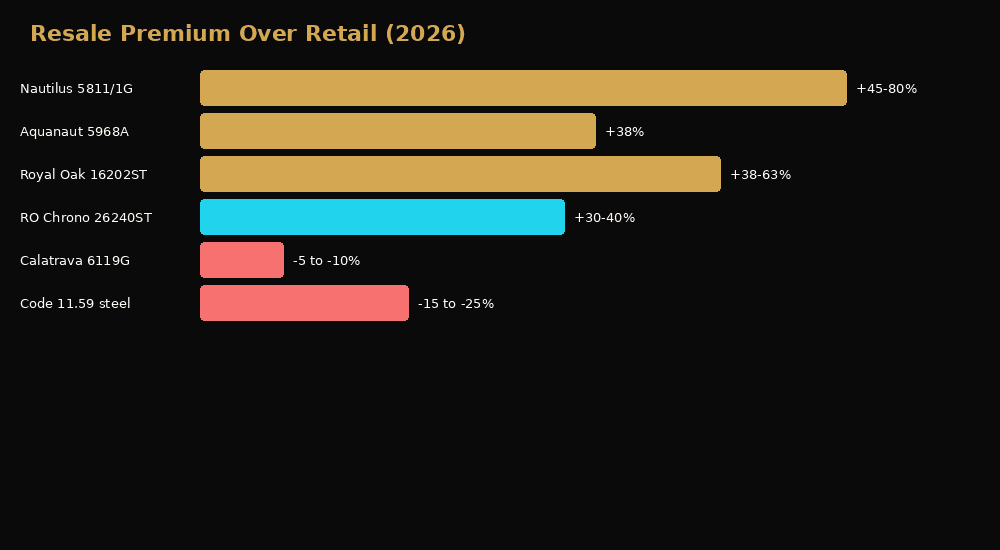
Resale tells a sharper story. Used Calatravas typically hold 80–95% of retail depending on the reference, with popular models like the 5196 holding firmly above 90%. The Code 11.59, however, still trades at roughly 15–25% below retail on the secondary market — a discount that makes it an interesting buy for collectors willing to purchase pre-owned, but a concern for anyone hoping to flip at or above retail.
Flagship Sports Watches: Nautilus vs Royal Oak
This is the matchup most collectors care about. The Patek Philippe Nautilus 5811/1G in white gold — the successor to the legendary 5711 — retails at $82,021. The Audemars Piguet Royal Oak “Jumbo” Extra-Thin 16202ST in stainless steel retails at approximately $40,000.
On the secondary market, both trade above retail, but the Nautilus commands a steeper premium. Pre-owned 5811/1G pieces have been spotted at $120,000–$150,000, representing a 45–80% premium over retail. The Royal Oak 16202ST trades at roughly $55,000–$65,000, a 38–63% premium. The outgoing 15202ST — now discontinued — commands even higher prices, often above $80,000.
| Category | Patek Philippe | Audemars Piguet |
|---|---|---|
| Entry dress | Calatrava 6119G — $37,510 | Code 11.59 steel — ~$27,000 |
| Flagship sport | Nautilus 5811/1G — $82,021 | Royal Oak 16202ST — ~$40,000 |
| Sport chrono | Aquanaut Chrono 5968A — $61,766 | RO Chrono 26240ST — ~$42,500 |
| Perpetual calendar | 5236P-011 — ~$156,000 | RO QP 26574ST — ~$85,000 |
| Flagship resale premium | +45–80% over retail | +38–63% over retail |
The price gap at retail is substantial — the Nautilus 5811 costs more than double the Royal Oak Jumbo — but the gap narrows on the secondary market. Both are effectively unobtainable at authorized dealers without a significant purchase history, which makes the secondary-market premium the true cost of ownership for most buyers.
Chronographs: Aquanaut 5968 vs Royal Oak 26240
The Patek Philippe Aquanaut Chronograph 5968A in steel retails at $61,766. It runs the calibre CH 28-520 C, a flyback chronograph movement finished to Patek’s exacting standards. The 42.2 mm case wears comfortably on its composite strap, and the travel-time function (with a second time zone) adds genuine utility for frequent travellers.
Audemars Piguet’s answer is the Royal Oak Chronograph 26240ST in stainless steel, retailing at approximately $42,500. It uses the calibre 4401 — AP’s integrated chronograph movement with a column wheel and flyback function — housed in a 41 mm Royal Oak case. The 26240 replaced the long-running 26331 and brought a fully integrated movement to the line for the first time.
Pre-owned, the Aquanaut 5968A trades around $85,000–$100,000, while the RO Chrono 26240ST sits at roughly $55,000–$65,000. Both command healthy premiums, but the Aquanaut’s secondary-market trajectory has been stronger through 2026. The Aquanaut family index is up roughly 10.7% year-on-year, outpacing even the broader Patek index.
For the buyer choosing between them, the decision often comes down to bracelet versus strap and aesthetic preference. The Royal Oak Chrono on its integrated bracelet is a more assertive, angular piece. The Aquanaut Chrono on its tropical strap is sportier and arguably more comfortable in hot weather. Both movements are exceptional, and both watches will hold their value well.
Curious what your watch is worth?
Upload a photo and Grailr technology identifies the model and returns an indicative value estimate in seconds.
Try It FreeGrand Complications and Perpetual Calendars
Both brands are master complication houses, but Patek Philippe has historically led in variety and auction prices. The Patek 5236P-011 in-line perpetual calendar retails at approximately $156,000 and features a patented display that shows day, date and month on a single line — a mechanical tour de force that required an entirely new movement architecture (calibre 31-260 PS QL).
Audemars Piguet’s Royal Oak Perpetual Calendar 26574ST in stainless steel retails at roughly $85,000. It uses the calibre 5134 and presents the classic sub-dial perpetual-calendar layout in the unmistakable Royal Oak case. The more recent 26574TI in titanium has become a collector favourite, trading at significant premiums.
At the summit, Patek’s Grand Complications — minute repeaters, split-seconds chronographs, celestial charts — occupy a space that AP enters less frequently. The Patek 6300G Grandmaster Chime, while an extreme example, set the record for the most expensive watch ever sold at auction ($31.2 million at Christie’s in 2019). AP’s most complex current-production piece, the Royal Oak Concept Supersonnerie, retails above $600,000 and demonstrates that AP can compete at the highest levels of complication, but the brand’s production emphasis remains on the core Royal Oak family.
For collectors who value complication depth and auction pedigree, Patek is the traditional choice. For those who want a perpetual calendar in a modern, sporty case with strong resale, the Royal Oak QP is a compelling alternative at nearly half the price.
Production Numbers and Availability
Patek Philippe produces roughly 72,000 watches per year, generating about CHF 2.5 billion in annual revenue. Audemars Piguet makes approximately 53,000 pieces for roughly CHF 2.6 billion. The math is instructive: AP earns slightly more total revenue from significantly fewer watches, thanks to the Royal Oak family’s premium pricing in precious metals and complications.
Availability at authorized dealers is severely constrained for both brands’ sports models. The Nautilus, Aquanaut, Royal Oak and Royal Oak Offshore are essentially allocation-only at most boutiques. Wait lists, where they still formally exist, stretch years. The practical path to either brand’s flagship is the secondary market, which is why resale premiums matter so much.
Dress and complication models are more accessible. A Calatrava or a non-Royal-Oak AP (such as a Jules Audemars minute repeater) can often be purchased at retail with less friction, though stock is never guaranteed.
| Metric | Patek Philippe | Audemars Piguet |
|---|---|---|
| Annual production | ~72,000 watches | ~53,000 watches |
| Annual revenue | ~CHF 2.5 billion | ~CHF 2.6 billion |
| Founded | 1839 | 1875 |
| Ownership | Stern family (private) | Audemars & Piguet families (private) |
| Core collection | Nautilus, Aquanaut, Calatrava, Grand Complications | Royal Oak, RO Offshore, Code 11.59 |
Both brands have expanded production capacity in recent years — Patek opened a new manufacturing centre in Plan-les-Ouates, and AP invested heavily in its Le Brassus facilities — but neither has signalled an intent to dramatically increase volume. Scarcity, whether by design or by demand, remains central to both brands’ positioning.
2026 Resale Trajectories: Who Is Winning?
The secondary-market data for 2026 tells a clear story. The overall Patek Philippe market index is up approximately 7.7% year-on-year, with the Aquanaut family leading at +10.7% and the Nautilus following closely. This recovery has been driven by renewed demand for steel sports watches and a broader sentiment that Patek’s prices had corrected enough from their 2022 peaks to represent value again.
Audemars Piguet’s market index, by contrast, has been roughly flat to slightly negative over the same period. The Royal Oak Jumbo and certain perpetual-calendar references have held firm, but the broader Royal Oak Offshore line and the Code 11.59 have weighed on the average. The Code 11.59’s secondary-market discount of 15–25% below retail continues to dampen AP’s overall index performance.
This does not mean AP is a poor choice. It means that the brand’s resale performance is more reference-dependent. A Royal Oak 16202 or a Royal Oak Perpetual Calendar will hold value as well as almost anything Patek makes. But the broader AP catalogue — especially newer lines and precious-metal Offshore variants — is more susceptible to depreciation than the equivalent Patek models.
For buyers focused on value retention, the takeaway is simple: stick to core references. At Patek, that means Nautilus, Aquanaut and classic Calatravas. At AP, it means the Royal Oak in steel or titanium. For a deeper breakdown, see our Royal Oak buying guide and 2026 Royal Oak price tracker.
Identify any Patek or AP in seconds
Upload a photo and Grailr technology returns the reference number, production year range and an indicative value estimate — no serial number needed.
Identify Your WatchFrequently Asked Questions
Is Patek Philippe more prestigious than Audemars Piguet?
Both sit at the top of independent watchmaking. Patek is traditionally considered the pinnacle of dress-watch finishing and holds stronger overall resale premiums. AP’s Royal Oak invented the luxury sports-watch category and commands massive premiums of its own. Prestige depends on whether you value horological tradition or design-led innovation.
Is the Nautilus or the Royal Oak a better investment?
Neither is a guaranteed investment. Secondary-market data favours the Nautilus in 2026 — the Patek index is up roughly 7.7% year-on-year while the AP index is roughly flat. Specific Royal Oak references still retain value very well. Past performance does not predict future returns.
Why are Patek Philippe watches more expensive than AP?
Patek leans more heavily on precious-metal cases and grand complications, which raises its average retail price. AP generates similar total revenue (CHF 2.6 billion vs CHF 2.5 billion) by producing fewer, slightly lower-priced pieces on average.
Can you buy a Patek Philippe or AP at retail?
The most desirable references (Nautilus, Aquanaut, Royal Oak, Royal Oak Offshore) carry multi-year wait lists. Entry-level dress models like the Calatrava and Code 11.59 are generally easier to purchase at retail, though availability varies by market.
Which brand holds its value better over time?
Patek Philippe has historically led in value retention. Most steel sports models trade at or above retail, and even dress references hold 80–95% of retail. AP performs well with the Royal Oak family but has seen softer resale on the Code 11.59 line, which often trades 15–25% below retail.
Related Guides
The Bottom Line
Patek Philippe and Audemars Piguet are not interchangeable. Patek offers broader collection depth, stronger overall resale premiums and an unmatched auction pedigree. AP concentrates its identity in the Royal Oak — one of the most iconic watch designs ever made — and delivers comparable mechanical quality at a lower entry price.
If secondary-market performance is a priority, the data currently favours Patek, especially in the Nautilus and Aquanaut families. If you want the most iconic sports-watch design at a lower cost of entry, the Royal Oak remains one of the best values in ultra-high-end horology, provided you choose references carefully.
Either way, you are buying from a family-owned, independent manufacture with more than a century of history and a commitment to producing fewer than 75,000 watches per year. In a market increasingly dominated by conglomerates, that independence is itself a form of value.
Check the current value of any Patek or AP
Snap a photo and let Grailr technology return an instant identification and indicative value estimate.
Get Your EstimateSources
- Patek Philippe official retail prices, patek.com (September 2026)
- Audemars Piguet official retail prices, audemarspiguet.com (September 2026)
- Morgan Stanley & LuxeConsult, Swiss watch industry report 2025–2026
- WatchCharts market index data, Patek Philippe and Audemars Piguet (September 2026)
- Chrono24 and WatchBox secondary-market asking prices (September 2026)
- Christie’s, “The Grandmaster Chime Ref. 6300A-010,” Only Watch 2019 auction results