Best Wrist Watch for Pilots: The 2026 Buying Guide
Eight pilot watches compared — IWC, Breitling, Bell & Ross, Longines, Hamilton and Laco — on legibility, movement, price and what each one is really worth today.
Price context: this guide includes indicative prices from its original publication period. They have not all been refreshed to current quotes. Use the linked primary sources for specifications and policies, and verify prices independently.

- A genuine wrist watch for pilots runs from the $310 Laco Augsburg 39 to the $14,600 IWC Big Pilot 43, spanning Japanese quartz-adjacent automatics through full in-house Swiss calibers
- Dial layout splits into two historic standards — Type A puts hours on the outer ring, Type B puts minutes there instead — and both remain in production today
- Power reserve varies enormously, from 38 hours on the Breitling Navitimer Auto 41 to 168 hours (seven days) on the IWC Big Pilot
- The Longines Spirit Zulu Time is the strongest value pick with a COSC-certified GMT movement at $2,750
- In-house movements (IWC, Breitling B01) hold resale value meaningfully better than outsourced-caliber watches at similar price points
What Makes a Wrist Watch for Pilots?
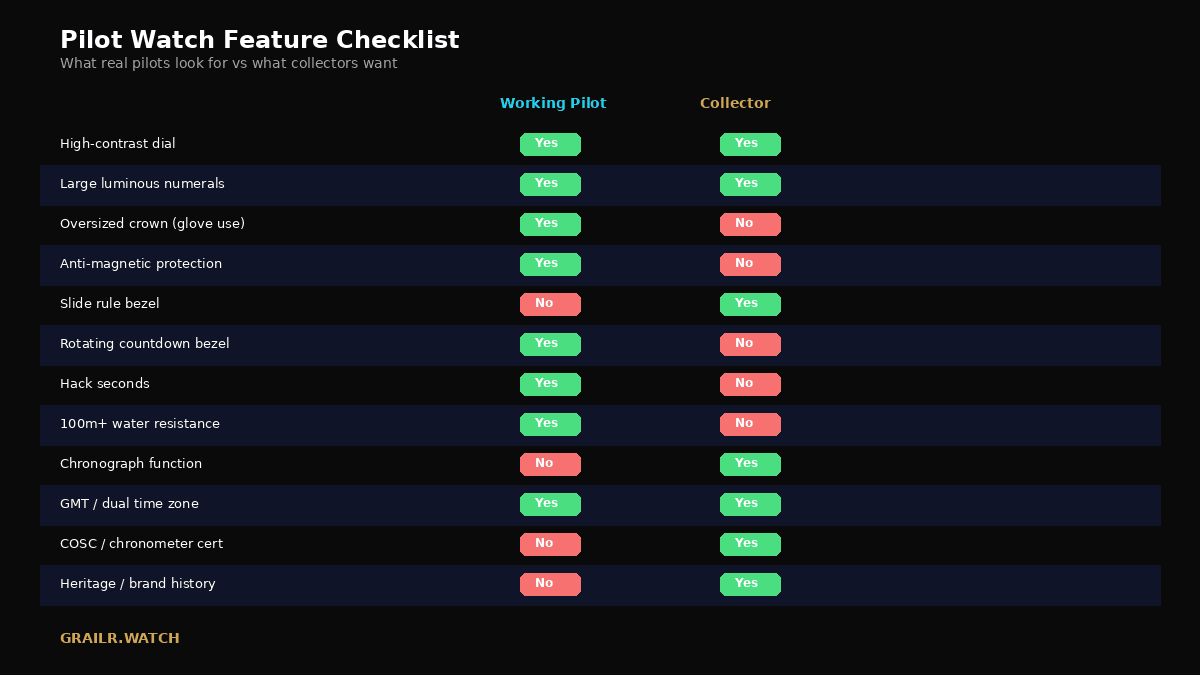
The pilot watch traces to a specific engineering brief: a cockpit instrument you could read at a glance in poor light, operate with thick gloves on, and trust not to drift or fail mid-flight. Early flieger watches built for German Luftwaffe navigators in the late 1930s and early 1940s set the template that nearly every wrist watch for pilots still follows — a black dial for maximum contrast, oversized luminous numerals, a plain sword or cathedral hand set, and a crown large enough to wind or set while wearing gloves.
A second, less visible feature mattered just as much: magnetic shielding. Cockpit instruments and radio equipment generate magnetic fields that can throw off a mechanical movement’s accuracy, so historic military fliegers used a soft-iron inner case to protect the escapement. IWC still builds this into its Mark series today, a direct link back to the watches it supplied to Luftwaffe pilots in 1940.
Modern pilot watches have branched well beyond that original brief. Some, like the Longines Spirit Zulu Time and Breitling Navitimer, add a GMT function or a chronograph to track a second time zone or time a flight leg — genuinely useful for a working pilot, and a strong aesthetic hook for everyone else. Others, like the Laco Augsburg, stay deliberately close to the 1940s original: a time-only dial, a manual or simple automatic movement, and a price that reflects the simplicity. What unites the category is legibility first, complications second — the opposite priority order from most other watch genres.
The Complete Pilot Watch Lineup
We compared eight watches spanning $310 to $14,600 — enough range to cover a first-time buyer and a collector chasing an in-house chronometer. Each one earns its place in the flieger tradition, but they solve the brief in noticeably different ways.
IWC Mark XX — $5,800
The current-generation Mark, at 40mm, is the closest thing on the market to a direct descendant of the 1940 Mark IX supplied to the Royal Air Force. It runs IWC’s in-house Caliber 32111 with a 120-hour power reserve — five days — and the soft-iron inner case that defines the lineage. Water resistance sits at a modest 100m, reflecting its role as a cockpit instrument rather than a dive tool.
Breitling Navitimer Auto 41 — $4,950
The Navitimer’s circular slide rule bezel is arguably the most recognizable complication in aviation watchmaking, originally built to calculate fuel burn, distances and rates of climb. The Auto 41 uses Breitling’s B17 caliber, an ETA-based movement, with a 38-hour power reserve and 30m water resistance — enough for daily wear but not a watch to swim in.
Breitling Navitimer B01 — $9,100
The chronograph version steps up to Breitling’s fully in-house B01 movement, adding a proper chronograph function on top of the slide rule bezel and nearly doubling the power reserve to 70 hours. At 43mm it wears noticeably larger than the Auto 41, and the in-house caliber is the main reason it commands almost double the price.
Bell & Ross BR 03-92 — ~$4,200
Bell & Ross takes the cockpit-instrument brief literally — the BR 03-92’s square case is modeled directly on an aircraft dial housing. Inside is the BR-CAL.302, an ETA-based automatic with a 40-hour reserve, and the case is rated to 100m. At 42mm the square silhouette wears differently from every round watch on this list, which is either the appeal or the dealbreaker depending on taste.
Longines Spirit Zulu Time — $2,750
Available in 39mm and 42mm, the Spirit Zulu Time punches well above its price with a COSC-certified L844.4 movement, a true jumping-hour GMT complication, 100m water resistance and a 72-hour power reserve. It is the strongest specification-per-dollar watch in this guide, and the one we recommend most often to buyers who want genuine chronometer performance without an IWC or Breitling price tag.
Hamilton Khaki Aviation — $625
Hamilton’s aviation history runs deep — the brand supplied navigation watches to the US military for decades — and the Khaki Aviation carries that legacy at an accessible price. The 42mm case houses the H-10 automatic movement with an unusually long 80-hour power reserve for the price tier, plus 100m water resistance.
Laco Augsburg 39 — $310
Laco is a direct historical link to the original 1940s flieger watches — the company was one of five original suppliers to the German Air Ministry. The Augsburg 39 keeps the classic Type A proportions at an entry price, running the Japanese Miyota 821A automatic with a 42-hour reserve and 50m water resistance. It is the most affordable genuinely well-built pilot watch on this list.
IWC Big Pilot 43 — $14,600
The range-topper. At 43mm with a broad, cushion-shaped case and an oversized onion crown, the Big Pilot is the most instantly recognizable modern flieger. IWC’s in-house Caliber 82100 delivers a remarkable 168-hour power reserve — a full seven days — and 100m water resistance. It is a statement watch more than a daily-wear proposition for most buyers, and priced accordingly.
Full Specifications and Pricing
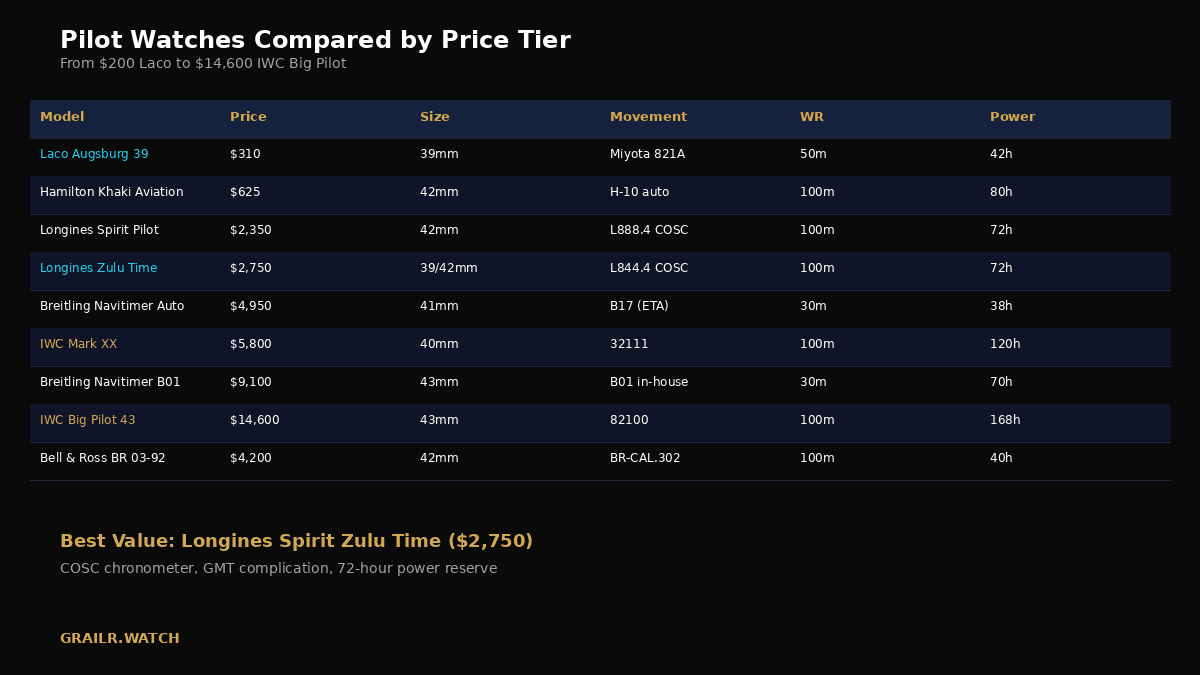
| Watch | Size | Movement | Power Reserve | Water Resist. | Price |
|---|---|---|---|---|---|
| Laco Augsburg 39 | 39mm | Miyota 821A | 42h | 50m | $310 |
| Hamilton Khaki Aviation | 42mm | H-10 auto | 80h | 100m | $625 |
| Longines Spirit Zulu Time | 39/42mm | L844.4 (COSC) | 72h | 100m | $2,750 |
| Bell & Ross BR 03-92 | 42mm | BR-CAL.302 | 40h | 100m | ~$4,200 |
| Breitling Navitimer Auto 41 | 41mm | B17 (ETA) | 38h | 30m | $4,950 |
| IWC Mark XX | 40mm | Cal. 32111 | 120h | 100m | $5,800 |
| Breitling Navitimer B01 | 43mm | B01 (in-house) | 70h | 30m | $9,100 |
| IWC Big Pilot 43 | 43mm | Cal. 82100 | 168h | 100m | $14,600 |
A few patterns stand out. Power reserve does not track price in a straight line — the $625 Hamilton beats the $4,950 Breitling Navitimer Auto 41 on reserve alone, because the Navitimer’s ETA-based B17 simply was not designed to chase a long reserve. Water resistance also splits along an unexpected line: the Navitimer models, at 30m, are the least water-resistant watches here despite being among the most expensive, a reminder that a pilot watch’s water resistance figure has never been the point of the design brief. If you want a full specification breakdown of the IWC side of this list on its own, our IWC pilot’s watch buying guide covers the full current Mark and Big Pilot ranges.
Type A vs Type B Dials Explained
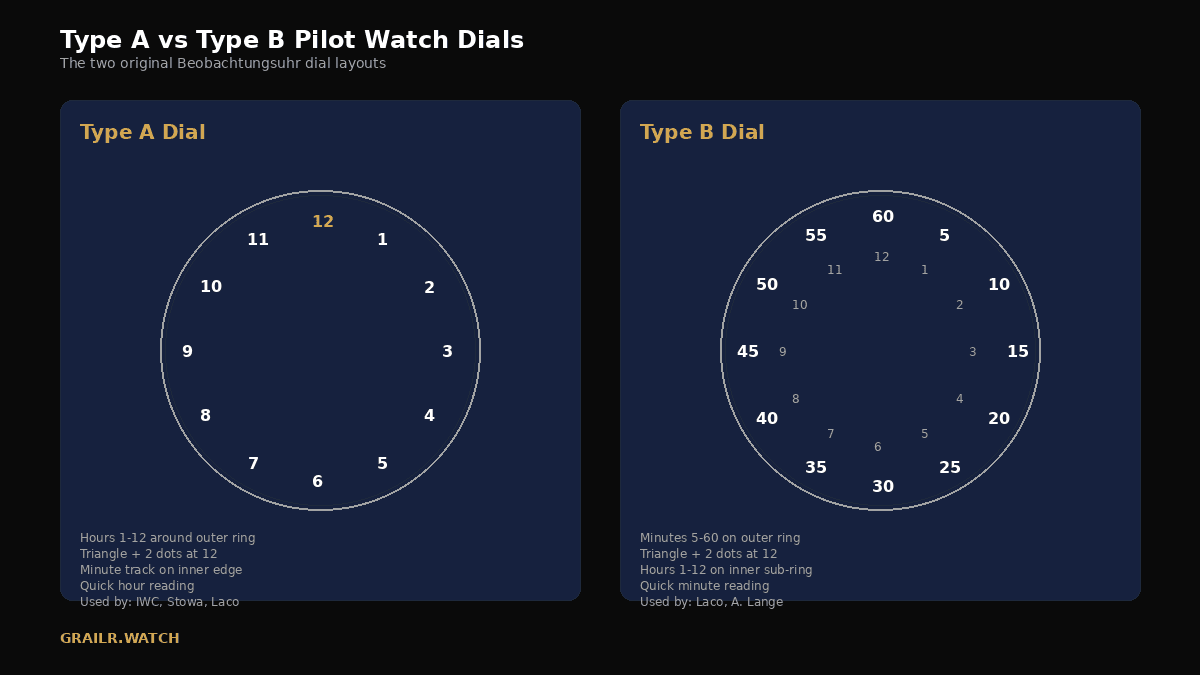
Two historic dial standards still shape nearly every wrist watch for pilots sold today, and the difference is easy to spot once you know what to look for. A Type A dial places the hour numerals 1 through 12 around the outer edge of the dial with a plain triangle marker at 12 o’clock — the simpler, older of the two formats, used by IWC, Stowa and Laco on their classic flieger models. It reads almost like a clock face stretched to the edge of the case, prioritizing raw hour-and-minute legibility above all else.
A Type B dial flips the emphasis: minute markers 5 through 60 move to the outer ring, while the hour numerals shrink and move to an inner ring closer to the center. The idea, developed for wartime navigators who needed to read elapsed minutes quickly during a timed maneuver, was that minutes mattered more moment-to-moment than the hour did. Laco still offers Type B dials alongside its Type A models, and A. Lange & Sohne’s pilot watches use the same layout at a considerably higher price point.
Neither layout is objectively better today — both trace to the same 1940s specification and both remain genuinely legible at a glance. The choice comes down to which reading habit feels more natural: most modern buyers find Type A more intuitive since it matches how every other watch dial is laid out, while Type B has a slightly more distinctive, historically literal look that collectors of the format tend to prefer specifically because it is less common.
Identify Any Pilot Watch in Seconds
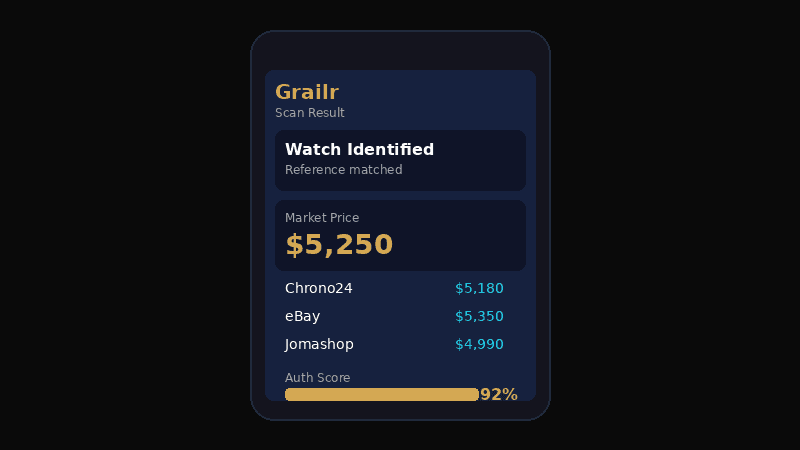
Grailr uses a photo to suggest a watch identity and an indicative price estimate, with active eBay listings where available.
- Instant model identification from a photo
- Indicative price estimate with active listings
- Authentication confidence scoring
Head-to-Head: Legibility and Movement
Price is only part of the story. Two watches at similar money can differ sharply in how they actually solve the pilot-watch brief — in-house engineering, dial legibility under real cockpit lighting, and how close a design stays to the 1940s original versus how far it has drifted toward a lifestyle chronograph.
| Watch | Movement Origin | Dial Type | Best For |
|---|---|---|---|
| Laco Augsburg 39 | Outsourced (Miyota) | Type A | Budget-conscious flieger purists |
| Hamilton Khaki Aviation | In-house-adjacent | Modern hybrid | Everyday value and long reserve |
| Longines Spirit Zulu Time | In-house (COSC) | Modern GMT | Best spec-per-dollar overall |
| Bell & Ross BR 03-92 | Outsourced (ETA) | Instrument-style | Distinctive square case |
| Breitling Navitimer Auto 41 | Outsourced (ETA) | Slide-rule bezel | Iconic Navitimer look, lower entry |
| IWC Mark XX | In-house | Type A | Historic military lineage |
| Breitling Navitimer B01 | In-house | Slide-rule bezel | Chronograph collectors |
| IWC Big Pilot 43 | In-house | Type A | Statement piece, 7-day reserve |
Notice the split: outsourced-movement watches (Laco, Bell & Ross, the Navitimer Auto 41) tend to sit at lower price points, while every in-house caliber on this list — Longines’ COSC-certified L844.4, both IWC calibers, and Breitling’s B01 — commands a real premium. That premium buys tighter chronometric control and, generally, a movement the brand can service and support for decades without relying on a third-party supplier.
Resale Value: What Pilot Watches Actually Retain
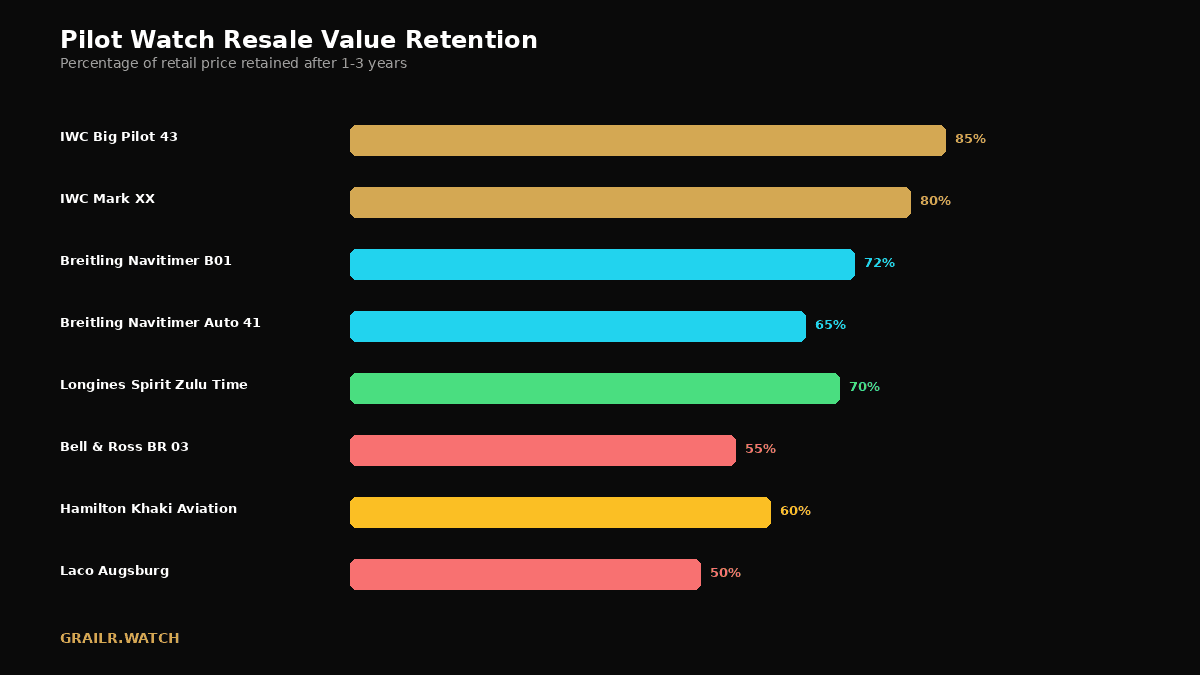
Resale performance tracks movement provenance and brand demand more than it tracks retail price. The IWC Mark XX and Breitling Navitimer B01 generally hold up best pre-owned, indicatively in the 85–95% range, thanks to in-house movements, strong secondary-market demand and limited annual production relative to demand. The Longines Spirit Zulu Time also performs respectably given its price tier, helped by the COSC certification and genuine GMT complication.
At the value end, the Hamilton Khaki Aviation and Laco Augsburg trade at a steeper discount pre-owned, indicatively 55–70% of retail, which reflects both watches competing in a crowded, price-sensitive segment rather than any flaw in build quality. If resale matters more than sticker price to your decision, our broader guide to watches under $5,000 that hold value puts these figures in wider context. These percentages are indicative editorial estimates from active pre-owned listings, not a verified transaction dataset or a guarantee of future performance.
5 Tips Before You Buy a Pilot Watch
1. Decide Whether You Actually Want a GMT
A second time zone is genuinely useful for frequent travelers, but it adds cost and dial complexity. If you will never track a second zone, the simpler Type A/B time-only watches like the Mark XX or Laco Augsburg deliver better legibility for less money.
2. Try the Crown Size in Person
The oversized crown is a defining pilot-watch feature, but it also catches on cuffs and jacket sleeves more than a standard crown does. Wear a candidate watch for a full day before committing, especially with the Big Pilot’s notably large onion crown.
3. Weigh In-House Against Outsourced Movements
An outsourced ETA or Miyota caliber is not a lesser watch — both are proven, serviceable movements — but in-house movements tend to hold resale value better and offer manufacturer-controlled long-term parts support. Decide how much that matters relative to the price gap.
4. Identify Before You Commit
Use Grailr’s free identification tool to photograph a listing and get a suggested model identification alongside an indicative price estimate. It is a starting point for due diligence, not proof of authenticity — pair it with an independent inspection before you send payment.
5. Water Resistance Is Not the Priority Here
Several watches on this list, notably the Breitling Navitimers at 30m, are not built for swimming. If you need a genuinely water-capable daily watch as well as pilot-watch styling, look toward the higher water-resistance options here like the IWC Mark XX or Longines Spirit Zulu Time, both rated to 100m.
Frequently Asked Questions
What makes a watch a pilot watch?
A true pilot watch traces to cockpit instruments built for legibility and reliability: large luminous numerals, a high-contrast dial, an oversized crown that can be operated with gloves, and historically an anti-magnetic case to protect the movement near aircraft electronics. Many modern models add a GMT or flyback chronograph for tracking a second time zone or timing a flight leg.
What is the difference between a Type A and Type B pilot dial?
A Type A dial puts the hour markers 1 through 12 on the outer ring with a plain triangle at 12 o'clock, the format IWC, Stowa and Laco use on their classic flieger watches. A Type B dial moves the minute markers 5 through 60 to the outer ring and the hour numerals to an inner ring, a layout Laco and A. Lange & Sohne also offer, originally meant to help navigators read elapsed minutes at a glance.
How much does a good pilot watch cost?
A well-built pilot watch starts around $310 for the Laco Augsburg 39 and runs to roughly $625 for the Hamilton Khaki Aviation, $2,750 for the Longines Spirit Zulu Time, $4,200 to $4,950 for a Bell & Ross BR 03-92 or Breitling Navitimer Auto 41, and $5,800 to $14,600 for an IWC Mark XX or Big Pilot. Movement, in-house manufacturing and complications like a GMT or chronograph drive most of the price spread.
Is the IWC Big Pilot too large for most wrists?
At 43mm, the Big Pilot wears large by modern standards and suits wrists above roughly 6.75 inches comfortably. Buyers with smaller wrists generally do better with the 40mm Mark XX or the 39mm Laco Augsburg, both of which keep classic flieger proportions without the Big Pilot's bulk.
Do pilot watches need to be anti-magnetic?
It helps but is not strictly required for everyday wear. Historic military fliegers used soft-iron inner cases to shield the movement from magnetic fields generated by cockpit instruments and radios. Modern references like the IWC Mark XX keep that shielding as a heritage feature; most other pilot-style watches on this list rely on standard movement construction, which is adequate for typical exposure away from strong industrial magnets.
Which pilot watch holds its value best?
Among the models in this guide, the IWC Mark XX and Breitling Navitimer B01 hold value most consistently thanks to in-house movements and strong brand demand, generally trading in the 85-95% range pre-owned. The Hamilton Khaki Aviation and Laco Augsburg trade at a steeper discount pre-owned, closer to 55-70%, since both compete in a crowded, value-driven segment.
What movement do most pilot watches use?
It varies by tier. Budget models like the Laco Augsburg run the Japanese Miyota 821A. Mid-range watches like the Hamilton Khaki Aviation use the in-house-adjacent H-10 automatic. The Longines Spirit Zulu Time runs a COSC-certified L844.4. Higher-tier watches split between outsourced ETA-based calibers, as in the Breitling Navitimer Auto 41's B17, and full in-house movements, as in the Navitimer B01 and every IWC on this list.
Related Articles
The Bottom Line
There is no single best wrist watch for pilots — only the right one for your budget and your priorities. The Longines Spirit Zulu Time is the easiest recommendation for most buyers: a COSC-certified in-house GMT movement at a price that undercuts every Swiss competitor on this list. If heritage and in-house engineering matter more than value, the IWC Mark XX delivers a direct line back to 1940s military fliegers with a five-day power reserve. And if budget is the constraint, the Laco Augsburg 39 proves a genuine flieger watch can still start under $350. Whichever you choose, verify the exact reference, movement and current market price before you commit; a photo and a listing description are a starting point, not a guarantee.
Found a Pilot Watch You Like?
Grailr uses a photo to suggest a watch identity and an indicative price estimate, with active eBay listings where available. Check the exact reference and condition independently; a photo scan cannot authenticate a watch.
Identify a Watch NowSources and price context
- IWC Pilot’s Watches collection — Official specifications for the Mark XX and Big Pilot cases, movements and water resistance.
- Breitling Navitimer collection — Movement, power reserve and water resistance details for the Auto 41 and B01 references.
- Longines Spirit Zulu Time specifications — Caliber L844.4 details, COSC certification and case dimensions.
These primary sources support the specifications and history noted above. Prices and resale percentages elsewhere in this guide are indicative editorial figures, not a verified transaction dataset or guaranteed returns. Confirm the exact reference, region, condition and current quote before buying; asking prices are not completed-sale prices.