IWC Pilot’s Watch Guide: Every Collection from the Mark XX to the Big Pilot
From the $5,800 Mark XX to six-figure Big Pilot perpetual calendars — every IWC Pilot’s Watch collection compared with 2026 pricing and practical buying advice.
Price context: this guide includes indicative prices from its original publication period. They have not all been refreshed to current quotes. Use the linked primary sources for specifications and policies, and verify prices independently.

- IWC Pilot’s Watch entry pricing starts at $5,800 for the Mark XX on a textile strap, reaching six figures for Big Pilot complications in precious metals
- The Mark XX introduced IWC’s in-house Calibre 32110 with a 120-hour power reserve, replacing the ETA-based movement of its predecessor
- Indicative resale retention runs 55–70% of retail depending on the collection, with the Mark XX and Top Gun holding best
- Four sub-collections serve different wrist sizes and styles: Mark (40mm everyday), Big Pilot (43–46mm statement), Spitfire (41mm heritage), Top Gun (41–44.5mm tactical)
- All current Pilot’s Watch movements feature soft-iron inner cases for anti-magnetic protection, a hallmark of the line since the original Mark XI in 1948
Why IWC Pilot’s Watches
IWC Schaffhausen has been building pilot’s watches longer than almost anyone. The original Mark XI, produced for the Royal Air Force from 1948, established the template that every modern aviation watch follows: a matte black dial with high-contrast numerals, a soft-iron inner case for magnetic protection, and a movement accurate enough for navigation. Seventy-eight years later, those same principles define the current Pilot’s Watch lineup.
What sets IWC apart from the crowded field of pilot’s watches is the depth of the range. Where most brands offer one or two aviation-themed models, IWC runs four distinct sub-collections under the Pilot’s Watch banner, each targeting a different wrist and a different use case. The Mark XX is a refined 40mm everyday watch. The Big Pilot is a 43–46mm statement piece with up to seven days of power reserve. The Spitfire draws on World War II heritage with bronze and steel cases. The Top Gun brings ceramic and titanium into tactical-themed designs.
IWC sits within the Richemont group alongside Jaeger-LeCoultre, Cartier and Panerai. The manufacture operates from Schaffhausen in northeastern Switzerland, where it has been based since its founding by American watchmaker Florentine Ariosto Jones in 1868. Current pricing positions IWC in the upper-middle luxury segment, above Omega and Tudor but below Audemars Piguet and Patek Philippe. For buyers who want a serious tool watch from a genuine manufacture, with in-house movements and a clear design identity, IWC delivers one of the strongest portfolios in the industry.
The Mark XX
The Mark XX is where most buyers enter the IWC Pilot’s Watch line. At 40mm in diameter and 10.8mm thick, it sits in the modern sweet spot for a daily-wear watch — large enough to read at a glance, slim enough to slide under a shirt cuff. The case is finished with a mix of brushed and polished surfaces that give it a dressier look than its military ancestors, though the soft-iron inner case and anti-magnetic protection remain.
The headline specification is the Calibre 32110, IWC’s in-house automatic movement with a 120-hour power reserve. That is five full days without winding — enough to leave the watch on your bedside table on Friday evening and pick it up again on Wednesday morning still running. The movement replaced the ETA-based Cal. 35111 used in the Mark XVIII, bringing IWC’s entry-level Pilot’s Watch fully in-house for the first time.
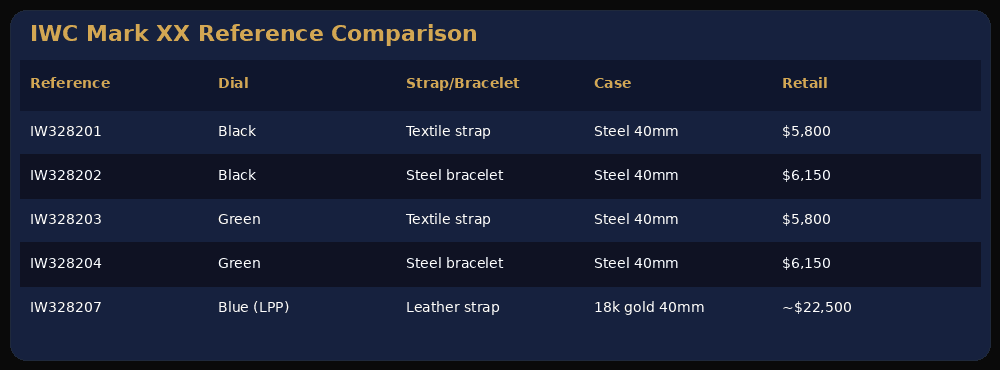
IWC offers the Mark XX in two dial colours across four references. The black dial (IW328201 on textile, IW328202 on bracelet) and green dial (IW328203 on textile, IW328204 on bracelet) share identical specifications. Pricing starts at $5,800 on the textile strap and $6,150 on the bracelet. The bracelet uses IWC’s EasX-CHANGE system, letting you swap between strap and bracelet without tools.
Mark XX Le Petit Prince
The Le Petit Prince variant (IW328207) adds a sunburst blue dial and an 18k red gold case, pushing the price to roughly $22,500. The movement and dimensions are identical to the steel version. It is a collectors’ piece rather than an everyday beater — the gold case is softer and more susceptible to scratching than steel. Pre-owned Le Petit Prince models from the Mark XVIII generation start around $5,000–$7,000.
| Mark XX Reference | Dial | Strap/Bracelet | Case | Retail |
|---|---|---|---|---|
| IW328201 | Black | Textile strap | Steel 40mm | $5,800 |
| IW328202 | Black | Steel bracelet | Steel 40mm | $6,150 |
| IW328203 | Green | Textile strap | Steel 40mm | $5,800 |
| IW328204 | Green | Steel bracelet | Steel 40mm | $6,150 |
| IW328207 | Blue (LPP) | Leather strap | 18k red gold 40mm | ~$22,500 |
Check Any Watch Price in Seconds
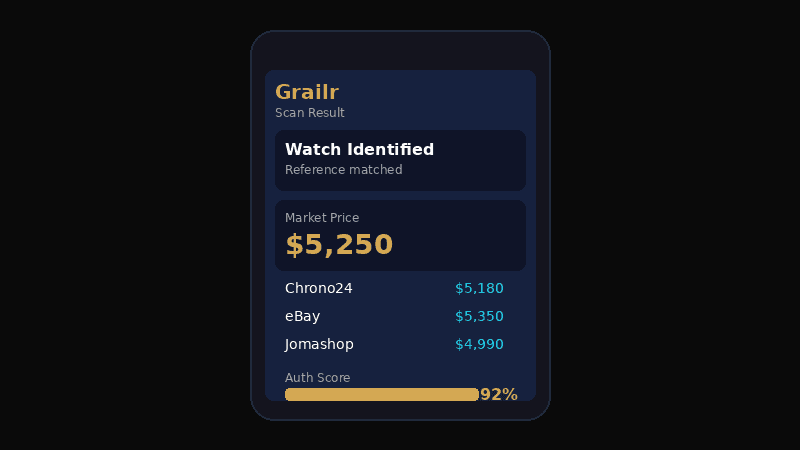
Grailr scans your watch photo and pulls live pricing from Chrono24, eBay, and Jomashop.
- AI identifies brand, model & reference number
- Live market prices from 3+ sources
- Authentication confidence score
Big Pilot & Spitfire
The Big Pilot is the watch that made IWC famous outside the watch community. Its oversized crown, originally designed to be operated with gloved hands in an unpressurized cockpit, is the single most recognizable design element in modern aviation horology. The current lineup splits into two sizes: the Big Pilot 43 and the Big Pilot 46.
Big Pilot 43 ($8,900–$12,500)
The Big Pilot 43 (IW329301 in steel) downsizes the classic design into a 43mm case that actually works as a daily wearer. The in-house Calibre 82100 delivers a 60-hour power reserve with a central seconds hand and date at 6 o’clock. At $8,900 on the steel bracelet, it competes directly with the Omega Speedmaster Professional and the Breitling Navitimer B01. The 43mm case is 13.6mm thick, so it wears large despite the moderate diameter.
Big Pilot 46 ($15,500+)
The Big Pilot 46 is the watch for buyers who want the full experience. The 46.2mm case uses the legendary Calibre 52010 with a seven-day (168-hour) power reserve and a power reserve indicator on the dial. Prices start at roughly $15,500 in steel and escalate sharply with complications and materials — the Annual Calendar in steel runs about $19,500, and the Perpetual Calendar in red gold exceeds $50,000. This is a large, thick watch (15.3mm) that demands a wrist circumference of at least 19cm to wear comfortably.
Spitfire ($7,000–$9,000)
The Spitfire collection applies World War II Supermarine Spitfire styling to a more manageable 41mm case. The standout is the Spitfire Chronograph in bronze (IW387902), which develops a unique patina over time as the case oxidises. Bronze models start around $8,500, while the steel Spitfire Automatic runs about $7,000. All Spitfire models use in-house movements with at least a 46-hour power reserve. For buyers who want pilot’s watch heritage in a size that works on smaller wrists, the Spitfire line is IWC’s best answer.
Top Gun Collection
The Top Gun line brings modern materials into the Pilot’s Watch family. Cases are ceramic, titanium, or a combination of both, giving the watches a stealthy, blacked-out aesthetic that pairs with a tactical design language — matte dials, military-style numbering, and sand-coloured or red accent lume. The collection ranges from the relatively accessible Automatic at roughly $9,000 to the Chronograph Double at around $15,000.
Ceramic cases are the primary draw. Zirconium oxide ceramic is roughly five times harder than steel, which means the matte black finish resists scratching in a way that DLC-coated steel cannot. The trade-off is brittleness — a sharp impact that would dent a steel case can crack a ceramic one. IWC mitigates this with titanium casebacks and crowns, keeping the most impact-vulnerable points in a ductile material.
The Top Gun Chronograph (IW389101) at roughly $11,500 is the volume seller in the line. It pairs a 41mm ceramic case with the in-house Cal. 69380 chronograph movement and a 46-hour power reserve. For buyers who want a modern, tool-oriented chronograph that stands apart from the ubiquitous Speedmaster, the Top Gun delivers genuine material differentiation at a competitive price. Pre-owned Top Gun pieces hold well — roughly 70–80% of retail — partly because ceramic cases age better than steel, showing fewer signs of wear over time.
Pricing Across the Range
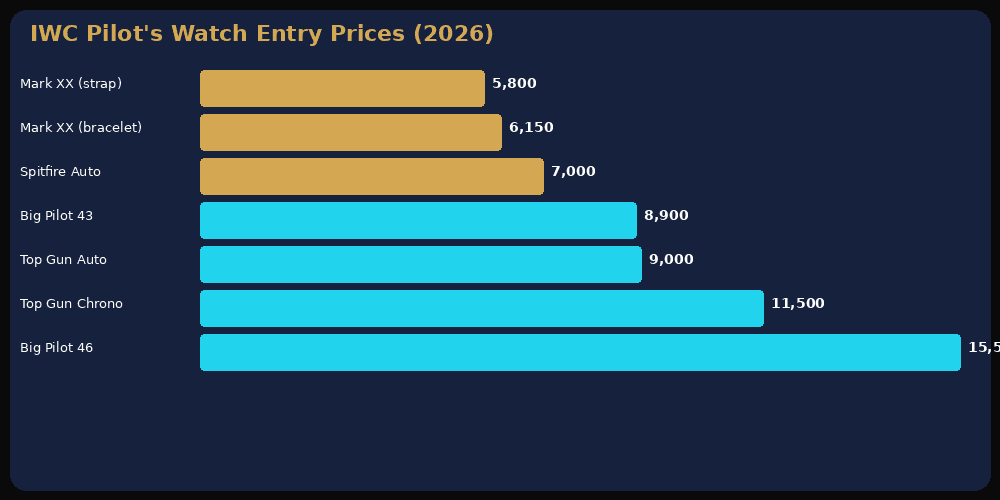
| Collection | Size | Entry (Steel) | Mid-Range | Top |
|---|---|---|---|---|
| Mark XX | 40mm | $5,800 | $6,150 | $22,500 (gold) |
| Big Pilot 43 | 43mm | $8,900 | $10,500 | $12,500 |
| Big Pilot 46 | 46.2mm | $15,500 | $19,500 | $50,000+ |
| Spitfire | 41mm | $7,000 | $8,500 | $9,000 |
| Top Gun | 41–44.5mm | $9,000 | $11,500 | $15,000 |
Resale Value
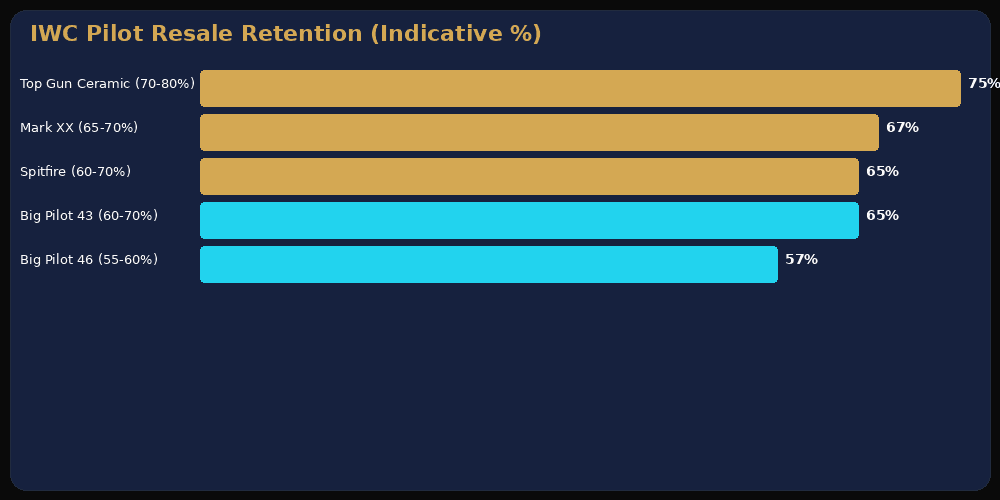
IWC’s resale performance falls roughly in line with other Richemont brands — below Rolex, above most fashion watches, and competitive with Omega and Breitling. The Mark XX holds best among the standard-production models, with pre-owned examples from the past two years typically asking 65–70% of retail. A used Mark XX on bracelet (IW328202) currently runs about $3,900–$5,200 against a $6,150 retail price.
The Top Gun line benefits from ceramic’s scratch resistance: a two-year-old Top Gun Chronograph often looks nearly new, which supports asking prices of 70–80% of retail. Big Pilot models are more mixed. The 43mm versions retain reasonably well (60–70%), but the 46mm pieces can struggle on the secondary market because the size limits the buyer pool. A pre-owned Big Pilot 46 at 55–60% of retail can represent exceptional value if you have the wrist for it.
For buyers who care about watches that hold value, the sweet spot in the IWC Pilot’s Watch range is the Mark XX on bracelet. It offers the best combination of strong resale, genuine in-house movement, and everyday wearability. If you want stronger value retention, consider the Top Gun Chronograph — ceramic holds up better both physically and financially.
How to Buy an IWC Pilot’s Watch
1. Generally Available at ADs
Unlike Rolex, IWC Pilot’s watches are typically available at authorized dealers without a waitlist. Some limited editions and Le Petit Prince variants may require a pre-order, but the standard Mark XX, Big Pilot and Top Gun models can usually be purchased the same day.
2. Pre-Owned Value Is Strong
Because IWC watches lose 30–45% on the secondary market, buying pre-owned delivers real savings. A lightly used Mark XX on bracelet can run $3,900–$4,500 versus $6,150 new. Look for full-set examples (box, papers, warranty card) to maximise resale when it is your turn to sell. Authenticate before you buy.
3. IWC My IWC Warranty
Register your watch within 90 days of purchase on IWC’s My IWC portal to extend the warranty from two years to eight years. This is one of the longest in the industry and matters because a full IWC service typically costs $600–$1,200 depending on the movement complexity.
4. Scan Before You Buy Pre-Owned
Use Grailr’s free scanner to photograph any listing and check the identification, compare market pricing, and get a confidence score. A photo scan is not proof of authenticity — arrange a professional inspection for high-value pieces.
5. Try the Size — Especially the Big Pilot
The Big Pilot 46 wears substantially larger than its dial diameter suggests because of its 15.3mm thickness and long lugs. Visit a boutique or AD to try it on before ordering. The Big Pilot 43 at 13.6mm thick is more manageable but still wears large. The Mark XX at 10.8mm is the only Pilot’s Watch that feels genuinely mid-sized on the wrist.
Frequently Asked Questions
What is the cheapest IWC Pilot's Watch?
The Mark XX on a textile strap (IW328201) starts at $5,800. On the integrated bracelet (IW328202) it runs $6,150. Pre-owned Mark XX examples in good condition start around $3,900–$4,500.
Does IWC hold its value?
IWC Pilot's watches typically retain 55–70% of retail after 3–5 years. The Mark XX holds best at roughly 65–70%, while Big Pilot models settle around 55–65%. Top Gun ceramic pieces can hold 70–80%. Verify current asking prices independently.
Is the IWC Mark XX better than the Rolex Explorer?
They serve different priorities. The Mark XX offers a larger 40mm case, 120-hour power reserve and a lower entry price ($5,800 vs ~$7,900). The Explorer offers stronger brand recognition, better resale and Rolex's Superlative Chronometer certification. Both are excellent everyday watches.
What movement is in the IWC Mark XX?
The Mark XX uses IWC's in-house Calibre 32110, an automatic movement with a 120-hour (5-day) power reserve, soft-iron inner case for magnetic protection, and 28,800 vph frequency.
What is the difference between the Big Pilot 43 and Big Pilot 46?
The Big Pilot 43 uses the Cal. 82100 with a 60-hour power reserve in a 43mm case at ~$8,900. The Big Pilot 46 uses the Cal. 52010 with a 168-hour (7-day) power reserve in a 46.2mm case at ~$15,500. The 43 wears like a large everyday watch; the 46 is a statement piece.
Related Articles
The Bottom Line
The IWC Mark XX on bracelet is our top recommendation for a first IWC Pilot’s Watch. At $6,150, you get a genuine in-house movement with a class-leading 120-hour power reserve, anti-magnetic protection, and the cleanest aviation dial design in the industry. If you want something larger and more dramatic, the Big Pilot 43 at $8,900 brings the iconic oversized crown into a more wearable case size. And if materials matter more than tradition, the Top Gun Chronograph at $11,500 offers a ceramic case that will look new years from now. Buy the one that makes you reach for it every morning.
Considering an IWC?
Grailr uses a photo to suggest a watch identity and an indicative price estimate. Check the exact reference and condition independently; a photo scan cannot authenticate a watch.
Get a Price EstimateSources and price context
- IWC Pilot’s Watch collection — Official specifications, case dimensions and current retail pricing.
- IWC Mark XX product page — Calibre 32110 technical details, EasX-CHANGE system and pricing.
These primary sources support the specific specification and policy points noted above. Prices and resale percentages elsewhere in this guide are indicative editorial figures, not a verified transaction dataset or guaranteed returns. Confirm the exact reference, region, condition and current quote before buying.