Jaeger-LeCoultre Buying Guide: Reverso, Master Control and What They’re Worth
The watchmaker’s watchmaker, from the $6,200 Reverso Classic to the $52,500 Master Control Chronomètre in gold — every collection compared with real pricing and resale data.
Price context: this guide includes indicative prices from its original publication period. They have not all been refreshed to current quotes. Use the linked primary sources for specifications and policies, and verify prices independently.

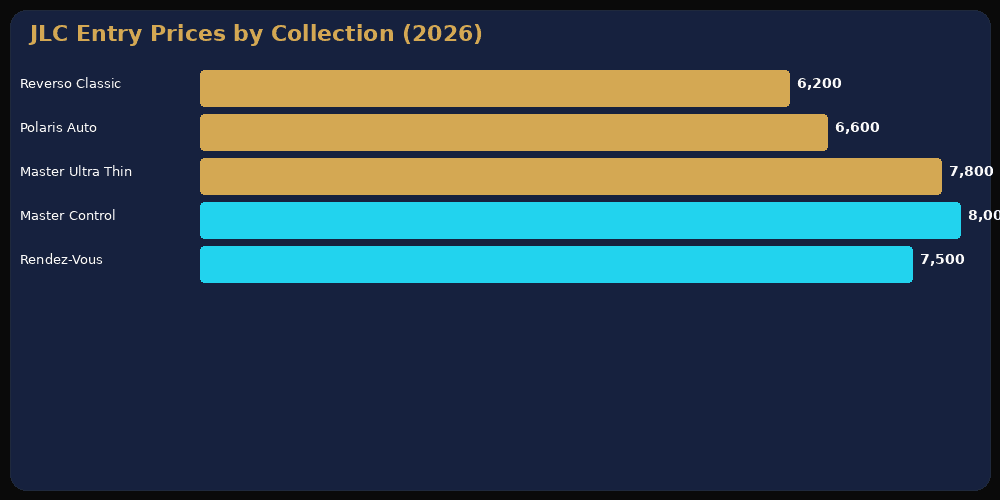
- JLC entry pricing starts at roughly $6,200 for the Reverso Classic Small and reaches six figures for complicated pieces in precious metals
- Over 1,400 different calibres produced since 1833, all manufactured in-house at Le Sentier in the Vallée de Joux
- Indicative resale retention runs 55–75% of retail depending on the collection, with the Reverso Tribute line holding best
- The 2026 Master Control Chronomètre collection introduced JLC’s new High Performance Guarantee (HPG) standard alongside COSC certification
- Four main wristwatch collections serve different needs: Reverso (Art Deco dress), Master (classical complications), Polaris (sport), and Rendez-Vous (women’s)
Why Jaeger-LeCoultre
Jaeger-LeCoultre occupies a peculiar position in luxury watchmaking. It is not the most expensive Swiss brand — that distinction belongs to the likes of Patek Philippe and Audemars Piguet — yet it is arguably the most technically accomplished. Since Antoine LeCoultre founded the workshop in 1833 in the Vallée de Joux, the manufacture has produced over 1,400 different calibres, more than almost any other single house. Patek Philippe, for comparison, has produced roughly 300 in a comparable timeframe.
The “watchmaker’s watchmaker” reputation is not marketing. JLC historically supplied movements to Audemars Piguet, Patek Philippe and Vacheron Constantin before those houses developed full in-house manufacturing capacity. Today, JLC still designs and builds every movement at a single integrated facility in Le Sentier, Switzerland, covering everything from the raw metal blank to the final assembly and regulation of the finished watch.
For buyers, this translates into a practical advantage: you get genuine haute horlogerie finishing and complication depth at prices that sit meaningfully below the Holy Trinity. A JLC perpetual calendar starts where an AP Royal Oak time-only watch begins. A JLC minute repeater costs roughly what a Patek Philippe annual calendar commands. The trade-off is resale value — JLC watches lose more on the secondary market than Rolex or Patek — but for buyers who plan to wear rather than flip, the value proposition is difficult to match.
The brand sits within the Richemont group alongside Cartier, IWC, Panerai and Vacheron Constantin. Richemont ownership means strong retail distribution through boutiques and authorized dealers worldwide, an eight-year international warranty on new purchases, and access to the Care Programme for servicing. It also means periodic retail price adjustments — JLC raised prices by roughly 5–7% in early 2026, in line with the broader industry trend.
The Reverso Collection
The Reverso is the watch that defines JLC in the public imagination. Designed in 1931 for polo players who needed a watch that could survive a match, the rectangular case flips on a sliding carriage to protect its crystal face-down against the wrist. Ninety-five years later, no one is playing polo in a Reverso, but the swivelling case remains one of the most recognizable designs in watchmaking.
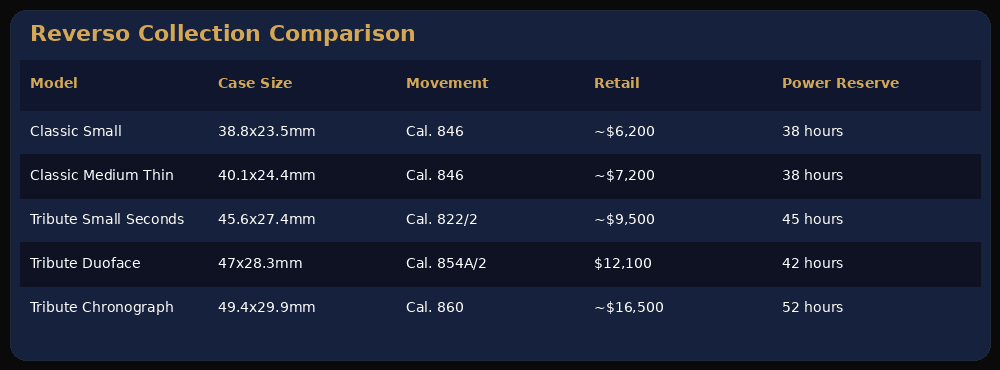
The current Reverso lineup spans from the entry-level Classic Small at roughly $6,200 to the Tribute Chronograph at about $16,500 in steel. The most popular model for collectors is the Reverso Tribute Small Seconds at around $9,500, which pairs a cleanly executed dial with the hand-wound Calibre 822/2 and a 45-hour power reserve. The blank caseback invites engraving, which is part of the Reverso’s enduring appeal as a gift watch.
Reverso Tribute Duoface ($12,100)
The Duoface is the complication that justifies the swivelling case. Flip the watch and you get a second dial showing a second time zone, powered by the Calibre 854A/2 with a 42-hour power reserve. The case measures 47 × 28.3mm — large by Reverso standards but surprisingly comfortable on the wrist thanks to the narrow profile (9.1mm thick). For frequent travellers, it is the most elegant dual-timezone solution available at this price point.
Reverso Classic Small ($6,200) & Medium Thin ($7,200)
The entry points. Both run the hand-wound Calibre 846 with a 38-hour power reserve and 30m of water resistance — enough for hand-washing, not enough for a swimming pool. The Classic Small (38.8 × 23.5mm) wears as a compact dress watch; the Medium Thin (40.1 × 24.4mm) adds a few millimeters without changing the proportions. At these prices, you are buying a genuine in-house JLC movement in the brand’s most iconic case shape. No other manufacture offers that combination under $7,000.
| Reverso Model | Case Size | Movement | Retail | Power Reserve |
|---|---|---|---|---|
| Classic Small | 38.8 × 23.5mm | Cal. 846 (manual) | ~$6,200 | 38 hours |
| Classic Medium Thin | 40.1 × 24.4mm | Cal. 846 (manual) | ~$7,200 | 38 hours |
| Tribute Small Seconds | 45.6 × 27.4mm | Cal. 822/2 (manual) | ~$9,500 | 45 hours |
| Tribute Duoface | 47 × 28.3mm | Cal. 854A/2 (manual) | $12,100 | 42 hours |
| Tribute Chronograph | 49.4 × 29.9mm | Cal. 860 (manual) | ~$16,500 | 52 hours |
Master Control & Master Ultra Thin
If the Reverso is the watch that gets JLC noticed, the Master line is where the manufacture shows what it can build. The Master collection spans two families: the Master Control, focused on practical complications with robust daily-wear credentials, and the Master Ultra Thin, which prioritizes elegant thinness and classical dial layouts.
Master Control Chronomètre (New for 2026)
The headline release at Watches & Wonders 2026 was the Master Control Chronomètre collection, which debuted JLC’s new High Performance Guarantee (HPG) — a proprietary testing standard that combines COSC chronometer certification with an internal regimen simulating real-world wearing conditions. The collection launched with three references: the Date ($14,200 in steel), the Date Power Reserve, and the Perpetual Calendar ($39,500 in steel). All use a new-generation Calibre 899 automatic with a 70-hour power reserve and run at 28,800 vph.
The Master Control Chronomètre also introduced JLC’s first integrated bracelet in the Master line, a seven-link design that flows into the lugs without visible attachment points. At 38mm and 7.9mm thick, the proportions target the same wrist that might consider a Rolex Datejust or an Omega Aqua Terra, but with hand-finished movement decoration visible through the sapphire caseback.
Master Ultra Thin ($7,800–$40,000+)
The Master Ultra Thin line emphasizes slim profiles and clean dials. The entry-level Master Ultra Thin Date sits around $7,800 in steel. The Moon phase version, one of JLC’s best sellers, runs about $10,500–$11,000. At the top, the Master Ultra Thin Perpetual Calendar commands roughly $21,500 on the secondary market, though new examples in pink gold can exceed $40,000.
For buyers choosing between a Master Ultra Thin and a Reverso, the decision comes down to lifestyle. The MUT wears as a conventional round dress watch with slender proportions that slip under a shirt cuff without effort. The Reverso is a conversation piece that demands a certain confidence in its rectangular Art Deco shape. Both are equally well finished; the MUT simply attracts less attention.
Check Any Watch Price in Seconds
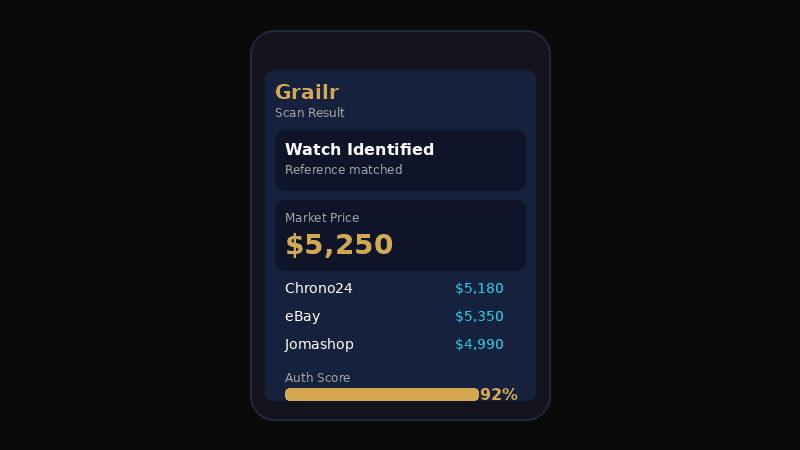
Grailr scans your watch photo and pulls live pricing from Chrono24, eBay, and Jomashop.
- AI identifies brand, model & reference number
- Live market prices from 3+ sources
- Authentication confidence score
The Polaris Collection
The Polaris is JLC’s sport watch, occupying the space that the Royal Oak fills for AP or the Nautilus fills for Patek. Launched in 2018 as a revival of the 1968 Memovox Polaris, the modern collection pairs stainless steel cases with inner rotating bezels, 200m water resistance, and rubber or bracelet options that can handle a weekend at the coast.
Entry pricing for the Polaris Automatic starts at roughly $6,600 in steel. The Polaris Date at about $8,100 adds a date complication and a slightly more refined dial layout. The Polaris Chronograph at around $9,300 pairs a column-wheel chronograph movement with a tachymeter scale on the inner bezel. For buyers who want a luxury sports watch from a serious manufacture without paying Royal Oak money, the Polaris delivers genuine value.
The Polaris Mariner line extends the collection’s dive-watch credentials further, with a graduated bezel and up to 300m of water resistance on certain references. Prices run from roughly $10,000 to $15,000 depending on complication and material, placing them in direct competition with the Omega Seamaster Professional 300M and the Tudor Pelagos at the lower end.
Full Pricing Across Collections
| Collection | Entry (Steel) | Mid-Range | Top | Style |
|---|---|---|---|---|
| Reverso | ~$6,200 | $9,500–$12,100 | $16,500+ | Art Deco dress |
| Master Ultra Thin | ~$7,800 | $10,500–$14,000 | $40,000+ | Classical round |
| Master Control | ~$8,000 | $14,200–$17,500 | $52,500+ | Everyday complications |
| Polaris | ~$6,600 | $8,100–$9,300 | $22,000+ | Sports / diver |
| Rendez-Vous | ~$7,500 | $10,000–$15,000 | $30,000+ | Women’s dress |
Resale Value: What JLC Actually Retains
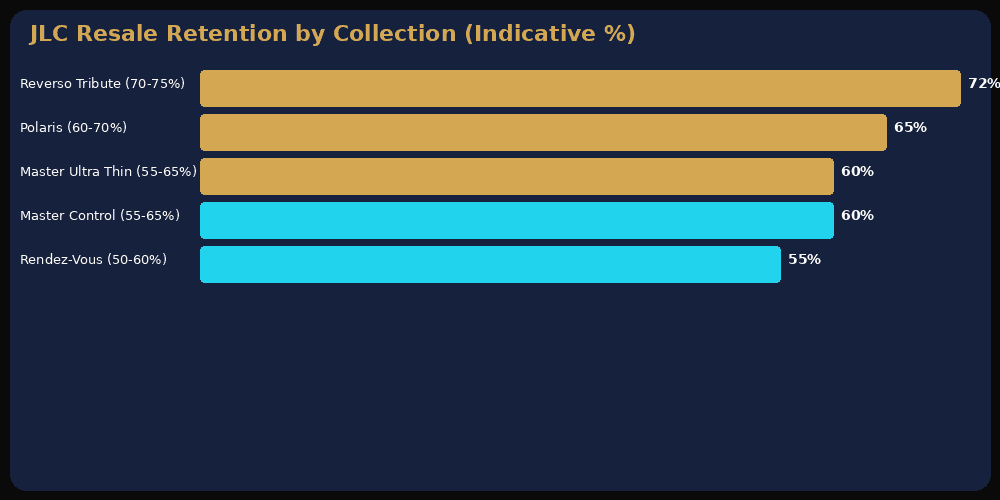
JLC’s resale performance sits below Rolex and Patek Philippe but is broadly competitive with other Richemont brands and with Omega. The Reverso Tribute line holds best, with pre-owned examples from the past three to five years typically asking 70–75% of their original retail price. The Master Ultra Thin settles around 55–65%, and the Polaris around 60–70%. These are indicative ranges drawn from asking prices on major platforms, not completed-sale data, so actual transaction prices may be lower.
Why the Reverso outperforms: scarcity of the design. No other luxury house makes a rectangular swivelling-case dress watch at this level. The Master Ultra Thin, by contrast, competes directly with round dress watches from Cartier, Breguet, Blancpain and others, which dilutes its secondary-market distinctiveness.
For buyers who care about watches that hold value, JLC is best approached as a “buy to wear” rather than “buy to invest” brand. You get substantially more watchmaking for your money than a Rolex — more complications, finer finishing, deeper movement heritage — but you will not recover as much when you sell. If that trade-off works for you, JLC offers one of the strongest value propositions in Swiss horology.
How to Buy a Jaeger-LeCoultre
1. No Waitlists (Usually)
Unlike Rolex, JLC watches are generally available at authorized dealers without a waitlist. The Master Control Chronomètre collection saw some initial demand, but most references across the range can be tried on and purchased the same day. This makes JLC an excellent choice for buyers who want to see and handle the watch before committing.
2. Consider Pre-Owned for Value
Because JLC watches lose 25–45% on the secondary market, buying pre-owned can deliver exceptional value. A one-to-two-year-old Reverso Tribute Small Seconds in excellent condition might run $7,000–$8,000 versus $9,500 new — a saving of roughly $1,500–$2,500 on a watch that still looks and runs like new. Authenticate before you buy.
3. Know the Warranty
JLC offers an eight-year international warranty on new watches purchased from authorized dealers, one of the longest in the industry. This matters because JLC movements, while beautifully finished, are mechanically complex and a full service typically costs $800–$1,500 depending on the complication level.
4. Scan Before You Buy Pre-Owned
Use Grailr’s free scanner to photograph any listing and check the identification, compare market pricing, and get a confidence score. A photo scan is not proof of authenticity — arrange a professional inspection for high-value pieces.
5. Try the Size in Person
Reverso watches measure differently from round watches. The case dimensions describe length × width, and the long side sits along your wrist rather than across it. A 45.6 × 27.4mm Reverso Tribute wears more like a 38mm round watch than the numbers suggest. Visit a boutique or AD to try the size before ordering.
Frequently Asked Questions
What is the cheapest Jaeger-LeCoultre watch?
The Reverso Classic Small starts at roughly $6,200, making it the most affordable new JLC. The Classic Medium Thin follows at about $7,200. Pre-owned examples from older references start around $3,000 on Chrono24.
Does Jaeger-LeCoultre hold its value?
JLC watches typically retain 55-75% of retail after 3-5 years. The Reverso Tribute line holds best at roughly 70-75%, while Master Ultra Thin models settle around 55-65%. Verify current asking prices independently.
Is Jaeger-LeCoultre better than Rolex?
They serve different markets. JLC is a haute horlogerie manufacture known for complication depth and finishing; Rolex dominates in brand recognition, robustness and resale value. JLC offers more movement variety; Rolex offers stronger secondary-market liquidity.
What is the best JLC to buy as a first watch?
The Reverso Tribute Small Seconds at roughly $9,500 is the sweet spot: iconic design, in-house manual-wind movement, and reasonable resale retention. The Polaris Date at about $8,100 suits buyers who want a sportier watch.
Why is JLC called the watchmaker's watchmaker?
JLC has produced over 1,400 different calibres since 1833, more than almost any other Swiss manufacture, and historically supplied movements to AP, Patek and Vacheron Constantin.
Related Articles
The Bottom Line
Jaeger-LeCoultre delivers more mechanical watchmaking per dollar than almost any other Swiss manufacture. The Reverso Tribute Small Seconds is our top recommendation for a first JLC — it is the most iconic design at a price that, while not cheap, buys a level of in-house movement finishing and heritage that competitors cannot match under $10,000. If you want something sportier, the Polaris Date at $8,100 competes with the Omega Seamaster on specs and beats it on finishing. Buy what makes you look twice.
Considering a JLC?
Grailr uses a photo to suggest a watch identity and an indicative price estimate. Check the exact reference and condition independently; a photo scan cannot authenticate a watch.
Get a Price EstimateSources and price context
- Jaeger-LeCoultre Reverso collection — Official specifications, case dimensions and current retail pricing.
- Master Control Chronomètre launch at Watches & Wonders 2026 — HPG certification details, pricing and integrated bracelet introduction.
These primary sources support the specific specification and policy points noted above. Prices and resale percentages elsewhere in this guide are indicative editorial figures, not a verified transaction dataset or guaranteed returns. Confirm the exact reference, region, condition and current quote before buying.