Rolex Datejust Buying Guide 2026: Every Size, Reference & Price Compared
The most popular Rolex ever made, dissected — four sizes, dozens of configurations, and real pricing from retail to secondary market. Everything you need to pick the right Datejust.
- New Datejust pricing starts at $7,200 (Lady-Datejust 28) and tops out at $15,250 (41mm two-tone) in 2026
- The fluted bezel is always 18k gold — even on steel models — adding $1,800–$2,400 to the price
- Pre-owned fluted/Jubilee configurations trade at 20–50% above MSRP; smooth/Oyster models trade closer to retail
- Seven factors drive Datejust pricing: material, retail vs secondary, bezel, dial, bracelet, size, and condition
A Brief History: From 1945 to Today
The Rolex Datejust arrived in 1945 as Ref. 4467 — the world’s first self-winding wristwatch with a date display visible through a window on the dial. It was released to celebrate Rolex’s 40th anniversary, and it came with an innovation that would become one of the most recognisable features in watchmaking: the Jubilee bracelet, designed specifically for this model.
In 1953, Rolex added the Cyclops lens — a magnifying crystal over the date window that made the date 2.5x larger and instantly readable. This detail, combined with the fluted bezel and Jubilee bracelet, created a visual language so powerful that it has defined what a luxury watch looks like for eight decades.
Through the 1960s and 1970s, the Datejust (notably Ref. 1601 and Ref. 1603) became the default dress watch for executives, diplomats, and world leaders. It appeared on the wrist of U.S. presidents, on the cover of magazines, and across boardrooms worldwide. While the Submariner and Daytona have louder reputations today, the Datejust has outsold them all by an enormous margin.
The modern era began in 2009 when Rolex introduced the Datejust II at 41mm — the first time the model had been offered larger than 36mm. Movement specifications depend on size and reference; they are not identical across the family. In particular, Rolex specifies calibre 2236 and approximately 55 hours of power reserve for the 28mm Lady-Datejust 279160, so the 3235 and 70-hour specification must not be applied to every size. Today, the Datejust is available in four sizes (28, 31, 36, and 41mm), three materials (Oystersteel, two-tone, and full precious metal), and an almost overwhelming number of dial-bezel-bracelet combinations.
Size Guide: 28mm, 31mm, 36mm & 41mm
One of the biggest decisions when buying a Datejust is choosing the right size. Unlike most Rolex sport models (which come in a single size), the Datejust gives you four options — and the “right” choice depends entirely on your wrist, your style, and your intention.
Lady-Datejust 28mm
The smallest Datejust, designed specifically as a women’s watch. At 28mm, it wears elegantly on wrists from 5 to 6.5 inches. Starting at $7,200 in Oystersteel, it’s the most affordable entry to the Datejust family. The Ref. 279174 with white gold fluted bezel ($8,800) is the most popular Lady-Datejust configuration. Pre-owned examples range from $7,500 to $13,000 depending on material and condition.
Datejust 31mm
A mid-size option that works brilliantly for those who want something slightly larger than the Lady-Datejust but smaller than the traditional 36mm. At $7,300 in steel, it offers excellent value. This size has grown in popularity as unisex sizing trends continue — men with slimmer wrists (under 6.5 inches) increasingly choose the 31mm for a vintage-inspired look.
Datejust 36mm
The original size and, for many collectors, still the “correct” size for a Datejust. At 36mm, it sits comfortably on wrists from 6 to 7.5 inches. The smooth-bezel Ref. 126200 starts at $7,750 — making it the cheapest new Datejust — while the fluted-bezel Ref. 126234 jumps to $9,550. The two-tone Ref. 126233 with fluted bezel runs $14,400.
If you’re buying your first Datejust and want the most historically authentic experience, the 36mm is the purist’s choice. Every president who wore a Datejust wore a 36.
Datejust 41mm
The largest Datejust, introduced as the Datejust II in 2009 and refined in 2019. At 41mm, it offers commanding wrist presence and is by far the most popular size in the current market. The smooth-bezel Ref. 126300 starts at $8,500, while the fluted-bezel Ref. 126334 commands $10,900. Two-tone options (Ref. 126333) reach $15,250. On the secondary market, the Datejust 41 trades at significant premiums — a sign of just how strong demand is for this size.
The 7 Factors That Determine Datejust Pricing
No other Rolex model has as many configuration options as the Datejust. Understanding what drives the price will help you find the best value — or avoid overpaying.
1. Material
Oystersteel is the base. Two-tone (steel and gold, known as “Rolesor”) nearly doubles the price. Full gold or platinum models can exceed $30,000. For most buyers, steel is the sweet spot — it’s more durable, more versatile, and holds its value better as a percentage of purchase price.
2. Retail vs Secondary Market
This is where things get interesting. Unlike most watches that depreciate, popular Datejust configurations often trade above retail on the secondary market. A Ref. 126334 (41mm fluted on Jubilee) with an MSRP of $10,900 sells for $13,500–$16,000+ pre-owned. Buying from an authorised dealer at retail saves you thousands — if you can get the allocation.
3. Bezel
The single biggest price lever on a steel Datejust. The smooth bezel is polished Oystersteel. The fluted bezel is always 18k white gold — even on an otherwise all-steel watch. This adds $1,800 on the 36mm and $2,400 on the 41mm. The fluted bezel also drives stronger resale values because it’s the “classic” Datejust look.
4. Dial
Standard dials (silver, black, blue, mint green) are included at base price. Special dials drive premiums. The Wimbledon dial — slate grey with green Roman numeral indices — commands a $2,000–$3,000 premium on the secondary market. Diamond-set and mother-of-pearl dials push prices higher still, though they appeal to a narrower audience.
5. Bracelet
The Jubilee bracelet was invented for the Datejust in 1945 and remains its signature. The sportier Oyster bracelet is also available. Retail price is the same for either, but on the secondary market, Jubilee commands a modest premium because it’s considered the “proper” Datejust pairing — especially with a fluted bezel.
6. Size
Larger cases cost more at retail and command stronger secondary market premiums. The 41mm outsells the 36mm roughly 3:1 in the current market, which keeps demand (and premiums) high. However, the 36mm is having a renaissance among collectors who prefer the vintage-correct proportions.
7. Condition & Papers
A complete set (box, papers, warranty card) adds 10–15% to pre-owned value. “New old stock” or unworn examples command the highest premiums. A well-maintained Datejust with minor desk-diving marks will trade for 5–10% less than an unworn example. Always verify authenticity before purchasing pre-owned.
Current Lineup & 2026 Retail Pricing
Here’s every current-production Datejust reference with its 2026 MSRP, alongside real secondary market pricing. Use this table to understand exactly what you’re paying — and what the watch is actually worth on the open market.
| Model | Ref. | Size | MSRP | Pre-Owned | Retention |
|---|---|---|---|---|---|
| DJ 36 Smooth/Oyster | 126200 | 36mm | $7,750 | $7,500–$9,000 | 97–116% |
| DJ 36 Fluted/Jubilee | 126234 | 36mm | $9,550 | $10,500–$14,500 | 110–152% |
| DJ 36 Two-Tone Fluted | 126233 | 36mm | $14,400 | $13,000–$15,500 | 90–108% |
| DJ 41 Smooth/Oyster | 126300 | 41mm | $8,500 | $10,500–$12,500 | 124–147% |
| DJ 41 Fluted/Jubilee | 126334 | 41mm | $10,900 | $13,500–$16,000+ | 124–147% |
| DJ 41 Two-Tone Fluted | 126333 | 41mm | $15,250 | $14,500–$17,000 | 95–111% |
| Lady-DJ 28 Fluted | 279174 | 28mm | $8,800 | $7,500–$13,000 | 85–148% |
| Vintage DJ (1601) | 1601 | 36mm | — | $4,500–$6,500 | — |
The price ranges below are illustrative and vary by condition and dial. They are not a live or independently verified transaction dataset. Use Grailr’s appraisal tool for an indicative estimate on a suggested reference.
Check Any Watch Price in Seconds
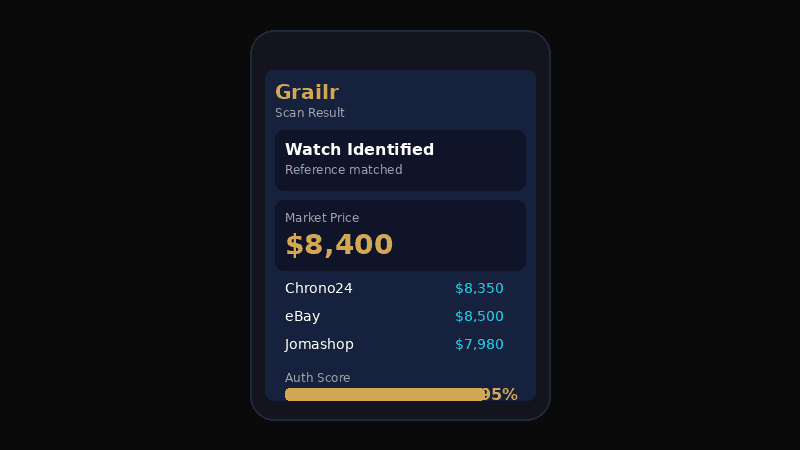
Grailr uses your photo to suggest a watch identification and an indicative AI price estimate. Active eBay listings, when available, offer asking-price comparisons.
- AI suggests brand, model & reference number
- Active eBay asking-price comparisons
- Identification confidence score
MSRP vs Secondary Market: Where the Value Really Is
The Datejust presents an unusual market dynamic. Unlike entry-level Rolex models such as the Oyster Perpetual that sometimes trade near or below retail, many Datejust configurations — particularly the 41mm with fluted bezel and Jubilee bracelet — trade at significant premiums on the secondary market.
Consider the numbers: a Ref. 126334 (Datejust 41, fluted bezel, Jubilee bracelet) has an MSRP of $10,900. On the secondary market, the same watch in popular dial colours sells for $13,500–$16,000+. That’s a 24–47% premium. The Wimbledon dial version of the 36mm Ref. 126234 ($9,550 retail) trades for $12,000–$14,500 — a premium driven almost entirely by dial scarcity.
The exception is the smooth-bezel, Oyster-bracelet configuration. A Ref. 126300 (41mm smooth/Oyster) at $8,500 retail trades for $10,500–$12,500 pre-owned — still above retail, but the premium is lower. And vintage Datejusts, particularly the Ref. 1601 from the 1960s and 1970s, remain one of the best values in the Rolex market at just $4,500–$6,500 for a genuine, serviced example.
The takeaway: if you can secure a Datejust from an authorised dealer at retail, your resale outcome still depends on the configuration, purchase price and market; a retail purchase does not guarantee a profit. If you’re buying pre-owned, use Grailr’s scanner to verify you’re paying a fair market price and not an inflated one.
Buying Tips: AD vs Pre-Owned vs Vintage
Buying from an Authorised Dealer
The best deal on a Datejust is always retail price from an AD. You get a full five-year international warranty, a guaranteed authentic watch, and — in the current market — instant equity since most configurations trade above MSRP. The catch? Availability is limited. Popular configurations (41mm, fluted bezel, Jubilee, blue or Wimbledon dial) may require weeks or months of waiting. Smooth-bezel models in less popular dials are generally easier to acquire.
Pro tip: building a relationship with your AD matters. Visit regularly, express genuine interest, and be open to trying the watch on. Many ADs prioritise buyers who demonstrate real enthusiasm over those who simply want to flip watches for profit.
Buying Pre-Owned
If you don’t want to wait, the secondary market offers immediate access to any configuration — at a price. The premium varies dramatically depending on the specific model. Expect to pay 20–50% above retail for in-demand configurations and closer to retail (or occasionally below) for less popular ones.
Always buy from reputable dealers with return policies and authentication guarantees. Use Grailr’s authentication guidance to understand what needs physical inspection before committing. Check for the original box, papers, and warranty card — a complete set adds 10–15% to resale value.
Buying Vintage
For buyers who want Datejust heritage at a lower price point, vintage is compelling. A 1970s Ref. 1601 with its acrylic crystal, pie-pan dial, and 36mm case can be had for $4,500–$6,500 — less than the cheapest new Datejust. These watches have a warmth and character that modern references can’t replicate. The trade-offs: shorter power reserve (roughly 48 hours), no quick-set date, and the need for more frequent servicing. Budget $600–$800 for a full service every 5–7 years.
Datejust vs the Competition
The Datejust doesn’t exist in a vacuum. Here’s how it stacks up against the watches most often cross-shopped with it.
Datejust 41 vs Rolex Oyster Perpetual 41
The Oyster Perpetual is $2,350–$4,750 cheaper at retail (depending on bezel choice) but lacks the date complication, fluted bezel option, and Jubilee bracelet. If you want the iconic Datejust silhouette, there is no substitute. If you want the purest time-only Rolex at the lowest price, the OP is the better buy.
Datejust 36 vs Cartier Santos Medium
The Santos Medium (~$7,650) offers a completely different aesthetic — angular Art Deco design versus the Datejust’s rounded classicism. The Santos has a quicker bracelet change system (SmartLink), but the Datejust has a superior movement (70-hour vs 42-hour power reserve), better water resistance (100m vs 100m), and dramatically stronger resale value. The Santos is a style play; the Datejust is a value play.
Datejust 41 vs Omega Aqua Terra 38
The Aqua Terra (~$6,300) undercuts the Datejust 41 by $2,200–$4,600 while offering the Co-Axial Master Chronometer movement, anti-magnetic protection to 15,000 gauss, and a teak-patterned dial. On pure specifications, the Omega wins. On prestige, brand recognition, and resale value, the Datejust wins decisively. An Aqua Terra retains roughly 60–75% of its retail value; a Datejust retains 90–147%.
Investment Potential & Value Retention
Let’s be clear: buying a watch purely as an investment is risky. Markets shift, tastes change, and Rolex can adjust production at any time. That said, the Datejust has one of the strongest value-retention profiles in the entire watch industry — and certain configurations have genuinely appreciated over the past five years.
The models that hold value best share three characteristics: fluted bezel, Jubilee bracelet, and a desirable dial. A Ref. 126334 in blue or Wimbledon is the gold standard. These configurations have traded above retail consistently since 2021, and there’s no sign of demand softening.
Smooth-bezel, Oyster-bracelet models are the weaker performers in value retention — but they’re still strong compared to non-Rolex alternatives. A Ref. 126300 trading at $10,500–$12,500 against an $8,500 MSRP represents 124–147% retention. Try finding that performance from any other brand in this segment.
Two-tone models present a more nuanced picture. The Ref. 126333 (41mm Rolesor) at $15,250 retail trades for $14,500–$17,000 pre-owned — a tighter range that reflects the higher entry price and a slightly narrower buyer pool for gold-and-steel watches.
Vintage Datejusts, particularly clean examples of the Ref. 1601 and Ref. 16013, have appreciated steadily at 5–8% annually over the past decade. They represent one of the most accessible entry points into vintage Rolex collecting and offer genuine upside potential as the supply of pristine examples continues to shrink.
Frequently Asked Questions
How much does a new Rolex Datejust cost in 2026?
A new Datejust starts at $7,200 for the Lady-Datejust 28 in Oystersteel. The most affordable men's Datejust is the 36mm smooth bezel (Ref. 126200) at $7,750. The Datejust 41 in steel starts at $8,500 (smooth) or $10,900 (fluted bezel). Two-tone models range from $14,400 to $15,250.
Is the Rolex Datejust 36 or 41 better?
It depends on wrist size and style. The 36mm is the classic, historically correct size that works on 6–7.5 inch wrists. The 41mm offers more wrist presence and is the best seller today. Both use the same Cal. 3235 movement. Try both on at an AD before deciding — Rolex cases wear larger than their listed diameter.
Do Rolex Datejust watches hold their value?
Yes — steel Datejusts retain 90–147% of MSRP on the secondary market. Fluted bezel/Jubilee bracelet models hold value best. Even smooth-bezel configurations trade above retail in the current market. The Datejust outperforms virtually every competitor in this category for resale value.
Why is the fluted bezel more expensive?
The fluted bezel is always made from 18k white gold, even on stainless steel models. This adds $1,800 (36mm) to $2,400 (41mm) to the retail price over the smooth steel bezel. It's also the defining visual signature of the Datejust and drives stronger resale values.
What is the Wimbledon dial and why does it cost more?
The Wimbledon dial features a slate grey sunburst finish with green Roman numeral hour markers — named for Rolex's partnership with the tennis championships. It's only available in certain references and commands a $2,000–$3,000 premium on the secondary market due to limited supply and strong collector demand.
Should I buy a Datejust from an AD or pre-owned?
If you can get the configuration you want from an authorised dealer at retail, always buy AD. You'll pay MSRP (which is below market value for most configurations), get a full five-year warranty, and have guaranteed authenticity. Pre-owned is the way to go if you want immediate availability or a specific vintage reference.
Related Articles
The Bottom Line
The Rolex Datejust isn’t just the most popular Rolex — it’s arguably the most important wristwatch ever made. It invented the date window, launched the Jubilee bracelet, and established the visual template that every luxury dress watch has followed for 80 years.
For buyers in 2026, the Datejust offers an almost unique combination: a watch that you can wear every day, that holds or appreciates in value, and that carries eight decades of horological heritage on your wrist. Whether you choose the vintage charm of a $5,000 Ref. 1601, the value play of a $7,750 smooth-bezel 36mm, or the iconic silhouette of a $10,900 fluted/Jubilee 41mm — you’re buying into the single most proven watch in the history of the industry. Identify the exact reference you’re considering, compare market prices, and make your move.
Ready to Find Your Datejust?
Grailr can suggest a model and reference from a clear photo and provide an indicative AI price estimate. Active eBay listings, when available, show asking prices for comparison. Confirm the reference and condition with the seller; a photo scan does not authenticate a watch.
Scan a Watch NowSources and price context
- Rolex Datejust — Model history and links to official Datejust configurations.
- Rolex ownership FAQ — Availability, retail pricing and care guidance from Rolex.
The links identify the specific manufacturer information and marketplace guidance used for this guide. Price ranges and resale percentages in this guide are illustrative, not live quotes or guaranteed returns; compare the exact reference, condition and sale date before relying on them.