Raymond Weil Watches: Every Collection and Price
Freelancer, Tango, Maestro, Millesime and Noemia compared — with 2026 retail prices, movement specs and honest resale expectations.
Price context: this guide includes indicative prices from its original publication period. They have not all been refreshed to current quotes. Use the linked primary sources for specifications and policies, and verify prices independently.

- Raymond Weil is one of the last family-owned Geneva watchmakers, founded in 1976 and now led by third-generation Elie Bernheim
- Five main collections span $825 (Tango quartz) to $6,600 (Freelancer Skeleton limited edition)
- Automatic models use Sellita-based Swiss calibres with 38–56 hour power reserves; the RW1212 is the brand’s first in-house movement
- Pre-owned Freelancers hold the best value at roughly 35–50% of retail; quartz lines retain less
The Raymond Weil Story
Raymond Weil founded his namesake company in Geneva in 1976 — a difficult moment for Swiss watchmaking. The quartz crisis was decimating traditional manufacturers, and starting a mechanical-watch brand seemed like a questionable bet. Weil saw it differently: he believed that customers who valued craft and design would always exist, and that Geneva’s watchmaking heritage could still support a new name.
Nearly fifty years later, that bet has paid off. Raymond Weil remains one of the last independent, family-owned Swiss watch brands in an industry dominated by conglomerates. LVMH owns TAG Heuer and Hublot. Swatch Group controls Longines, Tissot and Omega. Richemont holds Cartier and IWC. Raymond Weil answers to no holding company — it answers to the Weil-Bernheim family, now in its third generation under Elie Bernheim, Raymond Weil’s grandson.
That independence matters because it means the brand can move at its own pace. When Bernheim launched the Freelancer collection in 2007, it was a deliberate expansion into sportier territory. When the Millesime arrived in 2022, it was a nod to vintage sector dials without chasing a trend. Every collection is named after a musical term — Maestro, Freelancer, Tango, Noemia — reflecting the brand’s long association with the performing arts.
Collection Overview and Pricing
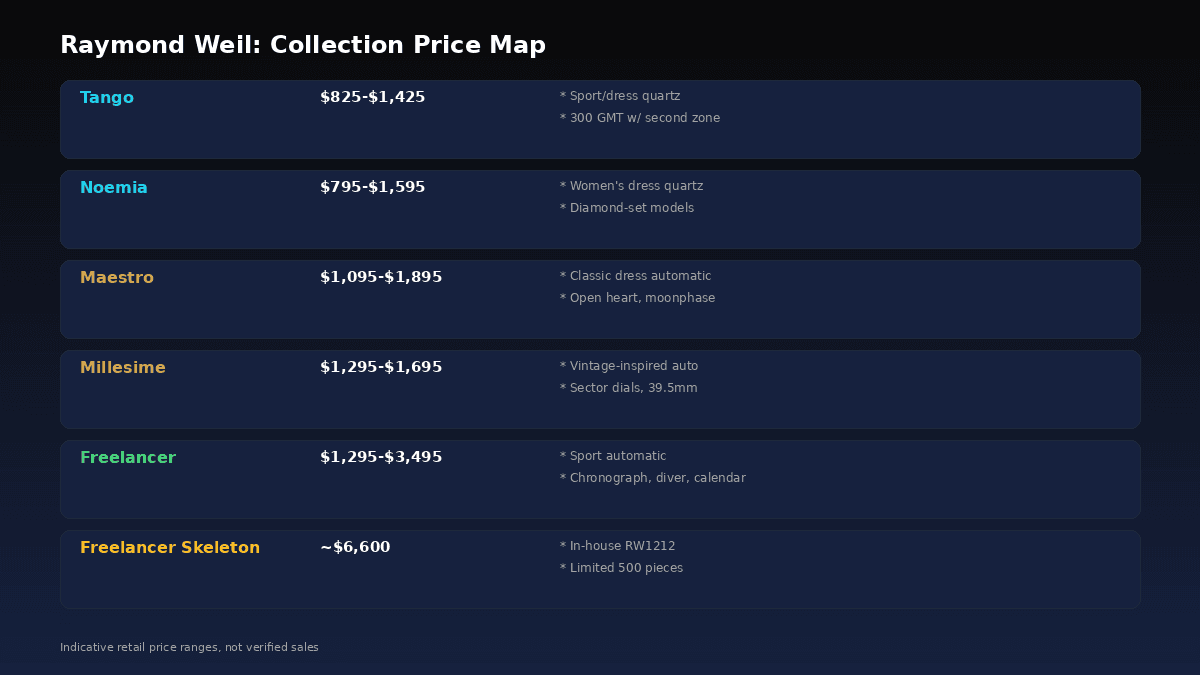
Raymond Weil’s current catalogue runs from the $825 Tango quartz to the $6,600 Freelancer Skeleton. That range puts it squarely in the accessible luxury tier — above fashion watches, below the likes of Longines and Omega in most comparisons, though there is overlap at the boundaries.
| Collection | Type | Movement | Size | Retail Price |
|---|---|---|---|---|
| Tango | Sport / dress | Swiss quartz | 30–41mm | $825–$1,425 |
| Noemia | Women’s dress | Swiss quartz | 27–32mm | $795–$1,595 |
| Maestro | Dress | Sellita auto | 39–40mm | $1,095–$1,895 |
| Millesime | Vintage dress | Sellita auto | 39.5mm | $1,295–$1,695 |
| Freelancer | Sport / dress | Sellita auto | 38–42mm | $1,295–$3,495 |
| Freelancer Skeleton | Limited (500 pcs) | In-house RW1212 | 42mm | ~$6,600 |
Freelancer: The Flagship Line
The Freelancer is where Raymond Weil puts its most ambitious watchmaking. Launched in 2007 as the brand’s first collection under Elie Bernheim’s leadership, it spans time-only models, chronographs, divers, skeleton watches and world timers in both round and cushion cases. Prices range from roughly $1,295 for a basic automatic to $6,600 for the skeleton limited edition.
The standout release in 2025 was the Freelancer Complete Calendar (ref. 2766-ST-50001). At 40mm with a 10.15mm thickness, it packs day, date, month and moon phase into a wearable case. The calibre RW3281 — based on the Sellita SW300-1 with a calendar module — delivers a 56-hour power reserve, which is generous for a complete calendar complication. It retails at CHF 3,495 (approximately $3,775) — significantly less than comparable calendars from Longines or Oris.
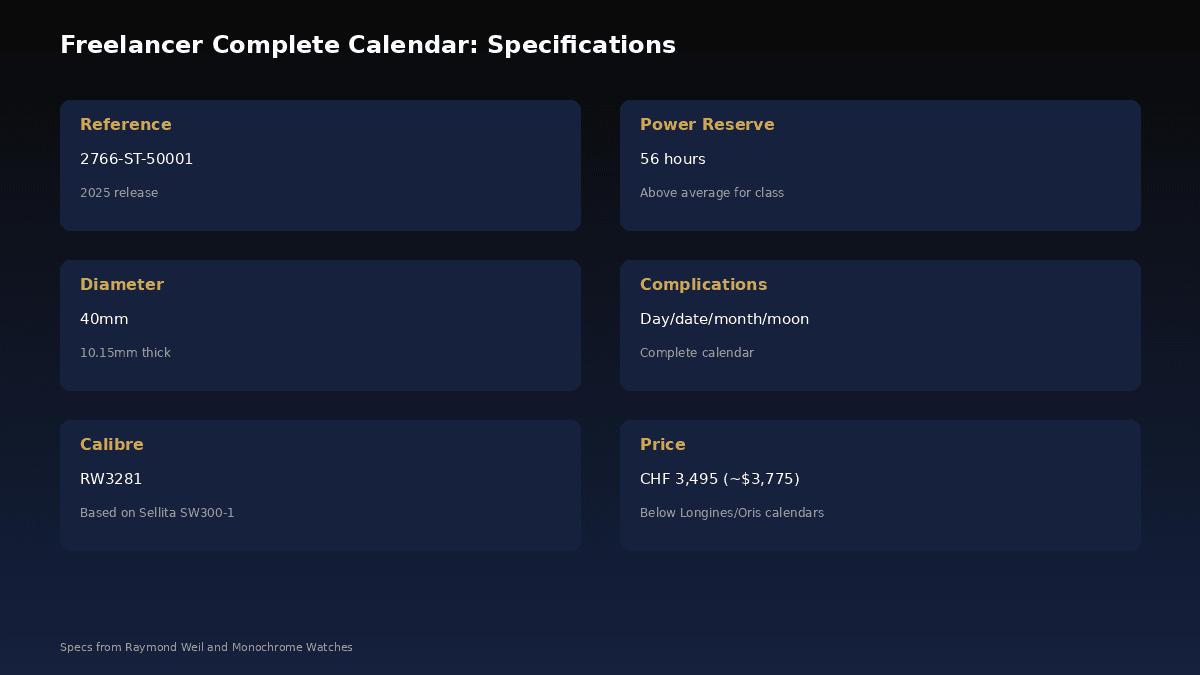
One important distinction: the Freelancer Complete Calendar is not an annual calendar. It requires manual adjustment at the end of every month with fewer than 31 days. That’s five corrections per year — a small trade-off for the price saving versus a true annual calendar, which typically starts above $5,000 even from mid-range brands.
At the top of the Freelancer range sits the Freelancer Skeleton, limited to 500 pieces. It uses the RW1212 — Raymond Weil’s first in-house movement — with a 41-hour power reserve and openworked dial showing the balance wheel and gear train. At roughly $6,600, it crosses into territory where you could buy a Tissot PRX and a Longines Spirit with money left over. The appeal is exclusivity and the satisfaction of owning Raymond Weil’s most technically ambitious piece.
Standard Freelancer automatics range from $1,295 to $2,575 depending on the complication and bracelet. The chronograph models use Sellita SW500-based calibres, and the diver versions are rated to 200 metres. All Freelancers feature sapphire crystals front and back, screw-down crowns and robust finishing for their price point.
Tango, Maestro, Millesime and Noemia
Tango ($825–$1,425)
The Tango is Raymond Weil’s entry point and its most versatile collection. Powered by Swiss quartz, it’s available in 41mm men’s and 30mm women’s sizes with steel bracelets. The Tango 300 GMT adds a second-timezone hand for roughly $1,425 — an affordable way to get a Swiss-made GMT without stepping up to an automatic. Water resistance across the line runs from 50 to 300 metres depending on the reference.
Maestro ($1,095–$1,895)
The Maestro is the classic dress watch in the lineup. At 39–40mm with slim proportions, it uses Sellita-based automatic movements with 38-hour power reserves. The range includes time-and-date models, open-heart versions that show the balance wheel through a dial aperture, and a moon phase variant at roughly $1,595. If you want a Swiss automatic dress watch under $2,000 with sapphire crystal and an exhibition caseback, the Maestro is one of the strongest options alongside the Hamilton Khaki Field and Tissot Gentleman.
Millesime ($1,295–$1,695)
Introduced in 2022, the Millesime is Raymond Weil’s most distinctive collection. The 39.5mm case houses a sector dial — a vintage-inspired layout that divides the dial into geometric segments — with a small seconds subdial at 6 o’clock. Inside sits a Sellita-based automatic calibre. The Millesime targets collectors who appreciate mid-century aesthetics without the uncertainty of buying a genuine 1950s watch. At $1,295 to $1,695, it competes with the Tissot Heritage and the Junghans Meister lines.
Noemia ($795–$1,595)
The Noemia is Raymond Weil’s dedicated women’s collection, named after Raymond Weil’s wife. Available in 27mm and 32mm sizes, it uses Swiss quartz movements and features diamond hour markers on most models. Mother-of-pearl dials, two-tone cases and slim profiles place it firmly in the jewellery-watch category. The entry point at $795 makes it one of the few Swiss-made, diamond-set watches under $1,000, competing with the Longines Dolce Vita and other sub-$2,000 dress watches.
Check Any Watch Price in Seconds
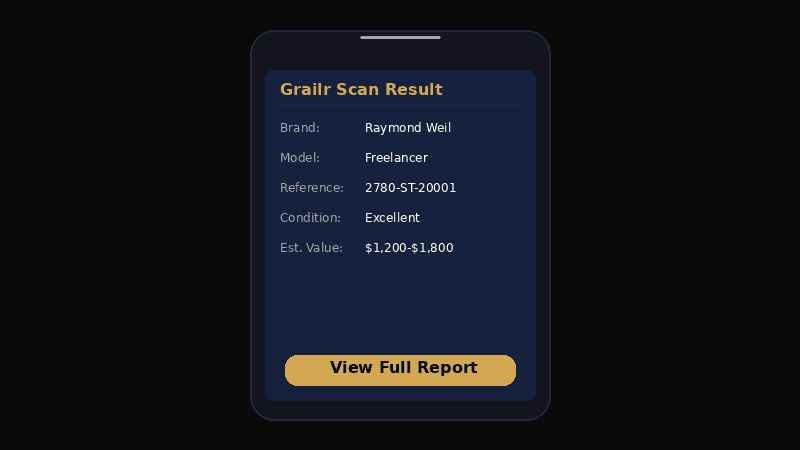
Grailr scans your watch photo and pulls live pricing from Chrono24, eBay, and Jomashop.
- AI identifies brand, model & reference number
- Live market prices from 3+ sources
- Authentication confidence score
Movements and Build Quality
Raymond Weil uses a Sellita-based architecture across most of its automatic collections. The workhorse is the RW4200 (based on the Sellita SW200-1), a proven 28,800 vph movement with a 38-hour power reserve. It appears in the Maestro, standard Freelancer, and Millesime. The Freelancer Complete Calendar steps up to the RW3281, built on the SW300-1 with a calendar module that pushes the reserve to 56 hours.
The brand’s most significant technical achievement is the RW1212, an in-house skeletonised movement used exclusively in the Freelancer Skeleton limited edition. Developing an in-house calibre is a major investment for a brand of Raymond Weil’s size — most competitors at this price point rely entirely on third-party suppliers. Whether the RW1212 will expand to other models remains to be seen, but its existence signals the brand’s ambition.
Build quality across the range is consistent: sapphire crystals (often double-sided anti-reflective on the Freelancer), screw-down crowns on the sport models, exhibition casebacks on all automatics, and stainless steel construction. Water resistance varies from 30 metres on dress models to 200–300 metres on the Freelancer diver and Tango 300. Bracelets use folding clasps with safety pushers — a detail often cut at this price point.
The quartz collections (Tango and Noemia) use Swiss-made quartz movements, not the cheaper Japanese alternatives found in some similarly priced fashion watches. That distinction matters for accuracy and longevity: Swiss quartz typically rates to ±10 seconds per month and requires a battery change every two to three years.
Resale Value and the Pre-Owned Market
Let’s be direct: Raymond Weil watches are not strong resale performers. Secondary-market data shows the brand retains roughly 30–50% of retail price on average, which is typical for the accessible-luxury tier and similar to what you’d see from Tissot, Hamilton or Mido. If you’re buying a watch as a store of value, this is not the brand for that purpose.
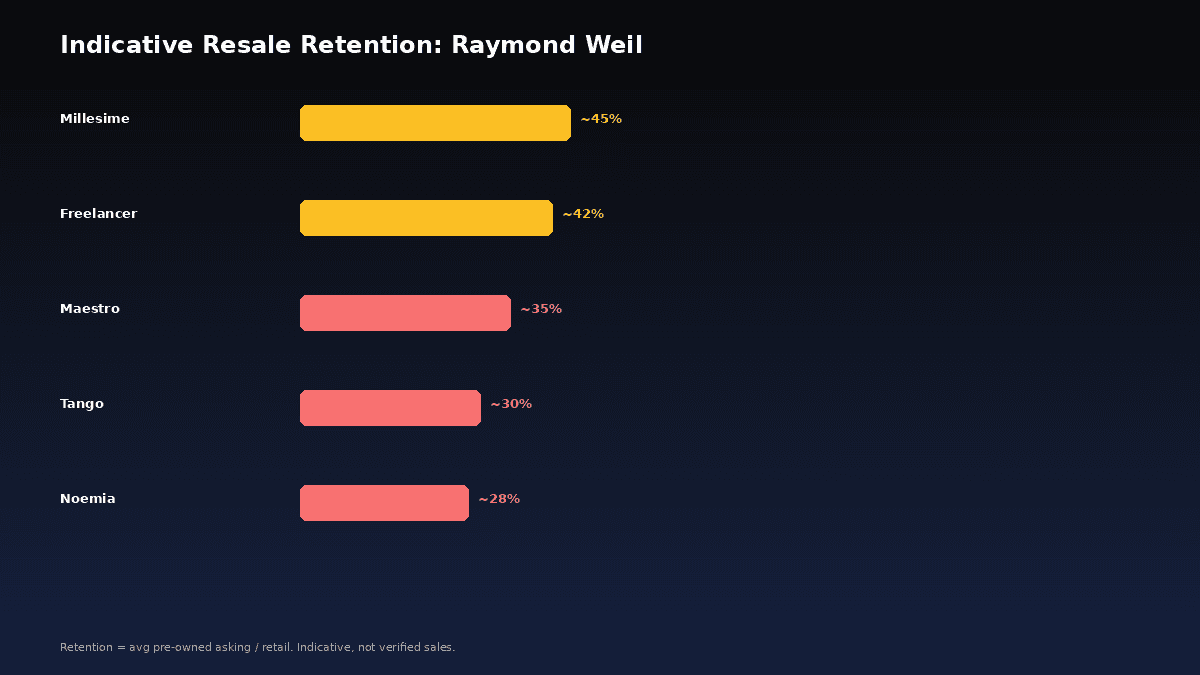
| Collection | Retail Range | Pre-Owned Avg | Retention |
|---|---|---|---|
| Freelancer | $1,295–$3,495 | $450–$1,500 | 35–50% |
| Maestro | $1,095–$1,895 | $350–$700 | 30–40% |
| Millesime | $1,295–$1,695 | $500–$900 | 35–55% |
| Tango | $825–$1,425 | $200–$500 | 25–35% |
| Noemia | $795–$1,595 | $200–$450 | 25–30% |
The Freelancer holds value best because it uses automatic movements, has wider collector interest, and includes complications that create secondhand demand. The Millesime is newer and has smaller data, but early indications suggest solid retention for its niche. Quartz models from the Tango and Noemia lines follow the usual pattern: battery-powered watches in this tier lose the most at resale. If you’re curious about the specific value of a Raymond Weil you already own, Grailr’s appraisal tool can provide an indicative estimate.
How Raymond Weil Compares to Competitors
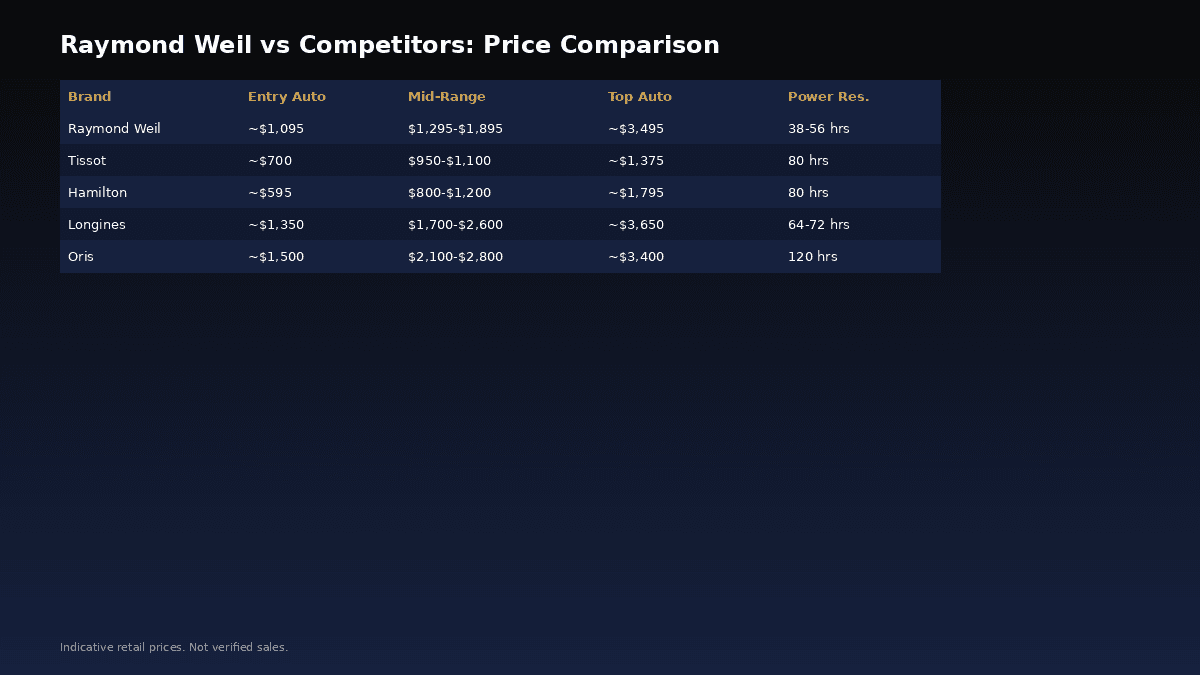
The $800–$3,500 Swiss watch market is crowded. Raymond Weil competes directly with Tissot (Swatch Group), Hamilton (also Swatch Group), Longines, and to some extent Oris and Frederique Constant. Each has its strengths.
Tissot offers the Powermatic 80 movement with an 80-hour reserve — substantially longer than Raymond Weil’s 38 hours on comparable models. Hamilton brings genuine heritage (founded 1892) and strong ties to aviation and military history. Longines occupies a slightly higher tier with in-house movements and COSC certification on many models. Oris offers its own Calibre 400 with a 120-hour reserve.
Where Raymond Weil stands out is in design refinement and independence. The Millesime’s sector dial, the Freelancer Complete Calendar’s value proposition, and the Noemia’s diamond-set elegance at under $1,000 all occupy niches that competitors don’t exactly replicate. The brand’s independent family ownership also means it isn’t subject to corporate group strategies that might dilute its identity.
The honest assessment: if you prioritise power reserve and brand recognition, Tissot or Hamilton may serve you better. If you value design distinctiveness, independent ownership, and a Geneva pedigree at an accessible price — and if resale value is not your primary concern — Raymond Weil offers something its conglomerate-owned rivals cannot.
Buying Recommendations
Best Overall Value
Freelancer Automatic — ~$1,500
Swiss automatic, sapphire crystal front and back, 200m water resistance on the diver, and the strongest resale in the lineup. The sweet spot.
Best Entry Point
Tango Quartz — $825
Swiss quartz, sapphire crystal, solid bracelet. The most affordable way into a Geneva-made watch with real finishing.
Best Complication
Freelancer Complete Calendar — ~$3,775
Day, date, month and moon phase for under $4,000. The 56-hour reserve is a practical bonus. Hard to match at this price.
Best Women’s Watch
Noemia 32mm Diamond — ~$1,095
Swiss quartz, diamond indices, mother-of-pearl dial. One of the few Swiss-made diamond watches under $1,200.
Frequently Asked Questions
Is Raymond Weil a luxury watch brand?
Raymond Weil sits in the accessible-luxury tier, priced between $800 and $6,600. The brand uses Swiss movements, sapphire crystals, and quality finishing, but it competes with Longines and Tissot rather than Omega or Rolex.
What movement does Raymond Weil use?
Most automatic models use Sellita-based calibres (SW200, SW300). The Freelancer Skeleton uses the in-house RW1212. Quartz models in the Tango and Noemia lines use Swiss quartz movements.
Do Raymond Weil watches hold their value?
They retain roughly 30-50% of retail on the secondary market. Freelancer automatics hold the best. This is typical for the accessible-luxury tier and similar to Tissot, Hamilton or Mido.
What is the cheapest Raymond Weil watch?
The Tango quartz starts around $825 retail. Pre-owned Tango models can be found for $200-$400, making them one of the most affordable Swiss-made watches available.
Is Raymond Weil better than Tissot?
They compete at similar price points but serve different tastes. Tissot offers the Powermatic 80 with an 80-hour reserve; Raymond Weil uses Sellita movements with 38-56 hours. Raymond Weil favours dressier designs; Tissot covers more sporty ground with the PRX and Seastar.
Where are Raymond Weil watches made?
All Raymond Weil watches are assembled in Geneva, Switzerland. The brand was founded there in 1976 and remains headquartered in the city. Every model carries the Swiss Made designation.
Related Articles
The Bottom Line
Raymond Weil makes well-finished Swiss watches at prices that undercut the conglomerate-owned competition on several fronts. The Freelancer Complete Calendar at under $4,000 is exceptional value for a moonphase complication. The Millesime’s sector dial offers genuine personality. And the Noemia puts Swiss-made diamond-set watches within reach of budgets that other brands ignore. The trade-off is resale: buy a Raymond Weil because you want to wear it, not because you expect to sell it for more later. For a brand that started during the quartz crisis and is still family-owned nearly fifty years later, that emphasis on the wearing over the flipping feels about right.
Considering a Raymond Weil?
Grailr uses a photo to suggest a watch identity and an indicative price estimate, with active eBay listings where available. Check the exact reference and condition independently; a photo scan cannot authenticate a watch.
Scan a Watch NowSources and price context
- Raymond Weil official collections — Current catalogue, collection descriptions and specifications.
- Monochrome Watches: Freelancer Complete Calendar introduction — Detailed specs, pricing and movement analysis for the 2025 release.
These primary sources support the specific specification and pricing points noted above. Pre-owned prices and resale percentages are indicative editorial figures based on secondary-market data, not a verified transaction dataset or guaranteed returns. Confirm the exact reference, region, condition and current quote before buying; asking prices are not completed-sale prices.