Tissot PRX Buying Guide: Powermatic 80 vs Quartz
Quartz, Powermatic 80 and chronograph — every Tissot PRX model broken down with real 2026 pricing, movement specs, sizing advice and honest resale data so you know exactly what you’re buying.
Price context: this guide includes indicative prices from its original publication period. They have not all been refreshed to current quotes. Use the linked primary sources for specifications and policies, and verify prices independently.
- The Tissot PRX delivers the integrated-bracelet luxury-sport look of an AP Royal Oak or Patek Nautilus at roughly 1/50th the price
- Quartz ($375–$450) is the smart first buy; the Powermatic 80 ($650–$750) justifies the premium for mechanical-watch enthusiasts
- All PRX models share sapphire crystal, 100 m water resistance and a quick-change bracelet system
- The new 38 mm fills the gap between the dressier 35 mm and the standard 40 mm — with titanium and Damascus steel options at higher prices
- Resale is modest (50–70% retention) — the PRX is a value watch, not an investment watch
Why the PRX Became a Phenomenon
In 2021, Tissot reintroduced the PRX as a modern take on the 1978 Seastar Seven — a watch that had been quietly forgotten for four decades. Within months it became one of the most talked-about releases in the sub-$1,000 segment. The reason was obvious to anyone who looked at it: the PRX delivered the integrated-bracelet, luxury-sports-watch silhouette that Audemars Piguet, Patek Philippe and Vacheron Constantin had made iconic, but at a price that a university student or first-time watch buyer could actually reach.
The design language is unmistakable. The PRX’s tonneau-shaped case flows directly into a flat-link bracelet with no visible lugs — the same visual trick the Royal Oak (1972), the Nautilus (1976) and the Overseas (1977) used to create watches that looked simultaneously elegant and robust. Tissot’s own Seastar Seven from 1978 used a similar formula, which gives the modern PRX a legitimate historical claim to the style rather than a borrowed one.
What sealed the PRX’s reputation wasn’t just aesthetics — it was the spec sheet. Every PRX ships with a sapphire crystal, 100 m water resistance and a quick-change bracelet system that lets you swap between steel and rubber or leather without tools. At $375 for the quartz, you get a watch that looks and feels several multiples above its price. At $650–$750 for the Powermatic 80, you add a Swiss automatic movement with one of the longest power reserves in the segment.
By 2026, Tissot has expanded the PRX into a full collection: four case sizes, three movement types, and materials ranging from stainless steel to titanium and Damascus steel. The lineup has grown complex enough that choosing the right PRX requires actual research — which is why this guide exists. Whether you’re cross-shopping against the best watches under $1,000 or deciding between quartz and automatic for the first time, what follows is the complete breakdown.
Quartz vs Powermatic 80 vs Chronograph
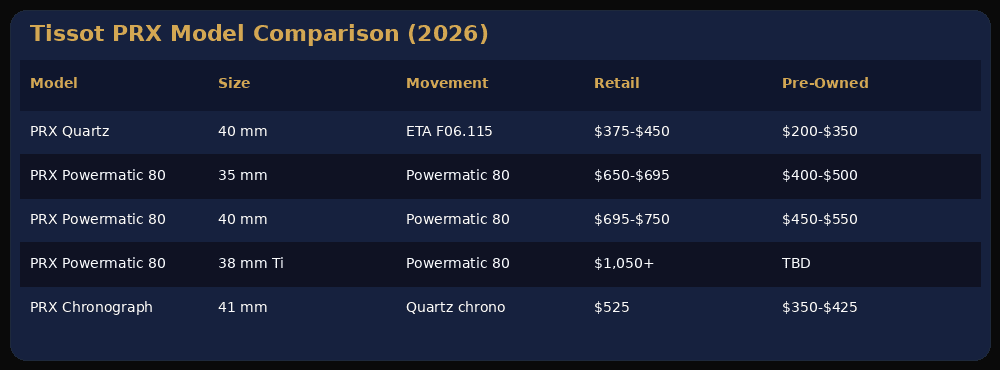
The first decision every PRX buyer faces is movement type. Tissot offers three options, each aimed at a different buyer. Here’s how they compare side by side.
| Spec | Quartz | Powermatic 80 | Chronograph |
|---|---|---|---|
| Case Size | 40 mm | 35 / 38 / 40 mm | 41 mm |
| Movement | ETA F06.115 (quartz) | Powermatic 80 (auto) | Quartz chronograph |
| Power Reserve | Battery (~3–4 yrs) | 80 hours | Battery (~3–4 yrs) |
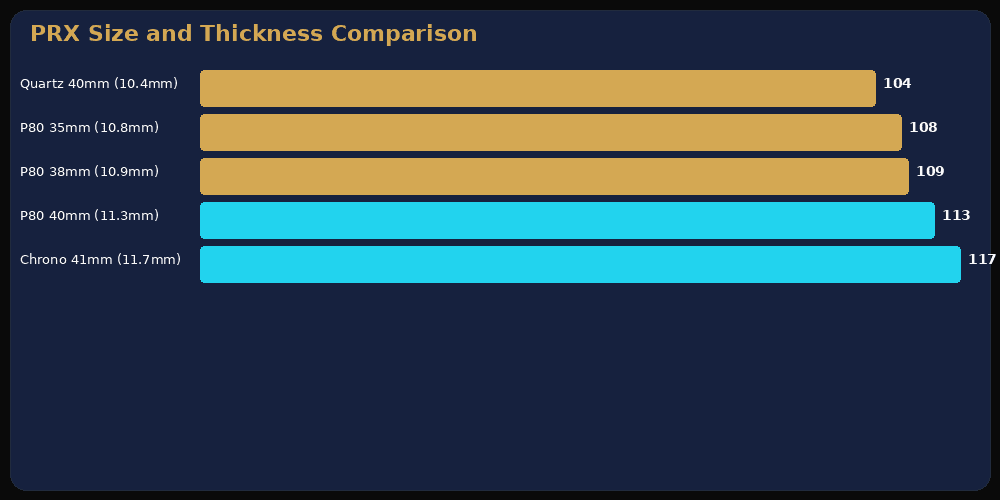
| Thickness | 10.4 mm | 11.3 mm (40 mm) | 11.65 mm |
| Water Resistance | 100 m | 100 m | 100 m |
| Crystal | Sapphire | Sapphire | Sapphire |
| Date | Yes (3 o’clock) | Yes (3 o’clock) | Yes |
| Retail | $375–$450 | $650–$750 | ~$525 |
| Pre-Owned | $200–$350 | $400–$550 | $350–$450 |
The quartz PRX is the entry point. At $375–$450, you get the full PRX design — the integrated bracelet, the sapphire crystal, the 100 m water resistance — powered by an ETA quartz movement that will run for years on a single battery with no maintenance beyond an occasional battery swap. The seconds hand ticks rather than sweeps, which is a non-issue for most buyers but a dealbreaker for mechanical purists. Available in black, blue, green and silver dials, the quartz PRX is the version most people should buy if they want the look without the premium.
The Powermatic 80 is the enthusiast’s choice. The self-winding Powermatic 80 movement — built on an ETA base with Swatch Group’s proprietary 80-hour power-reserve technology — is the same platform that powers the Hamilton Khaki Field Auto and the Certina DS Action. Three full days of power reserve means you can take the watch off Friday evening and it will still be running Monday morning. The trade-off is roughly 1 mm of additional thickness and nearly double the price. For anyone who understands why a mechanical movement matters, the Powermatic 80 is worth every cent of the upgrade.
The PRX Chronograph is the newest addition to the lineup. At 41 mm with a quartz chronograph movement, it adds elapsed-time functionality at a middle-ground price of roughly $525. The slightly larger case and busier dial give it a sportier character than the time-only models. It’s a solid watch, but the quartz movement in a chronograph format makes it harder to recommend over the Powermatic 80 at $650 — for $125 more you get a superior movement and the sweeping seconds hand that defines the luxury-watch experience.
Sizing Guide: 35 mm, 38 mm, 40 mm and 41 mm
Tissot has expanded the PRX into four case sizes, and the integrated bracelet makes sizing trickier than a conventional watch. The bracelet adds visual width to the case, so every PRX wears slightly larger on the wrist than its millimetre count suggests. Here’s how each one breaks down.
35 mm — The Vintage Fit
The 35 mm PRX is officially unisex, but its proportions echo the golden era of men’s watches — when a 36 mm Rolex Datejust was considered full-size. On wrists from 5.5 to 7 inches it looks balanced and elegant, sitting flat without overpowering the wrist. The integrated bracelet creates the illusion of a larger watch, which means a 35 mm PRX wears closer to a conventional 37–38 mm. Available exclusively in Powermatic 80, it’s one of the few sub-36 mm automatic watches with an integrated bracelet at any price.
38 mm — The New Sweet Spot
Tissot’s newest addition fills the gap between the dressier 35 mm and the standard 40 mm. At 38 mm, it hits the modern Goldilocks zone — large enough to feel contemporary, small enough to slide under a shirt cuff. The 38 mm is where Tissot has placed its most ambitious materials: titanium and Damascus steel variants push the price well above the standard steel models. For wrists between 6 and 7.5 inches, this is arguably the most versatile PRX in the collection.
40 mm — The Standard
The 40 mm is the core of the PRX lineup. It’s the size available in both quartz and Powermatic 80, with the widest range of dial colours. On wrists between 6.5 and 7.5 inches it wears perfectly — present without being loud. The integrated bracelet means the 40 mm PRX has the visual footprint of a conventional 42 mm watch. If you’re buying your first PRX and your wrist measures between 6.5 and 7.5 inches, start here.
41 mm — The Chronograph
The 41 mm case is exclusive to the PRX Chronograph. The extra millimetre plus the additional thickness from the chronograph pushers give it a noticeably sportier presence. It suits wrists 7 inches and above comfortably. On smaller wrists it can feel imposing, especially since the chronograph sub-dials add visual busyness to the dial. Try it on before committing — the step up from 40 to 41 mm is small in numbers but significant in wrist presence.
Check Any Watch Price in Seconds
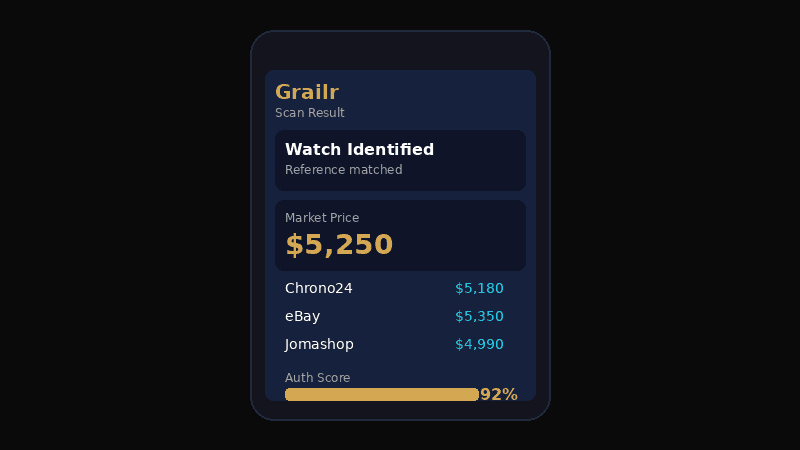
Grailr scans your watch photo and pulls live pricing from Chrono24, eBay, and Jomashop.
- AI identifies brand, model & reference number
- Live market prices from 3+ sources
- Authentication confidence score
Movement Details: What Powers Each PRX
Movements matter because they define the long-term ownership experience — accuracy, maintenance cost, and how the watch feels on the wrist. Here’s what’s inside each PRX.
ETA F06.115 — Quartz PRX
A standard Swiss quartz calibre with date complication at 3 o’clock. Accuracy is typically ±15 seconds per month — far better than any mechanical watch. Battery life runs three to four years. Maintenance is a battery swap every few years and a gasket check to maintain water resistance. Total cost of ownership over a decade is minimal: two or three battery changes at $20–$40 each. The quartz PRX is the “set it and forget it” option.
Powermatic 80 — Automatic PRX
The Powermatic 80 is Swatch Group’s workhorse automatic platform, built on an ETA base and modified with a longer mainspring for the signature 80-hour power reserve. It operates at 21,600 vibrations per hour (3 Hz) — slightly slower than the 28,800 vph used in higher-end movements, but perfectly adequate for daily use and a key reason the power reserve stretches to three days. Accuracy is typically ±7 seconds per day out of the box, with many examples running better than that.
The same movement appears in the Hamilton Khaki Field Auto, the Certina DS Action, and various Mido models — it’s proven, well-documented, and inexpensive to service. A full service runs $200–$300 every five to seven years. The movement features a silicon hairspring in current production, improving magnetic resistance and long-term reliability. For a deeper comparison of movement types, see our automatic vs quartz guide.
Quartz Chronograph — PRX Chronograph
The PRX Chronograph uses a quartz-based chronograph calibre with elapsed-time counters. Like the standard quartz, accuracy is excellent and maintenance is limited to battery changes. The chronograph pushers add functionality but also complexity to the case — chronograph gaskets should be checked during any battery service to maintain the 100 m water resistance rating.
The Resale Reality
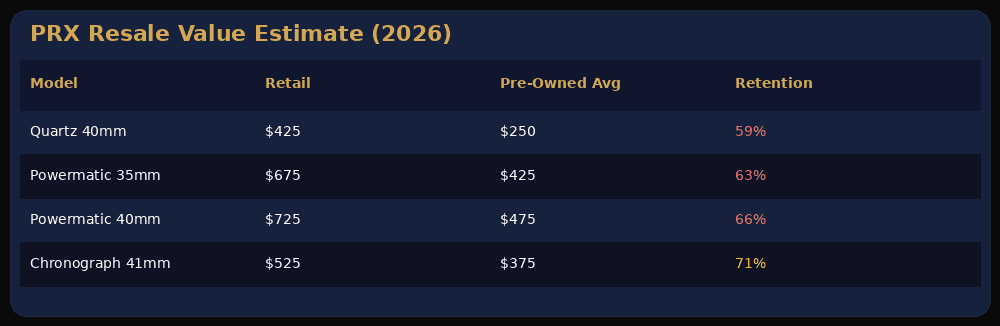
The Tissot PRX is not a watch you buy to flip. It’s a watch you buy because it delivers more design, movement quality and finishing per dollar than almost anything in its class. But understanding resale matters even if you plan to keep the watch — it tells you how the market values what you own.
PRX Quartz (40 mm)
Retail: $375–$450 — Pre-owned: $200–$350
Value retention: ~50–60%. This is fashion-watch territory for resale, which is typical for sub-$500 quartz watches. At $200–$250 pre-owned, the quartz PRX is an excellent buy for a second-hand shopper.
PRX Powermatic 80 (40 mm)
Retail: $650–$750 — Pre-owned: $400–$550
Value retention: ~60–70%. The automatic commands a stronger secondary market thanks to the mechanical movement and collector interest. Green and blue dials tend to hold slightly better than black or silver.
PRX Chronograph (41 mm)
Retail: ~$525 — Pre-owned: $350–$450
Value retention: ~65–70%. Newer to market, so secondary data is thinner, but early pre-owned prices suggest it holds slightly better than the standard quartz.
Context matters here. At the $375–$750 price range, the PRX competes against Seiko Presage, Orient Star, and other Swatch Group siblings like Certina and Mido. Resale percentages across this entire tier are similar — none of these brands produce watches that appreciate. The PRX’s advantage is that its design competes with watches at three to four times the price, which means you get exceptional value per dollar spent even if the resale return is modest.
If you’re buying a PRX pre-owned, use Grailr’s appraisal tool for an indicative estimate before committing. A Powermatic 80 in the $400–$450 range with box and papers is one of the best-value automatic watches on the secondary market in 2026.
Best PRX for Each Buyer
Six buyers, six recommendations. Here’s the PRX that makes the most sense for each.
Best first watch: PRX Quartz 40 mm in blue ($375–$400). The blue sunburst dial is the most versatile colour, the quartz movement means zero maintenance, and the price leaves room to add a strap or a second watch down the line. No compromises where it matters — sapphire crystal, 100 m WR, the full integrated-bracelet look.
Best for watch enthusiasts: PRX Powermatic 80 40 mm in green ($650–$700). The green dial catches light beautifully and stands out in a collection. The 80-hour power reserve is class-leading, and the sweeping seconds hand delivers the mechanical experience. This is the PRX that makes enthusiasts smile.
Best for smaller wrists: PRX Powermatic 80 35 mm ($650). Vintage proportions with a modern movement. It wears like a 37–38 mm conventional watch and pairs equally well with jeans or a suit. The 35 mm PRX proves that bigger isn’t always better.
Best all-rounder: PRX Powermatic 80 38 mm ($700–$750). The new 38 mm is the Goldilocks model — modern enough for casual wear, restrained enough for professional settings. If you can only own one watch, this is the size to choose.
Best on a budget: Pre-owned PRX Quartz ($200–$250). At this price you are getting a Swiss-made, sapphire-crystal watch with the design language of a $20,000 Royal Oak. It’s one of the strongest values in the entire budget watch segment.
Skip: The PRX Chronograph at full retail ($525) unless you specifically need a chronograph. For $125 more you get the Powermatic 80 with a superior movement and a cleaner dial. The chronograph is a better buy pre-owned at $350–$400, where the quartz movement is priced appropriately.
How the PRX Compares
The PRX exists in a competitive segment. Here’s how it stacks up against the watches most often cross-shopped with it.
| Watch | Retail | Movement | Power Reserve | WR |
|---|---|---|---|---|
| Tissot PRX Powermatic 80 | $650 | Powermatic 80 (Swiss auto) | 80h | 100 m |
| Hamilton Khaki Field Auto | $695 | H-10 (Swiss auto) | 80h | 100 m |
| Seiko Presage Sharp Edged | $725 | 6R35 (Japanese auto) | 70h | 100 m |
| Certina DS Action | $695 | Powermatic 80 (Swiss auto) | 80h | 200 m |
| Longines Conquest 39mm | $1,250 | L888.4 (Swiss auto) | 72h | 300 m |
The PRX’s closest Swatch Group sibling is the Hamilton Khaki Field Auto — same movement platform, similar price, but completely different design language. The Hamilton is a military field watch; the PRX is a luxury-sports-watch design. They serve different wardrobe needs and many collectors own both.
Against the Seiko Presage Sharp Edged, the PRX wins on power reserve (80h vs 70h), bracelet design and the “Swiss Made” designation. Seiko counters with arguably superior dial finishing and a more distinctive aesthetic. Both are excellent watches; the choice comes down to whether you prefer Swiss engineering or Japanese artistry.
The real comparison that matters is Longines — Tissot’s upmarket sibling. A Longines Conquest at $1,250 gets you COSC-tier accuracy, better finishing and a more prestigious name. Whether that’s worth $600 more than a PRX Powermatic 80 depends on how much brand positioning matters to you. On pure specs, the PRX punches remarkably close to Longines at nearly half the price.
Frequently Asked Questions
Is the Tissot PRX a good watch?
Yes. The PRX is widely considered one of the best watches under $1,000. The quartz starts at $375 with sapphire crystal and 100m water resistance; the Powermatic 80 adds a Swiss automatic movement with an 80-hour power reserve for $650-$750. It competes on design with watches costing three to four times as much.
What is the difference between Tissot PRX quartz and Powermatic 80?
The quartz ($375-$450) uses a battery-powered ETA movement — set it and forget it. The Powermatic 80 ($650-$750) is a self-winding mechanical watch with an 80-hour power reserve. The Powermatic is slightly thicker (11.3mm vs 10.4mm) and costs roughly twice as much, but offers the sweep seconds hand and tactile appeal that mechanical watch enthusiasts value.
Is the Tissot PRX 35mm too small for a man?
Not at all. The 35mm PRX is a unisex model that wears proportionally on wrists from about 5.5 to 7 inches. Its integrated bracelet creates the visual impression of a larger watch. Many male collectors deliberately choose the 35mm for its vintage proportions, similar to how a vintage Rolex Datejust at 36mm is considered a classic men's size.
Does the Tissot PRX hold its value?
The PRX is a value watch, not an investment watch. The quartz retains roughly 50-60% on the secondary market, while the Powermatic 80 holds about 60-70%. These are typical figures for sub-$1,000 Swiss watches. You buy a PRX because it delivers outstanding quality for the price, not because you expect to sell it for a profit.
What size Tissot PRX should I buy?
Tissot offers the PRX in 35mm, 38mm, 40mm and 41mm. For wrists under 6.5 inches, the 35mm or 38mm will look most balanced. For wrists 6.5-7.5 inches, the 40mm is the sweet spot. The 41mm chronograph works on 7-inch-plus wrists. The integrated bracelet adds visual width, so all sizes wear slightly larger than their diameter suggests.
Is the Tissot PRX inspired by the Royal Oak?
The PRX shares the integrated-bracelet, luxury-sports-watch design language popularised by the Audemars Piguet Royal Oak (1972) and Patek Philippe Nautilus (1976). But Tissot's own Seastar Seven from 1978 used a similar formula, and the modern PRX is officially a reissue of that watch. The resemblance is real, but the PRX has its own lineage — and costs roughly 1/50th of an AP.
Related Articles
The Bottom Line
The Tissot PRX is the watch that proved you don’t need five figures to wear an integrated-bracelet luxury sports watch. At $375 for the quartz and $650–$750 for the Powermatic 80, it delivers sapphire crystal, 100 m water resistance, a quick-change bracelet system and a design that holds its own against watches costing 10 to 50 times as much. It’s not perfect — resale is modest, the quartz seconds hand ticks, and the Powermatic 80 runs at a leisurely 3 Hz — but nothing at this price point does what the PRX does.
If we had to pick one: the PRX Powermatic 80 in 40 mm at $650 is the sweet spot. You get the full luxury-sports-watch experience — sweeping seconds, 80-hour power reserve, Swiss automatic movement — at a price that leaves the competition looking overpriced. But the quartz at $375 is genuinely excellent, and the new 38 mm fills a gap that the watch world has needed for years. Whatever version you choose, the PRX delivers.
Shopping for a Tissot PRX?
Upload a photo for a suggested Tissot reference and indicative price estimate. Compare the exact reference, condition and active listings before buying.
Scan a Watch NowSources and price context
- Tissot PRX Collection — Official PRX product listing with current specifications and pricing.
- Tissot PRX Powermatic 80 — Reference page for the 40 mm automatic with Powermatic 80 movement details.
- eBay watch Authenticity Guarantee — Eligibility, physical inspection and exclusions for the marketplace programme.
These primary sources support the specific specification and policy points noted above. Prices and resale percentages elsewhere in this guide are indicative editorial figures, not a verified transaction dataset or guaranteed returns. Confirm the exact reference, region, condition and current quote before buying; asking prices are not completed-sale prices.