The Rolex Models You Can Buy Under $5,000 in 2026
Every pre-owned reference that still fits a $5K budget — real asking prices, condition advice, and what to avoid.
Price context: this guide includes indicative prices from its original publication period. They have not all been refreshed to current quotes. Use the linked primary sources for specifications and policies, and verify prices independently.
- No new Rolex retails under $5,000 in 2026 — the cheapest is the OP 28 at ~$5,800
- Roughly a dozen pre-owned references trade reliably below the $5K mark, from ~$2,000 to ~$4,800
- Men’s options centre on 34mm vintage models: Air-King 5500, OP 1002, OP Date 1500
- Women’s options include the Lady-Datejust 69173 and Lady OP 76080 in 26mm
- Budget $400–$800 on top for a movement service if the watch hasn’t been serviced recently
Why $5,000 Is the Magic Number for Pre-Owned Rolex
Five thousand dollars used to buy a new Rolex. As recently as 2019, the Oyster Perpetual 39 retailed for $5,700, and pre-owned examples of that reference traded below $5,000 the moment they left the boutique. That era is over. After Rolex’s January 2026 price adjustment, the cheapest model in the current catalogue — the Oyster Perpetual 28 — starts at approximately $5,800. The Oyster Perpetual 36, the most accessible full-size men’s Rolex, now lists at roughly $6,450.
That means every Rolex you can own for under $5,000 in 2026 is pre-owned or vintage. And that is not a consolation prize — it is an opportunity. The secondary market for older Rolex references is deep, liquid, and full of genuinely excellent watches that wear beautifully, run reliably after a service, and carry all the heritage of the crown logo without the five-figure price tag.
The catch? This price bracket is also where fakes are most common, where condition matters most, and where buying decisions require the most homework. A polished-out, redial, franken-watch looks the same in a thumbnail as a clean, all-original example — but it is worth a fraction of the price and will not hold its value. This guide covers the specific references you should be searching for, what “good condition” actually means at this price point, and how to avoid the most common traps.
If you have been eyeing the Rolex name but assumed it was out of reach, keep reading. You may be closer than you think. For context on where these models sit relative to Rolex’s current entry-level lineup, see our guide to entry-level Rolex watches.
The Best Men’s Rolex Under $5,000
The men’s options under $5,000 are almost exclusively 34mm models from the 1970s through the early 2000s. If you are accustomed to modern 40–41mm watches, 34mm may feel small on a larger wrist. Try one on before you commit. That said, the vintage watch trend has pushed 34–36mm back into fashion, and these proportions look outstanding on wrists up to about 7 inches.
Air-King 34mm — Refs. 5500 and 14000
The Air-King is the most affordable automatic Rolex you can buy. The ref. 5500 (produced from 1957 to 1990) is a 34mm time-only watch with a simple, clean dial and an acrylic crystal. It runs the Cal. 1520 or 1530, a workhorse movement that any competent watchmaker can service. Expect to pay $2,500–$3,500 for a clean example with an original dial. Silver and grey dials are most common; the rarer blue and champagne dials command a small premium.
The ref. 14000 (1989–2000) upgraded to a sapphire crystal and the Cal. 3000 movement. It trades at $3,500–$4,500 and is the better daily wearer thanks to the scratch-resistant crystal. Both references use a 19mm lug width, which limits aftermarket strap options compared to the standard 20mm. The Air-King name was retired after the ref. 14010M and relaunched in 2016 as a completely different 40mm watch — that modern Air-King is well above $5,000 pre-owned.
Oyster Perpetual 34mm — Refs. 1002 and 14000
The Oyster Perpetual is the purest expression of the Rolex formula: Oyster case, Perpetual rotor, time-only dial. The ref. 1002 (1960s–1980s) features a smooth bezel, acrylic crystal, and the Cal. 1570 automatic. Prices sit at $2,800–$3,800 for an original-dial example in good condition. The engine-turned bezel variant has a dressier look and sometimes trades at a slight premium.
The later ref. 14000 (shared with the Air-King line, 1989–2000) brought a sapphire crystal and the modern Cal. 3000. Expect $3,200–$4,200. Some collectors prefer the Oyster Perpetual dial printing to the Air-King variant; in practice, the movements and cases are identical between the two. Choose based on which dial layout appeals to you.
Oyster Perpetual Date 34mm — Refs. 1500 and 15200
Add a date window and a Cyclops lens to the Oyster Perpetual and you get the OP Date. The ref. 1500 (1960s–1980s) is one of the most collectible sub-$5K Rolex references, with its pie-pan dial, smooth bezel, and Cal. 1570. Prices range from $2,800–$3,800, with sigma dials (marked with the Greek sigma symbol at 6 o’clock) fetching slightly more. It is a versatile everyday watch that looks equally at home with a suit or a pair of jeans.
The ref. 15200 (1988–2001) is the sapphire crystal upgrade with the Cal. 3135 — the same movement that powered the Submariner for decades. At $3,800–$4,800, it sits near the top of the budget but delivers a genuinely modern wearing experience. The quickset date function is a major convenience upgrade over the older 1500.
Oysterdate Precision 34mm — Ref. 6694
The ref. 6694 is the hand-wound alternative. Produced from the late 1950s through the 1980s, it uses the Cal. 1225, a manually wound movement that is simple, reliable, and inexpensive to service. The “Precision” designation on the dial indicates it passed a stricter accuracy test than the standard Oysterdate. Prices range from $2,500–$3,500.
Hand-wound movements appeal to collectors who enjoy the daily winding ritual. They also tend to be slimmer on the wrist because there is no rotor adding thickness. The downside is that you genuinely must remember to wind it every day — there is no automatic fallback. For many buyers, that’s a feature rather than a limitation.
Datejust 36mm — Refs. 1601 and 16200
The Datejust is the most iconic Rolex ever made, and certain 36mm references just barely fit under the $5,000 ceiling. The ref. 1601 (1960s–1977), with its acrylic crystal, fluted bezel, and Jubilee bracelet, can be found at $3,000–$5,000 depending on dial condition. Linen and “wide boy” dials command the highest prices. The later ref. 16200 (1988–2006), with a smooth bezel and sapphire crystal, trades at $4,000–$5,000. Both sit right at the ceiling — if you need the fluted bezel and Jubilee of a 16234, you will likely cross into $5,200+ territory, which we cover later.
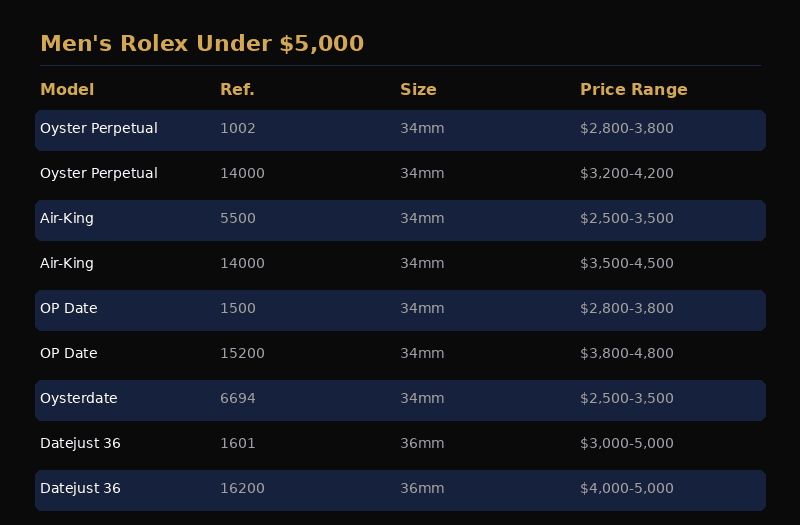
| Model | Reference | Era | Crystal | Price Range |
|---|---|---|---|---|
| Air-King 34mm | 5500 | 1957–1990 | Acrylic | $2,500–$3,500 |
| Air-King 34mm | 14000 | 1989–2000 | Sapphire | $3,500–$4,500 |
| Oyster Perpetual 34mm | 1002 | 1960s–1980s | Acrylic | $2,800–$3,800 |
| Oyster Perpetual 34mm | 14000 | 1989–2000 | Sapphire | $3,200–$4,200 |
| OP Date 34mm | 1500 | 1960s–1980s | Acrylic | $2,800–$3,800 |
| OP Date 34mm | 15200 | 1988–2001 | Sapphire | $3,800–$4,800 |
| Oysterdate Precision | 6694 | 1950s–1980s | Acrylic | $2,500–$3,500 |
| Datejust 36mm | 1601 | 1960s–1977 | Acrylic | $3,000–$5,000 |
| Datejust 36mm | 16200 | 1988–2006 | Sapphire | $4,000–$5,000 |
The Best Women’s Rolex Under $5,000
Women’s Rolex models under $5,000 offer more variety than the men’s side, partly because 26mm watches have less demand from the current unisex-sizing trend. That means better prices for buyers who actually want a smaller, more traditionally proportioned watch. Most of these references are two-tone (steel and yellow gold), which adds visual presence and the warmth of genuine 18k gold.
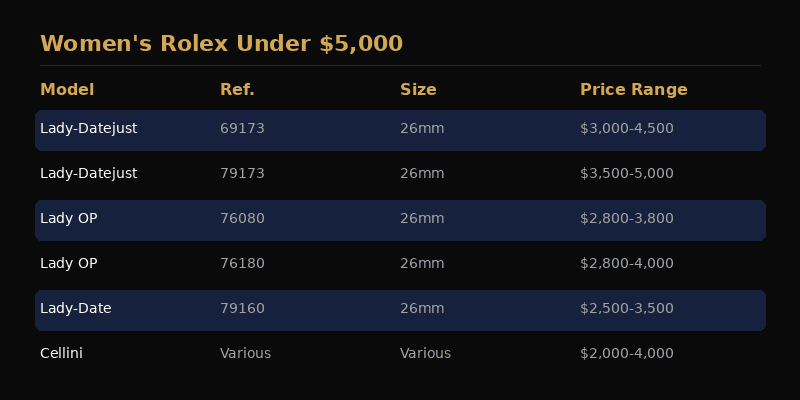
| Model | Reference | Size | Material | Price Range |
|---|---|---|---|---|
| Lady-Datejust | 69173 | 26 mm | Two-Tone | $3,000–$4,500 |
| Lady-Datejust | 79173 | 26 mm | Two-Tone | $3,500–$5,000 |
| Lady OP | 76080 | 26 mm | Oystersteel | $2,800–$4,000 |
| Lady OP | 76180 | 26 mm | Oystersteel | $2,800–$4,000 |
| Lady-Date | 79160 | 26 mm | Oystersteel | $2,500–$3,500 |
| Cellini | Various | 24–33 mm | 18k Gold | $2,000–$4,000 |
Lady-Datejust 26mm — Refs. 69173 and 79173
The Lady-Datejust is the definitive women’s Rolex. The ref. 69173 (1985–2000) is a two-tone model with a fluted yellow gold bezel, Jubilee bracelet, and Cyclops date. It trades at $3,000–$4,500 depending on dial colour and condition. Champagne and silver dials are most common; mother-of-pearl and diamond-index dials push prices toward the upper end.
The ref. 79173 (2001–2006) added an upgraded movement and redesigned case but retained the same 26mm sizing and two-tone aesthetic. At $3,500–$5,000, it is the more modern option. Both references look and feel like watches costing twice the price — the combination of gold and steel has an undeniable presence on the wrist.
Lady Oyster Perpetual 26mm — Refs. 76080 and 76180
For buyers who prefer an all-steel look, the Lady Oyster Perpetual is the answer. The ref. 76080 (2000s) features a smooth bezel, Oyster bracelet, and sapphire crystal. The ref. 76180 is the engine-turned bezel variant. Both trade at $2,800–$4,000. They are understated, everyday watches that pair with anything from a business suit to a weekend outfit.
Lady-Date 26mm — Ref. 79160
A step down from the Lady-Datejust, the Lady-Date has a smooth bezel instead of fluted gold. The ref. 79160 trades at $2,500–$3,500, making it one of the most affordable women’s Rolex references with a date complication. The all-steel construction keeps it lighter and more casual than the two-tone Lady-Datejust.
Cellini — Various References
The Cellini is Rolex’s dress watch line — thinner, dressier, and less recognisably “Rolex” than the Oyster family. Gold Cellini references from the 1990s and 2000s trade at $2,000–$4,000, often in solid 18k yellow or white gold. They are a different proposition from the sport-oriented Oyster models: formal, elegant, and best suited to dressy occasions. If you want the Rolex name on a genuine gold watch for under $4,000, the Cellini is the only path.
Check Any Watch Price in Seconds
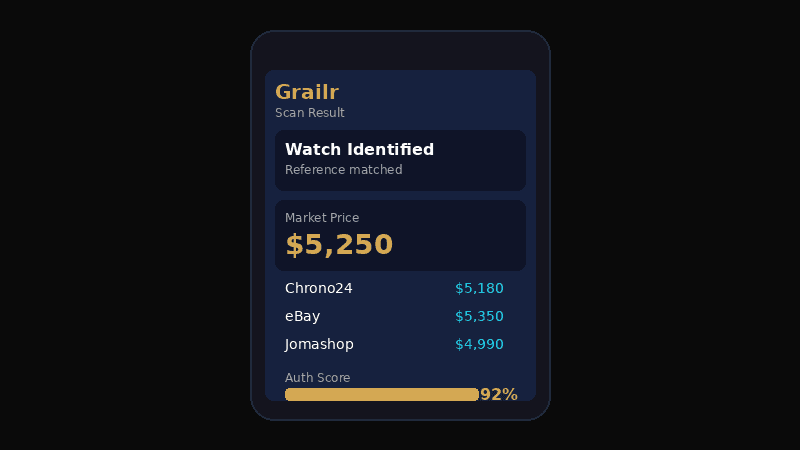
Grailr scans your watch photo and pulls live pricing from Chrono24, eBay, and Jomashop.
- AI identifies brand, model & reference number
- Live market prices from 3+ sources
- Authentication confidence score
Models Just Above the $5,000 Line
If your budget has even a little flex, several models sit in the $5,000–$6,000 range that represent a significant step up in capability or desirability. Knowing where the boundary falls helps you decide whether stretching makes sense — or whether the sub-$5K options already give you everything you need.
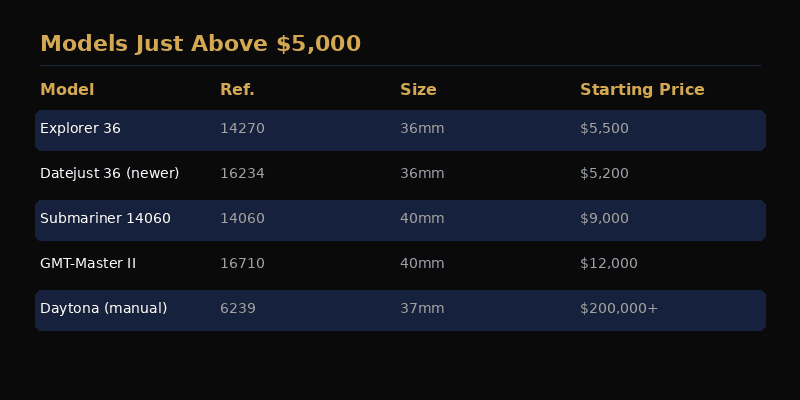
Datejust 16234 (36mm) — ~$5,200
The fluted-bezel Datejust on a Jubilee bracelet — the classic Datejust look. The ref. 16234 (1988–2006) is the most popular vintage Datejust and trades just above the budget. If you can stretch $200, this is often worth the jump from a 16200.
Explorer 14270 (36mm) — ~$5,500
The tritium-dial Explorer from 1989–2001. At 36mm with the Cal. 3000, it is the most affordable way into the Explorer line. The “blackout” dial (no lume plots on 3-6-9) commands a premium; standard luminous examples are more attainable.
Submariner 14060 (40mm) — ~$9,000+
The no-date Submariner is the grail for many, but it is firmly out of the sub-$5K range. The ref. 14060 (1990–2000) is the cheapest path into a genuine Submariner and currently trades around $9,000–$10,000 for a clean example. Worth saving for, but not in this guide’s budget.
For a deeper look at these models, our complete guide to buying a used Rolex covers condition grading, trusted dealers, and pricing for every major reference.
What to Check Before Buying a Sub-$5K Rolex
At the sub-$5,000 price point, condition and originality are everything. A clean, all-original example will hold its value and potentially appreciate. A watch with replaced parts, a refinished dial, or heavy polishing will not — and it may have been priced to disguise those issues. Here is what to examine, in order of importance.
1. Dial Originality
The dial is the single most important factor in a vintage Rolex’s value. An original dial with gentle, even patina is desirable. A refinished or repainted dial — even a well-done one — can cut a watch’s value by 30–50%. Look for consistent printing, even lume plots (or cleanly aged tritium), and text that matches the known production details for that reference. When in doubt, consult an authentication guide or a specialist dealer.
2. Case Condition
Light scratches on a vintage watch are normal and expected. Heavy polishing that rounds the lugs, removes the chamfers, or distorts the case shape is a much bigger concern. A case that has been polished several times will look “melted” — rounded edges where there should be crisp lines. This is irreversible and reduces value significantly.
3. Movement Service History
Ask for service records. A recently serviced watch (within the last 3–5 years) is ready to wear. One that hasn’t been opened in decades may run fine but could need gaskets, a new mainspring, and fresh lubricant. Budget $400–$800 for a basic service through an independent watchmaker, or $800–$1,200 through Rolex Service. Factor this into your total cost of ownership.
4. Bracelet Stretch
Vintage Rolex bracelets wear out. Links develop play, clasps loosen, and the bracelet sags. A tight, unstretched bracelet adds real value. A badly stretched bracelet may need replacement — and a genuine replacement Rolex bracelet for these references can cost $500–$1,500, which may blow the total budget. Check the bracelet carefully and factor any replacement cost into the price.
5. Box and Papers
A complete set with box, papers, and warranty card adds 10–20% to the value of a vintage Rolex. At this price range, most watches come without original packaging — and that is perfectly acceptable. Don’t pay a significant premium for a generic green box that may not even be original to the watch. Prioritise the watch itself over accessories.
A clean, original example typically performs better over time than a tired luxury-name reference. You can use Grailr’s scanner to photograph any listing and get a suggested model identification with indicative pricing — but remember that a photo scan cannot verify authenticity, and any identification should be confirmed against the watch’s physical details. For watches at this price point, knowing how to spot a fake is essential.
Where to Buy Safely
The under-$5,000 Rolex market is served by a mix of established dealers, online platforms, and private sellers. Each has trade-offs in price, authentication, and buyer protection. Here is how to navigate them.
Specialist pre-owned dealers (Bob’s Watches, Crown & Caliber, Watchfinder) offer authentication guarantees, return policies, and sometimes their own warranty. You will pay a modest premium over private-sale prices, but you get accountability. For a first vintage Rolex purchase, this is the safest route.
Online marketplaces (Chrono24, eBay with Authenticity Guarantee) provide the widest selection and the most competitive pricing. Chrono24’s Trusted Checkout programme holds your payment in escrow until you confirm the watch matches the listing. eBay’s Authenticity Guarantee routes watches over $2,000 through a third-party authenticator before delivery. Both add meaningful protection, though disputes can still be time-consuming.
Private sellers (forums like Watchuseek, Reddit r/Watchexchange, local classifieds) offer the lowest prices but no safety net. Unless you have the expertise to authenticate a watch yourself — or can bring it to a watchmaker before payment — private sales carry real risk at this price point. High-quality fakes of vintage Rolex models are common and increasingly sophisticated.
Regardless of where you buy, always request clear photographs of the dial, caseback, serial number, and bracelet clasp. Cross-reference the serial number against the known production range for that reference. And never send payment for a vintage Rolex sight-unseen without an escrow service or a dealer’s return policy behind you. Our marketplace comparison guide covers the major platforms in more detail.
Value Retention at This Price Point
The question everyone asks: will a sub-$5,000 Rolex hold its value? The honest answer is “it depends.” Rolex as a brand has a strong track record of value retention, but individual results at this price point vary significantly based on the specific reference, condition, and originality.
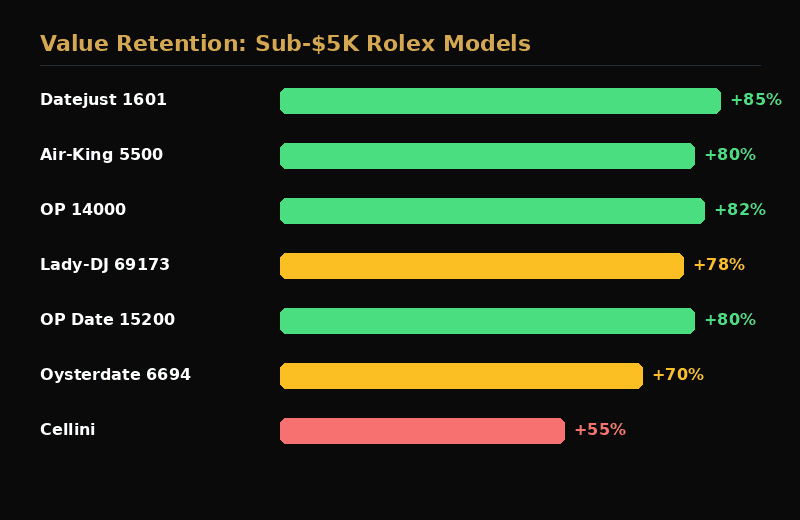
What tends to hold or gain value: All-original examples with untouched dials, sharp case edges, and tight bracelets. References with historical significance (the OP Date 1500’s pie-pan dial, the Datejust 1601’s linen dial) have shown steady appreciation over the past decade. The Air-King 5500 has quietly climbed from a $1,500–$2,000 watch a decade ago to $2,500–$3,500 today.
What tends to lose value: Watches with replaced dials, aftermarket parts, heavy polishing, or missing bracelets. A redial that looks “clean” today will be recognised by the next buyer — or the next buyer’s watchmaker — and the discount at resale will be steep. Also, references with very high production numbers and no particular collectibility (some later Cellini quartz models, for example) may drift sideways rather than up.
The takeaway: buy the best condition you can afford, prioritise originality over cosmetic perfection, and choose a reference with genuine collector interest. If you do that, a sub-$5K Rolex is unlikely to lose money over a five-to-ten-year holding period — and it may well appreciate. To understand what a specific Rolex is worth today, Grailr’s valuation tool can provide an indicative estimate based on recent market data.
Frequently Asked Questions
Can you buy a Rolex for under $5,000?
Yes, but only pre-owned or vintage. After the January 2026 price adjustment, the cheapest new Rolex is the Oyster Perpetual 28 at approximately $5,800. Several older references — including the Air-King 5500, Oyster Perpetual 1002, and Lady-Datejust 69173 — trade well under $5,000 on the secondary market.
What is the cheapest Rolex you can buy in 2026?
The cheapest Rolex watches on the pre-owned market start around $2,000–$2,500 for vintage hand-wound models like the Oysterdate Precision ref. 6694 and older Cellini dress watches. The cheapest automatic Rolex under $5,000 is typically the Air-King 5500 at $2,500–$3,500.
Are pre-owned Rolex watches under $5,000 authentic?
They can be, but this price range is also heavily targeted by counterfeiters. Always buy from a reputable dealer with an authentication guarantee, request service history, and verify reference numbers. A photo scan is not a substitute for professional authentication.
Do Rolex watches under $5,000 hold their value?
Vintage Rolex models in clean, original condition have generally appreciated over time, but individual results depend heavily on condition, originality, and market demand. A well-maintained Air-King 5500 or OP Date 1500 in original condition tends to hold or gradually gain value.
Should I budget for servicing a sub-$5,000 Rolex?
Yes. A basic movement service typically costs $400–$800 through an independent watchmaker. If the watch has not been serviced in over five years, factor that cost into your total budget. A $3,000 watch that needs a $600 service is really a $3,600 purchase.
Related Articles
The Bottom Line
You cannot buy a new Rolex for under $5,000 in 2026 — but you can buy a genuine, well-made, historically significant one. The Air-King 5500, Oyster Perpetual 1002, and OP Date 1500 are our top picks for men, offering clean designs, reliable movements, and strong collector interest between $2,500 and $4,000. For women, the Lady-Datejust 69173 in two-tone is hard to beat for presence and value.
Whichever reference you choose, prioritise originality over cosmetic perfection, factor in the cost of a service, and buy from someone who stands behind the sale. A clean, all-original vintage Rolex at $3,500 is a better purchase than a polished, redialed one at $4,500 — every time. Do the homework, trust your eyes, and wear it well.
Found a Watch You Like?
Grailr uses a photo to suggest a watch identity and an indicative price estimate, with active eBay listings where available. Check the exact reference and condition independently; a photo scan cannot authenticate a watch.
Scan a Watch NowSources and price context
- Rolex Oyster Perpetual specifications — Current retail pricing and specifications for the 2026 Oyster Perpetual range.
- Rolex Certified Pre-Owned process — Explains physical authentication, servicing and the two-year programme guarantee.
These primary sources support the specific specification and policy points noted above. Prices and value retention figures elsewhere in this guide are indicative editorial estimates drawn from publicly listed asking prices, not a verified transaction dataset or guaranteed returns. Asking prices are not completed-sale prices. Confirm the exact reference, region, condition and current quote before buying.