Best Seiko Watches for Men: Every Collection Ranked
Prospex, Presage, 5 Sports, King Seiko and Astron compared — with real pricing, movement specs and honest resale expectations.
Price context: this guide includes indicative prices from its original publication period. They have not all been refreshed to current quotes. Use the linked primary sources for specifications and policies, and verify prices independently.

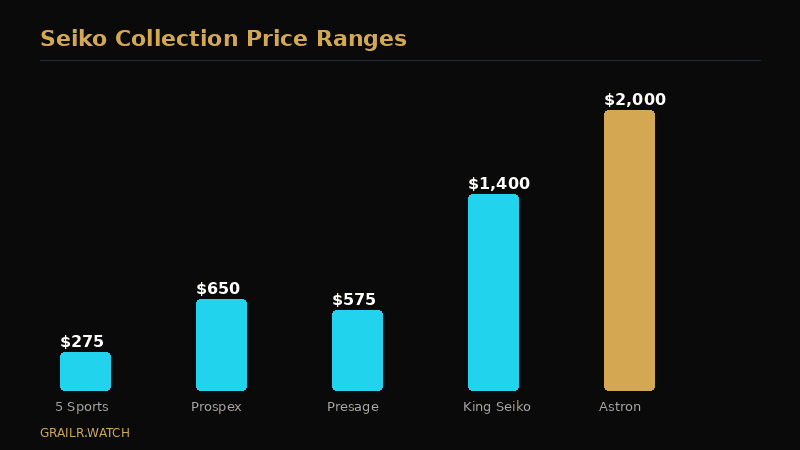
- Seiko covers every price tier from the $200 5 Sports to the $2,500 Astron GPS Solar, all with in-house movements
- The Prospex Turtle and Sumo remain the best value dive watches on the market for under $650
- King Seiko’s 6L35 hi-beat movement offers Grand Seiko finishing standards at a third of the price
- Resale retention ranges from 40–60% on 5 Sports to 60–80% on Prospex divers
Why Seiko Dominates Men’s Watches
Founded in Tokyo in 1881, Seiko has spent over 140 years building movements that punch above their price. The company makes everything in-house — from hairsprings to cases to lubricants — across factories in Japan. That vertical integration is why a $350 Seiko automatic uses a movement designed and manufactured by the same firm, while most Swiss brands at that price rely on third-party ETA or Sellita calibers.
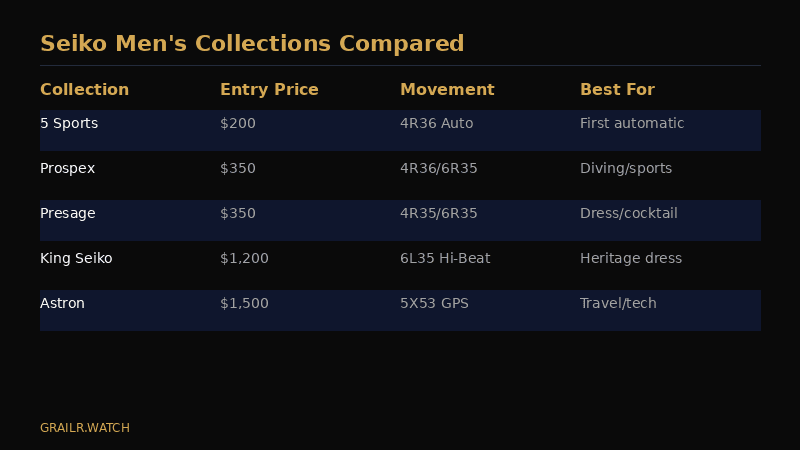
In 2026, Seiko’s men’s lineup spans five main collections: Prospex for divers and sports watches, Presage for dress and cocktail watches, 5 Sports for entry-level automatics, King Seiko for heritage-inspired dress pieces, and Astron for GPS solar technology. Grand Seiko, the luxury division, operates as a separate brand with its own manufacturing facility in Shinshu and is not covered in this guide.
What makes Seiko unusual is the breadth of what you can buy under one name. A $200 Seiko 5 Sports and a $2,500 Astron GPS Solar sit in entirely different product categories, yet both carry movements designed and assembled by Seiko’s own Morioka or Shizukuishi factories. No other watchmaker covers that range with fully in-house production.
Prospex: Divers and Sports Watches
The Prospex line — short for “Professional Specifications” — is Seiko’s tool-watch collection and the one most men associate with the brand. Every Prospex diver meets or exceeds ISO 22810 standards for water resistance, with most rated to 200m and the Marinemaster series to 300m or 1,000m.
The Turtle (SRPD series, ~$350) is the collection’s workhorse. Its cushion-shaped case design dates to the 6309 from 1976 and remains one of the most comfortable dive watches on any wrist. Inside sits the 4R36 automatic with hacking and hand-winding, day-date display, and a 41-hour power reserve. The Turtle’s 45mm case wears large, so try it on before buying if your wrist is under 7 inches.
The Samurai (SRPB series, ~$400) adds angular case geometry and a slightly more modern aesthetic. Same 4R36 movement, same 200m rating, but the sharp case edges and broader dial give it a more aggressive presence. The Sumo (SPB series, ~$550–$650) steps up to the 6R35 movement with a 70-hour power reserve and ±15 seconds per day accuracy — a meaningful upgrade over the 4R36’s 41 hours and ±35 seconds.
At the top of the Prospex range, the Willard (SPB series, ~$1,100–$1,400) uses the same 6R35 but adds sapphire crystal, a slimmer case profile, and finishing that approaches the quality of watches twice its price. The name comes from Captain Willard in Apocalypse Now — Martin Sheen wore the original 6105 on screen, and the reissue captures that thick, angular case shape. For serious divers who want Seiko’s best without crossing into Grand Seiko territory, the Willard is the reference to chase.
Presage: Dress Watches With Character
The Presage line proves that mechanical dress watches do not need to cost thousands. The collection is built around Seiko’s expertise in dial craftsmanship — enamel firing, textured lacquer, and Arita porcelain — techniques that would be prohibitively expensive at Swiss price points.
The Cocktail Time (SRPB/SRPE series, ~$350–$475) is the gateway. Its sunburst dials in ice blue, Manhattan, and Old Fashioned colourways catch light in ways that photographs cannot capture. The 4R35 or 4R36 movement inside is the same entry-level caliber as the 5 Sports, but the dial finishing, applied indices, and case polishing put the Cocktail Time in a different visual class.
Step up to the Sharp Edged series (SPB series, ~$750–$1,200) for the 6R35 movement, sapphire crystal, and Seiko’s Asanotsuyu textured dials inspired by morning dew on hemp leaves. The case geometry is precise and angular, with a level of finishing that puts Swiss watches at twice the price on notice. At 39.3mm on most references, the Sharp Edged wears perfectly under a shirt cuff.
The Presage also includes porcelain-dial models from the Arita ceramics region (SPB series, ~$900–$1,600) and enamel-dial pieces (SPB series, ~$1,200–$2,000). These are small-batch productions with hand-finished dials, and they represent the best value in artisanal watchmaking available anywhere. If you want Seiko’s craft in a smaller size, the Presage also comes in 33.8mm and 30.3mm for women.
5 Sports: The Entry-Level Automatic
The Seiko 5 has been the world’s gateway to automatic watches since 1963. The name refers to five attributes the original promised: automatic winding, day-date display, water resistance, a recessed crown, and a durable case. Today’s 5 Sports (SRPD/SRPE series, ~$200–$325) delivers all five plus hacking and hand-winding via the 4R36 movement.
The current generation, nicknamed the 5KX, replaced the legendary SKX007 in 2019. The 5KX uses a pressed Hardlex crystal instead of the SKX’s mineral glass, and its 100m water resistance is half the SKX’s 200m rating. Those downgrades sting, but the 5KX compensates with hacking, hand-winding, a screw-down crown, and an exhibition caseback — four features the SKX never offered.
The range spans sports styles (SRPD55, the “new SKX” in black and stainless), field watches (SRPE series), and GMT models (SSK series, ~$325). For a detailed breakdown of every 5 Sports sub-collection, see the full 5 Sports guide.
At $200–$325, the 5 Sports competes with the Orient Kamasu ($250, in-house F6722 movement, 200m WR) and the Citizen Promaster Diver ($250, Eco-Drive solar). The Seiko wins on modding potential — the 5KX has the largest aftermarket parts ecosystem of any watch under $500 — and on brand recognition, but Orient gives you 200m water resistance and sapphire crystal at the same price, which the 5 Sports does not.
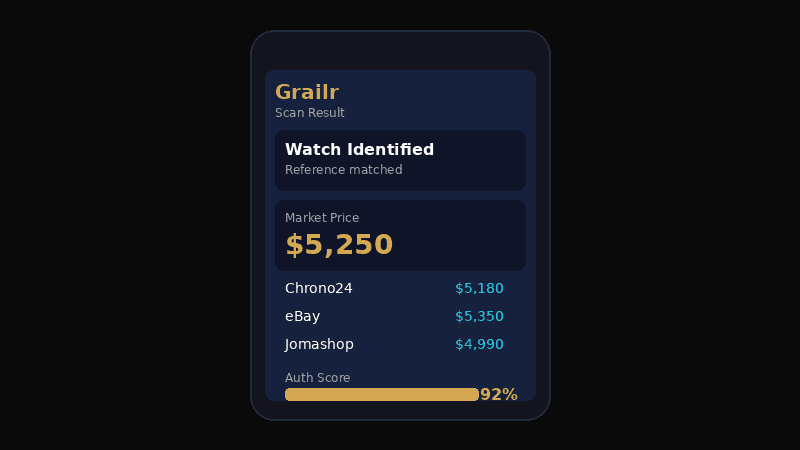
Check Any Watch Price in Seconds
Grailr scans your watch photo and pulls live pricing from Chrono24, eBay, and Jomashop.
- AI identifies brand, model & reference number
- Live market prices from 3+ sources
- Authentication confidence score
King Seiko: Heritage and Hi-Beat
King Seiko was originally a rival to Grand Seiko within Seiko’s own factory system during the 1960s. Revived in 2022, the modern King Seiko (SPB series, ~$1,200–$1,600) occupies the space between Presage and Grand Seiko: hand-assembled at the Shizukuishi Watch Studio in Iwate Prefecture, the same facility that builds Grand Seiko mechanical watches.
The defining feature is the 6L35 hi-beat movement, running at 28,800 vibrations per hour (vph) compared to the 6R35’s 21,600 vph. The higher beat rate produces smoother second-hand sweep and, in theory, better positional accuracy. Power reserve is 45 hours — shorter than the 6R35’s 70 hours, a trade-off for the faster oscillation.
King Seiko cases follow the “Grammar of Design” philosophy established by designer Taro Tanaka in 1969: flat surfaces, sharp ridgelines, and distortion-free polishing. At 37mm to 38.6mm, the watches are compact by modern standards, and the thin bezels make the dials appear larger than the case size suggests. If you appreciate hi-beat movements and traditional case finishing, King Seiko offers the closest experience to Grand Seiko without the Grand Seiko price tag.
Astron: GPS Solar Technology
The Astron is Seiko’s technology flagship. The original 2012 Astron was the world’s first GPS solar watch, and the current generation uses Caliber 5X53 (dual-time) and 5X63 (chronograph) movements that connect to the GPS satellite network to set time zone, date, and atomic-clock accuracy anywhere on Earth. Solar charging means no battery changes, ever.
The Astron lineup ranges from about $1,500 to $2,500. Most models use Super-Hard Coating on titanium cases — harder than stainless steel and significantly lighter. The 5X53 dual-time models at ~$1,500–$1,800 are the practical choice for frequent travellers: one button press syncs to the local time zone from any position with a clear view of the sky.
The trade-off is that the Astron is a quartz watch — a technologically sophisticated one, but quartz nonetheless. Collectors who value mechanical movements will find nothing to admire inside, and the 42.7mm–43.3mm case sizes wear large. The Astron is best understood as a functional travel tool, not a collector’s piece, and its resale value reflects that position: expect 40–55% retention after two years.
Seiko Movement Hierarchy Explained
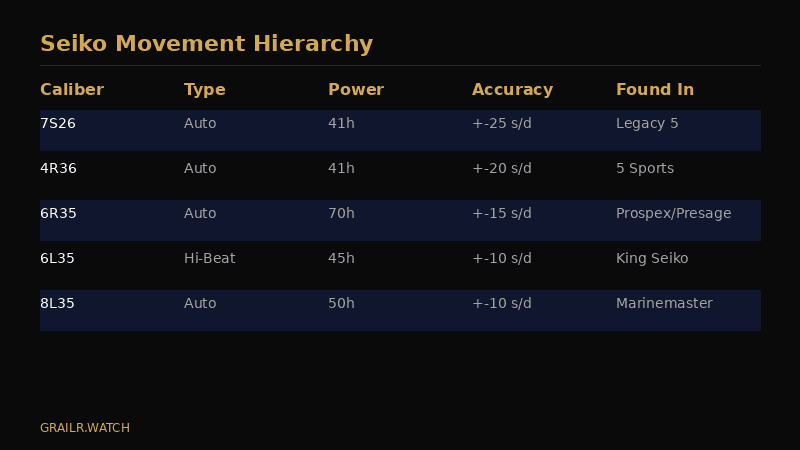
Every mechanical Seiko for men uses one of five automatic calibers. Understanding the hierarchy helps you decide where your money goes — and whether the upgrade is worth it at each tier.
| Caliber | Beat Rate | Power Reserve | Accuracy | Found In |
|---|---|---|---|---|
| 4R36 | 21,600 vph | 41 hours | ±35 sec/day | 5 Sports, entry Prospex |
| 6R35 | 21,600 vph | 70 hours | ±15 sec/day | Presage Sharp Edged, Sumo, Willard |
| 6L35 | 28,800 vph | 45 hours | ±15 sec/day | King Seiko |
| 8L35 | 28,800 vph | 50 hours | ±10 sec/day | Prospex Marinemaster |
The jump from 4R36 to 6R35 is the single biggest upgrade in the lineup. You get 70 hours of power reserve instead of 41 — meaning a full weekend off the wrist without stopping — and accuracy doubles from ±35 to ±15 seconds per day. The 6L35 hi-beat adds smoother sweep and marginally better positional accuracy. The 8L35, found only in top-tier Prospex references, is hand-assembled with individual regulation, approaching Grand Seiko 9S standards at a fraction of the cost.
Head-to-Head Collection Comparison
| Collection | Flagship Model | Movement | WR | Price Range | Best For |
|---|---|---|---|---|---|
| 5 Sports | SRPD55 (5KX) | 4R36 | 100m | $200–$325 | First automatic, modding |
| Prospex (entry) | SRPD Turtle | 4R36 | 200m | $350–$450 | Everyday diver |
| Presage (entry) | Cocktail Time | 4R35 | 50m | $350–$475 | Dress, date night |
| Prospex (mid) | SPB Sumo / Willard | 6R35 | 200m | $550–$1,400 | Serious diver, collector |
| Presage (mid) | Sharp Edged SPB | 6R35 | 100m | $750–$1,200 | Office, special occasion |
| King Seiko | SPB (37–38.6mm) | 6L35 | 50m | $1,200–$1,600 | Heritage dress, finishing |
| Astron | SSJ (5X53/5X63) | Solar GPS | 100m | $1,500–$2,500 | Travel, tech, no-fuss |
Resale Value and How Seiko Compares
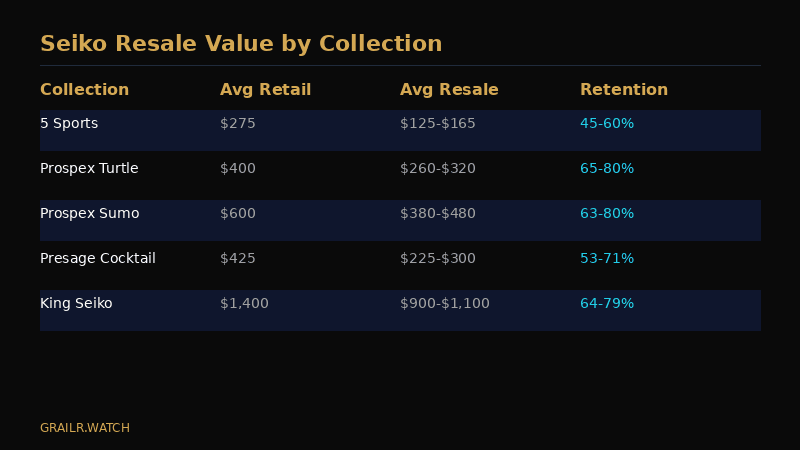
Seiko watches are not investment pieces — with rare exceptions, they depreciate. But the rate of depreciation varies dramatically by collection and model. Understanding resale helps you buy smarter, especially if you plan to rotate your collection.
Best Resale
Prospex Divers — 60–80%
The Turtle and Sumo hold value well because demand is steady and supply is predictable. Discontinued references like the SKX007 and SRP777 have appreciated above original retail.
Worst Resale
5 Sports — 40–60%
High production volume and low retail price mean a $275 5KX sells for $110–$165 used. The modding community creates demand for parts, not complete watches.
Seiko vs Competitors at Each Tier
At the $200–$400 tier, Seiko’s main competitors are Orient and Citizen. Orient’s Kamasu and Bambino offer in-house movements with sapphire crystal at similar prices — a specification Seiko reserves for higher-priced models. Citizen’s Eco-Drive line eliminates the need for winding or battery changes entirely, which matters if you rotate watches.
At the $500–$1,000 tier, Seiko competes with Tissot and Hamilton. The Tissot PRX Powermatic 80 ($650) offers Swiss-made pedigree, 80-hour power reserve, and sapphire crystal. The Hamilton Khaki Field Auto ($595) uses the same Powermatic 80 movement. Seiko’s advantage at this tier is dial craftsmanship — no Swiss brand matches the Presage Sharp Edged’s finishing at $750.
At the $1,200–$1,600 tier, King Seiko faces the Longines Spirit ($1,400) and the Seiko Alpinist special editions. The Longines wins on Swiss COSC certification and brand prestige; King Seiko wins on case finishing and movement heritage. Both offer excellent value; the choice comes down to whether you prefer Swiss provenance or Japanese craft.
Our Top Picks by Use Case
Best Overall
Prospex Sumo SPB — ~$600
The sweet spot: 6R35 movement, 200m WR, sapphire crystal, and finishing that exceeds its price tier. Comfortable enough for daily wear, capable enough for real diving.
Best Under $300
5 Sports SRPD55 — ~$250
The automatic watch that launched a thousand mods. Proven 4R36, day-date, 100m WR, and the largest aftermarket ecosystem of any watch at this price.
Best Dress Watch
Presage Sharp Edged SPB — ~$900
The textured dial and angular case geometry create a dress watch that looks like it costs $2,000. The 6R35’s 70-hour reserve means it survives a full weekend off wrist.
Best for Collectors
King Seiko SPB — ~$1,400
Hi-beat 6L35, Grammar of Design case, hand-assembled at Shizukuishi. The closest you get to Grand Seiko finishing without the Grand Seiko price.
5 Tips for Buying a Seiko
1. Check the Movement First
The jump from 4R36 to 6R35 is worth every dollar. If your budget allows $550+, always pick the 6R35 model — the 70-hour power reserve and better accuracy transform the ownership experience.
2. Buy From an Authorized Dealer
Grey-market Seiko watches are common and heavily discounted, but they come without the manufacturer’s warranty. For models under $500, the savings rarely justify the risk. For models over $1,000, an AD purchase protects your investment.
3. Try It On
Seiko’s cushion-case divers (Turtle, Samurai) wear significantly larger than their listed diameter. A 45mm Turtle has a lug-to-lug span of 48mm and sits tall on the wrist. Visit a retailer before ordering online.
4. Scan Before You Buy Used
Use Grailr’s identification tool to verify the reference number and check current market pricing before buying pre-owned. Seiko references are confusing — similar model numbers can have very different movements and specifications.
5. Consider the Strap
Seiko’s stock rubber and silicone straps are adequate but not exceptional. Budget an extra $30–$80 for a quality aftermarket rubber strap (Uncle Seiko, Crafter Blue) or a NATO — it transforms the watch on the wrist.
Frequently Asked Questions
What is the best Seiko watch for men under $500?
The Prospex Turtle (SRPD series, ~$350) is the best all-rounder under $500: 200m water resistance, proven 4R36 automatic, and a design heritage that dates to 1976. For dress wear, the Presage Cocktail Time (~$425) offers stunning dial finishing at the same price tier.
Is Seiko better than Orient or Citizen for men?
All three brands belong to the same parent group. Seiko offers the widest collection range and strongest resale. Orient wins on value with in-house movements and sapphire crystal at lower prices. Citizen leads in solar tech with Eco-Drive. For most men, Seiko’s depth from $200 to $2,500 covers more needs than either competitor.
Do Seiko watches hold their value?
Moderately. Prospex divers retain 60–80% of retail, Presage holds 50–70%, and 5 Sports holds 40–60%. Limited editions and discontinued references like the SKX007 can appreciate, but most mainline Seiko watches are not investment pieces. Buy for the watch, not the return.
What is the difference between Seiko and Grand Seiko?
Grand Seiko is a separate luxury brand within the Seiko Group. It has its own design studio, manufacturing facility in Shinshu, and proprietary movements including the Spring Drive. Grand Seiko starts around $3,200 and competes with Omega and Tudor. Mainline Seiko ranges from $200 to $2,500.
Which Seiko movement is the best?
The 6R35 offers the best balance of power reserve (70 hours) and accuracy (±15 sec/day) for the price. The 6L35 hi-beat in King Seiko adds smoother sweep. The 8L35 in top Prospex models is hand-assembled with ±10 sec/day accuracy, approaching Grand Seiko standards.
What size Seiko should a man buy?
Most men’s Seiko watches range from 38mm to 45mm. For wrists under 7 inches, the 38–41mm Presage or King Seiko models wear best. For wrists over 7 inches, 42–45mm Prospex divers are proportionate. Cushion-case divers wear larger than their listed diameter due to the lug-to-lug span.
Related Articles
The Bottom Line
Seiko offers more watch for less money than almost any other brand, and its men’s lineup covers everything from a $200 beater to a $1,600 hand-finished dress piece. For most first-time buyers, the Prospex Sumo (~$600) hits the sweet spot of movement quality, build, and everyday wearability. For those on a budget, the 5 Sports 5KX at $250 remains the best introduction to mechanical watchmaking. And if finishing matters more than water resistance, King Seiko’s hi-beat movement and Grammar of Design cases deserve a closer look. Whatever you choose, you’re buying a watch from a company that designs and builds its own movements — a claim very few brands at any price can make.
Found a Seiko You Like?
Grailr uses a photo to suggest a watch identity and an indicative price estimate, with active eBay listings where available. Check the exact reference and condition independently; a photo scan cannot authenticate a watch.
Scan a Watch NowSources and price context
- Seiko Prospex collection overview — Official Seiko page covering Prospex line philosophy, ISO dive ratings and current model families.
- Seiko Caliber 6L35 technical specifications — Independent movement database with beat rate, jewel count and power reserve details for the King Seiko hi-beat caliber.
These primary sources support the specific specification and collection points noted above. Prices and resale percentages elsewhere in this guide are indicative editorial figures, not a verified transaction dataset or guaranteed returns. Confirm the exact reference, region, condition and current quote before buying; asking prices are not completed-sale prices.