Shinola Runwell Watch Guide: Pricing, Specs & Value
Quartz, automatic, and chronograph — every Runwell model compared with real pricing, Detroit-built movement details, and honest resale data.
Price context: this guide includes indicative prices from its original publication period. They have not all been refreshed to current quotes. Use the linked primary sources for specifications and policies, and verify prices independently.

- Shinola Runwell prices range from roughly $550 for a quartz three-hand to about $1,095 for the automatic
- The Argonite 1069 quartz movement is hand-assembled in Detroit from 46 Swiss-sourced parts
- The Runwell Automatic uses a Swiss Sellita SW260-1 rather than the in-house Argonite platform
- Pre-owned Runwell models typically sell for $200–$500, reflecting roughly 40–55% value retention
- Hamilton, Tissot, and Seiko offer stronger horological value at similar price points, but none carry the same Detroit-built narrative
What Is Shinola, and Why Does It Matter?
Shinola is a Detroit-based consumer goods company founded in 2011 by Tom Kartsotis, the same entrepreneur who built Fossil into a global watch brand. The name itself is borrowed from a defunct shoe-polish company, revived as a symbol of American manufacturing revival. From the start, Shinola positioned itself around a single idea: that premium goods could be built in Detroit, a city whose manufacturing legacy needed a modern chapter.
The “Built in Detroit” tagline is central to the brand’s identity, though it requires a footnote. Shinola assembles its watches at a factory on Cass Avenue in Midtown Detroit, but the components — dials, hands, cases, crystals, and the Swiss-made quartz modules that form the basis of the Argonite movements — are sourced globally. The Federal Trade Commission forced the brand to revise its “Made in America” language in 2016, and the corrected phrasing is “Built in Detroit using Swiss and imported parts.” That distinction matters if provenance is your primary buying motivation.
None of that diminishes what Shinola actually delivers. The Runwell, launched as the brand’s first and still flagship watch, introduced thousands of buyers to the idea that a watch could carry a story beyond its movement type. Walk into a Shinola retail store — there are over a dozen across the United States — and you’ll find watches displayed alongside leather goods, bicycles, and turntables, all presented as artifacts of American craft. The experience is closer to visiting a lifestyle boutique than a traditional watch dealer.
For watch enthusiasts who evaluate timepieces primarily on movement pedigree and resale curves, Shinola can be a difficult brand to assess. Its quartz movements will never excite a collector in the way a Swiss automatic does. But for buyers who want a well-finished, genuinely attractive watch with a compelling origin story and strong retail availability, the Runwell occupies a space that no Swiss brand has tried to fill. Understanding what Shinola is — and what it is not — is the key to deciding whether a Runwell belongs on your wrist.
The Runwell Collection Explained
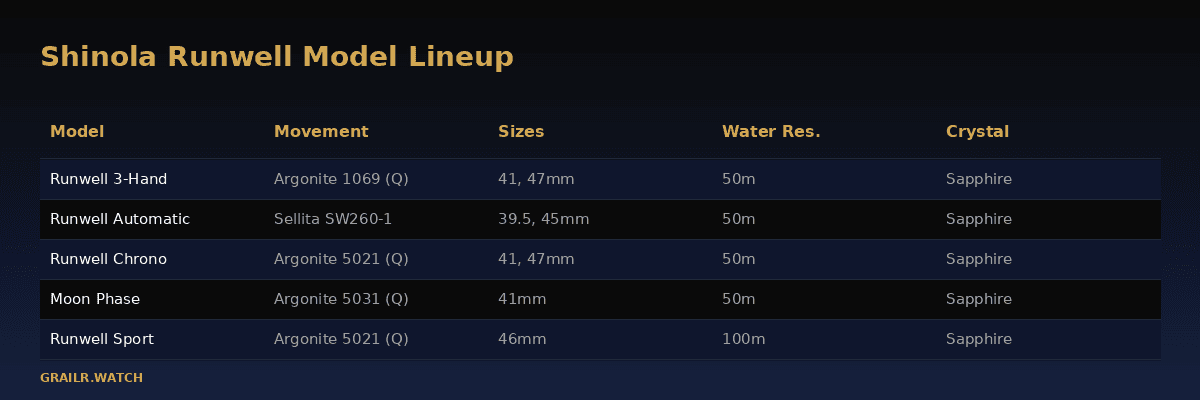
The Runwell name covers a family of sub-collections rather than a single watch. Each shares Shinola’s signature design language — a clean dial, polished stainless-steel case, double-domed sapphire crystal, and Detroit-assembled movement — but they differ in complication, movement type, and price. Here is how the family breaks down.
Runwell Three-Hand (Quartz)
The original and most affordable member of the family. Powered by the Argonite 1069, a quartz movement that Shinola hand-assembles in Detroit from 46 Swiss-sourced components. Available in 41mm and 47mm case sizes with a range of dial colours and leather or bracelet options. Retail pricing runs from roughly $550 to $650 depending on configuration. This is the model most people picture when they hear “Shinola.”
Runwell Automatic
Shinola’s answer to the enthusiast who wants a mechanical heart. The Runwell Automatic uses the Sellita SW260-1, a Swiss-made automatic movement with a 38-hour power reserve. Sized at 39.5mm, it wears noticeably more compact than the quartz models and appeals to buyers who prefer the sweep of a mechanical seconds hand. Priced at roughly $995 to $1,095, it competes directly with Swiss automatics from Hamilton and Tissot.
Runwell Chronograph
The chronograph variant uses the Argonite 5021, a quartz chronograph movement that adds start-stop-reset timing sub-dials to the Runwell’s clean face. Available in 41mm and 47mm, with retail pricing around $750 to $875. The chronograph pushers and additional sub-registers give the dial a busier, more sport-oriented look than the three-hand model.
Runwell Sport and Moon Phase
Two specialized variants round out the range. The Runwell Sport increases water resistance and adds a more robust case design aimed at active wear. The Moon Phase adds a lunar complication — a moon-phase disc visible through a sub-dial aperture — for buyers who want a dressier aesthetic. Both use Argonite quartz movements and sit within the $600–$900 price band. They share the same case finishing and sapphire crystal as their siblings but are produced in more limited quantities.
Specifications and Movement Breakdown
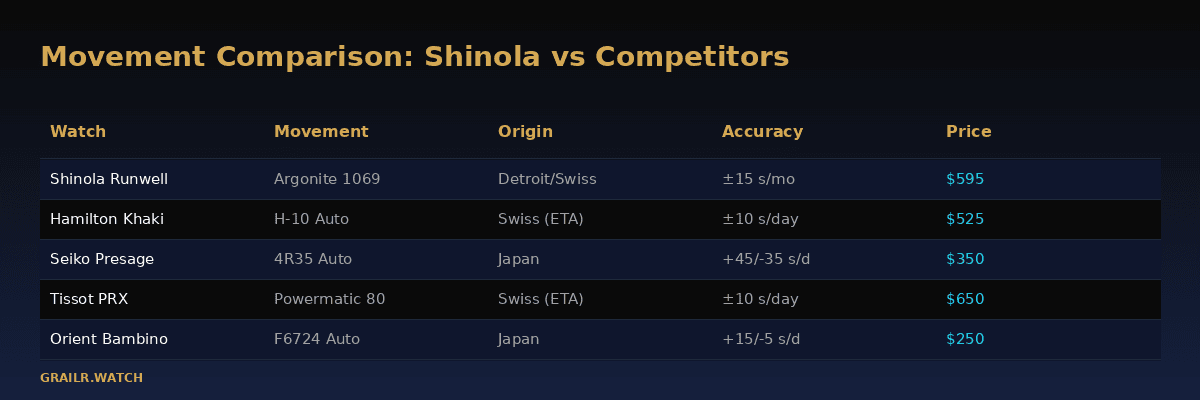
The movement is where Shinola’s story gets interesting — and where most enthusiast criticism lands. The quartz Argonite 1069 is not a ground-up proprietary caliber. Shinola licenses Swiss quartz modules from Ronda (primarily the Ronda 762 or 763 base) and then hand-assembles a bridge plate, additional jewels, and the rotor housing in Detroit to produce a finished movement carrying the Argonite name. The result is a reliable quartz movement with a battery life of roughly three to four years, accurate to approximately ±15 seconds per month.
The Runwell Automatic takes a different path entirely. Rather than extending the Argonite platform, Shinola sources the Sellita SW260-1, a Swiss automatic movement with 26 jewels, a 28,800 vph beat rate, and a 38-hour power reserve. Sellita movements are widely used by mid-range Swiss brands, and the SW260-1 is a well-proven workhorse. Accuracy is typically within ±10 seconds per day out of the box, which is standard for this tier of automatic movement.
Across the entire Runwell family, case construction follows a consistent formula: polished stainless steel with a 10.1mm thickness on the 41mm case, a double-domed sapphire crystal with anti-reflective coating, and 5 ATM (50 metres) of water resistance. That water-resistance rating is adequate for rain, hand washing, and brief swimming, but this is not a dive watch. The sapphire crystal is a genuine differentiator at this price — many competitors below $600 use hardened mineral glass instead. You can review the full Runwell specifications on Shinola’s official collection page.
| Model | Movement | Size | Water Res. | Crystal |
|---|---|---|---|---|
| Runwell 3-Hand | Argonite 1069 (quartz) | 41mm / 47mm | 50m | Sapphire |
| Runwell Automatic | Sellita SW260-1 (auto) | 39.5mm | 50m | Sapphire |
| Runwell Chrono | Argonite 5021 (quartz) | 41mm / 47mm | 50m | Sapphire |
| Runwell Sport | Argonite 1069 (quartz) | 48mm | 100m | Sapphire |
| Runwell Moon Phase | Argonite (quartz) | 41mm | 50m | Sapphire |
All models use polished stainless-steel cases. Finish options include natural steel, gold PVD, rose gold PVD, gunmetal PVD, and khaki PVD. Case thickness is 10.1mm on the 41mm models.
Pricing: New vs Pre-Owned
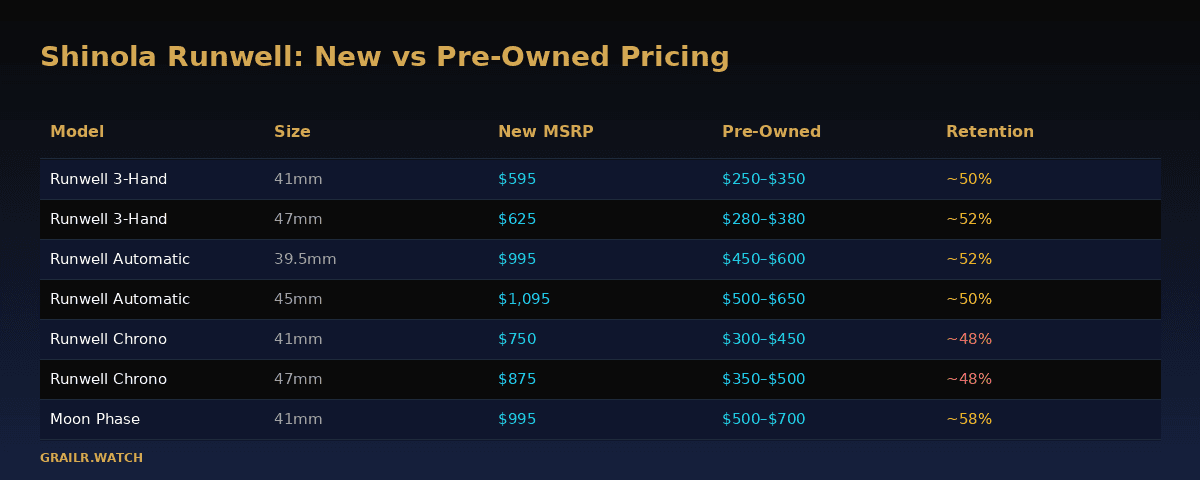
Shinola’s retail pricing positions the Runwell above fashion-watch territory but below the entry level of traditional Swiss brands. A basic three-hand quartz Runwell starts at roughly $550 and climbs to about $650 for larger sizes or premium strap options. The automatic jumps to $995–$1,095, and the chronograph sits in between at $750–$875. PVD-coated cases and limited editions can push individual references slightly higher, but the range stays below $1,200 across the board.
The pre-owned market tells a different story. Because Shinola’s brand positioning leans closer to lifestyle than horological heritage, secondary-market demand is softer than it is for Swiss competitors at comparable retail prices. A used Runwell three-hand in good condition typically sells for $200–$350 on platforms like eBay, Chrono24, and WatchPatrol. Automatic models hold slightly better, trading at roughly $450–$600 pre-owned. That said, budget-conscious buyers can find exceptional deals on barely-worn Runwell examples that a first owner bought on impulse and wore only a handful of times.
If you are buying new, Shinola offers frequent seasonal promotions and outlet pricing at its factory stores. Authorized third-party retailers occasionally discount discontinued colourways by 15–25%. Patience can save a meaningful amount on a brand that does not enforce strict minimum-advertised-price policies the way Swiss brands typically do.
| Model | New (Retail) | Pre-Owned | Retention |
|---|---|---|---|
| Runwell 41mm (quartz) | $550–$595 | $200–$350 | ~45% |
| Runwell 47mm (quartz) | $600–$650 | $225–$350 | ~42% |
| Runwell Automatic | $995–$1,095 | $450–$600 | ~50% |
| Runwell Chrono 41mm | $750–$825 | $300–$400 | ~45% |
| Runwell Chrono 47mm | $800–$875 | $300–$425 | ~43% |
All prices are indicative asking prices as of the original publication date, not verified completed sales. Verify independently before buying or selling.
Check Any Watch Price — Instantly
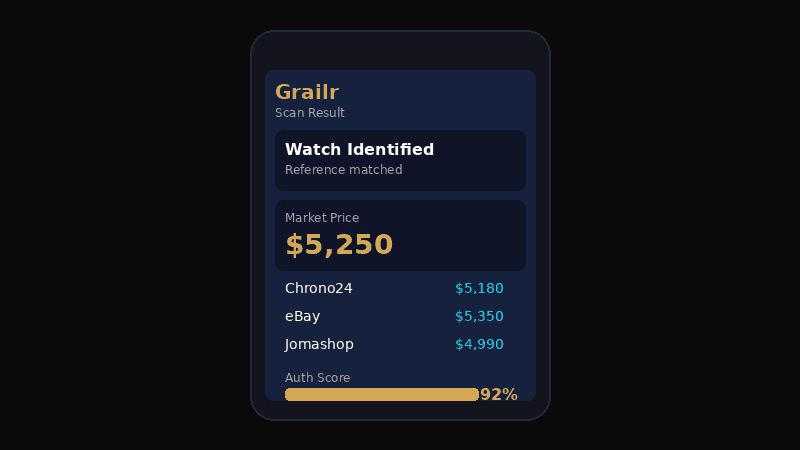
Grailr uses a photo to suggest a watch identity and an indicative price estimate, with active eBay listings where available. Check the exact reference and condition independently; a photo scan cannot authenticate a watch.
- Instant model identification
- Active eBay listings where available
- Authentication confidence scoring
Value Retention and Resale Reality
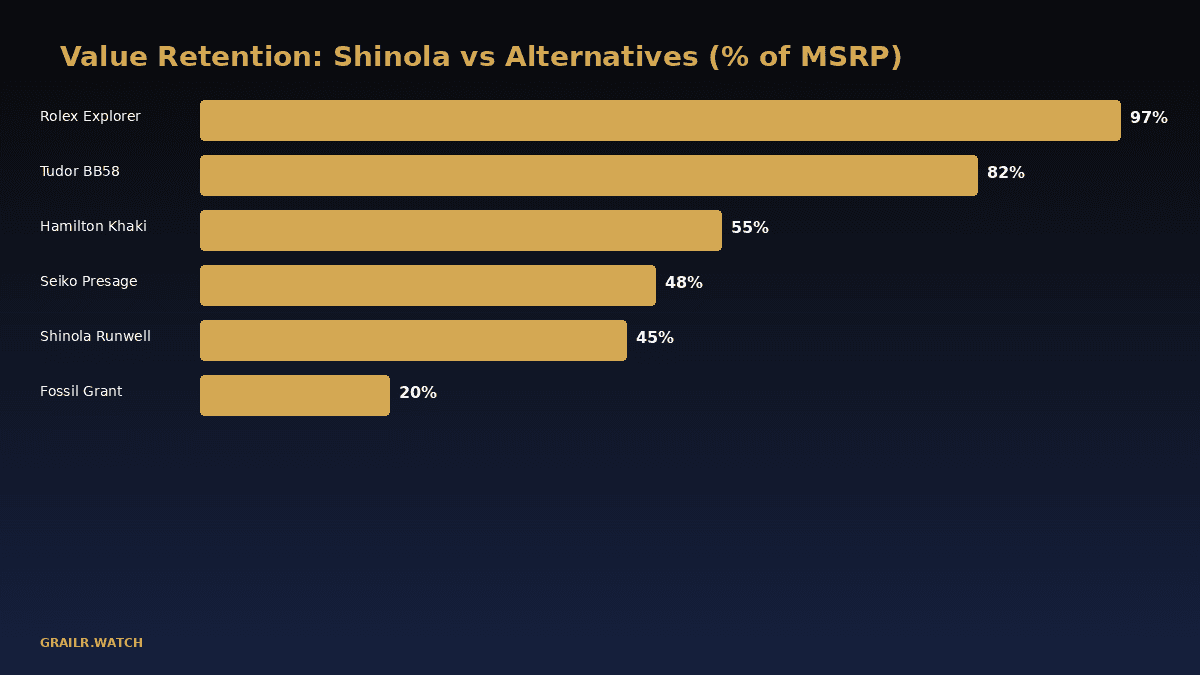
This is where candour matters more than marketing. Shinola Runwell watches typically retain roughly 40–55% of their retail price on the secondary market, with the automatic models at the higher end of that range and the larger-cased quartz models at the lower end. That places Shinola’s resale performance below most Swiss brands at comparable price points: a Hamilton Khaki Field automatic at a similar retail price often retains 55–70% of its value, and a Tissot PRX Powermatic 80 does even better in the current market.
The reasons are structural, not quality-related. Shinola’s brand identity is anchored in lifestyle and heritage storytelling rather than horological pedigree. Watch collectors who drive secondary-market demand tend to value Swiss-made automatic movements, in-house calibers, and brand histories measured in decades or centuries — not years. A quartz movement, regardless of how carefully it is assembled, does not generate the same collector interest as a Swiss automatic. That is a market reality, not a quality judgment.
There is also a supply factor. Shinola produces watches in higher volumes than most Swiss competitors in this price range and distributes through its own retail stores, Nordstrom, and numerous authorized dealers. High availability at retail suppresses pre-owned pricing because there is no scarcity premium. If a buyer can walk into a Shinola store and buy a new Runwell any day of the week, there is little incentive to pay near-retail on the secondary market.
None of this means a Runwell is a poor purchase. It means you should buy one because you want to wear it, not because you expect to recover your investment. If resale value is a primary decision factor, a Swiss automatic under $1,000 will likely serve you better on that dimension. If you value the design, the Detroit story, and the wearing experience, the Runwell delivers something those Swiss brands do not.
How to Buy a Shinola Runwell
Unlike Swiss luxury brands with tightly controlled distribution networks, Shinola makes its watches broadly accessible through multiple retail channels. That availability is both a convenience and a reason to shop carefully — pricing and experience vary meaningfully across channels.
Shinola Retail Stores
The best way to experience the brand. Shinola operates flagship stores in Detroit, New York, Chicago, Los Angeles, and several other US cities. Staff members can walk you through the full collection, let you try different sizes and strap options, and handle warranty service. Pricing is at full retail, but seasonal promotions do appear.
Shinola.com
The full current collection is available online with free shipping and a generous return window. The website also offers factory-reconditioned models at reduced prices — these are returned or display watches that Shinola refurbishes to like-new condition. If you are comfortable buying a watch sight-unseen, the online store is efficient and reliable.
Authorized Third-Party Retailers
Nordstrom, select department stores, and independent watch shops carry Runwell models. Third-party retailers occasionally discount discontinued colourways or outgoing references by 15–25%, which can make a Runwell substantially more affordable than buying direct. Confirm the model is current and carries a manufacturer warranty before buying.
Pre-Owned Sources
eBay, Chrono24, and WatchPatrol are the most active secondary markets for Shinola. Prices are typically 45–60% below retail for quartz models in good condition. Check that the sapphire crystal is intact, the crown pulls and pushes smoothly, and the caseback serial number matches the warranty card if one is included. Use Grailr’s free scanner to confirm the model identity and get a current market estimate before committing to a pre-owned deal.
Alternatives Worth Considering
Shinola occupies a unique position, but several Swiss and Japanese brands offer competitive options at overlapping price points. If pure horological value matters more than the Detroit narrative, these alternatives deserve a look. If you are building a broader shortlist, our guide to the best affordable watches covers the full landscape.
Hamilton Khaki Field
$495–$745
Swiss-made automatic (H-10 movement) with an 80-hour power reserve. Stronger resale value and deeper horological heritage than Shinola. The Khaki Field is the closest direct competitor for buyers weighing a Runwell Automatic.
Tissot PRX Powermatic 80
$650–$695
Swiss automatic with an 80-hour power reserve and integrated bracelet design. The PRX has become one of the most popular watches in this price range thanks to its retro aesthetics and excellent value proposition.
Seiko Presage
$350–$525
Japanese automatic with Seiko’s in-house 4R or 6R movement. Renowned for exceptional dial finishing at aggressive prices. Offers better movement pedigree than a Runwell quartz at a lower retail cost.
Orient Bambino
$200–$350
A dress automatic with an in-house Orient caliber at a fraction of the Runwell’s price. Lacks the brand cachet and sapphire crystal of a Shinola, but delivers a genuine mechanical watch experience for under $300.
Frequently Asked Questions
Are Shinola watches made in America?
Shinola watches are assembled in Detroit, Michigan, using a mix of Swiss-sourced and globally sourced components. The quartz Argonite movements are hand-assembled in-house from Swiss parts, but the watches are not fully American-made. The correct label is 'Built in Detroit,' not 'Made in the USA.'
How much does a Shinola Runwell cost?
New Runwell prices range from roughly $550 for a three-hand quartz to about $1,095 for the automatic. Chronograph models sit around $750 to $875. Pre-owned examples typically sell for $200 to $500 depending on model and condition.
Does the Shinola Runwell hold its value?
Not especially well. Shinola Runwell watches typically retain around 40 to 55 percent of their retail price on the secondary market. The brand's fashion-adjacent positioning and quartz movements make resale returns lower than traditional Swiss watchmakers at similar price points.
What movement is in the Shinola Runwell?
The standard three-hand Runwell uses the Argonite 1069, a quartz movement hand-assembled in Detroit from 46 Swiss-sourced parts. The Runwell Automatic uses a Sellita SW260-1, and the Runwell Chronograph uses the Argonite 5021 quartz chronograph movement.
Is Shinola a luxury watch brand?
Shinola occupies a space between fashion watches and entry-level luxury. Its pricing sits above mainstream fashion brands but below Swiss watchmakers like Hamilton, Tissot, and Longines. Most watch enthusiasts classify Shinola as an accessible lifestyle brand rather than a traditional luxury watchmaker.
Should I buy a Shinola Runwell or a Hamilton Khaki Field?
If horological value is the priority, the Hamilton Khaki Field offers a Swiss-made automatic movement with stronger resale value at a similar or lower price. If the Detroit heritage story and distinctive American design matter more to you, the Runwell delivers something no Swiss brand can replicate.
Related Articles
The Bottom Line
The Shinola Runwell is not a watch you buy for investment returns or collector credibility. It is a watch you buy because you believe in what it represents — a genuine manufacturing commitment in a city that needed one, wrapped in a design that is clean, confident, and distinctly American. The Argonite movements will never impress a Swiss-movement purist, and the resale numbers are honest about where Shinola sits in the broader market hierarchy.
If you want the strongest horological value per dollar, a Hamilton Khaki Field or Tissot PRX will serve you better on paper. But if the Detroit story resonates, if you appreciate the retail experience Shinola has built, and if you intend to wear your watch rather than flip it, a Runwell is a genuinely well-made timepiece that delivers exactly what it promises. Try one on at a Shinola store, check the current pricing, and decide with your wrist rather than a spreadsheet.
Considering a Shinola?
Grailr uses a photo to suggest a watch identity and an indicative price estimate, with active eBay listings where available. Check the exact reference and condition independently; a photo scan cannot authenticate a watch.
Scan a Watch NowSources and price context
- Shinola Runwell collection page — Lists current models, dial options, case specifications, and retail pricing for the full Runwell family.
- Caliber Corner: Sellita SW260-1 — Independent technical reference for the automatic movement used in the Runwell Automatic, including beat rate, jewel count, and power reserve.
These primary sources support the specific specification and movement details noted above. Prices and resale percentages elsewhere in this guide are indicative editorial figures, not a verified transaction dataset or guaranteed returns. Confirm the exact reference, condition, and current quote before buying; asking prices are not completed-sale prices.