Timex Atelier: Every Model, Spec and Price
How Timex quietly built a Swiss-made collection that competes with Hamilton, Tissot and Oris — and what every reference actually costs in 2026.
Price context: this guide includes indicative prices from its original publication period. They have not all been refreshed to current quotes. Use the linked primary sources for specifications and policies, and verify prices independently.
- Timex Atelier is a standalone Swiss-made sub-brand with enamel dials, ceramic bezels and sapphire crystals from $700 to $2,250
- The Marine M1A diver ($950) uses the Catena SA 100 automatic with 200m water resistance and a skeletonised case
- The M1A Ti chronograph ($2,100) adds a titanium case with a Swiss automatic chronograph movement
- Sold exclusively through the Timex Atelier online boutique — not available at regular Timex stockists
What Is Timex Atelier?
Timex Atelier launched in late 2025 as something nobody expected: a Swiss-made premium line from the brand most people associate with Indiglo and $40 Weekenders. Designed by Giorgio Galli — the same designer behind Timex’s Giorgio Galli S1 — the Atelier collection sits in a completely different market tier. Every watch uses a Swiss movement, sapphire crystal, ceramic bezel components and finishing details like polished enamel dials.
The collection debuted with a single model, the Marine M1A diver, and expanded in June 2026 with two chronographs: the titanium M1A Ti automatic and the steel M1Q quartz. As of November 2026, the lineup spans six references across three model families, priced from $700 to $2,250.
The crucial detail: Timex Atelier watches are sold exclusively through the Timex Atelier online boutique. They are not on Amazon, not in department stores, and not in regular Timex stockists. This direct-to-consumer model keeps prices lower than traditional Swiss distribution would allow, but it means you cannot try one on in a shop before buying.
Marine M1A Diver: The One That Started It
The Marine M1A is where Timex Atelier made its case. At $950 on rubber and $1,050 on bracelet, it arrives with specifications that would be unremarkable at $2,000 and genuinely surprising under $1,000: a polished enamel dial, a double-curved sapphire crystal with triple-layer anti-reflective coating, a unidirectional ceramic bezel with lumed numerals and a sapphire exhibition caseback.
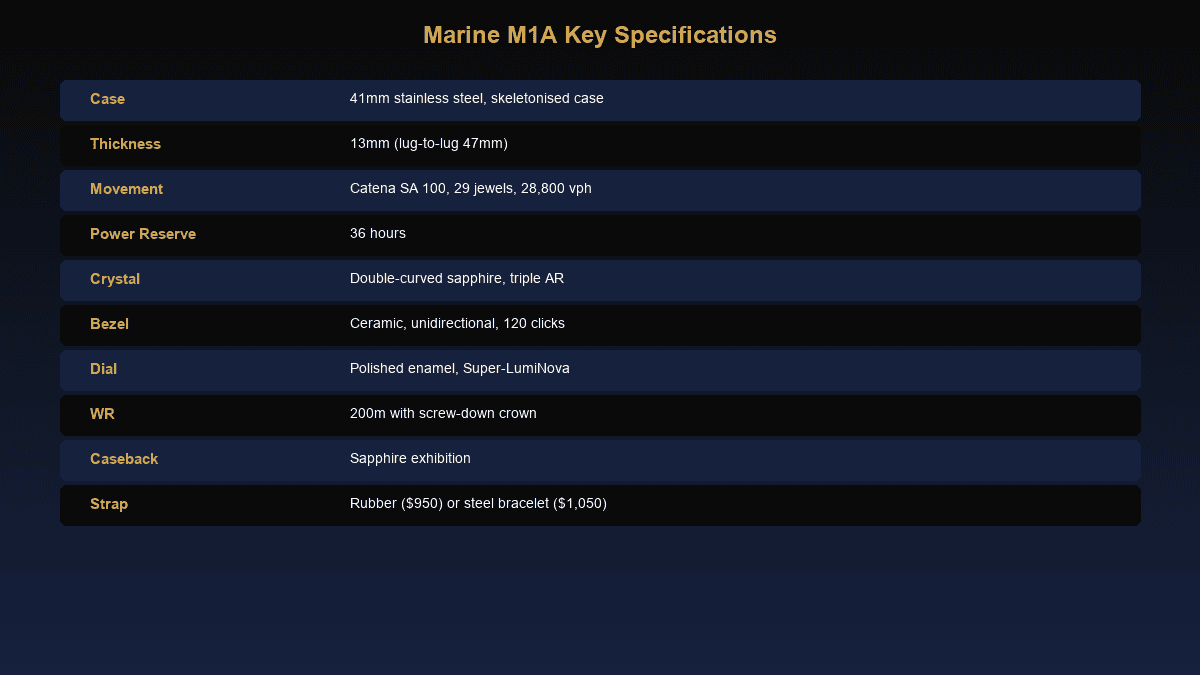
The case is 41mm by the official measurement, though independent reviewers have measured the bezel-less diameter at closer to 39.7mm. Lug-to-lug is 47mm and thickness is 13mm — wearable on most wrists, if not slim. The skeletonised case design, with cut-away lugs that expose the movement from certain angles, gives the M1A a visual identity that no other watch at this price shares.
Water resistance is rated at 200 metres with a screw-down crown at three o’clock, meeting ISO 6425 dive-watch requirements for recreational use. The bezel offers 120 clicks of rotation with a satisfying action that reviewers have compared favourably to watches costing three times the price.
The Movement Question
Inside sits the Catena SA 100, a Swiss automatic calibre running at 28,800 vibrations per hour with 29 jewels. It offers hacking seconds and hand-winding. The power reserve, however, is just 36 hours — noticeably shorter than the 70–80 hours offered by competitors like the Seiko Prospex SPB143 or the Hamilton Khaki Field (H-10 at 80 hours).
Catena is a smaller Swiss movement manufacturer that also supplies brands like Delma and Alpina. The calibre is competent and Swiss-certified, but it does not have the decades-long service track record of an ETA 2824 or Sellita SW200. For most buyers, this will not matter during normal use. For collectors who keep watches for 20 years and expect easy servicing, the relative obscurity of the movement is worth considering.
Chronograph M1A Ti and M1Q
In June 2026, Timex Atelier expanded the collection with two chronographs that bracket the original Marine M1A in price. Both carry the same design DNA — skeletonised cases, enamel-dial finishing, ceramic bezel accents — but target different buyers.
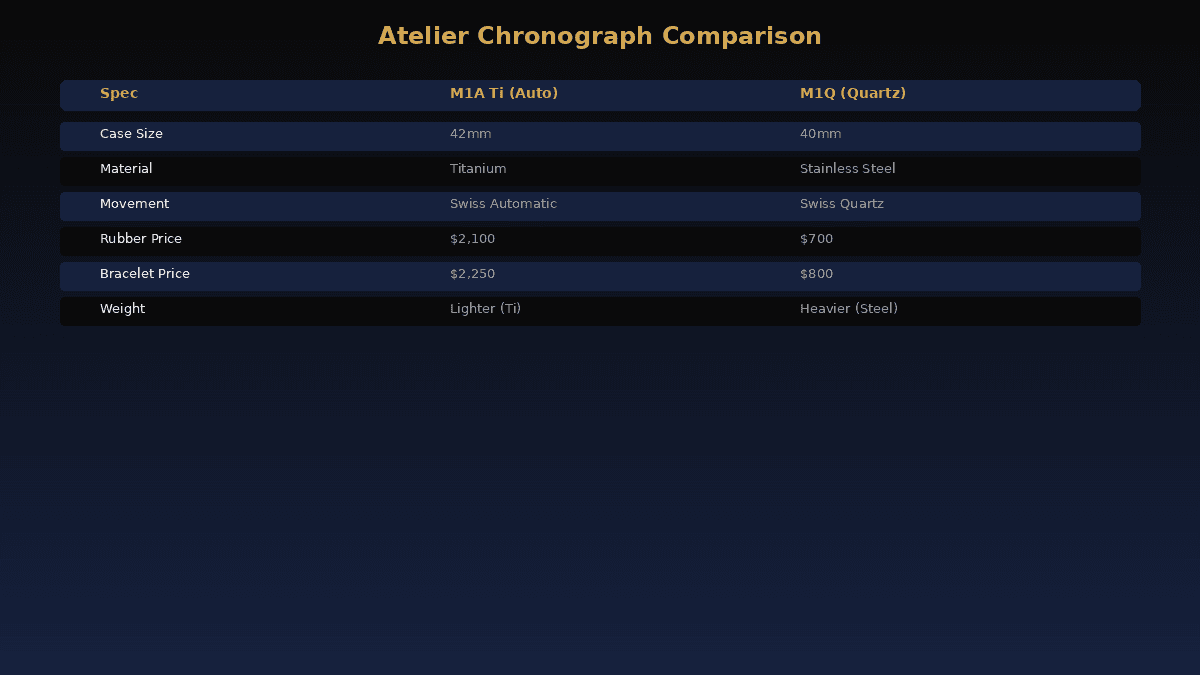
Chronograph Automatic M1A Ti ($2,100–$2,250)
The flagship of the collection. A 42mm titanium case with a Swiss automatic chronograph movement positions the M1A Ti as Timex’s answer to the Tissot PRX Chronograph and Hamilton Intra-Matic Chronograph. At $2,100 on rubber or $2,250 on the titanium bracelet, it undercuts most Swiss automatic chronographs while using lightweight grade-5 titanium.
The titanium case delivers a noticeable weight reduction compared to steel. Paired with the skeletonised lug design, the M1A Ti wears lighter than its 42mm diameter suggests. The chronograph pushers have a crisp, well-defined action, and the sub-dials maintain legibility against the enamel base.
Chronograph Quartz M1Q ($700–$800)
The entry point. A 40mm stainless steel case with a Swiss quartz chronograph movement at $700 on rubber or $800 on the steel bracelet. The M1Q delivers the Atelier’s design language — enamel dial, ceramic accents, sapphire crystal — at a price that competes directly with mainstream Swiss quartz models from watches under $1,000.
The quartz movement eliminates the power-reserve and servicing considerations of the automatic models. For buyers who want the Atelier aesthetic without the automatic-watch commitment, the M1Q is the rational choice. The smaller 40mm case also suits wrists that find the 42mm M1A Ti too large.
Full Lineup: Every Reference and Price
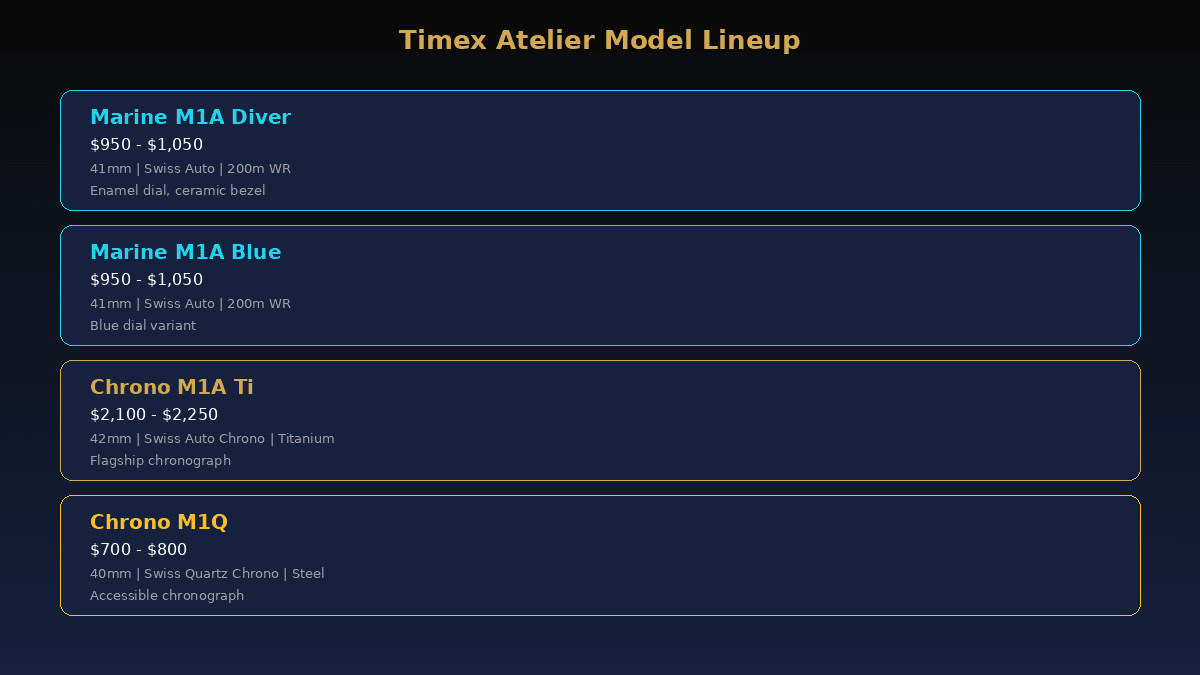
| Model | Case | Movement | Rubber | Bracelet |
|---|---|---|---|---|
| Marine M1A (Black) | 41mm Steel | Catena SA 100 Auto | $950 | $1,050 |
| Marine M1A (Blue) | 41mm Steel | Catena SA 100 Auto | $950 | $1,050 |
| Chrono M1Q | 40mm Steel | Swiss Quartz Chrono | $700 | $800 |
| Chrono M1A Ti | 42mm Titanium | Swiss Auto Chrono | $2,100 | $2,250 |
All models share the same design language: skeletonised lugs, enamel dials, sapphire crystals and ceramic bezel elements. The bracelet versions all include Timex’s I-Size tool-free link-removal system, which makes sizing adjustments straightforward without a trip to a jeweller.
Timex Atelier vs the Competition
The Atelier occupies a narrow gap between affordable Swiss brands and entry-level luxury. Here is how each model stacks up against its most direct competitor. Prices are approximate retail as of November 2026; check the manufacturer or an affordable-watch buying guide for the latest figures.
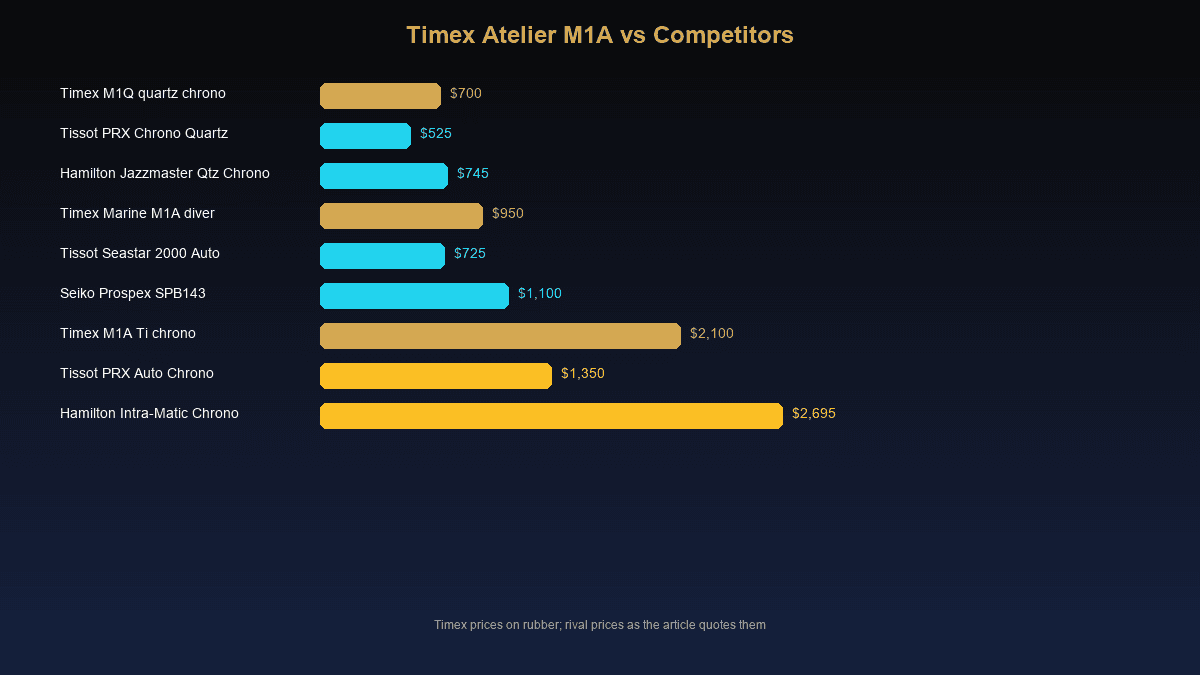
| Category | Timex Atelier | Closest Rival | Rival Price |
|---|---|---|---|
| Diver (auto) | Marine M1A — $950 | Tissot Seastar 2000 Auto | ~$725 |
| Diver (auto) | Marine M1A — $950 | Seiko Prospex SPB143 | ~$1,100 |
| Chrono (auto) | M1A Ti — $2,100 | Hamilton Intra-Matic Chrono | ~$2,695 |
| Chrono (auto) | M1A Ti — $2,100 | Tissot PRX Auto Chrono | ~$1,350 |
| Chrono (quartz) | M1Q — $700 | Tissot PRX Chrono Quartz | ~$525 |
| Chrono (quartz) | M1Q — $700 | Hamilton Jazzmaster Quartz Chrono | ~$745 |
The pattern is clear: Timex Atelier trades brand recognition and service-network depth for finishing that punches above its price. The enamel dials, ceramic bezels and skeletonised case details are genuinely unusual under $1,000. What you give up is the decades-long movement heritage of an ETA or Sellita, the resale liquidity of a Hamilton or Tissot, and the ability to walk into a shop and try one on. For a deeper look at how these compare, see Monochrome’s M1A Ti review.
Buying Advice: Which Atelier to Choose
Best Value Entry
Chronograph M1Q on rubber — $700
The full Atelier design language at its lowest price. Swiss quartz means no servicing headaches and no weekend power-reserve anxiety. The 40mm case suits a wide range of wrist sizes.
Best All-Rounder
Marine M1A on bracelet — $1,050
The watch that proved the concept. A genuine 200m diver with Swiss automatic movement, enamel dial and ceramic bezel for just over $1,000. The bracelet with I-Size quick-adjust is worth the $100 premium. If you’re after a capable dive watch with distinctive finishing, this is the one.
Best for Enthusiasts
Chronograph M1A Ti on titanium — $2,250
The halo piece. A Swiss automatic chronograph in a titanium case is rare at any price, let alone $2,250. This is for the buyer who has already owned a Hamilton or Tissot and wants something less common. Use Grailr’s scanner to compare market pricing if you spot one on the secondary market.
What to Watch Out For
1. Power Reserve
The Catena SA 100’s 36-hour reserve is the collection’s weakest spec. If you take the watch off Friday evening and pick it up Monday morning, it will have stopped. Competitors from Seiko, Hamilton and Tudor all offer 60–80 hours in this price range.
2. Servicing Access
Catena movements are not as widely supported by independent watchmakers as ETA or Sellita. For routine servicing this is unlikely to be a problem, but if you need parts in ten years, the supply chain may be thinner than for more established calibres.
3. Try-Before-You-Buy
Direct-to-consumer only means no trying on first. Pay attention to the lug-to-lug dimensions: the Marine M1A at 47mm wears larger than its 41mm diameter suggests, and the M1A Ti at 42mm pushes the comfortable limit for wrists under 7 inches. Check Timex Atelier’s return policy before ordering.
4. Resale Value
Timex Atelier is too new to have reliable resale data. The brand lacks the secondary-market recognition of Hamilton or Tissot, so expect a steeper depreciation curve if you sell within the first year. Buy to wear, not to flip.
Frequently Asked Questions
Is Timex Atelier the same as regular Timex?
No. Timex Atelier is a separate premium sub-brand that uses Swiss-made movements, sapphire crystals and ceramic bezels. Standard Timex watches use Japanese quartz or Miyota movements and mineral crystals. The two share the Timex parent company but differ in materials, manufacturing location and price tier.
What movement does the Timex Atelier Marine M1A use?
The Marine M1A uses the Catena SA 100, a Swiss automatic calibre running at 28,800 vph with 29 jewels, hacking seconds and hand-winding. Power reserve is 36 hours.
How much does the Timex Atelier cost?
The Atelier range starts at $700 for the M1Q quartz chronograph on rubber and tops out at $2,250 for the M1A Ti automatic chronograph on titanium bracelet. The original Marine M1A diver sits at $950 on rubber or $1,050 on bracelet.
Where can I buy a Timex Atelier watch?
Timex Atelier watches are sold exclusively through the Timex Atelier online boutique at timexatelier.com. They are not available through regular Timex retailers, Amazon or department stores.
Is the Marine M1A a good dive watch?
It meets the practical requirements: 200m water resistance, a screw-down crown, unidirectional ceramic bezel and Super-LumiNova. For recreational diving it is capable. However, the 36-hour power reserve is shorter than competitors like the Seiko SPB143 (70 hours) or Tudor Black Bay 58 (70 hours).
How does Timex Atelier compare to Hamilton and Tissot?
At $950 to $2,250, the Atelier overlaps with Hamilton ($500 to $2,500) and Tissot ($300 to $1,350). The Atelier wins on finishing details like enamel dials and ceramic bezels at its price point. Hamilton and Tissot offer more proven movements and wider service networks.
Related Articles
The Bottom Line
Timex Atelier is doing something genuinely interesting: delivering Swiss finishing details — enamel dials, ceramic bezels, sapphire crystals, skeletonised cases — at prices that undercut established brands by 20–40%. The Marine M1A at $950 is the standout value, offering a complete dive-watch package that most competitors only match at $1,200 or above. The trade-offs are real (short power reserve, unproven long-term track record, online-only sales), but for a buyer who values design execution over brand heritage, the Atelier is the most interesting thing to happen in this price bracket in years. Use Grailr’s identification tool to verify any model you spot on the secondary market.
Sources and price context
- Timex Atelier official boutique — Current pricing, specifications and availability for all Atelier models.
- Monochrome Watches: M1A Ti review — Independent review of the titanium chronograph with movement analysis and value assessment.
These primary sources support the specific specification and pricing points noted above. Prices elsewhere in this guide are indicative editorial figures, not a verified transaction dataset. Confirm the exact reference and current quote before buying.