Tudor Ranger Buying Guide: 36mm vs 39mm Compared
Everything you need to know about the Tudor Ranger — two sizes, in-house movements, field-watch heritage, and how it measures up against the Black Bay and Rolex Explorer.
Price context: this guide includes indicative prices from its original publication period. They have not all been refreshed to current quotes. Use the linked primary sources for specifications and policies, and verify prices independently.
- The Tudor Ranger comes in 36mm (ref 79930) and 39mm (ref 79950), both with COSC-certified in-house movements and 70-hour power reserve
- Retail pricing runs $3,550–$4,025 depending on size and bracelet/strap — roughly half the price of the Rolex Explorer
- Pre-owned values hold at 95–105% of retail, making it one of the stronger resale performers under $5,000
- Launched in 2022 to commemorate the 70th anniversary of the British North Greenland Expedition, reviving Tudor’s original 1960s Ranger name
What Is the Tudor Ranger?
The Tudor Ranger is a modern field watch that revives one of the brand’s most storied names. Tudor first used the “Ranger” designation in the 1960s for a line of rugged, legible watches built for military and expeditionary use. The current generation, launched in 2022 at Watches & Wonders, celebrates the 70th anniversary of the British North Greenland Expedition — the 1952 scientific and military operation that put Tudor watches on the wrists of Royal Navy personnel in some of the harshest conditions on Earth.
Where the Black Bay is Tudor’s dive watch and the Pelagos is its titanium tool watch, the Ranger occupies the field-watch niche: no rotating bezel, no date complication, just a time-only dial with bold Arabic numerals at 3, 6, 9, and 12. It is the Tudor you wear when you want something lighter, simpler, and more understated than a diver — but with the same in-house movement quality Tudor is known for.
The design DNA is immediately recognizable. A satin-brushed steel case, a matte domed dial, prominent Arabic hour markers with luminous fill, and a screw-down crown rated to 100 metres of water resistance. It borrows nothing from the Black Bay’s “snowflake” handset — instead it uses simple, pencil-shaped hour and minute hands with a red-tipped seconds hand, giving it a distinct personality within the Tudor lineup.
36mm vs 39mm: Which Size?
Tudor offers the Ranger in two case diameters, and the choice between them is the single most important decision you’ll make. The 36mm (ref 79930) is the historically correct size — vintage Ranger models from the 1960s sat in 34–36mm territory, and a 36mm case on a modern lug design wears cleanly on wrists from about 6” to 7.25”. It suits a dressy-casual aesthetic and slides under a shirt cuff without protest.
The 39mm (ref 79950) is the more contemporary option. An extra three millimetres of case diameter translates to noticeably more wrist presence, a marginally larger dial, and slightly wider lug-to-lug. If you tend toward sport watches, wear a Black Bay 41 comfortably, or simply prefer a more modern look, the 39mm will feel right. It is still moderate by today’s standards — well below the 41–44mm territory that most sport watches occupy.
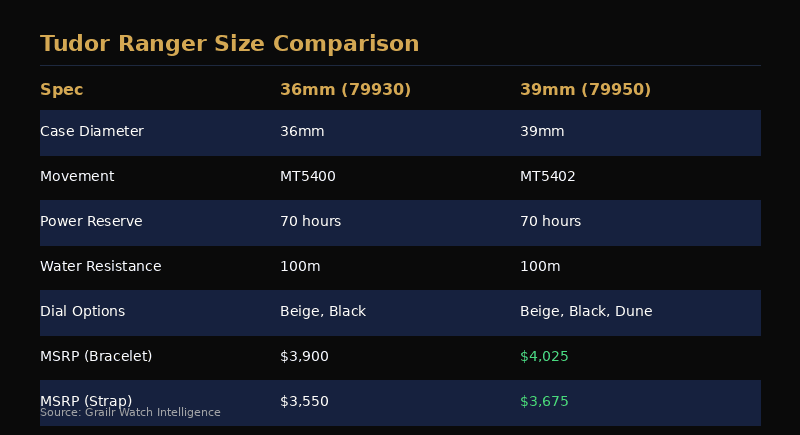
Illustration: Tudor Ranger 36mm vs 39mm size comparison
In terms of dial options, the 36mm comes in black or beige (sometimes called champagne). The 39mm adds a third option: the “Dune” white dial, a warm, silvery tone that has become a fan favourite since launch. Both sizes are available on either a riveted steel bracelet or a fabric strap with a folding clasp.
A practical consideration: lug width is 19mm on the 36mm and 20mm on the 39mm. The 20mm width opens up a wider aftermarket strap selection, though Tudor’s own options — particularly the jacquard fabric strap — are among the best OEM straps available at any price.
Full Specifications and Pricing
Both Ranger models share the fundamentals — 100m water resistance, COSC chronometer certification, and a 70-hour power reserve — but differ in calibre, case dimensions, and available dials. The table below lays out every specification that matters.
| Specification | Ranger 36mm (79930) | Ranger 39mm (79950) |
|---|---|---|
| Case diameter | 36mm | 39mm |
| Case material | Satin-brushed steel | Satin-brushed steel |
| Movement | MT5400 | MT5402 |
| Power reserve | 70 hours | 70 hours |
| Frequency | 28,800 vph (4 Hz) | 28,800 vph (4 Hz) |
| Certification | COSC chronometer | COSC chronometer |
| Water resistance | 100m (330 ft) | 100m (330 ft) |
| Crown | Screw-down | Screw-down |
| Lug width | 19mm | 20mm |
| Dial options | Black, Beige | Black, Beige, Dune |
| Bracelet MSRP | $3,900 | $4,025 |
| Fabric strap MSRP | $3,550 | $3,675 |
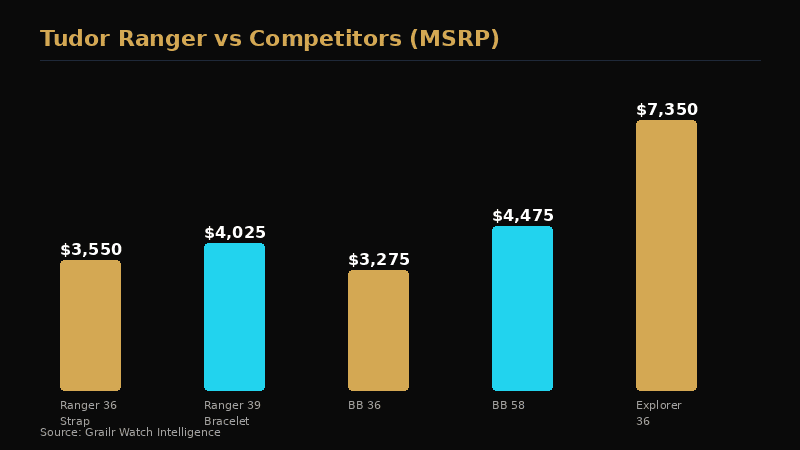
Illustration: Tudor Ranger pricing overview by size and configuration
The price gap between the two sizes is modest: roughly $125 per configuration. The larger difference is between bracelet and strap — a $350 premium for the bracelet across both sizes. Given that a Tudor bracelet is notoriously well-finished for its price segment, most buyers find the bracelet worth the extra cost, particularly for resale purposes.
Movement Deep Dive: MT5400 and MT5402
Both Ranger calibres belong to Tudor’s MT54xx family — the same in-house movement architecture found across the Black Bay and Pelagos lineups. The MT5400 (in the 36mm) and MT5402 (in the 39mm) are functionally identical: bidirectional automatic winding, COSC-certified accuracy of −4/+6 seconds per day, a 70-hour power reserve, and a variable-inertia balance wheel with silicon hairspring. The only difference is the physical dimensions of the movement, sized to fit each case diameter.
The 70-hour power reserve is a genuine practical advantage. Take the watch off on Friday evening and it will still be running on Monday morning without needing a winder or a manual wind. By comparison, most ETA-based movements in this price range offer 38–42 hours, and the Rolex Explorer’s Cal. 3230 also delivers 70 hours — at twice the price.
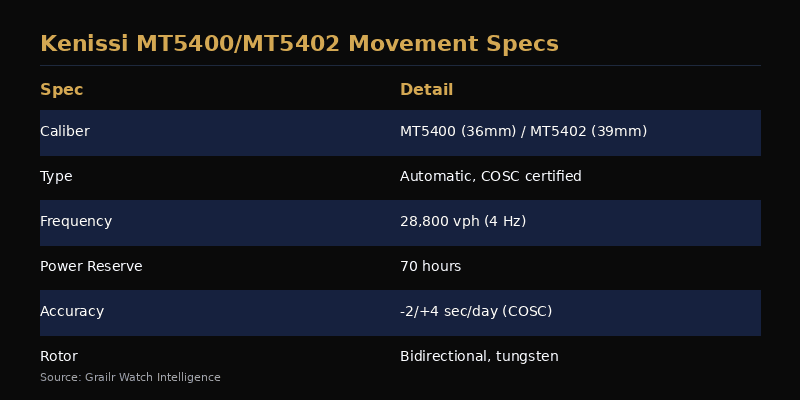
Illustration: MT5400 and MT5402 movement comparison
Tudor’s movements are assembled in-house in Le Locle, Switzerland, and carry a five-year warranty. Unlike Rolex, Tudor does not use a Parachrom hairspring or Paraflex shock absorber — instead, the silicon hairspring provides antimagnetic resistance up to about 500 gauss and excellent long-term stability. Servicing intervals are not officially published, but Tudor recommends a full service approximately every 10 years, which is generous compared to the 5–7-year intervals common among most Swiss manufacturers.
Check Any Watch Price in Seconds
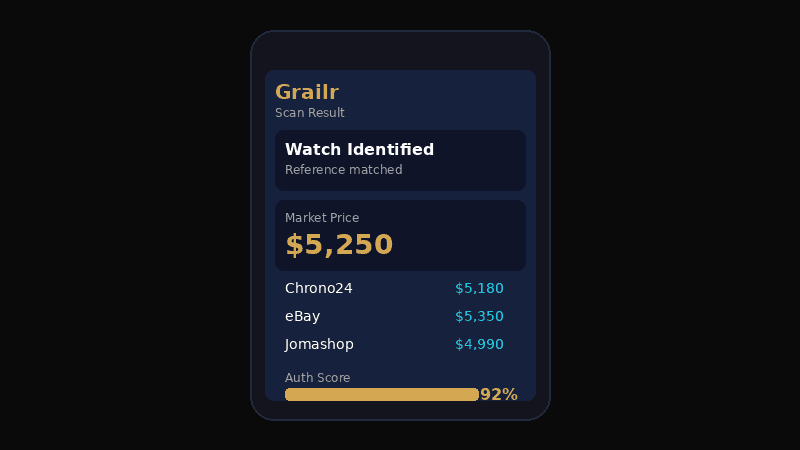
Grailr scans your watch photo and pulls live pricing from Chrono24, eBay, and Jomashop.
- AI identifies brand, model & reference number
- Live market prices from 3+ sources
- Authentication confidence score
Ranger vs Black Bay vs Rolex Explorer
The Ranger sits at an interesting intersection. Within Tudor’s own lineup, it competes with the Black Bay 36 and 41 — and externally, it draws inevitable comparisons to the Rolex Explorer, whose 3-6-9 dial layout it clearly echoes. Here is how all three stack up.
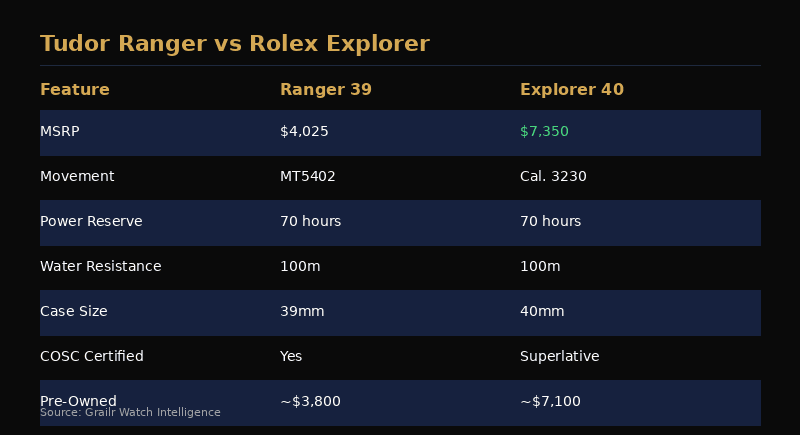
Illustration: Tudor Ranger vs Black Bay vs Rolex Explorer comparison
| Feature | Tudor Ranger 39mm | Tudor Black Bay 41 | Rolex Explorer 40 |
|---|---|---|---|
| Case size | 39mm | 41mm | 40mm |
| Movement | MT5402 (in-house) | MT5602 (in-house) | Cal. 3230 (in-house) |
| Power reserve | 70 hours | 70 hours | 70 hours |
| Water resistance | 100m | 150m | 100m |
| Retail MSRP | $3,675–$4,025 | $3,600–$3,950 | $7,350 |
| Pre-owned range | $3,700–$4,000 | $3,400–$3,800 | $6,800–$7,100 |
| Dial layout | 3-6-9-12 Arabic | Applied indices | 3-6-9 Arabic |
| Bezel | Fixed, smooth | Fixed, smooth | Fixed, smooth |
Ranger vs Black Bay
The Black Bay is a diver at heart — it has a more robust water resistance rating, a slightly larger case, and the iconic “snowflake” hands. The Ranger is a dedicated field watch: thinner, lighter on the wrist, and with a cleaner time-only dial. If you spend time outdoors and want legibility above all else, the Ranger is the better choice. If you want a one-watch collection that handles weekend dives, the Black Bay edges ahead.
Ranger vs Rolex Explorer
This is the comparison everyone makes, and the numbers tell the story. The Ranger offers a COSC-certified in-house movement with an identical 70-hour power reserve, comparable water resistance, and a nearly identical dial layout — for less than half the Explorer’s $7,350 retail price. You give up the Rolex name, the 904L Oystersteel, and the Superlative Chronometer certification (±2 sec/day vs COSC’s −4/+6). Whether those differences justify the premium is a personal calculation.
Resale Value and Market Position
The Tudor Ranger occupies a favourable position in the secondary market. Pre-owned examples with full box and papers consistently trade between $3,700 and $4,000 — which represents roughly 95–105% of retail, depending on configuration. That is strong retention for a watch in the sub-$4,000 segment, where many competitors lose 20–30% the moment they leave the authorized dealer.
Several factors underpin this stability. The Ranger launched relatively recently (2022), so the pre-owned supply is still limited. Tudor’s brand momentum, driven by its positioning as the value arm of the Rolex group, continues to strengthen. And the field-watch category itself has seen sustained interest, partly driven by the broader trend toward smaller, more versatile case sizes.
For buyers thinking about watches under $5,000 that hold value, the Ranger belongs on the shortlist alongside the Black Bay 41 and Omega Aqua Terra. Complete sets with box, papers, warranty card, and the original strap or bracelet command the highest prices. A watch sold without its box or with missing documentation can lose 10–15% compared to a full set.
One caveat: the Ranger is not an “investment watch” in the way that certain stainless-steel Rolex sport models appreciate above retail. It is a watch that holds its value well enough that you can wear it, enjoy it, and sell it later without taking a significant financial hit. That is the healthiest way to think about any watch purchase under $5,000. For a broader perspective on first luxury watch options, see our dedicated guide.
5 Tips Before You Buy a Ranger
1. Try Both Sizes In Person
Three millimetres sounds negligible on paper but feels different on the wrist. The 36mm wears like a classically sized dress watch; the 39mm has genuine sport-watch presence. If you have access to a Tudor AD, try both on your wrist before committing. Photos online tend to exaggerate the 39mm and flatten the 36mm.
2. Consider the Bracelet First
The riveted-style steel bracelet is one of the best in this price range. It adds about $350 to the price but dramatically increases wrist comfort and versatility. You can always buy a fabric or leather strap later; getting the bracelet separately from Tudor is more expensive after the fact.
3. Insist on Complete Sets
When buying pre-owned, look for the full set: outer box, inner box, warranty card, hang tag, and original strap or bracelet. A complete set with box and papers can trade 10–15% higher than a watch-only sale. The warranty card is especially important — Tudor’s transferable five-year warranty is a genuine selling point.
4. Scan Before You Pay
Use Grailr’s free scanner to photograph any listing and get a suggested identification with indicative pricing. It is not a substitute for professional authentication — always verify the reference number, serial, and condition independently — but it gives you a quick sanity check before you commit.
5. Check AD Availability First
Unlike many Rolex models, Tudor Rangers are generally available at authorized dealers without a waitlist. Visit or call your local Tudor AD before paying a grey-market premium. In many markets, you can walk in and walk out with a Ranger the same day — and you get the full five-year manufacturer warranty.
Frequently Asked Questions
Is the Tudor Ranger a good watch?
Yes. The Ranger offers a COSC-certified in-house movement with 70-hour power reserve, 100m water resistance, and satin-brushed steel finishing at $3,550–$4,025 — one of the strongest value propositions in the field-watch category.
What is the difference between the Tudor Ranger 36mm and 39mm?
The 36mm (ref 79930) uses the MT5400 movement and comes in black or beige dials. The 39mm (ref 79950) uses the MT5402 and adds a “Dune” white dial option. Both share 100m water resistance, 70-hour power reserve, and COSC certification.
How much does a Tudor Ranger cost?
The 36mm retails from $3,550 (strap) to $3,900 (bracelet). The 39mm retails from $3,675 (strap) to $4,025 (bracelet). Pre-owned examples trade at $3,700–$4,000, generally at or near retail.
Is the Tudor Ranger better than the Rolex Explorer?
The Ranger offers a comparable in-house COSC movement and 70-hour power reserve at roughly half the Explorer’s $7,350 price. You give up the Rolex name, 904L Oystersteel, and Superlative Chronometer certification. Whether those justify double the cost is a personal decision.
Does the Tudor Ranger hold its value?
Pre-owned Rangers trade at roughly 95–105% of retail, which is strong for the sub-$4,000 segment. Complete sets with box and papers perform best. The model’s 2022 launch means secondary supply is still limited.
Should I buy the Tudor Ranger on bracelet or strap?
The bracelet adds about $350 and offers more everyday versatility. The fabric strap is lighter and closer to the Ranger’s field-watch heritage. If you plan to own only one configuration, the bracelet typically holds resale value better.
Related Articles
The Bottom Line
The Tudor Ranger is one of the best-value field watches available today. An in-house COSC-certified movement, 70-hour power reserve, and 100m water resistance at $3,550–$4,025 — with pre-owned values that hold firm near retail — make it a compelling purchase whether it is your first serious watch or a field-watch complement to a diver-heavy collection. The 36mm suits classically proportioned wrists and dressy wear; the 39mm is the better everyday sport watch. Either way, you are getting genuine Swiss-made quality with expedition heritage at a price that the Rolex Explorer can only dream of matching.
Found a Tudor Ranger You Like?
Grailr uses a photo to suggest a watch identity and an indicative price estimate, with active listings where available. Check the exact reference and condition independently; a photo scan cannot authenticate a watch.
Scan a Watch NowSources and price context
- Tudor Ranger collection page — Official specifications, movement details, water resistance ratings, and current retail pricing for the Ranger 36mm and 39mm.
- Chrono24 Tudor Ranger listings — Live pre-owned asking prices and market data referenced for secondary-market price ranges in this guide.
These primary sources support the specific specification and pricing points noted above. Prices and resale percentages elsewhere in this guide are indicative editorial figures, not a verified transaction dataset or guaranteed returns. Confirm the exact reference, region, condition and current quote before buying; asking prices are not completed-sale prices.