Best Tudor Watches for Men: Every Model and Price
Black Bay, Pelagos, Ranger and 1926 — every current Tudor lineup compared with retail pricing, movement specs and real resale data for 2026.
Price context: this guide includes indicative prices from its original publication period. They have not all been refreshed to current quotes. Use the linked primary sources for specifications and policies, and verify prices independently.

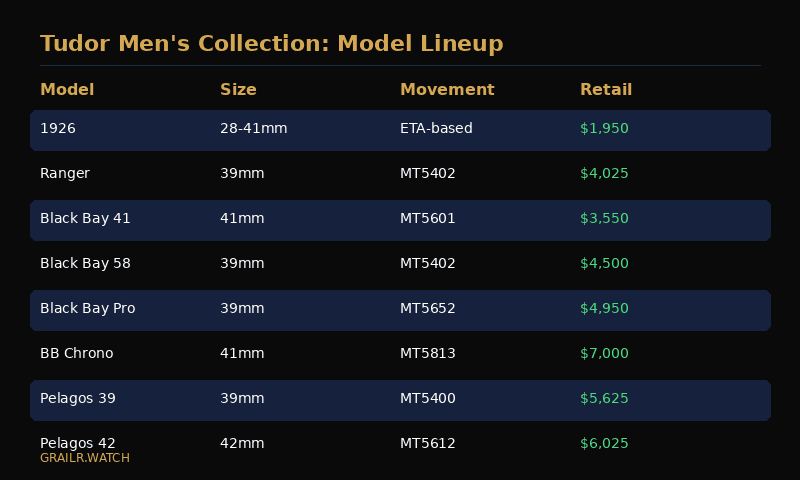
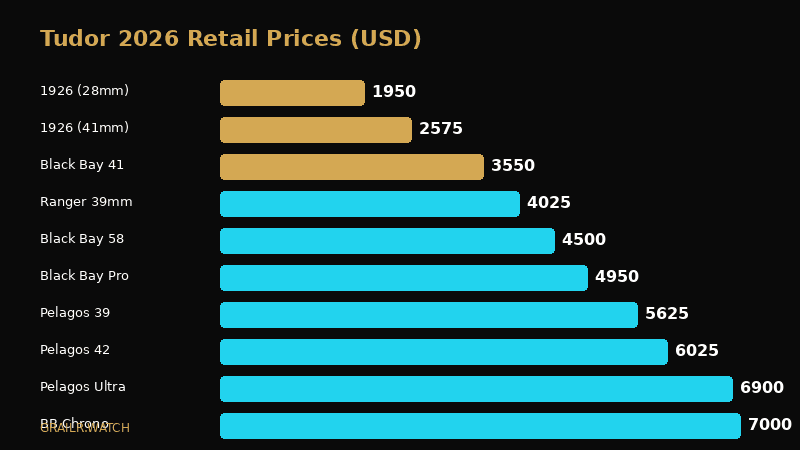
- Tudor spans $1,950 to $7,000 at retail — from the ETA-powered 1926 to the in-house Black Bay Chrono
- Every sport model above the 1926 runs an in-house caliber with a 70-hour power reserve, developed since 2015
- The Black Bay 58 is the strongest resale performer, trading near retail on the secondary market
- Most Tudor sport watches are available at authorized dealers without a waitlist, unlike comparable Rolex references
- US prices rose 4–8% in 2025–2026 due to tariff adjustments; verify current retail before buying
Why Tudor Belongs on Your Shortlist
Tudor was founded in 1926 by Hans Wilsdorf — the same man who founded Rolex — with a specific brief: deliver Rolex-grade case construction and water resistance at a price point accessible to a broader market. For decades that meant putting third-party movements inside Rolex-made cases, a strategy that kept quality high but left Tudor in its parent brand’s shadow. That changed decisively in 2015 when Tudor introduced the MT5602, its first in-house caliber, carrying a 70-hour power reserve that exceeded anything Rolex offered at the time.
Today Tudor operates as a genuinely independent design house under the Hans Wilsdorf Foundation, the same entity that owns Rolex. The two brands share case-manufacturing facilities and quality-control standards, but Tudor designs its own dials, develops its own movements through the MT5xxx family, and prices its watches at roughly 30–50% of equivalent Rolex models. That positioning — serious Swiss watchmaking without the Rolex premium or waitlist — is what draws most first-time buyers to the brand.
The current catalog breaks into four main families: Black Bay (the broadest range, covering heritage divers, GMTs, chronographs and two-tone models), Pelagos (titanium tool watches developed with military input), Ranger (a field watch in the explorer tradition), and 1926 (a dress-leaning entry line on an ETA base). Each family serves a different buyer, and the price spread across the full catalog — roughly $1,950 to $7,000 — means Tudor competes at multiple price points simultaneously.
The Black Bay Family
The Black Bay is Tudor’s flagship range and the line most buyers encounter first. It started in 2012 as a single heritage-inspired diver and has since expanded into a full family that covers time-only watches, GMTs, chronographs and two-tone precious-metal combinations. Every Black Bay above the entry models uses an in-house Tudor caliber with a 70-hour power reserve.
Black Bay 41 — $3,550
The most accessible in-house Black Bay. At 41mm with the MT5601 movement and 200m water resistance, it delivers the core Black Bay experience — domed crystal, snowflake hands, rivet-style bracelet — without the vintage-sized proportions of the 58. Available on fabric strap or steel bracelet, it is the easiest Black Bay to recommend as a first serious watch.
Black Bay 58 — $4,500–$5,350
The 58 is where Tudor’s heritage credibility and modern engineering overlap most convincingly. Named for the year of Tudor’s first dive watch, it wears at 39mm with slim proportions that fit under a shirt cuff — something the 41mm models struggle with. The MT5402 caliber inside runs at the same 70-hour reserve. On the secondary market the BB 58 is Tudor’s strongest performer, with pre-owned examples trading at or near retail in popular configurations.
Black Bay Pro — $4,950
Tudor’s GMT watch. The Pro runs the MT5652 movement with an independently adjustable hour hand for tracking a second time zone. At 39mm with 200m water resistance and a fixed black-and-gold bezel, it reads more tool-watch than travel-watch compared to the Rolex GMT-Master II it inevitably gets measured against. Pre-owned pricing sits at $3,200–$3,900, reflecting strong supply and no waitlist.
Black Bay Chrono — $7,000
The top of the steel Black Bay range. A 41mm chronograph powered by the MT5813 column-wheel movement, co-developed with Breitling. It is the most expensive non-precious-metal Tudor in the current lineup and the only Black Bay with a chronograph complication. The S&G (steel and gold) variants start from $5,375 and add a two-tone aesthetic for buyers who want something dressier.
| Model | Size | Movement | Water Resist. | Retail |
|---|---|---|---|---|
| Black Bay 41 | 41mm | MT5601 | 200m | $3,550 |
| Black Bay 58 | 39mm | MT5402 | 200m | $4,500–$5,350 |
| Black Bay S&G | 41mm | MT5612 | 200m | From $5,375 |
| Black Bay Pro | 39mm | MT5652 | 200m | $4,950 |
| Black Bay Chrono | 41mm | MT5813 | 200m | $7,000 |
The Pelagos Family
Where the Black Bay is built in steel and draws on heritage design, the Pelagos is an all-titanium tool watch developed with genuine military input. The matte titanium finish, self-adjusting clasp and purpose-built case construction set it apart from every other watch in Tudor’s catalog. Every Pelagos uses an in-house movement and all bracelet models pair a titanium head with a titanium bracelet — not a steel bracelet on a titanium case, a shortcut some competitors take.
Pelagos 39 — $5,625
Launched in 2022 as Tudor’s first METAS-certified watch. The 39mm titanium case houses the MT5400 caliber, rated to 200m of water resistance. It is meaningfully lighter on the wrist than a comparably sized steel diver and wears smaller than the original 42mm Pelagos, making it the more versatile daily option for most wrist sizes.
Pelagos 42 — $6,025
The larger, traditional Pelagos. At 42mm with the MT5612 movement, a helium escape valve and 500m water resistance, it is the closest descendant of the 2012 original. The spec sheet is aimed at saturation diving rather than recreational use, making it more watch than most buyers strictly need — but the engineering credibility is part of the appeal.
Pelagos FXD — $4,950
Developed with French Navy combat swimmer units. Fixed strap bars welded to the case prevent the strap from detaching underwater; there is no bracelet option. The MT5602 inside provides 200m water resistance and 70 hours of power reserve. It is a purpose-built instrument that happens to be sold to the public.
Pelagos Ultra — $6,900
The deepest-rated watch Tudor currently makes. At 1,000m water resistance in a titanium case, the Ultra pushes the Pelagos concept to its engineering limit. Few buyers will ever need that depth rating, but the build quality required to achieve it — case tolerances, crystal thickness, crown and caseback sealing — results in an unusually robust daily wearer for buyers who prioritize toughness above everything else.
Ranger and 1926: Tudor’s Entry Points
Not every buyer wants a dive watch or is ready to spend $5,000. Tudor’s Ranger and 1926 lines serve different entry points: the Ranger as a capable sport watch with an in-house movement, the 1926 as an affordable dress-leaning option on an ETA base.
Ranger — $4,025
Tudor’s field watch. At 39mm with the same MT5402 caliber used in the Black Bay 58, the Ranger offers 100m water resistance, a clean dial without a diving bezel, and a price that undercuts most of the Black Bay range. It sits in the explorer-watch tradition — legible, practical, understated — and appeals to buyers who find dive-watch aesthetics overdone but still want in-house Tudor engineering. On steel bracelet it lists at $4,025; on fabric strap it costs slightly less.
1926 — $1,950–$2,575
Tudor’s most affordable line and the only current range that uses a modified ETA movement rather than an in-house caliber. Available from 28mm to 41mm in a variety of dial and strap combinations, the 1926 is positioned as a dress watch or a first Swiss automatic for buyers who want the Tudor name and Rolex-adjacent build quality without crossing the $3,000 threshold. Resale is weaker than the sport models — expect 50–60% retention — but the entry price is low enough that depreciation is measured in hundreds rather than thousands.
| Model | Size | Movement | Water Resist. | Retail |
|---|---|---|---|---|
| Ranger (39mm) | 39mm | MT5402 | 100m | $4,025 |
| 1926 (28mm) | 28mm | ETA 2671 | 100m | $1,950 |
| 1926 (36mm) | 36mm | ETA 2824 | 100m | $2,175 |
| 1926 (41mm) | 41mm | ETA 2824 | 100m | $2,575 |
Check Any Watch Price in Seconds
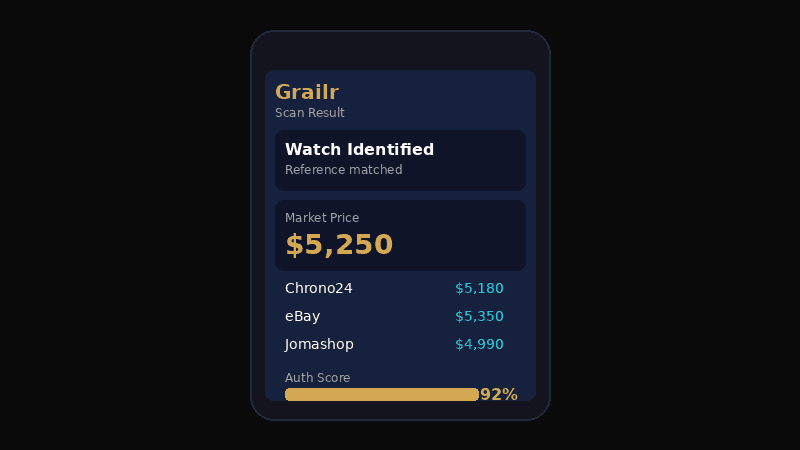
Grailr scans your watch photo and pulls live pricing from Chrono24, eBay, and Jomashop.
- AI identifies brand, model & reference number
- Live market prices from 3+ sources
- Authentication confidence score
Tudor vs Rolex: What You Get and Give Up
The comparison is inevitable because the two brands share a corporate parent, manufacturing facilities and a philosophy of over-engineering for durability. But the product experience diverges sharply once you look past the shared DNA.
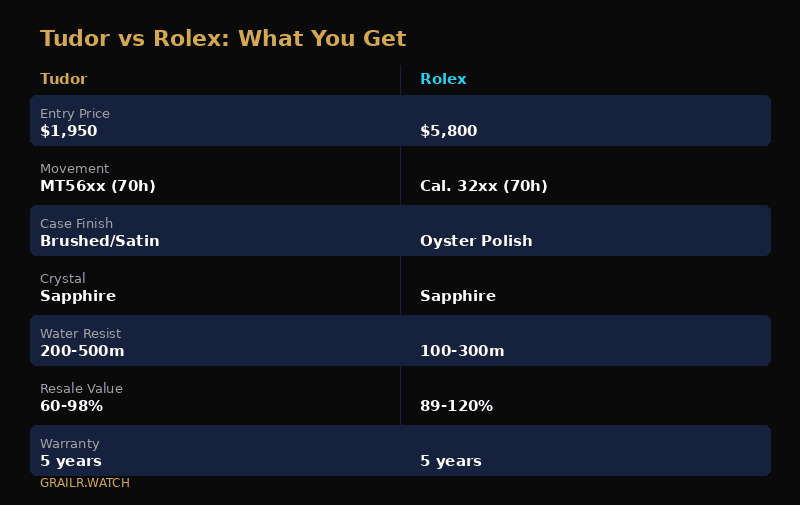
What Tudor gives you that Rolex does not: availability without a waitlist on most references, a lower entry price (the Black Bay 41 at $3,550 vs the Rolex Submariner at $10,250), and a 70-hour power reserve that Rolex only matched in 2020 with the caliber 3230. Tudor’s in-house movements are robust, independently developed calibers — not recycled Rolex parts — and they are COSC-certified across the sport range.
What you give up: Rolex’s Superlative Chronometer certification (which tests beyond COSC to ±2 seconds per day), the Rolex name’s secondary-market liquidity, the Oystersteel alloy, Rolex’s proprietary Cerachrom ceramic bezels, and the Glidelock fine-adjustment clasp. None of those are deal-breakers for most buyers, but they explain the price gap.
The practical upshot: a Tudor Black Bay 58 and a Rolex Submariner both keep excellent time, both survive years of daily wear, and both hold value better than most Swiss watches. The Submariner costs roughly $6,000 more at retail, is harder to buy at list price, and retains a higher percentage on resale. Whether that premium is worth it depends entirely on what the Rolex name means to you beyond the engineering.
Resale and Value Retention
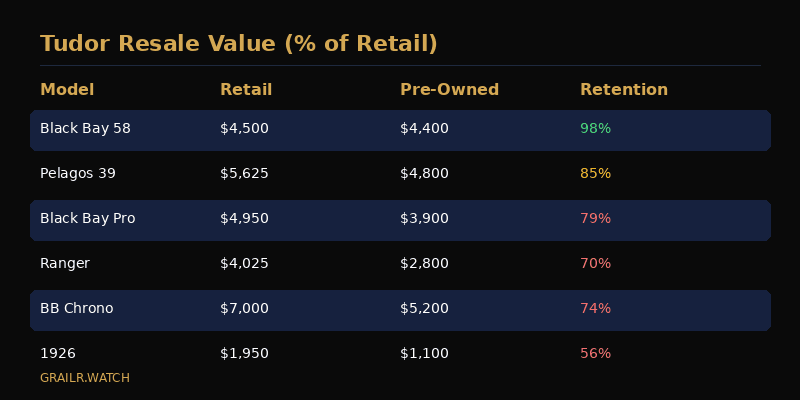
Tudor occupies a middle ground in resale performance: better than fashion brands and most mid-tier Swiss brands, weaker than Rolex, and roughly comparable to Omega’s popular sport references. Most Tudor sport watches trade at 60–75% of retail on the secondary market, with the Black Bay 58 as the clear outlier — desirable configurations trade near retail, and limited-edition colorways occasionally command a modest premium.
The Black Bay Pro, despite its GMT complication and in-house movement, has seen pre-owned prices settle at $3,200–$3,900 against its $4,950 retail, a gap that reflects abundant supply more than any quality concern. The Pelagos family retains better in percentage terms — 80–90% is typical for the 39 and FXD GMT — partly because titanium tooling limits production volume and partly because the military-adjacent backstory creates steady collector interest.
The 1926 line is the weakest performer, with pre-owned examples often available at 50–60% of retail. That is normal for a dress watch on an ETA movement at this price point — buyers shopping pre-owned can find excellent examples well under $1,500 — but it means the 1926 is a purchase to wear, not an investment to flip. US pricing across the catalog rose 4–8% in 2025–2026 as tariff adjustments worked through the supply chain, and those increases have not yet been fully reflected in secondary-market asking prices.
How to Buy a Tudor in 2026
1. Start at an Authorized Dealer
Tudor’s AD network includes independent jewelers and many Rolex boutiques. Unlike Rolex, most Tudor sport models are available without a waitlist, so you can try on the actual watch, compare sizes on your wrist, and buy the same day. The AD experience also gives you a full manufacturer warranty and documented provenance.
2. Consider Pre-Owned for Value
Because most Tudor models trade below retail on the secondary market, a pre-owned Black Bay Pro or Pelagos 42 can save you $800–$1,500 over retail with minimal wear. Platforms like Chrono24, Crown & Caliber and dealer trade-in programs offer buyer protection on pre-owned purchases. Verify box, papers and serial number before committing.
3. Factor in Strap Options
Tudor ships most models with a choice of steel bracelet, fabric strap or leather strap, and the price varies by several hundred dollars depending on the option. The bracelet is usually the best resale choice, since it is harder to add later, but the fabric straps are genuinely comfortable for daily wear and easy to swap with aftermarket NATO-style options.
4. Scan Before You Commit
Use Grailr’s free scanner to photograph a listing and get a suggested model identification alongside live pricing pulled from multiple marketplaces. It is a starting point for due diligence, not proof of authenticity — pair it with an independent inspection before you send payment.
5. Watch for Tariff-Adjusted Pricing
US retail prices rose 4–8% across Tudor’s sport range in 2025–2026 as tariff changes worked through the supply chain. If you see a price quoted in an older review or forum post, it is likely out of date. Always confirm current retail with your local AD or on Tudor’s official site before budgeting.
Frequently Asked Questions
What is the best Tudor watch for men in 2026?
For most buyers, the Black Bay 58 offers the strongest combination of wearability, in-house movement, and resale value. At 39mm with the MT5402 caliber and prices starting around $4,500, it fits a wider range of wrists than the 41mm models and trades near retail on the secondary market.
How much does a Tudor watch cost?
Tudor retail prices in 2026 range from roughly $1,950 for the entry-level 1926 to about $7,000 for the Black Bay Chrono. The core sport models, including the Black Bay 58, Pelagos 39, and Ranger, sit between $4,000 and $5,700.
Does Tudor hold its value better than Omega?
It depends on the reference. The Black Bay 58 and Pelagos 39 retain roughly 75-90% of retail, comparable to popular Omega Seamaster references. Less popular Tudor models like the 1926 can lose 40% or more. Neither brand matches Rolex resale performance overall.
Is Tudor owned by Rolex?
Tudor is a sister brand to Rolex. Both are owned by the Hans Wilsdorf Foundation. Tudor shares Rolex case-making facilities and quality control standards but develops its own in-house movements and designs its watches independently.
What movement does Tudor use?
Since 2015 Tudor has used its own in-house calibers for most sport models. The MT5602 powers the Black Bay, the MT5402 drives the BB 58 and Ranger, the MT5652 handles the GMT function in the BB Pro, and the MT5813 runs the chronograph. The entry-level 1926 still uses a modified ETA movement.
Where can I buy a Tudor watch?
Tudor sells through its authorized dealer network, which includes independent jewelers and Rolex boutiques that carry Tudor. Popular sport models are generally available without a waitlist. Pre-owned examples trade on Chrono24, Crown and Caliber, and dealer sites, typically a few hundred dollars below retail.
Related Articles
The Bottom Line
Tudor occupies a rare position in the watch market: genuine Rolex-adjacent engineering and build quality at 30–50% of Rolex prices, with availability that lets you actually walk into a store and buy the model you want. The Black Bay 58 is the strongest all-around recommendation for most men — the right size, the strongest resale, and a movement that matches anything at this price point. The Pelagos 39 is the pick for buyers who want titanium and tool-watch credibility. The Ranger suits minimalists who find dive-watch aesthetics overdone. And the 1926 remains the most accessible path into Swiss mechanical watchmaking from a brand with genuine heritage. Whichever model you choose, verify the exact reference, current retail pricing and box-and-papers status before you commit; a listing description and a photo are a starting point, not a guarantee.
Found a Tudor You Like?
Grailr uses a photo to suggest a watch identity and an indicative price estimate, with active eBay listings where available. Check the exact reference and condition independently; a photo scan cannot authenticate a watch.
Get an Indicative EstimateSources and price context
- Tudor official collection — Official specifications for case dimensions, movements, water resistance and retail pricing across all current Tudor families.
- Fratello Tudor coverage — Independent editorial reviews, hands-on impressions and market analysis of Tudor releases.
These primary sources support the specifications and history noted above. Prices and resale percentages elsewhere in this guide are indicative editorial figures, not a verified transaction dataset or guaranteed returns. Confirm the exact reference, region, condition and current quote before buying; asking prices are not completed-sale prices.