Online Watch Appraisals: What They Can and Cannot Tell You
Free tools, paid valuations, and professional inspections — a practical guide to understanding what each type of watch appraisal actually delivers and where each one falls short.
Price context: this guide includes indicative prices from its original publication period. They have not all been refreshed to current quotes. Use the linked primary sources for specifications and policies, and verify prices independently.
- Online appraisals range from free instant estimates to paid reports starting at $19.99 – $150+
- Three appraisal types exist — insurance replacement, fair market, and estate/liquidation — each for a different purpose
- No photo-based tool can verify authenticity; hands-on inspection is required to confirm a watch is genuine
- A complete set (box, papers, receipts) can add 15–25% to a watch’s value
- Insured watches should be reappraised every 2–3 years to keep coverage accurate
What Is an Online Watch Appraisal?
You’ve inherited a watch, found one in a drawer, or you’re considering selling a piece from your collection. The first question is always the same: what is it worth? A decade ago, the answer required a trip to a jeweller. Today, a growing range of online tools and services promise to tell you — some in seconds, some in days, and at price points from zero to several hundred dollars.
But “online watch appraisal” is a broad term that covers very different things. A free instant estimate from a marketplace aggregator is not the same as a certified written report from a credentialed appraiser who happens to accept submissions online. Understanding the difference — and knowing which type suits your situation — can save you money, prevent insurance gaps, and keep you from making decisions based on a number that doesn’t mean what you think it means.
This guide breaks down the three types of watch appraisals, compares the leading online services and free tools available in 2026, explains what none of them can do, and helps you decide when a professional hands-on inspection is the only responsible option. If you’re wondering whether your watch is worth anything at all, start there — then come back here for the valuation details.
The Three Types of Watch Appraisals
Not all appraisal numbers are created equal. The same watch can produce three very different figures depending on the type of appraisal you request. Confusing them is one of the most common mistakes watch owners make — and it can cost you real money.
Insurance Replacement Value (IRV)
This is the highest number you’ll see. It represents the current retail cost to replace the watch with an identical or equivalent piece from an authorised dealer. A Rolex Submariner you purchased for $9,000 five years ago might carry an insurance replacement value of $10,800 today because that’s what the same reference costs new right now. This is the figure your insurance company uses to set your premium and payout ceiling.
Fair Market Value (FMV)
The middle figure. FMV is what a knowledgeable, willing buyer would pay a knowledgeable, willing seller on the secondary market — neither under pressure to transact. It reflects condition, completeness, current demand, and comparable recent sales. For most watches, FMV falls between 60% and 90% of current retail, though highly sought-after references can exceed retail. This is the number that matters when you’re buying or selling.
Estate / Liquidation Value
The lowest figure. This is what a dealer would pay for quick acquisition — the wholesale price, essentially. It’s typically 50–70% of FMV because the dealer needs margin to resell. Estate and liquidation values are used for legal proceedings, tax assessments, and probate. If a dealer offers you this number while you’re expecting FMV, the gap can feel like an insult — but it’s simply a different measurement.
When you request any online appraisal, the first thing to establish is which type of value you’re receiving. A free market estimate from Chrono24 gives you something close to FMV. A paid insurance report from Prestige Valuations gives you IRV. Confusing the two could mean you insure your watch for 40% less than its replacement cost — or list it for sale at a price no buyer will touch.
Online Appraisal Services Compared
The online appraisal landscape in 2026 splits into two categories: free instant tools that pull from market data, and paid services where a human appraiser reviews your submission and produces a report. Here’s how they stack up.
| Service | Cost | Turnaround | Value Type | Insurance-Grade? |
|---|---|---|---|---|
| Chrono24 | Free | Instant | Market estimate | No |
| WatchCharts | Free | Instant | Market estimate | No |
| Grailr /appraise | Free | Instant | Indicative estimate | No |
| InstAppraisal | Free | Instant | Market estimate | No |
| Elite Timepieces (market) | $19.99 | Within 24 hours | Fair market value | No |
| Elite Timepieces (insurance) | $39.99 | Within 24 hours | Insurance replacement | Varies |
| Prestige Valuations | From $85 | 3–4 working days | Insurance replacement | Yes |
| AppraiseItNow | Varies | Varies | Certified appraisal | Yes |
| Luxury Watches USA | $150 | Varies | Insurance / FMV | Yes |
Free Instant Tools
Chrono24 lets you enter a reference number or select a make and model to receive a free market value estimate drawn from its global listing database. Because Chrono24 is the world’s largest watch marketplace, its data set is broad — but remember that it reflects asking prices, not completed sales. Actual transaction prices are typically 5–15% lower than listed prices.
WatchCharts provides a similar free instant appraisal with price-trend charts that show how a reference has moved over time. It’s especially useful for spotting whether a model is trending up or down before you commit to a sale or purchase.
InstAppraisal takes a different approach, drawing on a database of over 86,000 real appraisals dating back to 1995 to generate its estimates. Its strength is breadth — it covers vintage and unusual references that other tools may miss.
Grailr’s /appraise tool uses photo-based identification to suggest a watch’s brand, model, and reference number, then pulls indicative value estimates from multiple market sources. It’s a useful first step for identifying an unknown watch and getting a rough price range, but — like every photo-based tool — it cannot verify authenticity or replace a hands-on inspection.
Paid Online Services
Elite Timepieces offers the lowest entry point for paid appraisals: $19.99 for a market-value report and $39.99 for an insurance-grade report, both delivered within 24 hours. You submit photos and details online, and a specialist reviews them. The fast turnaround and low cost make this a practical option when you need more than a free estimate but don’t require formal USPAP documentation.
Prestige Valuations starts at $85 per piece for insurance appraisals, delivered in 3–4 working days. Their reports are designed to meet insurer requirements, with detailed descriptions, condition notes, and supporting market data.
Luxury Watches USA charges $150 per appraisal and offers both insurance replacement and fair market value reports. At the higher end, AppraiseItNow provides certified online appraisals with credentialed appraisers. For context, in-person professional appraisals typically run $150–$500 per watch, so paid online services often represent meaningful savings — with the trade-off of no physical inspection.
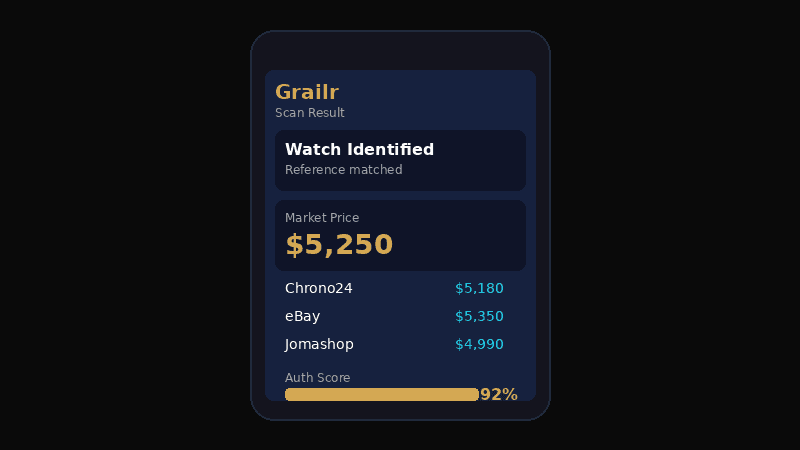
Check Any Watch Price in Seconds
Grailr scans your watch photo and pulls live pricing from Chrono24, eBay, and Jomashop.
- AI identifies brand, model & reference number
- Live market prices from 3+ sources
- Authentication confidence score
What Online Appraisals Cannot Do
Whether free or paid, every online appraisal shares the same fundamental limitation: no one is holding the watch. That single fact creates a chain of blind spots that no amount of photographic detail can fully close.
Detect Counterfeits
High-quality fakes reproduce dials, cases, and bracelets with alarming accuracy in photographs. Only hands-on inspection — checking movement finishing under magnification, verifying serial engravings, testing lume consistency, and measuring case tolerances — can reliably distinguish genuine from counterfeit. A photo-based system can be fooled by a well-made replica. If authentication is your primary concern, read our guide on how to authenticate a luxury watch.
Assess True Condition
Photographs hide hairline scratches, crystal chips, water damage, worn gaskets, and bracelet stretch. A watch that looks mint in photos could have a compromised water-resistance seal or a movement that’s running outside specification. Condition can move value by 20–40% on the secondary market, and an online appraiser can only grade what they see.
Inspect the Movement
The movement is the heart of a mechanical watch, and its condition is invisible from the outside. Has it been serviced recently? Are components original? Is the balance amplitude healthy? These questions require opening the case back and examining the calibre under magnification — something no online service performs.
Catch Aftermarket Modifications
Replaced dials, non-original hands, aftermarket bezels, and polished cases all reduce value significantly — sometimes by 30–50%. Experienced collectors may spot these in high-resolution photos, but automated tools generally cannot, and even human online reviewers miss subtle modifications without the watch in hand.
Satisfy USPAP Requirements
The Uniform Standards of Professional Appraisal Practice (USPAP) set the bar for appraisals used in legal, tax, and most insurance contexts. A USPAP-compliant report requires physical inspection, verifiable identification, and an appraiser’s certification. Free online estimates do not come close to this standard, and many paid online services fall short as well.
None of this makes online tools useless. For getting a quick sense of what your Rolex might be worth, screening a potential purchase, or deciding whether a watch merits the cost of a full professional appraisal, online estimates are genuinely helpful. The danger lies in treating them as definitive when they are inherently indicative.
When You Need a Hands-On Professional Appraisal
An online estimate is a starting point. For the following situations, nothing substitutes for a qualified appraiser physically examining your watch.
| Situation | Why Hands-On Is Required | Typical Cost |
|---|---|---|
| Insuring a watch | Most insurers require a written report with physical inspection | $150 – $300 |
| Estate settlement | Legal proceedings need USPAP-compliant documentation | $200 – $500 |
| Selling a high-value piece | Buyers and auction houses expect verified condition and authenticity | $150 – $400 |
| Divorce or property division | Courts require certified fair market valuations | $200 – $500 |
| Tax donation deduction | IRS requires qualified appraisal for items over $5,000 | $200 – $500 |
| Suspected counterfeit | Only physical inspection can confirm authenticity | $100 – $250 |
What happens during a professional appraisal? A qualified appraiser will spend 30–60 minutes with your watch. They examine the case, bracelet, dial, hands, and crystal under magnification using loupes and specialised lighting. They open the case back to inspect the movement, check the serial and reference numbers against manufacturer records, and assess whether any components are non-original.
The output is a formal report that includes detailed photographs, a written description of the watch and its condition, the appraiser’s credentials and certification, the appraisal methodology, and the final value figure with its type clearly stated. This document is what your insurance company, your solicitor, or the IRS actually needs.
Professional appraisals typically cost $150–$500 per watch, charged as a flat rate. This is important: a reputable appraiser always charges a flat fee, never a percentage of the watch’s value. Percentage-based fees create a financial incentive to inflate the appraisal, and any appraiser who quotes a percentage should be treated as a red flag. For detailed guidance on what a Rolex appraisal involves specifically, see our Rolex appraisal guide.
How to Choose a Qualified Watch Appraiser
Not all appraisers are equal. Whether you’re working with someone in person or through a paid online service, look for these credentials and practices.
GIA Certification
The Gemological Institute of America is the gold standard for jewellery and watch appraisal credentials. A GIA-trained appraiser has formal education in gemstone identification, precious metals, and valuation methodology.
ASA Membership
The American Society of Appraisers requires members to pass rigorous examinations and adhere to USPAP standards. ASA-accredited appraisers undergo regular reaccreditation.
NAJA Membership
The National Association of Jewelry Appraisers focuses specifically on jewellery and watch valuation. NAJA members must demonstrate ongoing education and ethical practice.
Flat-Fee Pricing
Always a flat rate per watch, never a percentage of appraised value. Percentage fees create a conflict of interest that undermines the appraisal’s credibility.
Completeness matters more than you think. A watch with its original box, warranty papers, purchase receipt, and service records (“full set”) can be worth 15–25% more than the same watch without them. If you have these documents, bring them to your appraisal or include them in your online submission. If you don’t, factor the discount into any value estimate you receive.
Timing matters too. The luxury watch market is not static. A Rolex Daytona that appraised at $35,000 in 2022 might appraise at $28,000 or $42,000 today depending on market shifts. For insured watches, the standard recommendation is to reappraise every 2–3 years. An outdated appraisal leaves you under-insured if the watch has appreciated or over-insured (and overpaying premiums) if it has depreciated.
A Practical Workflow: Online First, Professional When It Counts
The smartest approach combines online tools and professional appraisals at the right stages. Here’s the workflow we recommend.
Step 1: Identify the Watch
Use a free tool to establish the brand, model, and reference number. Grailr’s scan feature can suggest an identification from a photo. Chrono24’s reference lookup is useful if you already have a reference number. This step costs nothing and takes seconds.
Step 2: Get a Ballpark Value
Check the indicative estimate from your identification tool, then cross-reference it with WatchCharts price-trend data and recent Chrono24 listings for the same reference. If three sources roughly agree, you have a reasonable range. If they diverge significantly, the watch may have unusual characteristics that need expert evaluation.
Step 3: Decide If You Need More
If the watch is worth under $1,000 and you’re just curious, the free estimate is probably enough. If you’re considering selling and the value exceeds $2,000, a paid online appraisal ($20–$85) gives you a more defensible figure. If you need insurance coverage, legal documentation, or authentication, proceed to Step 4.
Step 4: Book a Professional
Find a GIA, ASA, or NAJA-credentialed appraiser in your area. Bring the watch, all original packaging and documentation, and any service records. Budget $150–$500 and expect the inspection to take 30–60 minutes. The formal report you receive is the document that insurers, courts, and serious buyers require.
Step 5: Reappraise Periodically
Set a calendar reminder for 2–3 years. In the interim, use free online tools to monitor whether the market has shifted significantly. If a major price movement occurs — like the 2021–2022 Rolex surge or the subsequent correction — consider reappraising sooner.
Frequently Asked Questions
How much does an online watch appraisal cost?
Free tools like Chrono24 and WatchCharts provide instant market estimates at no cost. Paid online appraisals range from $19.99 for a basic market value report (Elite Timepieces) to $85+ for an insurance replacement report (Prestige Valuations) and up to $150 for comprehensive paid services (Luxury Watches USA).
Can I use an online appraisal for insurance?
Most insurance companies require a formal written appraisal from a certified professional who physically inspected the watch. Free online estimates do not meet USPAP documentation standards. Some paid online services produce insurance-grade reports, but confirm with your insurer before relying on one.
How accurate are free online watch appraisals?
Free tools aggregate recent asking and sold prices for similar references, so they provide a useful ballpark for common models in standard condition. They cannot account for aftermarket modifications, condition details invisible in photos, or completeness of box and papers — which can shift value by 15-25%.
How often should I have my watch reappraised?
For insured watches, every 2-3 years. The luxury watch market fluctuates, and an outdated appraisal may leave you under-insured if the watch appreciated or over-insured if it depreciated. Use free online tools between formal appraisals to monitor significant market shifts.
Can an online appraisal detect a fake watch?
No. Online appraisals rely on photos and reference data, which cannot detect high-quality counterfeits. Verifying authenticity requires hands-on inspection of the case back, movement, dial printing, and lume under magnification. A photo-based tool may suggest a model identity, but that is not the same as authentication.
What is the difference between fair market value and insurance replacement value?
Fair market value is what a knowledgeable buyer would pay on the secondary market. Insurance replacement value is the cost to replace the watch at current retail — typically higher. A Rolex purchased for $9,000 five years ago might have a fair market value of $8,500 but an insurance replacement value of $10,800.
Related Articles
The Bottom Line
Online watch appraisals have made it easier than ever to get a quick sense of what a timepiece might be worth. Free tools provide useful ballparks in seconds. Paid online services deliver more detailed reports for a fraction of what a traditional appraiser charges. But every online method shares the same blind spot: no one is holding the watch.
For curiosity, screening a purchase, or deciding whether a watch is worth insuring at all, online estimates are a perfectly good starting point. For insurance documentation, legal proceedings, high-value sales, or authentication, a credentialed professional with the watch in hand remains irreplaceable. Use both — just know which one you’re relying on and why.
Curious What Your Watch Is Worth?
Grailr technology identifies your watch from a photo and provides indicative value estimates from multiple market sources. It’s a starting point, not a certified appraisal — but it’s free and takes seconds.
Get a Free EstimateSources and price context
- Chrono24 watch valuation tool — Free reference-based market estimates drawn from the Chrono24 listing database.
- WatchCharts instant appraisal — Free instant estimates with historical price-trend charts.
- American Society of Appraisers — Gems & Jewelry — Professional standards and accreditation for watch and jewellery appraisals.
These primary sources support the specific tools, credentials, or standards referenced above. Prices and service costs elsewhere in this guide are indicative editorial figures based on publicly listed rates at the time of publication. Confirm current pricing, availability, and whether a given report meets your insurer’s requirements before purchasing. Online estimates are not completed-sale prices or authenticated valuations.