Where Are Rolex Watches Made? Inside the Swiss Factories Behind Every Crown
Every Rolex is made in Switzerland across four specialized facilities — from smelting raw gold to setting the final diamond. Here’s what happens inside each one.
- Every Rolex is made entirely in Switzerland — no components are outsourced or manufactured abroad
- Rolex operates four specialized facilities: Les Acacias (HQ), Bienne (movements), Plan-les-Ouates (cases & bracelets), and Chêne-Bourg (gems & dials)
- The company smelts its own steel and gold alloys in a private foundry — one of very few watchmakers to do so
- An estimated 1.2 million watches leave these factories every year, each certified to ±2 seconds per day
The Short Answer: Rolex Watches Are Made in Switzerland
If someone asks you where Rolex watches are made, the answer is simple: Switzerland. Every single Rolex — from the $5,800 Oyster Perpetual to the $82,700 Platinum Daytona — is designed, engineered, manufactured, assembled, and tested within Swiss borders. There are no satellite factories in China, no outsourced dials from Japan, no movements from Southeast Asia. It’s all Switzerland, all the time.
But “Switzerland” is only the beginning of the story. Rolex doesn’t operate a single mega-factory. Instead, it runs four highly specialized facilities, each responsible for a different stage of watchmaking. Components travel between these sites during production, converging at the Geneva headquarters for final assembly and testing before a watch earns the Rolex crown on its dial.
This wasn’t always the plan. Rolex was actually founded in London in 1905 by a 24-year-old German immigrant named Hans Wilsdorf. He registered the brand name “Rolex” in 1908 — short enough to fit on a dial, easy to pronounce in any language. But London proved problematic. Heavy import duties on luxury goods during World War I made Swiss-cased watches expensive to sell in Britain, so Wilsdorf moved the entire operation to Geneva in 1919. It was a decision that would define both the brand and the Swiss watch industry itself.
In the century since, Rolex has grown from a small import office into the world’s largest luxury watchmaker by revenue, producing an estimated 1.2 million watches per year. And every one of them is born in one of the four facilities we’re about to tour. If you’re considering buying a Rolex and want to understand what makes them worth the price — or if you’re just curious about where the crown is forged — read on. The answer involves private foundries, paramagnetic hairsprings, and clasp testing machines that simulate decades of wear in a few days.
Les Acacias: Rolex World Headquarters & Final Assembly
The nerve center of the Rolex empire sits in Les Acacias, a district in central Geneva. This has been Rolex’s global headquarters since 1965, and it’s where every watch in the collection comes together for the final time.
Les Acacias houses the executive offices, global coordination teams, research and development labs, and — most critically — the final assembly lines. This is where movements from Bienne meet cases from Plan-les-Ouates and dials from Chêne-Bourg. Skilled watchmakers perform the delicate operation of casing the movement, fitting the dial and hands, securing the bezel, and sealing the Oyster case for waterproofness. The process is simultaneously artisanal and industrial: each watchmaker works at a dedicated bench with specialized tools, but the flow of components through the facility is orchestrated with factory-floor precision.
The R&D department at Les Acacias is where Rolex develops the innovations that keep its watches ahead of the industry. The Parachrom hairspring — a paramagnetic blue alloy made from niobium and zirconium that’s ten times more resistant to shocks than a conventional hairspring — was developed here. So was the Paraflex shock absorber system, which increased shock resistance by 50% over the previous Kif system. The Chromalight luminescent material, the Cerachrom ceramic bezel inserts, and the proprietary Oystersteel alloy were all born in these labs. Rolex holds hundreds of active patents, and the R&D teams at Les Acacias are responsible for ensuring the brand remains at the technical frontier of mechanical watchmaking.
Final assembly at Les Acacias follows a strict sequence. First, the cased movement is fitted with the dial and hands under dust-free conditions — even a single particle trapped between the dial and crystal would constitute a failure. Next, the watchmaker seats the movement inside the middle case, secures the caseback with a torque-controlled tool, and screws down the winding crown to engage the Twinlock or Triplock sealing system. The bezel is then snapped or screwed into position. At this stage, the watch is a complete, sealed unit — ready for the testing gauntlet that will determine whether it earns the Superlative Chronometer designation.
After assembly, every watch undergoes Rolex’s proprietary Superlative Chronometer testing protocol. This goes well beyond the standard COSC certification that most Swiss chronometers receive. While COSC tests a bare movement and certifies it to ±4/−6 seconds per day, Rolex tests the fully cased watch and holds it to a tighter standard of ±2 seconds per day. Only after passing this final battery of tests does a watch receive its distinctive green seal and leave Les Acacias for an authorized dealer somewhere in the world. That green seal isn’t just marketing — it’s a certificate backed by the most demanding quality protocol in the Swiss watch industry.
Bienne: Where Every Rolex Movement Is Born
About 90 kilometres northeast of Geneva, in the bilingual city of Bienne (Biel), sits one of the most important watch factories in the world. This is where Rolex manufactures every mechanical movement that powers its watches — roughly 1.2 million calibres per year.
Bienne is historically the heartland of Swiss watchmaking. Omega, Swatch Group, and dozens of component suppliers are based here. But Rolex’s Bienne facility stands apart because of its total self-sufficiency. While many Swiss brands outsource movement components to specialist suppliers like ETA or Sellita, Rolex manufactures virtually every part in-house — from the mainspring to the balance wheel, from the escapement to the gear train. The factory houses its own micro-machining department that produces tiny screws, jewels, and pinions with tolerances measured in thousandths of a millimetre. Even the lubricants used to oil each pivot point are specified and tested by Rolex’s own tribology lab.
The factory produces Rolex’s current generation of movements, including the Calibre 3200 series. The Cal. 3230 powers time-only models like the Oyster Perpetual and Explorer. The Cal. 3235 adds a date function for the Datejust and Submariner. The Cal. 4130 drives the Daytona chronograph. Each of these movements features Rolex’s Chronergy escapement, which is 15% more efficient than a standard Swiss lever escapement, contributing to the 70-hour power reserve found across the modern lineup.
Two components made in Bienne deserve special attention. The first is the Parachrom hairspring — the tiny coiled spring that regulates timing. Rolex developed a proprietary paramagnetic alloy of niobium and zirconium that makes this hairspring virtually immune to magnetic fields and up to ten times more shock-resistant than traditional hairsprings. The distinctive blue colour isn’t paint; it’s a result of the oxidation process during manufacturing.
The second is the Paraflex shock absorber, Rolex’s proprietary alternative to the industry-standard Incabloc system. Developed entirely in-house, the Paraflex increases shock resistance by 50% while taking up less space inside the movement. These are the kinds of incremental but meaningful innovations that happen when a company controls every stage of production — a theme we’ll return to later.
Plan-les-Ouates: The Case & Bracelet Factory
Southwest of Geneva, the commune of Plan-les-Ouates is home to Rolex’s largest production facility — a sprawling 58-acre complex dedicated to manufacturing watch cases, bracelets, and the proprietary metals they’re made from.
What makes Plan-les-Ouates extraordinary is that it begins not with watchmaking but with metallurgy. Rolex operates its own foundry here — one of the only watchmakers in the world to smelt its own alloys from raw materials. When Rolex says a watch is made from Oystersteel, they mean it literally: the company takes raw 904L stainless steel and processes it in-house to its own specifications.
This matters more than it might sound. Most watch brands use 316L stainless steel, the industry standard. Rolex uses 904L — a super-austenitic steel originally developed for the chemical industry and deep-sea pipelines. It contains more chromium, nickel, and molybdenum than 316L, giving it superior corrosion resistance, a harder surface, and a distinctive lustre when polished. The trade-off is that 904L is significantly harder to machine, which is why most brands don’t use it. Rolex invested in specialized tooling decades ago and has been using 904L exclusively since 2003.
The same foundry produces Rolex’s proprietary gold alloys. Everose gold is Rolex’s patented 18-karat rose gold formula, which includes a small percentage of platinum to prevent the copper from fading over time — a common problem with standard rose gold. Rolex also casts its own yellow gold and white gold in-house, controlling the exact composition and quality of every gram.
From the foundry, metal billets move to the machining department, where CNC machines and robotic arms cut, drill, and shape Oyster cases with tolerances measured in microns. Each case goes through dozens of individual machining operations — milling the lug shape, drilling the crown tube, cutting the caseback threads, and chamfering every edge. After machining, cases move to the finishing department, where a combination of mechanical polishing and hand brushing creates the mixed surface textures that define Rolex’s aesthetic: polished sides, brushed tops, and mirror-finished lugs. A single Submariner case reportedly passes through more than 100 hands before it’s ready for a movement.
The iconic Oyster case design — patented by Rolex in 1926 as the world’s first waterproof wristwatch case — uses a system of screw-down components (caseback, crown, and bezel) that creates a hermetically sealed chamber for the movement. This was the invention that put Rolex on the map. When Mercedes Gleitze wore an Oyster around her neck during her 1927 English Channel swim, the watch emerged from more than ten hours of saltwater immersion running perfectly. It was the proof of concept for waterproof wristwatches — and Wilsdorf made sure the world knew about it with a full front-page advertisement in the Daily Mail. Today, the Submariner’s Oyster case is rated to 300 metres, and the Sea-Dweller’s reaches 1,220 metres.
Bracelets are also manufactured here. The Oyster bracelet (the three-link sports bracelet) and the Jubilee bracelet (the five-link dress bracelet) are both machined, assembled, and finished at Plan-les-Ouates. Each link is individually machined and then assembled by hand. The Oysterlock safety clasp undergoes 26 different drop tests and is opened and closed tens of thousands of times during quality testing. Rolex even tests clasps in tanks of chlorinated water, salt water, and sand to simulate years of real-world wear in a matter of days. If you’re curious about how this build quality translates to real-world durability, our authentication guide covers what to look for in a genuine Rolex case and bracelet.
Check Any Watch Price in Seconds
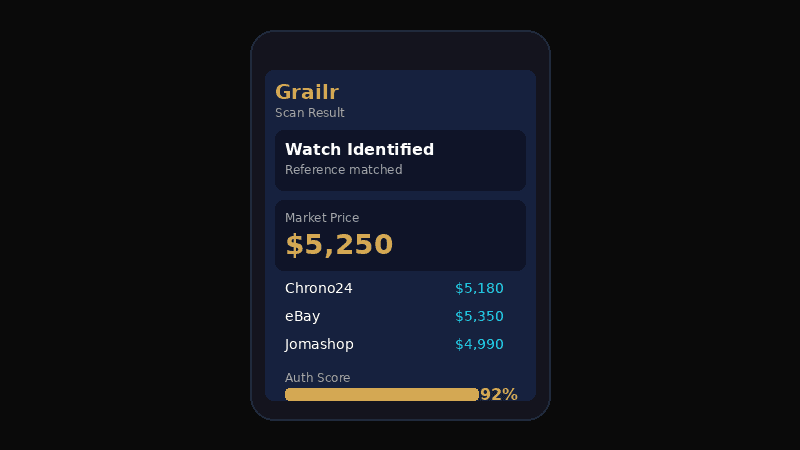
Grailr uses your photo to suggest a watch identification and an indicative price estimate. Active eBay listings, when available, offer asking-price comparisons.
- Grailr suggests brand, model & reference number
- Active eBay asking-price comparisons
- Identification confidence score
Chêne-Bourg: Where Artisans Set Gems & Create Dials
The fourth and perhaps most artistically fascinating Rolex facility sits in Chêne-Bourg, a municipality just east of Geneva. This is Rolex’s dedicated dial and gem-setting atelier — a place where industrial precision meets traditional craftsmanship in ways that few modern factories can match.
The gem-setting department employs some of the most skilled artisans in the Swiss watch industry. When you see a Datejust with a diamond-set bezel, or a Day-Date with a diamond-paved dial, every single stone was selected and set by hand at Chêne-Bourg. Rolex sources its diamonds, sapphires, rubies, and emeralds directly and grades them internally using criteria that the company says exceed standard gemological benchmarks. Every diamond used by Rolex is certified conflict-free and meets the brand’s proprietary standards for cut, colour, clarity, and lustre.
Setting gems on a watch dial or bezel is extraordinarily demanding work. The artisan must drill perfectly positioned seats for each stone, then secure it using prongs or a grain-setting technique — all while ensuring the stone sits at precisely the right height and angle to catch light uniformly. A single pavé-set dial can contain over 700 diamonds, each one individually placed. The tolerances are microscopic: a stone set even a fraction of a millimetre too high or too low will disrupt the pattern and fail Rolex’s quality inspection.
Beyond gems, Chêne-Bourg is where Rolex creates its most striking exotic dials. The meteorite dials found on certain Daytona and GMT-Master models use slices of actual iron meteorite, each one displaying a unique Widmanstätten pattern formed over millions of years in space. Mother-of-pearl dials are hand-selected for their iridescence and carefully lacquered. Malachite dials showcase the stone’s natural banding. Enamel dials are painted by hand using techniques that date back centuries — powdered glass is fused to the dial surface in a kiln, layer by layer, producing colours of extraordinary depth and permanence.
Even the “standard” Rolex dials produced here undergo remarkable processes. The sunray finish on a Datejust dial — that subtle starburst pattern radiating from the centre — requires multiple passes of precision brushing at exact angles. Colours are applied using physical vapour deposition (PVD), electroplating, or lacquering, depending on the desired effect. Every dial must pass colour-consistency checks against master references under controlled lighting conditions. It’s this level of obsessive control that makes even a basic black dial from Rolex look subtly richer than competitors’ offerings.
All Four Rolex Facilities at a Glance
Here’s a complete overview of where each component of a Rolex watch is made. Understanding this map of production helps explain why Rolex watches command the prices they do — and why no other brand has replicated this level of in-house control.
| Facility | Location | Primary Function | Key Output |
|---|---|---|---|
| Les Acacias (HQ) | Geneva | R&D, final assembly, Superlative Chronometer testing | Finished watches, global coordination |
| Movement Factory | Bienne | Manufacture of all mechanical movements | Cal. 31xx, 32xx, 4130 series; Parachrom hairsprings |
| Case & Bracelet Centre | Plan-les-Ouates | Metal smelting, case machining, bracelet assembly | Oystersteel & gold alloys, Oyster cases, bracelets |
| Gem & Dial Atelier | Chêne-Bourg | Gem setting, dial creation, enamel work | Diamond bezels, exotic dials, lacquered finishes |
How Rolex Tests Every Watch Before It Leaves Switzerland
Manufacturing a Rolex is one thing. Certifying it is another. Rolex’s testing regimen is arguably the most rigorous in the watchmaking industry, and it’s the final gate every watch must pass before earning its green seal.
The process begins at Bienne, where bare movements are first sent to COSC (Contrôle Officiel Suisse des Chronomètres) for independent certification. COSC tests each movement over 15 days in five positions and at three temperatures, certifying it to ±4/−6 seconds per day. This is the same certification used by Omega, Breitling, and other Swiss chronometer brands. But for Rolex, COSC is just the starting line.
After the movement returns from COSC, it’s shipped to Les Acacias and assembled into its case. The fully cased watch then undergoes Rolex’s proprietary Superlative Chronometer certification — a second, more demanding round of testing. This protocol evaluates the watch as the owner will actually wear it: cased, with dial and hands fitted, crown screwed down. Rolex tests for chronometric precision (±2 seconds per day — twice as strict as COSC), self-winding efficiency, power reserve, and waterproofness.
The waterproofness testing is particularly intensive. Every Oyster case is tested in a hyperbaric chamber that simulates water pressure beyond the watch’s rated depth. A Submariner rated to 300 metres is tested well beyond that threshold. Rolex also performs a condensation test — the watch crystal is chilled while the case is gently warmed, and inspectors check for any fogging that would indicate a microscopic seal failure.
Bracelets and clasps face their own gauntlet. The Oysterlock safety clasp is subjected to 26 different drop tests — simulating the watch being knocked against hard surfaces from various angles. Clasps are also tested in tanks filled with chlorinated water, salt water, and sand, then opened and closed tens of thousands of times. The goal is to simulate a decade of daily wear in a few days of accelerated testing.
If a watch fails any single test, it doesn’t get adjusted and retested. The failing component is replaced entirely, and the watch starts the testing cycle again from scratch. This zero-tolerance approach is expensive and time-consuming, but it’s why Rolex can offer a five-year warranty with confidence — and why a properly maintained Rolex will keep time within specification for decades.
It’s worth putting this in perspective. Most Swiss watch brands rely solely on the COSC certification for their chronometer models. Some brands don’t even submit to COSC at all. Rolex submits every single movement to COSC and then runs its own, stricter tests on the fully assembled watch. This dual-certification approach is essentially unique in the industry at Rolex’s production volume. If you want to verify that a pre-owned Rolex has retained this level of quality, our guide to spotting fakes covers the physical tells that separate genuine watches from counterfeits, or you can use Grailr’s authentication guidance to learn the limits of photo-based checks.
Why Vertical Integration Makes Rolex Different
The phrase “vertically integrated” gets thrown around a lot in watchmaking, but Rolex takes it further than almost any other brand. Vertical integration means controlling every stage of production in-house, from raw materials to the finished product. For Rolex, that means smelting their own steel and gold, casting their own alloys, machining their own cases, manufacturing their own movements, creating their own dials, setting their own gems, assembling every watch, and testing every watch — all within company-owned facilities staffed by company-employed workers.
Why does this matter? Three reasons.
Quality control. When you outsource components, you inherit your supplier’s quality standards. If your dial supplier has a 2% defect rate, 2% of your watches will ship with imperfect dials unless you inspect every one. Rolex eliminates this by making everything themselves. They don’t need to trust a supplier’s quality control — they are the supplier. Every component is made to Rolex’s specifications, on Rolex’s machines, by Rolex’s people.
Innovation speed. When Rolex engineers want to develop a new alloy, a new escapement, or a new surface treatment, they don’t need to negotiate with an external supplier or wait for someone else’s R&D timeline. They walk down the hall to their own foundry, their own movement workshop, or their own dial studio. The Parachrom hairspring, the Chromalight lume, and the Cerachrom bezel insert all emerged from this kind of vertically integrated development process — iterations happening rapidly across departments that share the same campus.
Supply security. During the COVID-19 pandemic and subsequent supply chain disruptions, many watch brands faced component shortages that limited production. Rolex was not immune, but its vertical integration provided a significant buffer. When you make your own steel, your own springs, and your own crystals, you’re less vulnerable to external shocks. This operational independence is one reason Rolex was able to maintain relatively consistent (if still constrained) output while competitors saw sharper declines.
For comparison, consider how most other Swiss watch brands operate. A typical mid-tier brand might buy movements from ETA or Sellita, cases from a specialist manufacturer, dials from another, and bracelets from yet another. The brand’s role is primarily design, assembly, marketing, and distribution. There’s nothing wrong with this model — it produces excellent watches — but it means the brand has less control over the details of each component.
At the high end, brands like Patek Philippe, Audemars Piguet, and Jaeger-LeCoultre also practice vertical integration, but none matches Rolex’s scale. Producing 1.2 million watches a year while maintaining in-house control of every component is a manufacturing achievement that no other luxury watchmaker has replicated. It’s also the core reason why Rolex watches hold their value so well on the secondary market — something you can verify instantly by scanning any Rolex with Grailr for an indicative estimate and active eBay asking prices when available.
From London to Geneva: A Brief History of Rolex Manufacturing
Understanding where Rolex watches are made today requires a quick look at how they got there. The brand’s manufacturing history is inseparable from the story of Hans Wilsdorf’s relentless pursuit of the perfect wristwatch.
1905: Hans Wilsdorf, a 24-year-old German émigré, co-founds Wilsdorf & Davis in London with his brother-in-law Alfred Davis. The company imports Swiss movements from Hermann Aegler in Bienne and fits them into cases made by London jewellers. At this point, Rolex is an assembler, not a manufacturer.
1910: A Rolex wristwatch receives the first Swiss Certificate of Chronometric Precision ever awarded to a wristwatch, issued by the Official Watch Rating Centre in Bienne. This marks Wilsdorf’s obsession with precision that would define the brand.
1919: Wilsdorf moves the company from London to Geneva to escape punishing British import duties on luxury goods. This is the pivotal moment — Rolex becomes a Geneva company.
1926: Rolex patents the Oyster case — the world’s first waterproof wristwatch case. The following year, a young English swimmer named Mercedes Gleitze wears an Oyster around her neck during her swim across the English Channel. After more than 10 hours in the water, the watch is still running perfectly. Wilsdorf takes out a full front-page advertisement in the Daily Mail to announce the feat. It’s considered one of the first modern celebrity endorsement campaigns.
1950s–1960s: Rolex begins bringing more production in-house and expands its Geneva facilities. The acquisition of component suppliers and the construction of new workshops marks the beginning of the vertical integration strategy that defines the company today.
1965–present: Rolex establishes its headquarters at Les Acacias and steadily expands its four-site production network. Major expansions at Plan-les-Ouates in the 2000s and 2010s bring the foundry and case production under one roof. The Bienne movement factory is expanded multiple times to accommodate growing demand and the development of new in-house calibres. Chêne-Bourg is expanded to handle increasing demand for gem-set and exotic-dial models.
Today, Rolex employs over 9,000 people across its Swiss operations. The company is owned by the Hans Wilsdorf Foundation, a private charitable trust, which means there are no external shareholders demanding quarterly earnings reports or cost-cutting measures. This unusual ownership structure gives Rolex the freedom to invest in long-term manufacturing improvements without short-term financial pressure — a significant advantage when you’re building factories and developing proprietary alloys that may take years to perfect. The serial number system that tracks every watch from production to sale reflects the scale and precision of this manufacturing network.
Frequently Asked Questions
Where are Rolex watches manufactured?
Every Rolex watch is manufactured entirely in Switzerland. The company operates four dedicated facilities: Les Acacias in Geneva (headquarters and final assembly), Bienne (movement manufacture), Plan-les-Ouates near Geneva (cases, bracelets, and metal smelting), and Chêne-Bourg near Geneva (gem setting and dial production). No components are made outside of Switzerland.
Are any Rolex watches made outside of Switzerland?
No. Rolex is fully vertically integrated within Switzerland. Every component — from the raw steel and gold alloys to the finished movement, case, dial, and bracelet — is produced in-house at Rolex's Swiss facilities. This is one of the key factors behind the brand's consistent quality and value retention.
How many Rolex watches are made per year?
Rolex produces an estimated 1.2 million watches per year, making it the largest luxury watch manufacturer by revenue. Despite this volume, every watch is individually tested to Rolex's Superlative Chronometer standard of ±2 seconds per day — stricter than the industry-standard COSC certification.
Why was Rolex founded in London but moved to Switzerland?
Hans Wilsdorf founded Rolex in London in 1905, but moved the company to Geneva in 1919 to escape heavy British import duties on luxury goods imposed during and after World War I. Being in Geneva also placed Rolex closer to its Swiss movement suppliers and the heart of the watchmaking industry.
Can you visit the Rolex factory?
No. Rolex does not offer public tours of any of its four Swiss facilities. The company's manufacturing processes, proprietary alloys, and production techniques are closely guarded trade secrets. Access is limited to employees and occasionally select journalists, though even press visits are rare and tightly controlled.
What steel does Rolex use for its watches?
Rolex uses 904L stainless steel, which it brands as Oystersteel. This is a super-austenitic steel with higher chromium, nickel, and molybdenum content than the 316L steel used by most other watch brands. Rolex smelts and processes this steel in its own foundry at Plan-les-Ouates, making it one of very few watchmakers to control its metal supply from raw material to finished product.
What is a Rolex Superlative Chronometer?
Superlative Chronometer is Rolex's proprietary quality certification, applied to every watch after final assembly. It tests the fully cased watch for chronometric precision (±2 seconds per day), self-winding efficiency, power reserve, and waterproofness. This is more stringent than the COSC certification, which only tests bare movements to ±4/−6 seconds per day.
Related Articles
The Bottom Line
Every Rolex watch is made in Switzerland — but that simple statement barely scratches the surface. Behind every crown logo is a network of four specialized facilities, a private foundry smelting proprietary alloys, thousands of skilled workers, and a testing regimen that rejects any watch falling outside ±2 seconds per day. From the Parachrom hairspring born in Bienne to the diamond bezels set by hand in Chêne-Bourg, each component represents Rolex’s century-long commitment to controlling every detail of watchmaking.
This is why Rolex commands the prices it does, and why the brand’s watches hold value better than almost any competitor. When you buy a Rolex, you’re not just buying a Swiss watch — you’re buying the output of one of the most vertically integrated manufacturing operations in any luxury industry. Whether that’s worth it is a personal decision, but at least now you know exactly what you’re paying for.
Thinking About Buying a Rolex?
Grailr can suggest a model and reference from a clear photo and provide an indicative price estimate. Active eBay listings, when available, show asking prices for comparison. Confirm the reference and condition with the seller; a photo scan does not authenticate a watch.
Scan a Watch NowSources and price context
- Rolex manufacturing and testing — Swiss production sites, manufacturing responsibilities and testing.
- Rolex ownership FAQ — Availability, retail pricing and care guidance from Rolex.
The links identify the specific manufacturer information and marketplace guidance used for this guide. Price ranges and resale percentages in this guide are illustrative, not live quotes or guaranteed returns; compare the exact reference, condition and sale date before relying on them.