Astor & Banks: The Chicago Microbrand Making Watches for Every Wrist
Fortitude, Sea Ranger, and Dorado compared — specs, pricing from $525 to $695, and whether this veteran-founded microbrand deserves a spot on your shortlist.
Price context: this guide includes indicative prices from its original publication period. They have not all been refreshed to current quotes. Use the linked primary sources for specifications and policies, and verify prices independently.

- Astor & Banks prices range from $525 to $695 across three core models, all with sapphire crystals, 200m water resistance and the Miyota 9015 automatic
- The Fortitude at 38.5mm is one of the few field watches in this price range deliberately sized for smaller and mid-size wrists
- Direct-to-consumer pricing keeps costs below competing Swiss brands with comparable build quality, though limited-edition drops sell out quickly
- The lineup competes directly with the Hamilton Khaki Field ($495–$595), Sinn 556 ($1,450) and Marathon GSAR ($1,100) on specs and finishing
- Founded by U.S. military veteran Andrew Perez in Chicago, the brand sells exclusively through its own website with no third-party dealer network
Brand Story: Veteran-Founded in Chicago
Astor & Banks started in Chicago as the kind of project that sounds simple on paper and proves brutally hard in practice: build a watch that looks and feels like it belongs in the $800–$1,200 range, sell it for half that by cutting out the middlemen, and size it for wrists that most tool watch brands ignore. Andrew Perez, a U.S. military veteran, founded the brand after spending years wearing watches that were either too big, too expensive, or both for what they actually delivered. His military background shows up in the design language — no gratuitous complications, no fashion-forward flourishes, just readable dials, robust cases, and water resistance that means something.
The “microbrand” label can mean anything from a kitchen-table Kickstarter to a serious small-batch manufacturer, and Astor & Banks falls firmly in the latter category. The brand designs in-house in Chicago, sources movements from Citizen’s Miyota division in Japan, and assembles in Asia with quality control that reviewers have consistently praised since the first models shipped. There is no authorized dealer network; every watch sells direct through astorandbanks.com, which is how a 200m-rated sapphire-crystal automatic can retail for $525 when comparable specs from a Swiss brand start north of $700.
The direct-to-consumer model carries a real tradeoff, though: you cannot try the watch on before you buy, and limited editions sell out in hours once they drop. There is no grey market pipeline to fall back on if you miss a release, and secondary availability is thin because production runs are deliberately small. If you want one, you either buy at release or wait for the next batch — which may be a different dial color or configuration entirely.
The Fortitude: A Field Watch for Every Wrist
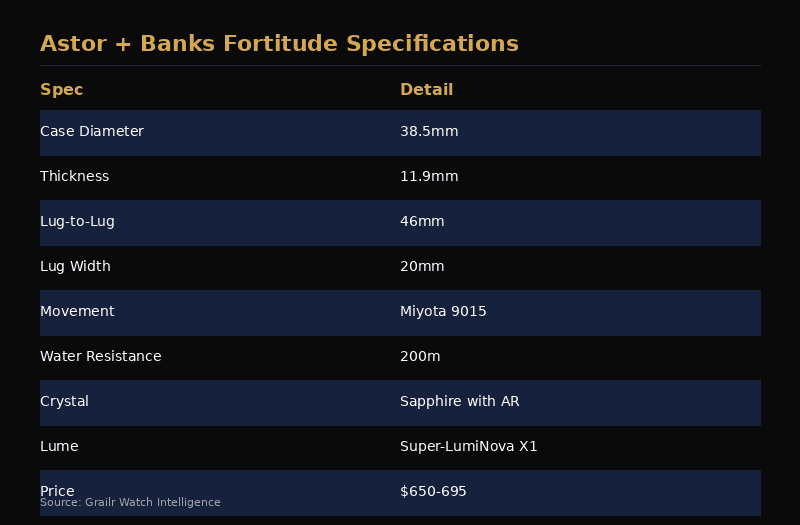
The Fortitude is the watch that put Astor & Banks on the map, and it remains the model that best represents what the brand is trying to do. At 38.5mm in diameter, 11.9mm thick, and 46mm lug-to-lug, it sits in a sizing sweet spot that most field watch competitors skip entirely. The Hamilton Khaki Field Automatic starts at 38mm but quickly jumps to 42mm for many configurations; the Sinn 556 is 38.5mm but costs nearly three times as much. The Fortitude slots right into that gap: a genuinely compact field watch with serious specifications at a microbrand price.
The case design is symmetrical and clean, with a fixed bezel featuring a brushed surface and polished chamfer that catches light without looking dressy. There is no rotating bezel here — this is a field watch, not a diver, even though its 200m water resistance rating would make it perfectly capable underwater. The sapphire crystal carries anti-reflective coating on both sides, and the dial is illuminated with Super-LumiNova X1, the brightest grade available in the Swiss lume range, which is a specification you normally see on watches costing two or three times this much.
The date window sits at 6 o’clock rather than the more common 3 o’clock position, preserving the dial’s visual symmetry — a detail that reflects genuine design consideration rather than defaulting to whatever the movement’s date wheel makes easiest. Dial options include navy blue, silver, mother of pearl, and mint green in standard production, with limited-edition colorways like the blue and gilt variant appearing periodically and selling out within hours of announcement.
The bracelet deserves separate mention. The Y-link design tapers from 20mm at the lugs to 16mm at the clasp, which is a proportion you find on watches costing four or five times as much from brands like Grand Seiko. The taper makes the watch sit more naturally on smaller wrists and gives the overall package a sense of refinement that a straight-link bracelet at this price would not. For $525 to $675 depending on dial and configuration, the Fortitude delivers a specification sheet that competes with watches priced at $1,000 or more. Gear Patrol called it “one of the best field watches of 2020,” and the underlying value proposition has only strengthened since.
Complete Lineup: Sea Ranger, Dorado and More
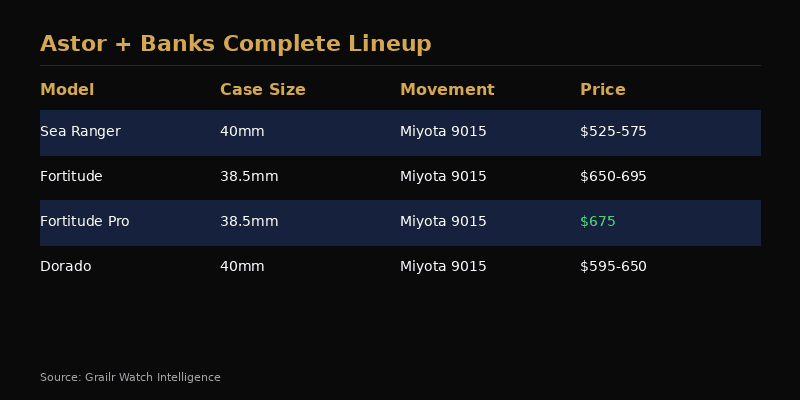
Sea Ranger — ~$595
The Sea Ranger is Astor & Banks’s answer to the sport-diver category. At 40mm it wears larger than the Fortitude, with 200m of water resistance and the same Miyota 9015 automatic inside. The slightly bigger case and sportier proportions make it the natural pick for buyers who find the Fortitude’s 38.5mm too compact but do not want to leave the brand. Where the Fortitude leans into field-watch restraint, the Sea Ranger pushes toward the diver aesthetic — a thicker case, broader indices, and a more assertive dial presence. It is a solid mid-range sport watch that could comfortably sit alongside pieces twice its price, though its limited-edition runs mean you need to catch the right production window to get the dial you want.
Dorado — ~$650
The Dorado is the brand’s most diver-forward model: a stainless steel case with a rotating bezel, 200m water resistance, and the same reliable Miyota 9015 automatic driving the hands. At roughly $650 it is Astor & Banks’s most expensive standard-production piece and the one that most directly competes with microbrands like NTH and Lorier, as well as entry-level Swiss divers from Tissot and Certina. The Dorado is worth considering if you want a genuine diver with a rotating bezel from a brand that keeps production volumes low and build quality high, though it shares the same bracelet and movement caliber as its siblings rather than stepping up to a more complex or regulated engine.
Fortitude Pro — ~$675
The Fortitude Pro is not a separate model line so much as an upgraded version of the standard Fortitude. It adds anti-magnetic shielding to the case construction, protecting the Miyota 9015 from the magnetic fields that smartphones, laptop speakers, and tablet covers routinely generate. For an extra $150 over the base Fortitude, you get a practical upgrade that most established brands reserve for watches priced well above $1,000 — Omega’s anti-magnetic Aqua Terra starts above $6,000, and even Sinn’s magnetically shielded models begin around $2,000. Whether you need anti-magnetic protection depends on how close your wrist spends to electronics every day; for an office worker, the answer is probably yes.
Specifications and Pricing
| Model | Case | Movement | Water Resist. | Crystal | Price |
|---|---|---|---|---|---|
| Fortitude | 38.5mm SS | Miyota 9015 | 200m | Sapphire AR | $525 |
| Fortitude Pro | 38.5mm SS | Miyota 9015 | 200m | Sapphire AR | $675 |
| Sea Ranger | 40mm SS | Miyota 9015 | 200m | Sapphire AR | $595 |
| Dorado | 40mm+ SS | Miyota 9015 | 200m | Sapphire AR | $650 |
Several things stand out from this table. First, every model in the lineup uses the same Miyota 9015 automatic movement, the same sapphire crystal with AR coating, and the same 200m water resistance rating — the differences between models are about case shape, size, and bezel type, not about one being built to a higher standard than another. Second, the entire price spread from cheapest to most expensive is only $150, which means the choice is really about which case shape and wrist presence you prefer rather than how much you want to spend. Third, the Fortitude Pro’s anti-magnetic shielding is the only functional upgrade anywhere in the range, and it adds just $150 over the base Fortitude.
Movement and Build Quality
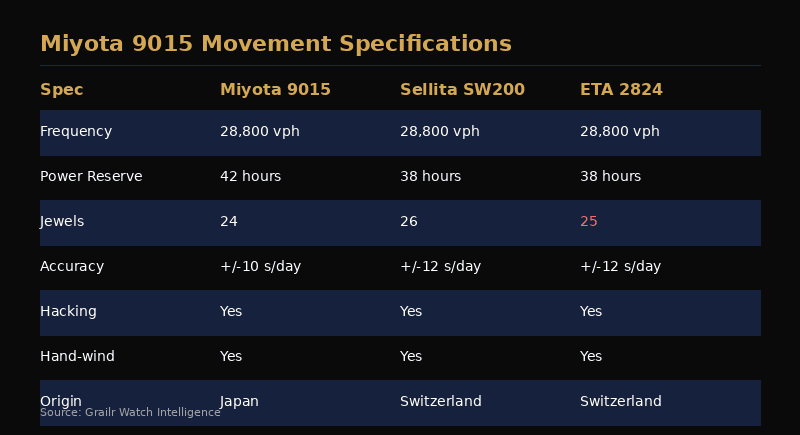
The Miyota 9015 is the engine behind every Astor & Banks watch, and it is worth understanding what that means in practice. Made by Citizen in Japan, the 9015 runs at 28,800 vibrations per hour (4 Hz), offers hacking and hand-winding, and carries roughly 42 hours of power reserve. Accuracy is rated at −10 to +30 seconds per day from the factory, though most examples settle into the −5 to +15 range after a brief wearing-in period. It is not a COSC-certified chronometer, and it will not match an ETA 2824-2 or Sellita SW200 on paper accuracy, but in daily wear the difference is unlikely to matter unless you time your watches against an atomic clock.
The reason microbrands default to the 9015 over Swiss alternatives is straightforward economics. A Miyota 9015 costs a manufacturer roughly $40–$60 depending on volume, while an ETA 2824-2 runs $120–$200 and a Sellita SW200 sits somewhere in between. At Astor & Banks’s retail prices, absorbing a Swiss movement cost would either push the watch past $800 or compress the margin to the point where a small-batch brand cannot sustain itself. The 9015 is the honest choice: reliable, serviceable by any competent watchmaker, and well-proven across hundreds of microbrand and even some mainstream manufacturers.
Beyond the movement, the Fortitude’s build quality holds up well under scrutiny. Case finishing alternates between brushed and polished surfaces with clean transitions, the crown action is smooth with a firm thread engagement for the screw-down mechanism, and the bracelet’s Y-link design shows none of the rattling or loose articulation that cheaper bracelets at this price point sometimes exhibit. The Super-LumiNova X1 application is even and bright, with legible readout lasting well into a dark night. Astor & Banks has invested its cost savings from the direct-to-consumer model into the parts of the watch you actually handle, rather than into marketing or retail distribution overhead.
Sizing and Wrist Fit
The Fortitude’s 38.5mm case diameter, 46mm lug-to-lug, and 20mm lug width put it in a size class that has become genuinely rare in the sport and field watch market. Most competitors in this price range default to 40–42mm cases with 48–50mm lug spans, which sit comfortably on a 7-inch wrist but overhang or look disproportionate on anything below 6.5 inches. The Fortitude was designed deliberately for wrists as small as 6 inches and fits comfortably up to about 7.5 inches, making it one of the few field watches at any price that works genuinely well for women and men with smaller frames.
Astor & Banks was one of the first microbrands to market its watches explicitly as unisex, and the Fortitude’s dimensions back up that claim. The 11.9mm thickness keeps the watch low on the wrist — it slides under a shirt cuff without catching — and the Y-link bracelet’s taper from 20mm to 16mm creates a visual proportion that reads smaller than the raw numbers suggest. On a 6.5-inch wrist, the Fortitude looks intentional rather than shrunken, which is the difference between a watch designed for this size and a large watch made smaller.
If you want more wrist presence, the Sea Ranger at 40mm and the Dorado at a similar size offer that step up without leaving the brand. But the Fortitude’s compact sizing is the reason most buyers come to Astor & Banks in the first place, and it remains the brand’s sharpest competitive edge against bigger names that treat sub-39mm watches as an afterthought.
Check Any Watch Price in Seconds
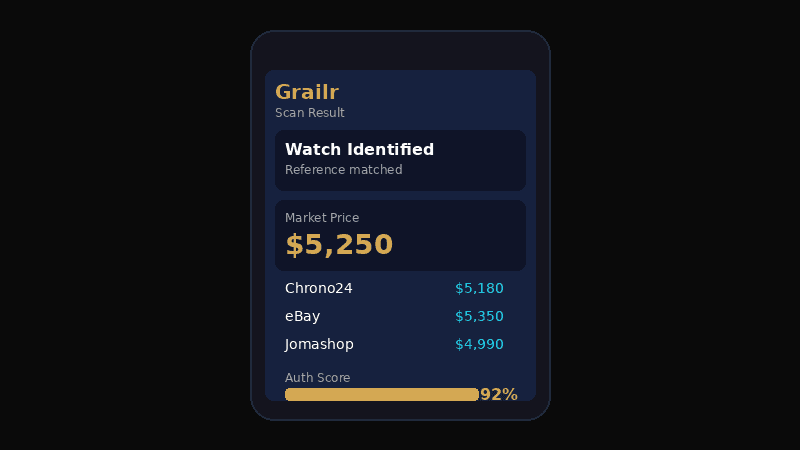
Grailr scans your watch photo and pulls live pricing from Chrono24, eBay, and Jomashop.
- AI identifies brand, model & reference number
- Live market prices from 3+ sources
- Authentication confidence score
Astor & Banks vs Hamilton, Sinn and Marathon
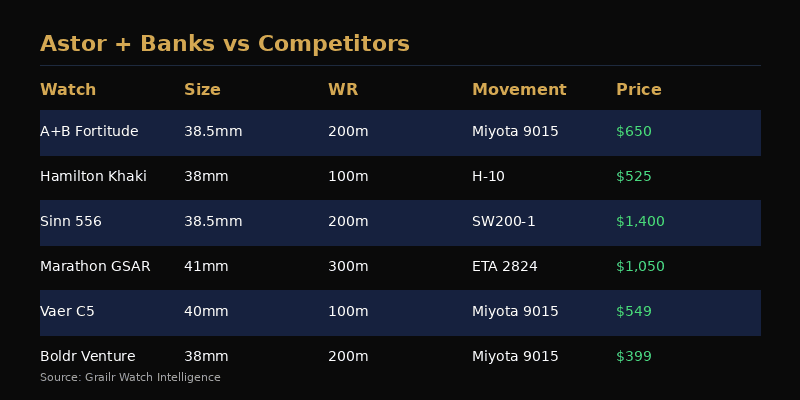
The comparison every prospective Astor & Banks buyer runs eventually is against the established players in the $500–$1,500 field and tool watch space. Four watches come up most often: the Hamilton Khaki Field, the Sinn 556, the Marathon GSAR, and the Fortitude itself. Here is how they compare on the specs that actually matter.
| Watch | Case | Movement | Water Resist. | Power Reserve | Price |
|---|---|---|---|---|---|
| A&B Fortitude | 38.5mm SS | Miyota 9015 | 200m | 42 hr | $525 |
| Hamilton Khaki Auto | 38mm SS | H-10 (Swiss) | 100m | 80 hr | $595 |
| Sinn 556 I | 38.5mm SS | SW200 (Swiss) | 200m | 38 hr | $1,450 |
| Marathon GSAR | 41mm SS | ETA 2824-2 | 300m | 38 hr | $1,100 |
Against the Hamilton Khaki Field Automatic, the Fortitude wins on water resistance (200m versus 100m) and price ($525 versus $595), while Hamilton counters with a Swiss-made movement carrying nearly double the power reserve at 80 hours. Hamilton also brings deeper brand heritage — over 130 years of watchmaking history, a long relationship with military procurement, and widespread retail availability through authorized dealers. If you value the ability to walk into a store, try the watch on, and carry a recognizable Swiss brand name on your wrist, Hamilton wins that argument. If raw specification value per dollar matters more, the Fortitude is hard to beat. For a deeper look, see our Hamilton Khaki Field buying guide.
The Sinn 556 is the comparison that flatters Astor & Banks most. Both watches are 38.5mm, both rate to 200m, and both target buyers who want a compact, no-nonsense tool watch. But the Sinn costs $1,450 — nearly triple the Fortitude — and the premium buys you a Swiss movement, Sinn’s proprietary low-humidity technology, German engineering heritage, and stronger resale performance on the secondary market. Whether that premium is worth it depends entirely on whether brand confidence and secondary-market liquidity matter to you, or whether you would rather put the $900 difference toward a second watch.
The Marathon GSAR sits between the two on price at $1,100 and brings genuine government-issue military credentials — it is supplied to armed forces including Canada’s Department of National Defence. At 41mm it is meaningfully larger than the Fortitude, with 300m of water resistance and an ETA 2824-2 Swiss movement. It is the right watch if military provenance and extreme durability matter more than compact sizing and value pricing. But it is also more than twice the Fortitude’s price, and the Fortitude matches or exceeds it on sapphire quality, lume brightness, and bracelet finishing. The gap is about origin story and movement nationality rather than the watch you hold in your hand.
Is an Astor & Banks Watch Worth Buying?
The honest answer depends on what “worth it” means to you. On pure specifications per dollar, the Fortitude is one of the strongest value propositions in the entire sub-$700 watch market: sapphire crystal with AR coating, Super-LumiNova X1, 200m water resistance, a reliable automatic movement, and a well-finished Y-link bracelet, all for $525. You cannot buy those specs from Hamilton, Tissot, or Seiko at that price. The direct-to-consumer model works — it genuinely delivers more watch for less money, and the build quality backs up the claim.
The tradeoffs are real, though. Astor & Banks has no brand heritage to speak of in traditional watch collecting circles. The Miyota 9015, while reliable, is a Japanese movement in a market where many buyers irrationally but genuinely prefer “Swiss Made” on the dial. Resale value is essentially nonexistent — there is no secondary market infrastructure for a microbrand this small, and you should expect to recover significantly less than retail if you sell. And the direct-only sales model means no try-before-you-buy, no local service center network, and limited edition drops that create scarcity whether or not you want to participate in it.
For a buyer who wants a well-built field watch to wear rather than flip, who values specifications over brand prestige, and who has a wrist that benefits from the 38.5mm sizing the market otherwise ignores, the Fortitude in particular is a straightforward recommendation. It does what it says it does, at a price that leaves room to save for the next one. For a buyer who cares about brand recognition, resale exit value, or Swiss movement provenance, Hamilton’s Khaki Field remains the safer choice at a modest premium.
Frequently Asked Questions
Are Astor & Banks watches good quality?
Yes. Astor & Banks uses sapphire crystals with AR coating, Super-LumiNova X1, the reliable Miyota 9015 automatic movement, and stainless steel cases rated to 200m water resistance across its lineup. Build quality is comparable to watches costing $200-$400 more from established brands.
Who is behind Astor & Banks?
Astor & Banks was founded in Chicago by Andrew Perez, a U.S. military veteran. Perez designed the watches to fill a gap he saw in the market: well-built field and dive watches at accessible prices, with sizing that works for a broader range of wrist sizes than most tool watch brands offer.
What movement does the Astor & Banks Fortitude use?
The Fortitude uses the Miyota 9015 automatic movement made by Citizen in Japan. It runs at 28,800 vibrations per hour, offers hacking and hand-winding, and carries approximately 42 hours of power reserve. It is one of the most widely used and reliable movements in the microbrand segment.
How does the Astor & Banks Fortitude compare to the Hamilton Khaki Field?
Both are field watches in the $500-$700 range. The Fortitude is slightly smaller at 38.5mm with 200m water resistance, while the Hamilton Khaki Field Automatic starts at 38mm with 100m resistance. Hamilton uses a Swiss H-10 movement with 80 hours of power reserve versus the Fortitude's Miyota 9015 at 42 hours. Hamilton carries deeper brand heritage; Astor & Banks offers stronger water resistance and bracelet quality at the price.
Is the Astor & Banks Fortitude a unisex watch?
Effectively, yes. The 38.5mm case diameter and 46mm lug-to-lug measurement make the Fortitude comfortable on wrists from roughly 6 inches to 7.5 inches. Astor & Banks was one of the first microbrands to design deliberately for this sizing range rather than defaulting to the 40-42mm cases common in field watches.
Where can I buy Astor & Banks watches?
Astor & Banks sells directly through its own website at astorandbanks.com. The brand does not use authorized dealer networks or third-party retailers for new sales. Limited editions sell out quickly and are available only during specific release windows announced on the brand's mailing list and social media.
Related Articles
The Bottom Line
Astor & Banks has earned its reputation in the microbrand world by doing something straightforward well: building field and sport watches with specifications that punch above their $525–$695 price range, in a compact case size that the mainstream market largely ignores. The Fortitude is the standout — a 38.5mm field watch with 200m water resistance, sapphire crystal, Super-LumiNova X1, and a Y-link bracelet that should not exist at this price. It will not impress anyone looking for a Swiss pedigree or a strong resale market, and you cannot try it on before buying. But as a watch to wear, on a wrist that most brands do not design for, it is one of the best values available. Verify the current availability on the brand’s site before you plan a purchase; production runs are small, and the dial you want may not be available when you are ready.
Considering a Microbrand Watch?
Grailr uses a photo to suggest a watch identity and an indicative price estimate, with active eBay listings where available. Check the exact reference and condition independently; a photo scan cannot authenticate a watch.
Get an Indicative EstimateSources and price context
- Astor & Banks official website — Specifications, pricing, and availability for the Fortitude, Sea Ranger, and Dorado lines.
- Hamilton Khaki Field collection — Official specifications and retail pricing for the Khaki Field Mechanical, Automatic, and Murph.
- Sinn 556 I product page — Official specifications, pricing, and technical details for the Sinn 556 I.
These primary sources support the specifications and history noted above. Prices and comparisons elsewhere in this guide are indicative editorial figures, not a verified transaction dataset or guaranteed returns. Confirm the exact reference, region, condition and current quote before buying; asking prices are not completed-sale prices.