Best Watch Safes: Fire Ratings, Bolt-Down and Insurance
Certifications matter more than brand names. Here is how to pick a safe that your insurer will actually accept.
Price context: this guide includes indicative prices from its original publication period. They have not all been refreshed to current quotes. Use the linked primary sources for specifications and policies, and verify prices independently.
- A watch safe needs both a fire rating (UL 72 Class 350, 60 min minimum) and a burglary rating (RSC or higher) — one without the other leaves a gap
- Bolt-down is not optional: any safe under 750 lb that is not anchored can be wheeled out in minutes
- Standard homeowner’s insurance caps jewellery losses at $1,500–$2,500 — you almost certainly need a rider or specialist policy
- Budget 5–10% of your insured collection value on the safe itself
Why a Watch Safe Is Different
A generic home safe from a hardware shop is designed to protect documents from fire, not to protect a $50,000 collection from a targeted break-in. Watch safes occupy a narrow niche: they need fire protection so your collection survives a house fire, burglary resistance so it survives a break-in, and interior conditions — stable humidity, soft linings, optional winders — that won’t damage the watches themselves.
The watch community tends to focus on the brand name on the door. That is the wrong approach. Certifications are what matters, because certifications are what your insurer will ask about when you file a claim. A beautifully made safe with no third-party rating is, from an insurance perspective, a cupboard.
This guide breaks the problem into its three components — fire, burglary and insurance — so you can match the right safe to your collection value and your insurer’s requirements.
Fire Ratings Explained
Fire ratings tell you how long the safe’s interior stays below a damaging temperature during a fire. The two standards you will see are UL 72 (North America) and EN 1047-1 (Europe). Both subject the safe to a furnace test that ramps to over 1,700°F externally.
UL 72 Class 350 means the interior did not exceed 350°F (177°C) for the rated duration — the threshold at which paper chars. Watches, which are metal and sapphire crystal, tolerate higher temperatures than paper, but the gaskets, leather straps and watch-box linings inside your safe do not. Class 350 at 60 minutes is the baseline for any collection worth insuring.
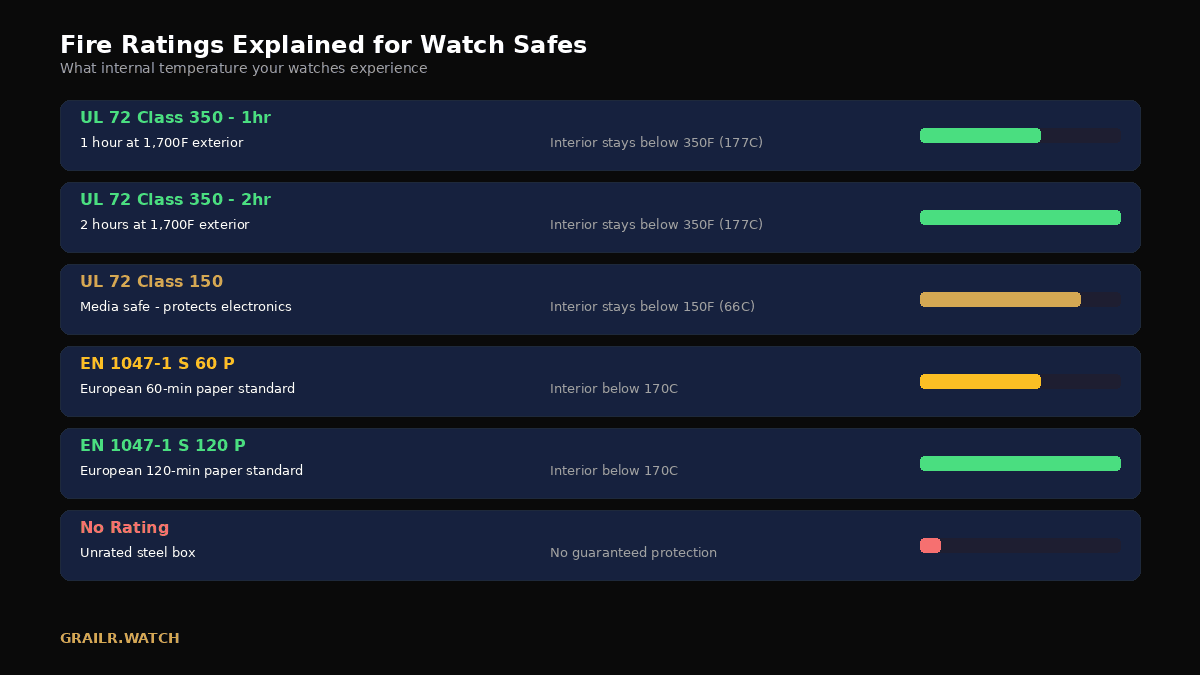
| Standard | Rating | Max Interior Temp | Duration | Watch Suitability |
|---|---|---|---|---|
| UL 72 | Class 350 – 1 hr | 350°F / 177°C | 60 min | Minimum |
| UL 72 | Class 350 – 2 hr | 350°F / 177°C | 120 min | Recommended |
| EN 1047-1 | LFS 60 P | 170°C / 338°F | 60 min | Minimum |
| EN 1047-1 | LFS 120 P | 170°C / 338°F | 120 min | Recommended |
Do not confuse a “fire-resistant” label with a certified fire rating. Many consumer safes claim fire resistance based on the manufacturer’s own testing, which has no independent verification. Look for the UL or EN mark, not the manufacturer’s promise.
Burglary Ratings Explained
Burglary ratings measure how long a safe resists a physical attack using specified tools. In North America, UL 687 defines the scale. In Europe, EN 1143-1 uses resistance units (RU). Higher is harder to crack.
| Rating | Attack Time | Tools Allowed | Typical Use |
|---|---|---|---|
| RSC (Residential Security Container) | 5 min net | Hand tools, pry bars | Collections under $25K |
| B-Rate | ~10 min | Hand tools, small drills | $25K–$50K |
| TL-15 | 15 min net | Drills, saws, hand tools | $50K–$150K |
| TL-30 | 30 min net | Same as TL-15, plus carbide | $150K–$500K |
| TRTL-30 | 30 min net | TL-30 plus torches | $500K+ |
| EN 1143-1 Grade III+ | 80+ RU | Power tools, torches | $250K+ (European) |
An RSC rating is the minimum a serious insurer will consider. For collections above $50,000, most underwriters want TL-15 or better. Ask your insurer before buying — upgrading a safe after installation is expensive and sometimes impossible if it is already bolted in.
Bolt-Down Requirements
This is the point most collectors miss. A 300 lb safe with a TL-15 rating is meaningless if two people can roll it out on a furniture dolly. The average residential burglary in the US takes 8–12 minutes. If the safe itself can be removed in 3 of those minutes, the rating on the door is irrelevant.
Floor bolting is the standard approach. Most safes ship with pre-drilled anchor holes in the base. You’ll need concrete anchors (for slab or basement floors) or through-bolts (for elevated wood framing). Two to four ½” bolts into a concrete slab make the safe effectively immovable without heavy equipment.
Wall bolting is an alternative for safes positioned against a load-bearing wall. It does not replace floor bolting but adds a second anchor point. Some insurers accept wall-only mounting for lighter safes in certain configurations.
The insurance angle: most specialist watch and jewellery policies require photographic evidence of the bolt-down installation. Some require a locksmith’s certificate of installation. Check your policy wording before you pour concrete.
Best Watch Safes by Collection Value
The right safe depends on what you are protecting. Below are recommendations by insured collection value, with indicative pricing. The 5–10% guideline means a $100,000 collection warrants a $5,000–$10,000 safe.
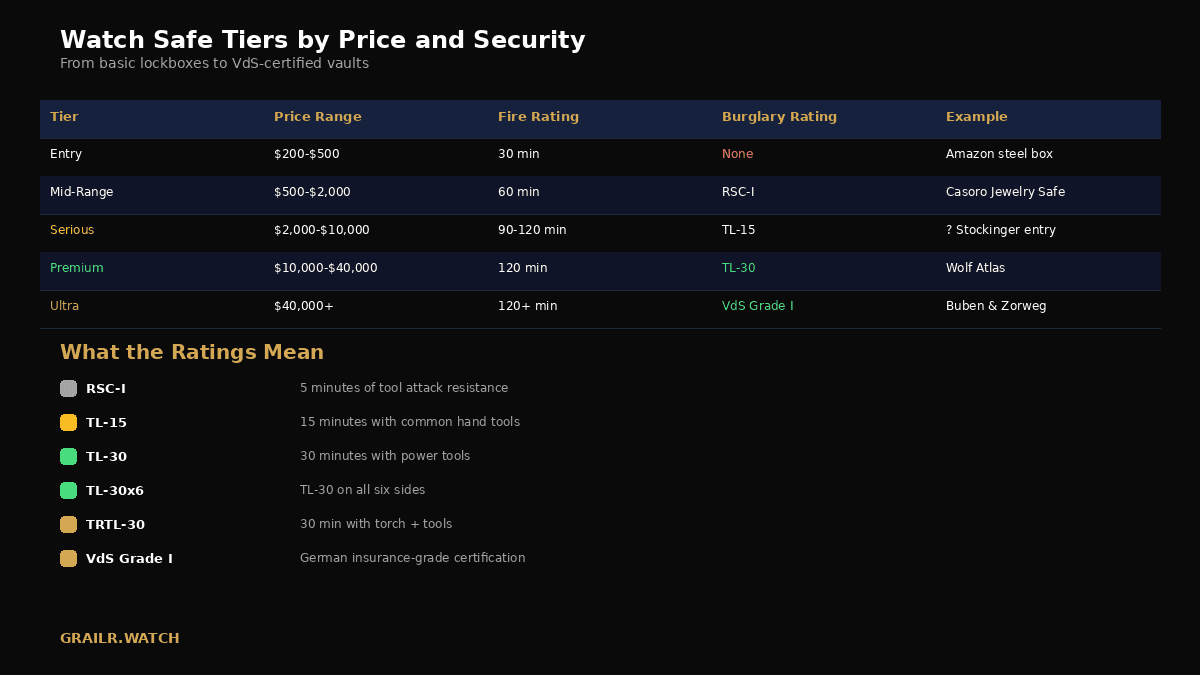
Under $25,000 — RSC Fire Safe ($500–$1,500)
A residential security container with UL 72 Class 350 fire rating is sufficient. The Liberty Safe Centurion series and Hollon HS series cover this range. Expect 200–400 lb curb weight, electronic keypad, and bolt-down hardware included. This tier protects a three- to five-watch collection of mid-range pieces.
$25,000–$100,000 — B-Rate or TL-15 ($2,000–$6,000)
At this level you need a heavier body, composite barriers, and a hard-plate behind the lock. The AMSEC BF series ($2,200–$4,500) offers 120-minute fire ratings with B-rate burglary protection. For TL-15, the Hollon MJ series starts around $4,000. Both accept aftermarket watch-winder drawers.
$100,000–$500,000 — TL-30 ($6,000–$15,000)
This is where dedicated watch safes start to make sense. The Wolf Atlas ($8,000–$40,000 depending on configuration) combines TL-equivalent construction with integrated winders, LED-lit display shelving, and biometric access. Alternatively, an AMSEC CF series with a custom interior achieves TL-30 from around $7,000.
$500,000+ — TRTL-30 or Vault ($15,000–$100,000+)
At half a million and above, you are looking at TRTL-30 stand-alone units or a walk-in vault room. Buben & Zörweg vault rooms start around $38,700 and are VdS-certified (the German equivalent of UL). At this level, the insurer typically specifies the exact safe model and installation requirements. Professional security consultants are recommended.
Know What Your Collection Is Worth
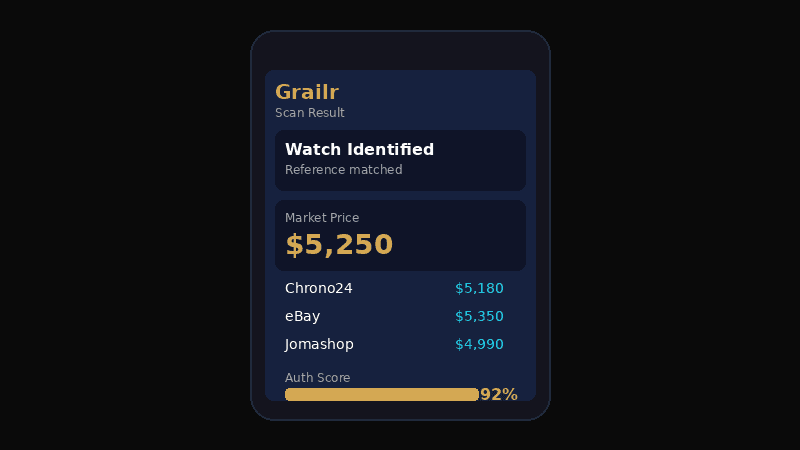
Grailr uses a photo to suggest a watch identity and an indicative price estimate, with active eBay listings where available. A useful starting point for insurance scheduling. Check the exact reference and condition independently.
- Instant model identification
- Indicative price estimates
- Active eBay listings where available
Insurance Requirements
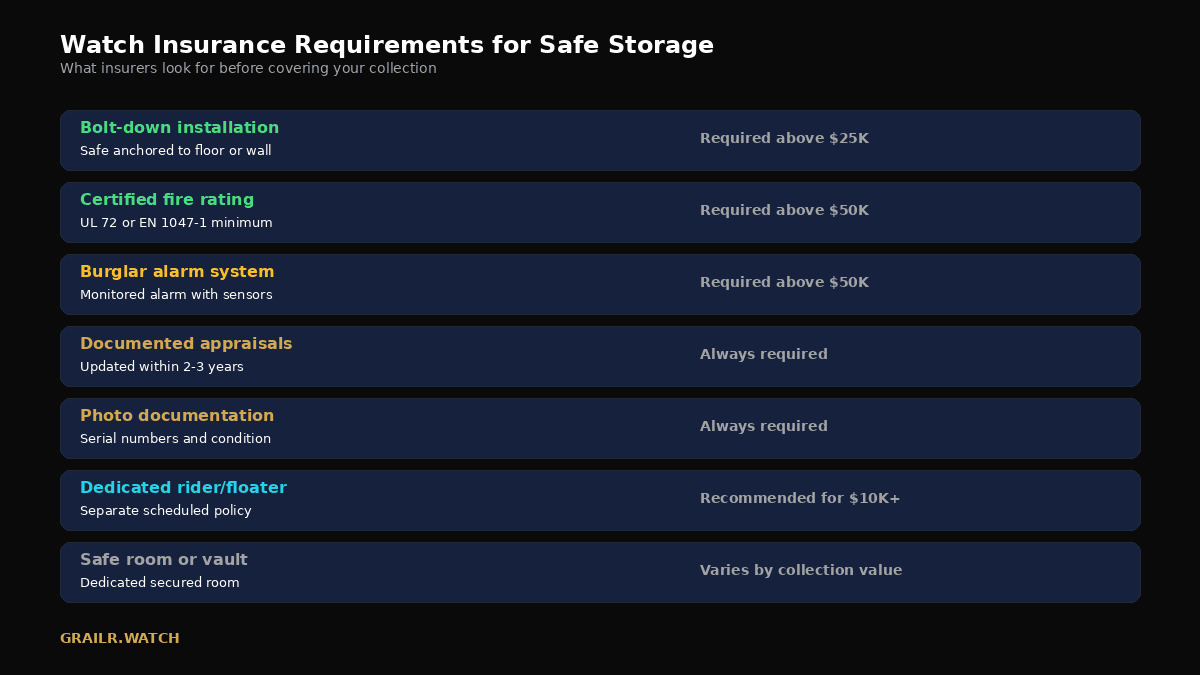
Most watch collectors are under-insured and don’t realise it until they file a claim. Standard homeowner’s and renter’s policies carry sub-limits for jewellery, watches and precious items — typically $1,500 to $2,500 aggregate regardless of policy size.
Coverage options
| Coverage Type | Typical Limit | Cost | Safe Required? |
|---|---|---|---|
| Homeowner’s base | $1,500–$2,500 | Included | No |
| Scheduled rider | Per item | $10–$20 per $1K/yr | Often |
| Specialist (Hodinkee, Jewelers Mutual) | Per item | $8–$15 per $1K/yr | Depends on value |
| Private client / high-net-worth | Blanket | Varies | Usually + alarm |
The interaction between safe rating and insurance cost is direct: a higher-rated safe typically earns a premium discount of 5–15%. Some underwriters will not write coverage above $50,000 without proof of a TL-rated safe. Others will write the coverage but exclude theft if the safe does not meet their specifications.
Always get the insurer’s requirements in writing before purchasing the safe. A safe that meets your expectations but not your insurer’s specifications is a very expensive cabinet.
Winder Safes vs Static Storage
Automatic watches stop running after 40–70 hours without wrist time. A watch winder keeps the rotor spinning so the watch stays set. Winder safes integrate the winder mechanism into the safe interior, combining security with convenience.
The argument for a winder safe: you open the door, and every watch is running, set and ready to wear. No need to wind and set the date on a perpetual calendar before leaving the house.
The argument against: winders add mechanical complexity, draw power (which means a cable pass-through in the safe body, a potential weak point), and cost. A quality winder module adds $200–$500 per watch position. More importantly, keeping a watch wound continuously may put marginally more wear on the movement compared to letting it rest — watchmakers disagree on how much this matters in practice.
Our take: if you rotate through your collection daily and have perpetual calendars or annual calendars, a winder safe saves real time. If your watches sit for weeks between wearings, static storage in watch pouches with a small silica sachet is perfectly fine and removes the cable pass-through concern entirely.
Five Mistakes to Avoid
1. Buying by Brand Name Instead of Rating
A $3,000 “luxury” safe with no UL or EN certification is less secure than a $1,200 RSC-rated safe from a commercial manufacturer. Check the rating plate on the inside of the door; if there is no plate, there is no third-party certification.
2. Skipping the Bolt-Down
A safe that is not anchored is a portable container. Bolt to the floor, bolt to the wall, or ideally both. Keep the receipt and photographs for your insurer.
3. Ignoring Humidity
Sealed safes trap moisture. A safe in a basement or garage needs a rechargeable dehumidifier rod (GoldenRod or similar) to keep internal humidity below 50%. Prolonged humidity damages leather straps, corrodes steel cases and can fog crystals.
4. Telling People About It
The best safe in the world does not help if someone knows it is there. Do not post your safe on social media. Do not tell the delivery drivers what is inside. Have it delivered in a generic crate and installed by a bonded locksmith.
5. Assuming Your Insurance Covers It
Call your insurer and ask three questions: what is the sub-limit for watches, what safe do they require at your collection value, and will they accept your current safe. Do this before the safe is installed, not after a loss.
Frequently Asked Questions
What fire rating should a watch safe have?
UL 72 Class 350 at 60 minutes minimum. This keeps interior temperature below 350°F, which protects paper, leather straps and watch boxes. For collections over $100,000, a 120-minute rating is recommended.
Do I need to bolt down a watch safe?
Yes. Any safe under 750 lb should be bolted to the floor or wall. Most insurers require bolt-down for collections over $25,000. A safe that is not anchored can be removed by two people with a hand truck in under five minutes.
Will my homeowner’s insurance cover watches in a safe?
Standard homeowner’s policies typically cap jewellery and watch losses at $1,500–$2,500. Collections above that need a scheduled personal property rider or a specialist policy from a provider such as Hodinkee Insurance or Jewelers Mutual.
How much should I spend on a watch safe?
A common guideline is 5–10% of the insured collection value. A $50,000 collection warrants a $2,500–$5,000 safe. Below $1,000, most safes lack meaningful burglary or fire certifications.
Related Articles
The Bottom Line
A watch safe is not a luxury purchase — it is risk management. Match the safe’s fire and burglary ratings to your collection value, bolt it down, and confirm that your insurer accepts it before you install it. The right safe pays for itself the moment you need it and never needs to justify its existence the rest of the time.
Need to Value Your Collection?
Grailr uses a photo to suggest a watch identity and an indicative price estimate. Useful for insurance scheduling. Check the exact reference and condition independently; a photo scan cannot authenticate a watch.
Scan a Watch NowSources and price context
- UL 72: Standard for Tests for Fire Resistance of Record Protection Equipment — Defines the Class 350 fire-resistance test for safes and filing cabinets.
- UL 687: Standard for Burglary-Resistant Safes — Defines RSC, TL-15, TL-30 and TRTL-30 burglary-resistance classifications.
These primary sources support the specific rating and classification points noted above. Prices are indicative editorial figures, not verified retail quotes. Confirm the exact model, rating and current price with the manufacturer or dealer before buying.