Travelling with Watches: Cases, Customs and Insurance
How to protect your collection in transit, what you owe at the border, and which insurance actually covers you abroad.
Price context: this guide includes indicative prices from its original publication period. They have not all been refreshed to current quotes. Use the linked primary sources for specifications and policies, and verify prices independently.

- Wear your watch through airport security — never check a watch in luggage
- Customs duty-free thresholds vary widely: $800 (US), €430 (EU), £390 (UK), 300 CHF (Switzerland)
- Pelican 1120/1200 cases are the gold standard for impact protection; watch rolls win on discretion
- Homeowner’s jewellery sub-limits apply abroad — check your rider covers travel
The Golden Rule: Wear It
The single most important piece of travel advice for watch collectors is this: wear your watch on your wrist. Do not put it in checked luggage, do not leave it in a coat pocket going through security, and do not store it in a hotel-room safe if you can avoid it.
A watch on your wrist is always with you. It cannot be lost by the airline, stolen from your suitcase, or left behind in a hotel-room safe (a disturbingly common scenario — most hotel-safe theft involves staff with override codes or guests who simply forget to check before checkout).
If you are travelling with more than one watch, wear your most valuable piece and pack the rest in a carry-on case. Never check watches. Airline liability for lost checked luggage is capped at roughly $3,800 under the Montreal Convention, and most carriers exclude jewellery and watches from even that limit.
Hard Cases: Pelican and Alternatives
Pelican cases are the standard for transporting sensitive equipment — photographers, military personnel and emergency medical teams have used them for decades. They work equally well for watches, and the smaller models fit easily in a carry-on bag.
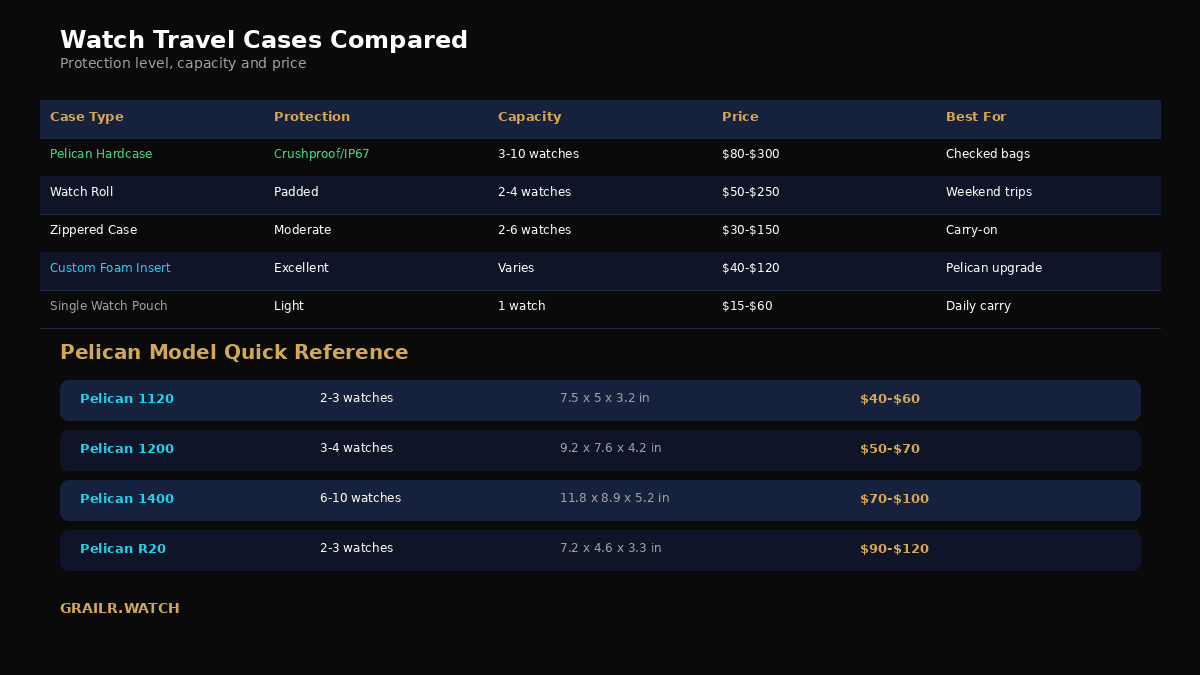
| Model | Interior (L × W × D) | Watches | Weight | Price |
|---|---|---|---|---|
| Pelican 1120 | 7.5 × 5.1 × 3.1″ | 2–3 | 1.2 lb | $35–$45 |
| Pelican 1200 | 9.3 × 7.1 × 4.1″ | 3–4 | 2.0 lb | $40–$55 |
| Pelican 1400 | 11.8 × 8.9 × 5.2″ | 6–8 | 3.5 lb | $65–$85 |
| Pelican R20 Ruck | 7.1 × 4.6 × 2.6″ | 2–3 | 0.8 lb | $25–$35 |
| Nanuk 903 | 7.4 × 4.9 × 3.1″ | 2–3 | 0.9 lb | $30–$40 |
All Pelican cases are IP67-rated (submersible to 1 metre for 30 minutes) and meet MIL-STD-810G for shock and vibration. The included Pick N Pluck foam lets you cut custom watch-shaped cavities in about ten minutes. For a more polished result, custom-cut Kaizen foam inserts are available from third-party suppliers for $15–$30.
The trade-off with hard cases is visibility. A small Pelican case in your carry-on is distinctive, and experienced thieves know what they contain. If discretion matters more than impact resistance, a soft watch roll is the better choice.
Watch Rolls and Soft Cases
A watch roll is a padded leather or canvas cylinder that holds one to five watches in individual cushioned slots. They are lighter, more discreet and faster to open than hard cases. For a weekend trip with one or two extra watches, a roll is usually the right choice.
Quality varies enormously. A $15 Amazon roll may have inadequate padding and magnets that can affect a mechanical movement (unlikely but worth avoiding). A well-made roll from Everest, Hodinkee or Wolf uses non-magnetic closures, Alcantara or microfibre linings, and firm individual cushions that prevent watch-on-watch contact.
| Feature | Hard Case (Pelican) | Watch Roll |
|---|---|---|
| Impact protection | Excellent (MIL-STD-810G) | Moderate |
| Water resistance | IP67 | None |
| Discretion | Low | High |
| Weight | 1–3.5 lb | 0.2–0.5 lb |
| Price | $25–$85 | $50–$250 |
| Best for | Adventure, checked situations | Business travel, weekends |
Customs Thresholds by Country
If you are crossing an international border wearing or carrying watches, you need to understand the duty-free personal exemption for the country you are entering. Goods above the threshold are subject to import duty and VAT (or sales tax), which can add 20–30% to the value of the item.
The key distinction: personal items you owned before the trip are generally exempt from duty. The threshold applies to items you are importing — watches purchased abroad, gifts, or items you cannot prove you owned prior to departure. This is why proof of prior ownership (next section) matters.
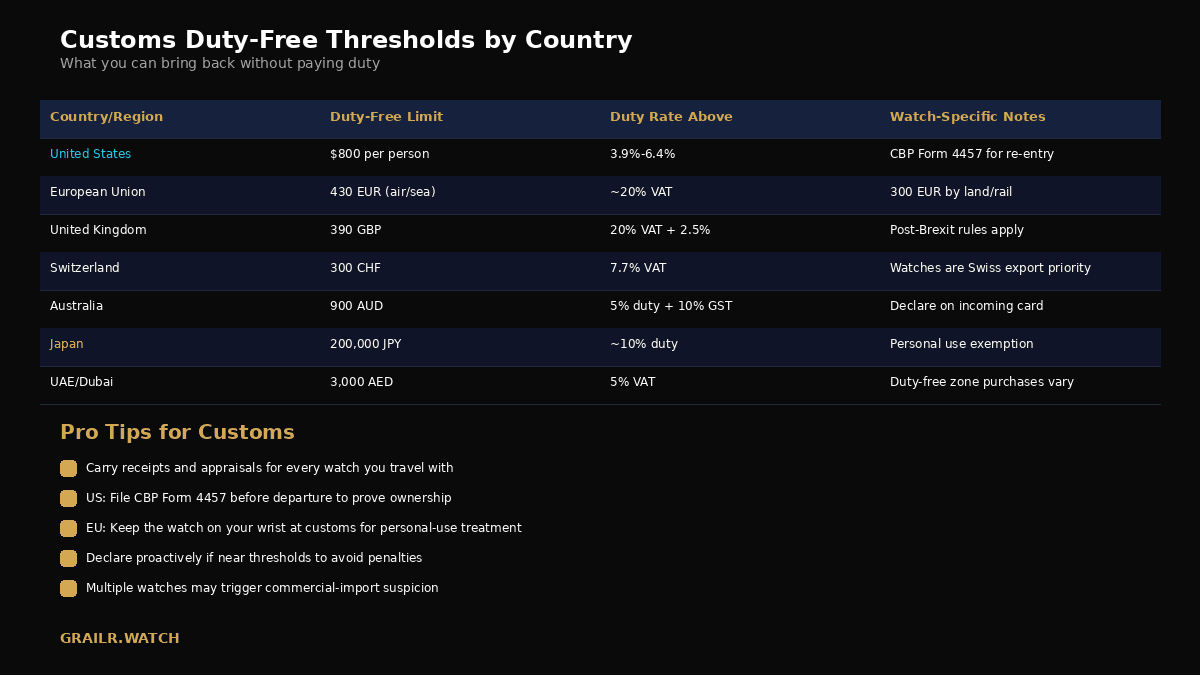
| Country / Region | Duty-Free Threshold | Duty Rate (Watches) | VAT / Tax |
|---|---|---|---|
| United States | $800 | 6.4% (mechanical) | None federal |
| European Union | €430 (air/sea) | 4.5% | 19–27% VAT |
| United Kingdom | £390 | 4.5% | 20% VAT |
| Switzerland | 300 CHF | 0% (Swiss origin) | 8.1% VAT |
| Canada | CAD 800 (48 hr+) | 5% | 5% GST + prov. |
| Australia | AUD 900 | 5% | 10% GST |
| Japan | ¥200,000 | 0% (under 300K) | 10% consumption tax |
| Singapore | SGD 600 | 0% | 9% GST |
Thresholds and rates are indicative and subject to change. Verify current figures with the destination country’s customs authority before travel.
How to Prove Prior Ownership
When you return home wearing a Rolex Daytona, a customs officer may reasonably ask whether you bought it abroad. If you cannot prove you owned it before you left, you may owe duty on its full value. Three forms of proof are widely accepted:
1. CBP Form 4457 (US) or Equivalent
In the United States, you can register personal items with Customs and Border Protection before departure using Form 4457. It is free, valid indefinitely, and accepted at every US port of entry. Present your watches at a CBP office at the airport before your outbound flight and they will stamp the form with serial numbers. Other countries have equivalent processes: the UK uses form C&E 1246.
2. Purchase Receipt or Invoice
An original receipt from a domestic retailer or a pre-owned dealer showing the serial number, purchase date and your name. A photo of the receipt on your phone is usually accepted, but carry the original if you have it.
3. Insurance Schedule
A current insurance schedule listing the watch by brand, model and serial number with an effective date before your departure. This is the easiest proof to produce if you already have your collection insured — which you should.
Carry copies of at least one of these forms when travelling internationally with watches worth more than the duty-free threshold. The five minutes it takes to prepare can save you thousands at the border.
Document Your Collection Before You Travel
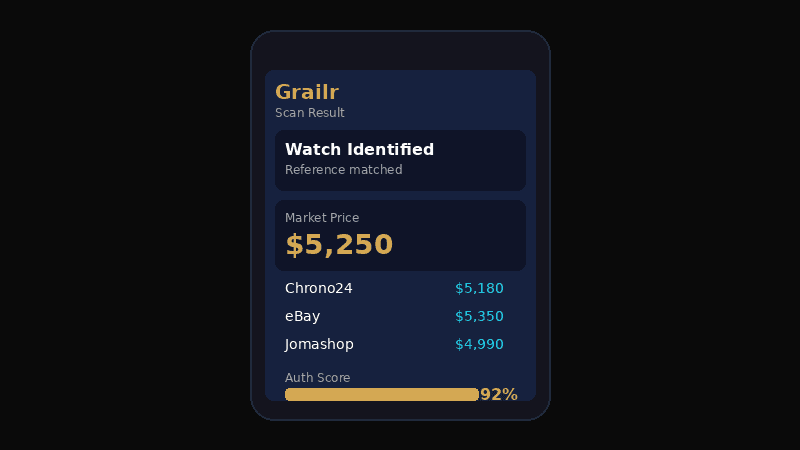
Grailr uses a photo to suggest a watch identity and an indicative price estimate. Scan each piece before departure so you have a timestamped record with model identification. Not proof of ownership or authenticity — but a useful supplement to your receipts and insurance schedule.
- Instant model identification
- Timestamped scan records
- Active eBay listings where available
Travel Insurance for Watches
Travel insurance and watch insurance are different things, and neither automatically covers what the other does. Here is how the main options compare for watch collectors specifically.
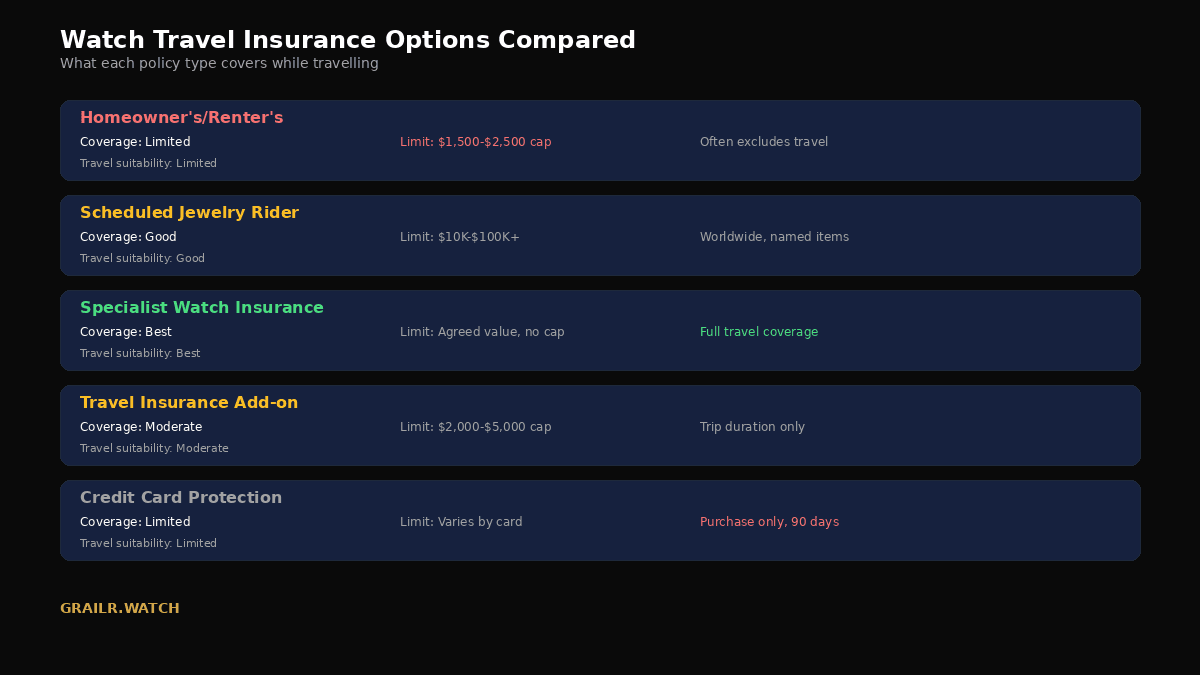
| Coverage Type | Watch Limit | Theft Covered? | Loss Covered? | Worldwide? |
|---|---|---|---|---|
| Generic travel insurance | $500–$1,000 | Limited | No | Yes |
| Homeowner’s rider | Per item | Yes | Yes | Check territory |
| Specialist watch (Hodinkee, JM) | Per item | Yes | Yes | Yes |
| Credit card travel benefit | $500–$10,000 | Varies | Rarely | Yes |
| Premium credit card (Amex Plat, etc.) | $10,000–$50,000 | Yes | Varies | Yes |
For most collectors, a specialist watch policy from Hodinkee Insurance or Jewelers Mutual is the cleanest solution. Coverage is worldwide, covers theft and accidental loss, and premiums run $8–$15 per $1,000 of insured value per year. A $20,000 Rolex Submariner costs roughly $200/year to insure globally with no deductible.
Hotel and Destination Safety
Hotel-room safes are a convenience, not a security measure. They are typically small electronic boxes bolted to a shelf with four screws. Staff have master override codes, and the safes themselves are rated for minutes of attack time at best. Many insurers do not consider a hotel-room safe adequate storage for high-value items.
If you must leave a watch in a hotel, ask the front desk about the hotel safe (not the room safe). Hotel main safes are larger, better-rated, and access is logged. Some five-star hotels offer individual safe-deposit boxes within their main vault. Get a receipt listing what you deposited.
At your destination, apply common sense. Avoid wearing a conspicuous watch — a gold Rolex Day-Date or an Audemars Piguet Royal Oak — in areas known for street crime. Rotate to a less recognisable piece, or wear your watch under a long sleeve. Targeted watch thefts are increasing in tourist areas of London, Paris, Barcelona and several US cities; awareness is your best defence.
If you are attending a watch event, trade show or meet-up, exercise extra caution leaving the venue. Criminals have been known to follow attendees from watch shows to their hotels or cars. Travel with a companion if possible, vary your route, and do not carry all your watches at once.
Packing Checklist
Before you leave for the airport, run through this list:
Wear your most valuable watch — it stays with you through security and on the plane
Pack extra watches in a carry-on case or roll — never checked luggage
Bring proof of prior ownership — CBP Form 4457, receipts, or insurance schedule
Photograph each watch before departure — timestamped photos on your phone showing the watch at home
Confirm your insurance covers travel — check territorial limits and theft-from-vehicle exclusions
Know the duty-free threshold — for every country you are entering, not just your destination
Frequently Asked Questions
Do I need to declare watches at customs?
Yes, if the total value of goods you are bringing in exceeds the duty-free threshold: $800 in the US, €430 in the EU, £390 in the UK, and 300 CHF in Switzerland. Personal items you owned before the trip are generally exempt, but you should carry proof of prior ownership.
Is a Pelican case good for travelling with watches?
Pelican cases offer excellent impact, water and dust protection (IP67 rated). The 1120 and 1200 models fit 2–4 watches with custom foam. The trade-off is visibility: a hard case may attract attention. A soft watch roll is less conspicuous for everyday travel.
Does my homeowner’s insurance cover watches while travelling?
Most homeowner’s policies cover personal property away from home, but the jewellery sub-limit still applies ($1,500–$2,500). A scheduled personal property rider typically covers items worldwide. Check whether your policy has a territorial exclusion.
Should I wear my watch or pack it when flying?
Wear it through security and during the flight. A watch on your wrist cannot be stolen from checked luggage, lost in transit, or damaged by baggage handling. Remove it only for the X-ray belt if asked by security, and put it back on immediately.
Related Articles
The Bottom Line
Travelling with watches is straightforward when you prepare. Wear your best piece, pack the rest in a carry-on case, carry proof of ownership, and make sure your insurance works abroad. The five minutes of preparation before departure prevent the five-figure headache at the border or after a loss.
Heading Somewhere?
Scan your watches before you travel to create a timestamped record of each piece. Grailr suggests an identity and an indicative price estimate — not proof of ownership, but a useful travel companion alongside your receipts.
Scan a Watch NowSources and price context
- CBP Form 4457: Certificate of Registration for Personal Effects — US Customs and Border Protection form for registering personal items taken abroad.
- Pelican Protector Cases — Manufacturer specifications for the 1120, 1200, 1400 and R20 cases referenced in this guide.
These primary sources support the specific product and policy points noted above. Duty-free thresholds, duty rates and insurance premiums are indicative editorial figures. Confirm current figures with the relevant customs authority or insurer before travel.