Bulova Watches: Every Collection, Price and Pick
Every Bulova collection compared — Lunar Pilot, Precisionist, Curv, Sutton, Marine Star, Hack Watch, and more — with 2026 street prices, real specifications, and the models that actually justify their asking price.
Prices shown are current asking prices from authorized dealers, Amazon, and grey-market retailers as of October 2026. They are not verified completed sales. Grailr does not sell watches and has no affiliate relationship with Bulova or the Citizen Watch Group.

Key Takeaways
- Bulova’s Precisionist 262 kHz movement is 16× more accurate than standard quartz and produces a sweeping seconds hand that looks mechanical
- The Lunar Pilot ($495–$550) is the only sub-$600 chronograph with a verified moon-mission pedigree — Apollo 15, Dave Scott, 1971
- Most models sit between $125 and $700, making Bulova one of the strongest value propositions in American-heritage watchmaking
- Resale is weak (50–70% depreciation on most models), but the Lunar Pilot and vintage Accutrons hold or appreciate — buy for enjoyment, not investment
150 Years of New York Heritage
Joseph Bulova, a Czech immigrant, opened a jewellery shop on Maiden Lane in lower Manhattan in 1875. Within two decades the company was manufacturing its own watch cases, and by the 1920s Bulova was one of the largest watch advertisers in America — the brand ran the first-ever radio commercial (1926) and the first television commercial (1941). That marketing instinct made Bulova a household name long before quartz arrived.
The defining chapter came in 1960 with the Accutron. Instead of a balance wheel, the Accutron used a 360 Hz tuning fork to regulate time — the first electronic watch ever produced. Accuracy was ±2 seconds per day, an order of magnitude better than mechanical watches of the era. NASA noticed: the Accutron movement was used in 46 space missions, timing instruments on everything from satellites to the Apollo program. On 1 August 1971, astronaut Dave Scott wore a Bulova chronograph prototype on the lunar surface during Apollo 15 — making it one of only a handful of watches worn on the Moon.
The Accutron was discontinued in 1977 as conventional quartz movements overtook tuning-fork technology on cost. Bulova passed through several ownership changes before Citizen Watch Group acquired the brand in 2008. That acquisition gave Bulova access to Citizen’s manufacturing infrastructure and movement technology while preserving the American-heritage identity.
In 2010, Bulova introduced the Precisionist movement — a 262 kHz quartz calibre that revived the brand’s accuracy-first philosophy. Today Bulova sits in a unique position: 150 years of New York provenance, a genuine space-programme history, Citizen’s engineering backbone, and a price range ($125–$700) that puts most of the lineup within reach of first-time buyers. Few brands at this price point can claim anything close.
The Precisionist Movement
A standard quartz watch oscillates at 32,768 Hz. The Precisionist crystal vibrates at 262,144 Hz — exactly 16 times higher. That higher frequency divides time into finer slices, delivering rated accuracy of ±10 seconds per year. For context, a typical quartz watch drifts ±15 seconds per month; the Precisionist drifts less than one second per month. Only thermocompensated quartz (TCXO) movements from the likes of Breitling’s SuperQuartz are more accurate, and those cost five to ten times as much.
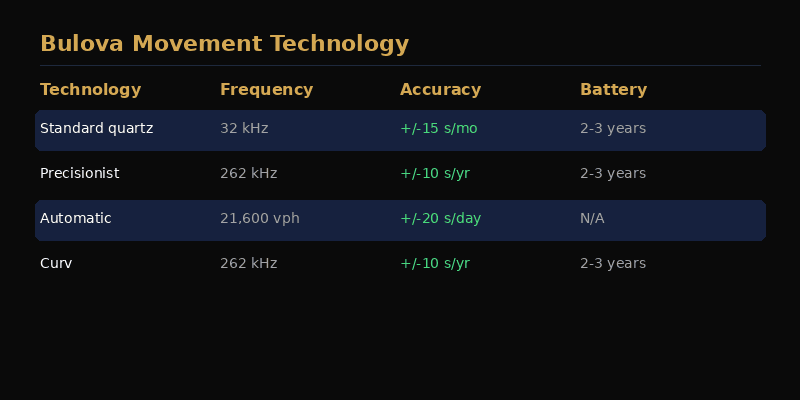
The practical upside is more than accuracy. Because the crystal frequency is so high, the seconds hand moves in 16 steps per second instead of the one-tick-per-second jump of conventional quartz. The result is a continuous sweeping motion that is visually indistinguishable from a mechanical watch at normal viewing distance. For buyers who like the look of a mechanical seconds hand but want quartz reliability, this is the strongest reason to choose Bulova over a comparably priced Seiko or Citizen.
The trade-off is battery life. Driving a 262 kHz crystal draws more current than 32 kHz, so Precisionist watches need a battery change every two to three years versus four to five for standard quartz. Replacement costs $15–$30 at a jeweller. Given what you get — 16× accuracy and a sweeping hand — most owners consider that a fair exchange.
Every Bulova Collection Reviewed
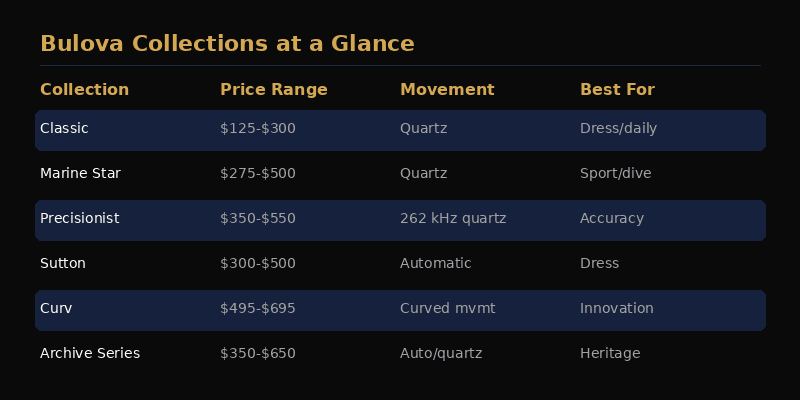
Bulova’s current lineup spans dress watches, sport chronographs, military field pieces, and heritage reissues. Here is every collection that matters, ranked by the combination of build quality, movement, and real-world value. For a broader look at watches in this price range, see our guides to the best affordable watches and best budget watches.
| Collection | Price Range | Movement | WR | Best For |
|---|---|---|---|---|
| Lunar Pilot | $495–$550 | Precisionist 262 kHz | 50m | Heritage chronograph |
| Precisionist | $450–$700 | Precisionist 262 kHz | 300m | Accuracy-first sport |
| Curv | $495–$695 | Curved chronograph | 30m | Ergonomic dress chrono |
| Marine Star | $395–$595 | Quartz chronograph | 200m | Sport and diving |
| Sutton | $350–$495 | Automatic | 30m | Dress and skeleton |
| Frank Sinatra | $395–$595 | Quartz / automatic | 30m | Heritage dress |
| Hack Watch | $250–$350 | Quartz | 50m | Military field style |
| Classic | $125–$250 | Quartz | 30m | Entry-level everyday |
1. Lunar Pilot ($495–$550)
The flagship. The Lunar Pilot is a direct descendant of the chronograph Dave Scott wore on the lunar surface during Apollo 15 in 1971. That prototype — not the mission-issued Omega Speedmaster — was what Scott strapped over his spacesuit glove for the moonwalk. Bulova released the modern Lunar Pilot (references 96A225 and 96B251) with the Precisionist 262 kHz movement, a 45mm cushion case, and a high-accuracy chronograph capable of timing to 1/1000th of a second.
At $495–$550, it is the only sub-$600 chronograph with a documented moon-mission connection. The sweeping seconds hand, sapphire crystal, and leather-strap presentation make it genuinely compelling. Water resistance is only 50m, so this is not a dive tool, but for desk, dress, and weekend wear it is the single strongest statement Bulova makes. Collector interest keeps secondary-market values higher than any other current-production Bulova.
2. Precisionist Chronograph ($450–$700)
If the Lunar Pilot is the heritage play, the Precisionist chronograph line is the technical one. These watches use the same 262 kHz movement but wrap it in sportier cases with rotating bezels and up to 300m water resistance. The 1/1000-second chronograph is functionally unnecessary for everyday timing but technically impressive — and the sweeping seconds hand is the real draw.
Cases run 46–48mm, which is large even by modern standards. On wrists under 7″ these will wear oversized. If you can carry the size, the Precisionist chronograph offers more sport-watch capability than the Lunar Pilot at a similar price. For men shopping in this bracket, our best watches under $1,000 guide covers the competitive landscape.
3. Curv ($495–$695)
The world’s first curved chronograph movement. Bulova engineered the movement plate, circuit, and crystal to follow the natural arc of the wrist, producing a watch that hugs the forearm instead of sitting on top of it. The result is a chronograph that wears dramatically thinner and more comfortably than a flat-movement watch of similar complication. At $495–$695, the Curv sits at the top of Bulova’s price range. It is a dress chronograph — 30m water resistance, titanium case options — not a sport tool. For buyers who want a conversation-starter with genuine engineering novelty, the Curv delivers.
4. Marine Star ($395–$595)
Bulova’s sport line. The Marine Star 96B272 is a six-hand chronograph with 200m water resistance, a rotating bezel, and a screw-down crown. At $395–$595, it competes with Citizen’s Promaster and Seiko’s Prospex on specification, though it uses a standard quartz chronograph movement rather than the Precisionist. If you want a Bulova for water sports and do not need the 262 kHz accuracy, the Marine Star is the right pick. Build quality is solid, and the 200m rating is genuine, not decorative.
5. Sutton ($350–$495)
Bulova’s automatic dress collection. The Sutton 96A208 is a clean three-hand automatic in a 43mm case with exhibition caseback. The Sutton Skeleton 96A187 opens up the dial to show the movement — a genuine skeleton design, not just an open-heart window. With a 4.8-star rating from over 1,000 buyers, the Skeleton is one of the most popular automatic watches in its price class.
Water resistance is just 30m, so the Sutton is strictly a dress watch. The automatic movements are Miyota-based (Citizen’s movement subsidiary), reliable and serviceable. At $350–$495, the Sutton competes with Seiko Presage and Orient Bambino — neither of which offers a skeleton option at this price.
6. Frank Sinatra ($395–$595)
A heritage dress collection named for Bulova’s most famous mid-century ambassador. These are conservative, elegant pieces — classic round cases, applied indices, and leather straps. The designs reference 1950s and 1960s aesthetics without veering into costume territory. At $395–$595 for quartz or automatic variants, the Frank Sinatra line is for buyers who want vintage style with modern reliability. Water resistance is 30m; these are boardroom and evening watches.
7. Hack Watch ($250–$350)
A military-inspired field watch based on watches Bulova supplied to the US armed forces. The “hack” refers to the ability to stop the seconds hand for synchronisation — a feature required by the military. Modern versions are quartz-powered with 50m water resistance, canvas or leather straps, and luminous hands. At $250–$350, the Hack Watch occupies a niche between Bulova’s Classic entry level and its higher-end collections. It competes directly with the Hamilton Khaki Field, which costs about $100 more but offers an automatic movement.
8. Classic ($125–$250)
The entry point. Bulova’s Classic line includes simple three-hand quartz watches, day-date models, and small dress chronographs. Cases are typically 38–42mm, water resistance is 30m, and movements are standard quartz. At $125–$250, the Classic range competes with Timex, Casio, and the lower end of Citizen’s Corso line. What you get for the money is Bulova’s case finishing, which is noticeably better than Timex at comparable prices, and access to the brand’s service network. For a first watch or an inexpensive gift, the Classic line is a reasonable choice. For more options in this bracket, see our best cheap watches guide.
Check Any Watch Price in Seconds
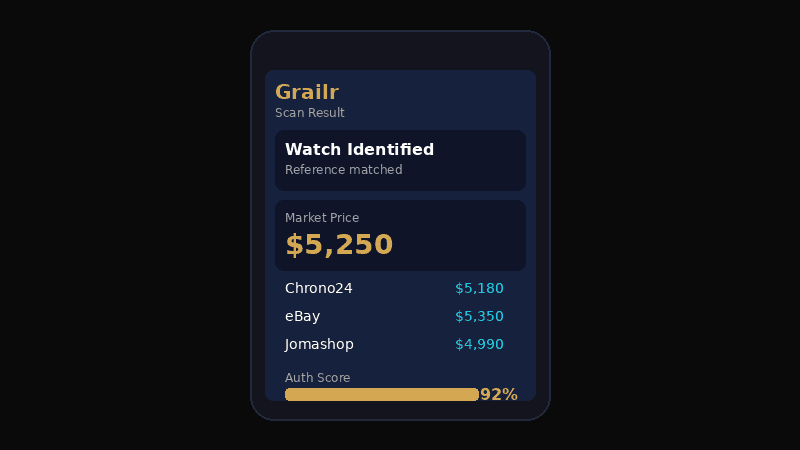
Grailr uses your photo to suggest a watch identification and an indicative price estimate. Active eBay listings, when available, offer asking-price comparisons.
- Grailr suggests brand, model & reference number
- Active eBay asking-price comparisons
- Identification confidence score
Top Picks at Every Budget
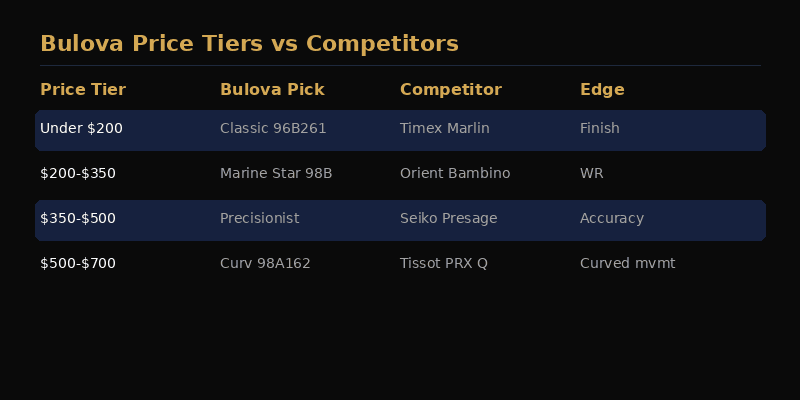
Eight collections produce a lot of references. Here are the specific models worth buying at each price tier, with the details that matter.
| Model | Ref. | Price | Movement | Size | WR |
|---|---|---|---|---|---|
| Classic 3-Hand | 96C141 | $125–$175 | Quartz | 40mm | 30m |
| Hack Watch | 96A253 | $250–$350 | Quartz | 38mm | 50m |
| Sutton Skeleton | 96A187 | $350–$495 | Miyota auto | 43mm | 30m |
| Marine Star Chrono | 96B272 | $395–$595 | Quartz chrono | 43mm | 200m |
| Lunar Pilot | 96A225 | $495–$550 | Precisionist 262 kHz | 45mm | 50m |
| Curv Chrono | 98A161 | $495–$695 | Curved chrono | 44mm | 30m |
Best Overall
Lunar Pilot 96A225 — ~$525
Precisionist chronograph with Apollo 15 heritage. No other watch under $600 combines this level of accuracy, storytelling, and collector interest.
Best Value
Hack Watch 96A253 — ~$295
Military-heritage field watch at a price that undercuts Hamilton and matches the finishing. The entry point for serious Bulova ownership.
Best Dress Watch
Sutton Skeleton 96A187 — ~$425
Open-dial automatic with 4.8-star reviews from 1,000+ buyers. The most visually striking Bulova for evenings and events.
Best Under $200
Classic 3-Hand 96C141 — ~$150
Clean everyday quartz with better case finishing than Timex or Casio at the same price. A solid first watch or gift.
Bulova vs the Competition
Bulova occupies a specific niche: American heritage, high-accuracy quartz, and a sweeping seconds hand at $125–$700. Here is how it stacks up against the brands you are most likely comparing it to.
Against Seiko, Bulova wins on quartz accuracy (Precisionist vs standard quartz) and heritage storytelling (Accutron, Apollo 15, Frank Sinatra). Seiko wins on mechanical movements — the Presage and Prospex lines offer in-house automatics with better finishing at $300–$500. If you want an automatic, buy Seiko. If you want the most accurate quartz with a sweeping seconds hand, buy Bulova.
Against Citizen, the comparison is parent-vs-subsidiary. Citizen’s Eco-Drive eliminates battery changes entirely, which is a meaningful advantage for buyers who value zero maintenance. Bulova’s Precisionist is more accurate but requires a battery every two to three years. For solar reliability, read our Citizen Eco-Drive guide. For raw accuracy and design heritage, Bulova is the stronger pick.
Against Orient, Bulova trades automatic movements for quartz precision. Orient’s Bambino ($130–$200) is the better dress automatic; Bulova’s Sutton Skeleton ($350–$495) is the better skeleton. Orient offers no quartz equivalent to the Precisionist. If mechanical is what you want at the lowest price, Orient wins. If you want heritage, accuracy, or a chronograph, Bulova is the stronger choice.
Resale Reality
This is the section most Bulova guides leave out, and it matters. Most current-production Bulova watches lose 50–70% of their retail price on the secondary market. A $500 Precisionist will sell for $150–$250 used. A $350 Sutton settles around $100–$175. The Classic line drops below $100 almost immediately. This is not unusual for watches in this price bracket — Citizen, Seiko, and Orient all behave similarly — but it means you should buy a Bulova because you want to wear it, not because you expect to recover your money.
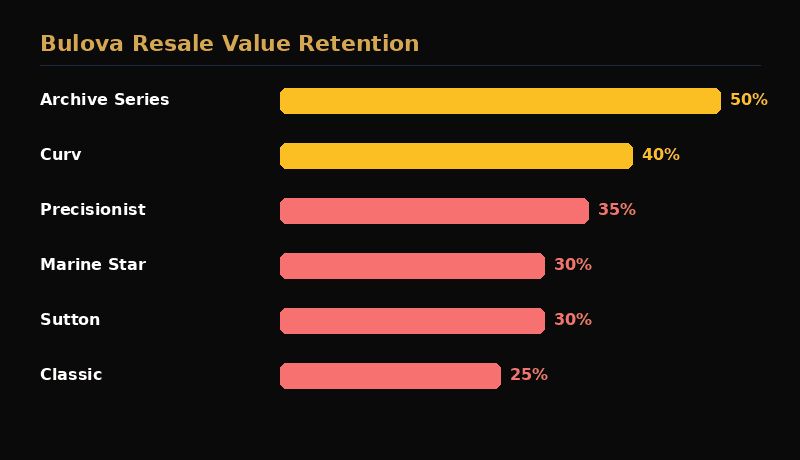
Two exceptions. The Lunar Pilot retains better than the rest of the range — roughly 60–70% of retail — because its Apollo 15 story gives it collector appeal that other Bulova models lack. And vintage Accutron tuning-fork models from the 1960s and 1970s have been appreciating steadily. A clean Accutron Spaceview in working condition trades for $400–$800 today, well above its original retail price adjusted for inflation. If you are buying for potential future value, vintage Accutron is the only segment of the Bulova market where that is a realistic expectation.
The flip side of steep depreciation is that buying pre-owned Bulova is exceptional value. A Precisionist chronograph that costs $600 new trades for $180–$250 on eBay. A Curv that retails for $695 can be found for $250–$350 used. Quartz watches have no mechanical wear to worry about — a battery change and a polish bring a five-year-old Bulova back to near-new condition.
Where to Buy
Amazon is the largest US retailer for Bulova and frequently offers 20–40% below MSRP. Most listings are sold by Bulova itself or by authorized dealers, so the manufacturer warranty is intact. Look for “Ships from and sold by Amazon.com” or the Bulova seller name.
Jomashop carries grey-market Bulova at even steeper discounts — sometimes 40–50% off MSRP — with a store warranty in place of the manufacturer’s. Given Bulova’s quartz reliability, losing the factory warranty is lower-risk here than it would be on a mechanical watch.
Bulova’s own website (bulova.com) charges full MSRP but runs seasonal sales (Black Friday, holiday, Memorial Day) at 20–30% off. It is the safest option for new releases and limited editions that have not reached discount channels. If you are timing a purchase, our affordable watches guide covers the best seasonal discount windows.
Pre-owned: eBay and Chrono24 both carry deep Bulova inventory. Because most Bulova watches are quartz, a pre-owned piece in good cosmetic condition is functionally identical to new — swap the battery and it is good for another three years. For pre-owned tips, see our guide on finding affordable watches.
The Bottom Line
Bulova is not trying to be Rolex, and it is not competing with fashion brands. It sits in a specific lane: 150 years of American heritage, genuine space-programme credentials, and the most accurate non-TCXO quartz movement you can buy — all at prices between $125 and $700. The Precisionist’s sweeping seconds hand solves the biggest aesthetic complaint about quartz. The Lunar Pilot tells a story no other sub-$600 watch can match. The Sutton Skeleton is one of the best-reviewed automatic watches in its class.
Resale is not the reason to buy. Heritage, accuracy, and the daily satisfaction of wearing something with more substance than a fashion label — those are. At these prices, the cost of admission is low enough that even steep depreciation does not sting.
Frequently Asked Questions
Are Bulova watches good quality?
Yes. Bulova has 150 years of watchmaking history and is now part of the Citizen Watch Group, which ensures reliable parts supply and servicing. The Precisionist 262 kHz movement is the most accurate non-thermocompensated quartz on the market. Build quality across the lineup is strong for the price, with case finishing and crystal quality consistently ahead of fashion-brand watches.
What is the Bulova Precisionist movement?
The Precisionist uses a 262,144 Hz quartz crystal, which is 16 times the frequency of standard quartz. This delivers accuracy of plus or minus 10 seconds per year and a continuous sweeping seconds hand that looks mechanical. The trade-off is battery life: 2-3 years instead of 4-5 for standard quartz.
Do Bulova watches hold their value?
Most Bulova watches lose 50-70% of retail on the secondary market. The Lunar Pilot retains better (60-70%) due to its Apollo 15 heritage and collector interest. Vintage Accutron tuning-fork models from the 1960s-1970s can actually appreciate. Buy current-production Bulova for enjoyment, not investment.
Is the Bulova Lunar Pilot worth it?
At $495-$550, the Lunar Pilot offers a Precisionist 262 kHz chronograph with documented Apollo 15 heritage, a sweeping seconds hand, and sapphire crystal. No other watch under $600 has a verified moon-mission pedigree. It is the single most compelling watch in the current Bulova lineup.
How does Bulova compare to Seiko at similar prices?
Bulova wins on quartz accuracy (Precisionist vs standard quartz) and heritage design (Accutron, Apollo 15). Seiko wins on mechanical movements, where the Presage and Prospex lines offer in-house automatics with better finishing. If you want an automatic, buy Seiko. If you want the most accurate quartz with a sweeping seconds hand, buy Bulova.
Where can I buy Bulova watches at the best price?
Amazon is the largest US retailer and regularly offers 20-40% below MSRP. Jomashop carries grey-market Bulova at steeper discounts with a store warranty. Bulova's own site (bulova.com) charges full MSRP but runs seasonal sales. Pre-owned on eBay and Chrono24 offers the best value since Bulova depreciation is steep.
Check Your Bulova’s Value
Already own a Bulova? Grailr identifies your exact model and reference from a photo and pulls live market prices from eBay, Chrono24, and Jomashop. Takes about ten seconds.
Scan Your WatchRelated Articles
Best Affordable Watches
Top watches across every style and price point under $500.
Best Budget Watches
The strongest value propositions in watches under $200.
Best Watches Under $1,000
Seiko, Tissot, Hamilton, Bulova, and more compared at the next tier up.
Citizen Eco-Drive Guide
How Eco-Drive solar technology works and every collection ranked.