Casio Edifice Buying Guide: Every Model Compared
Solar, chronograph and connected variants — choose the actual specification before the colour.
Price context: this guide includes indicative prices from its original publication period. They have not all been refreshed to current quotes. Use the linked primary sources for specifications and policies, and verify prices independently.
- Five model families — EFR, EFS, EQB, ECB and EFB — cover everything from $80 battery chronographs to $400 solar-Bluetooth-GPS pieces
- Tough Solar models eliminate battery changes for roughly ten years; a full charge runs five to seven months in complete darkness
- Bluetooth-connected EQB and ECB models auto-sync time zones and adjust for daylight saving through the Casio app
- The EFS-S660D at around $165 is our pick for most buyers: solar, sapphire crystal, chronograph and 100 m water resistance
What Is the Casio Edifice Line?
Casio launched the Edifice brand in 2000 as a metal-cased counterpart to G-Shock. Where G-Shock absorbs punishment with resin, Edifice wraps quartz movements in stainless-steel cases and bracelets, adds chronograph complications, and targets the driver and commuter who wants a tool watch that can pass for a dress piece. Two decades later it remains Casio’s primary analog line for adults who want a step above the plastic-cased range without stepping into the mechanical-watch price bracket.
What separates Edifice from every $80–$400 competitor is Casio’s vertical integration. The same company designs the movement module, the solar cell, the Bluetooth chip and the companion app. That means the solar charging rate, Bluetooth sync interval and power draw are engineered as a system, not bolted together from separate suppliers. It also means firmware updates arrive through the app — a feature no Swiss brand at this price offers.
The range now spans five distinct families, each identified by a three-letter prefix: EFR, EFS, EQB, ECB and EFB. The letters are not random. They encode exactly what’s inside the case, and once you know the system the entire catalogue becomes legible at a glance. That’s the real buying advantage: you can filter dozens of colourways and limited editions down to the five or six specifications that actually differ.
The Five Edifice Families Explained
EFR — The Battery Chronograph
The EFR is where the Edifice line starts. It runs on a standard SR927W button cell, delivers a 1/20-second chronograph with a tachymeter bezel, and pairs a stainless-steel case with a mineral crystal. Water resistance is typically 100 m. References like the EFR-574D and EFR-526D have been gateway models for years, and they remain the cheapest way into a stainless-steel Casio chronograph — often under $100 on a bracelet. The trade-off is a battery change every two to three years and no connected features.
EFS — The Solar Chronograph
Add the letter “S” and you gain Casio’s Tough Solar charging system. The EFS-S660D, released in 2026, is the current flagship of this family: a solar chronograph with a sapphire crystal, 100 m water resistance and a stainless-steel bracelet for around $165–$170. The older EFS-S650 adds a ceramic bezel insert for scratch resistance. Both run indefinitely in normal light and store enough charge for five to seven months of complete darkness. For most buyers, the EFS tier is the value sweet spot of the entire Edifice catalogue.
EQB — Bluetooth + Solar
The EQB family layers Bluetooth Low Energy and sometimes Multi-Band 6 atomic timekeeping onto the solar base. The watch pairs with the Casio Connected app on iOS or Android, automatically adjusts for daylight saving and time-zone changes, and displays a second city time on a sub-dial. The EQB-1300, launched internationally in 2026, runs Tough Solar, pairs sapphire crystal with a slim profile, and retails around $293–$345 depending on finish. Upper references in this family have traditionally been the thinnest connected Edifice models, sitting around 10 mm thick.
ECB — Analog-Digital Connected
The ECB prefix marks Casio’s most feature-dense Edifice tier. These are analog-digital hybrids: analog hands for time, a small LCD panel for data. The ECB-950DB at around $209 offers Tough Solar and Bluetooth in a relatively compact case. The ECB-2300 Sospensione pushes into motorsport territory at 50.2 × 45.8 × 10.9 mm with a layered dial design inspired by car suspension geometry. The slim ECB-S10 shows that the family can shrink, too. Selected ECB models add GPS hybrid timekeeping for automatic location-based time correction — useful for travellers who cross multiple zones in a day.
EFB — The Slim Dress Watch
The newest and quietest family. The EFB strips the chronograph and connectivity away, keeping a clean three-hand dial, a sapphire crystal, a slim profile under 9 mm and a stainless-steel case. The EFB-109D series is Casio’s answer to the dressy quartz market — think Tissot PR 100 territory at a fraction of the price. If you want an Edifice you can wear with a suit and forget about, this is the family.
Specification Comparison
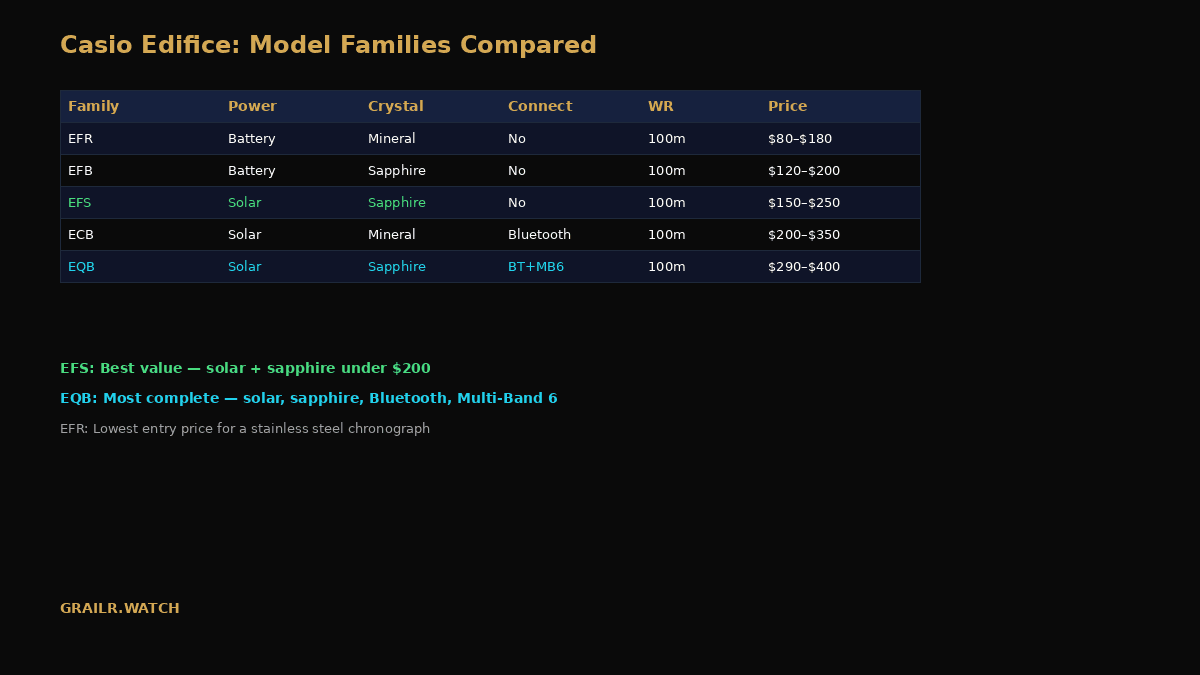
The table below compares one representative reference from each of the five families. Casio releases dozens of colour and strap variations per family, but the core specifications — movement module, power source, water resistance, crystal — stay consistent within each prefix.
| Family | Reference | Power | Crystal | WR | Bluetooth | Price |
|---|---|---|---|---|---|---|
| EFR | EFR-574D | Battery | Mineral | 100 m | No | ~$80 |
| EFS | EFS-S660D | Tough Solar | Sapphire | 100 m | No | ~$165 |
| EQB | EQB-1300D | Tough Solar | Sapphire | 100 m | Yes | ~$293 |
| ECB | ECB-950DB | Tough Solar | Mineral | 100 m | Yes | ~$209 |
| EFB | EFB-109D | Battery | Sapphire | 100 m | No | ~$120 |
Prices are indicative market figures from late 2026. Regional variation is common. Confirm the current price at the retailer before purchasing.
Solar vs Battery: Which Edifice Power Source?
The single most important specification decision in the Edifice range is the power source. A battery-powered EFR costs less up front, but you will pay $15–$30 for a battery swap every two to three years — and each swap opens the caseback, which risks compromising the water-resistance gasket if the work is done carelessly. Over a ten-year ownership horizon, those swaps add $50–$150 to the real cost of the watch.
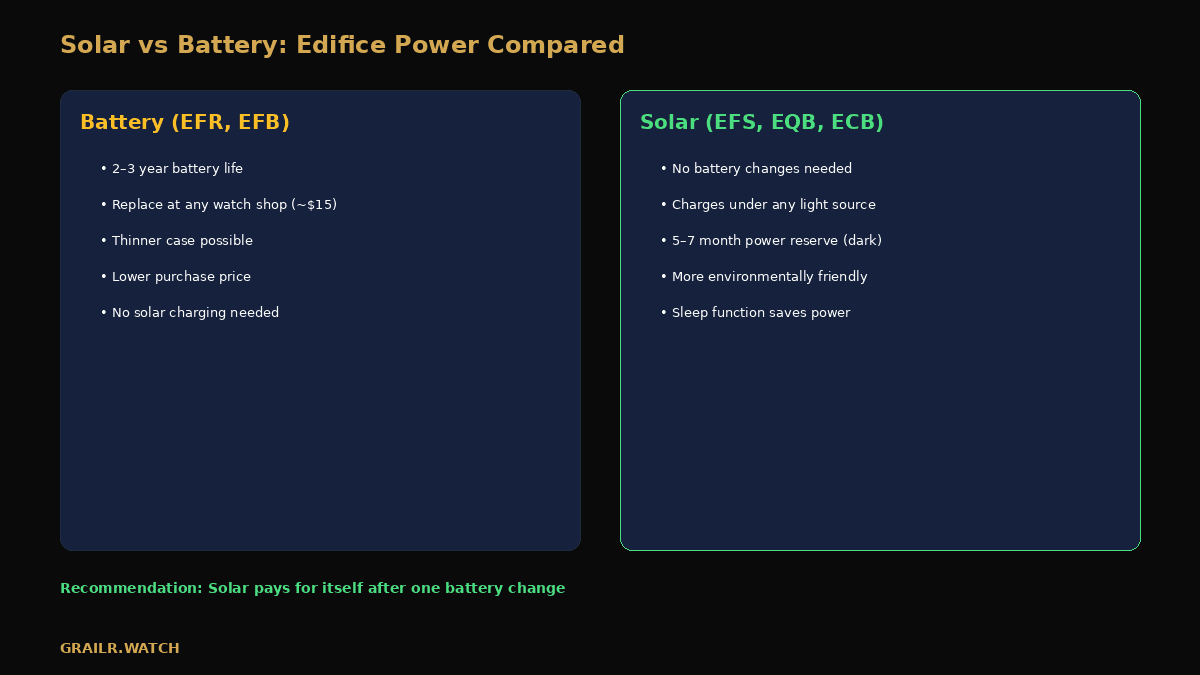
Tough Solar eliminates that cycle. Casio’s solar cell sits behind the dial and converts ambient light — not just direct sunlight — into charge. The rechargeable cell lasts roughly ten years before degradation becomes noticeable, and even then Casio services or replaces it. During those ten years you never open the case. The solar premium is typically $60–$80 above the battery equivalent, which pays for itself in two or three avoided battery swaps.
The practical caveat is darkness. If you store a solar Edifice in a drawer for months, it will enter a power-saving sleep mode where the hands stop but the module keeps time internally. When light returns, the hands catch up automatically. This is normal behaviour, not a defect, but it surprises first-time owners. If you wear the watch regularly or leave it near a window, you will never encounter it.
Our recommendation: unless your budget is strictly under $100, buy solar. The EFS family starts around $130 and the long-term savings, gasket preservation and zero-maintenance convenience make it the clearly better value over any ownership period beyond three years. For buyers who want the cheapest possible quartz watch, the battery EFR tier is still a solid choice — just factor in the running costs.
Bluetooth and Connected Features
The EQB and ECB families pair with the Casio Connected app via Bluetooth Low Energy. The connection is not always-on like a smartwatch — the watch requests a sync when you press a button or at a scheduled interval (typically four times a day). Each sync takes a few seconds and draws minimal power, which is why solar easily offsets the Bluetooth consumption.
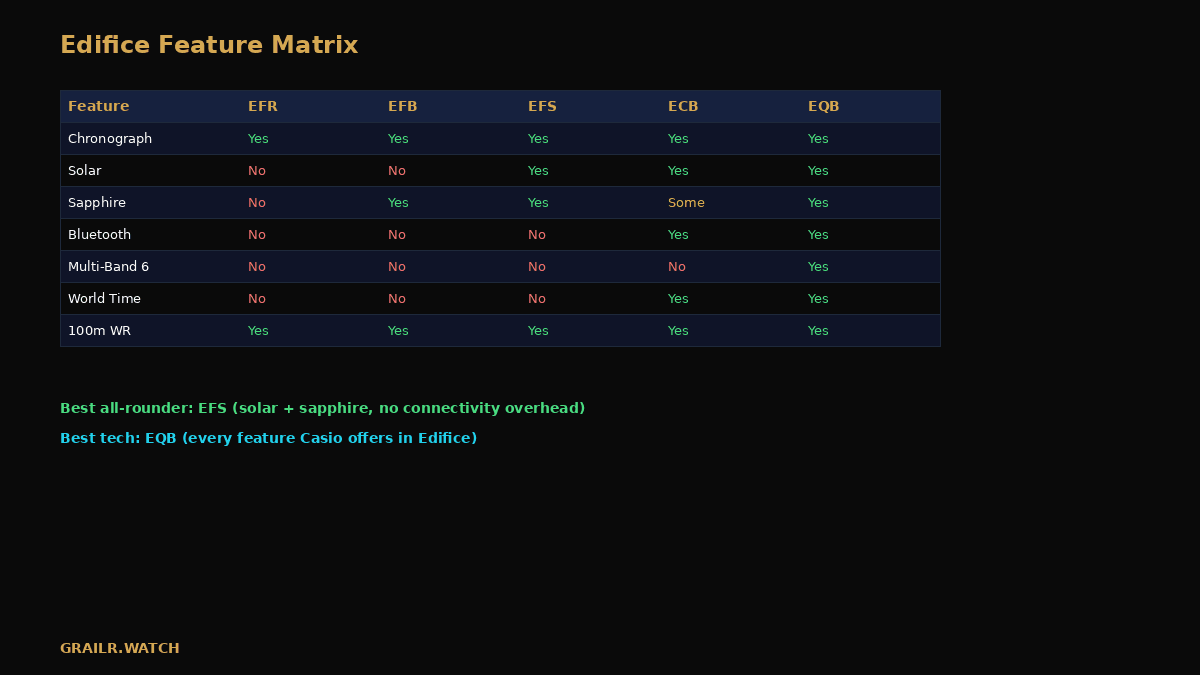
What the connection actually does depends on the model. At a minimum, every Bluetooth Edifice offers automatic time adjustment accurate to the phone’s network time, world-time selection for over 300 cities, and automatic daylight-saving adjustment. Some EQB references add Multi-Band 6 atomic timekeeping, which receives radio signals from six transmitters worldwide (two in Japan, one each in the US, UK, Germany and China) for sub-second accuracy even without the phone. Selected ECB models go further with GPS hybrid positioning, using satellite signals to determine your time zone when you land in a new country.
The app also lets you configure the watch — setting alarms, timers and the second time zone — without cycling through sub-dials on the crown. For anyone who has ever wrestled with a four-button Casio interface, the app is a genuine quality-of-life improvement.
The honest limitation: Bluetooth Edifice watches do not receive phone notifications, track fitness, or display messages. They are traditional analog watches that happen to sync their time wirelessly. If you want wrist notifications, you need a smartwatch. If you want an analog watch that is always perfectly accurate without manual correction, the EQB and ECB deliver exactly that.
Price Guide by Tier
Edifice pricing is refreshingly straightforward. Each family occupies a consistent band, and the variation within a family is driven by bracelet finish, dial colour and limited-edition status — not by movement or specification changes. The table below summarises the price tiers as of late 2026.
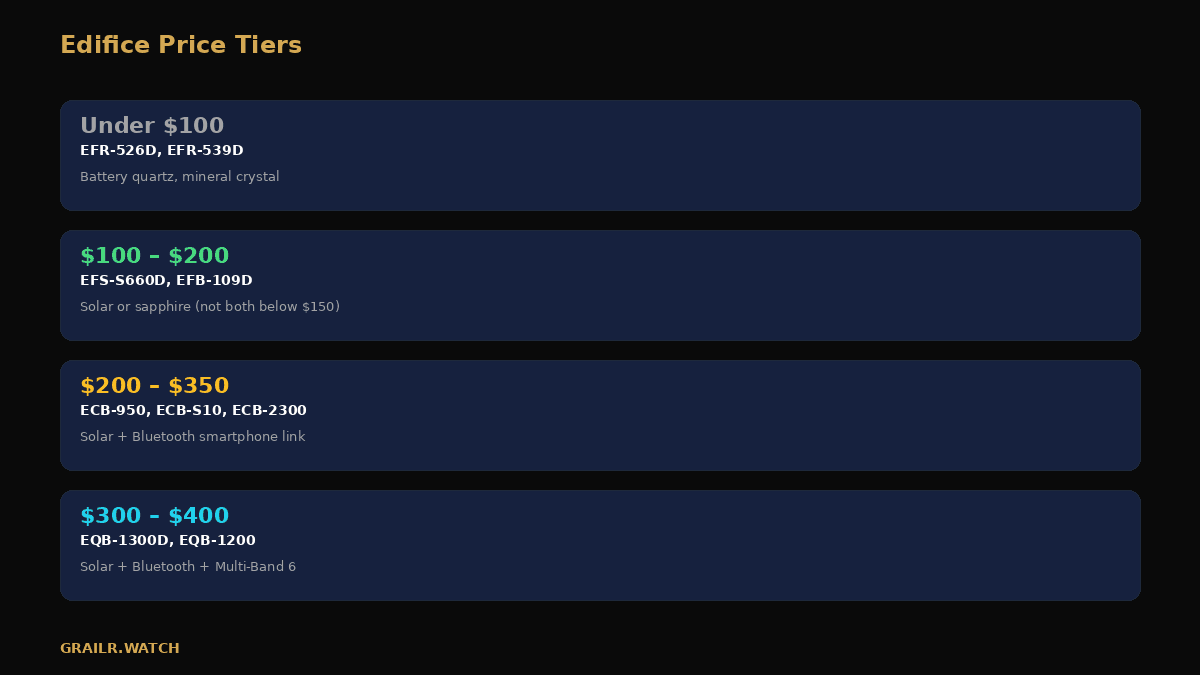
| Tier | Family | Price Range | Key Feature | Best For |
|---|---|---|---|---|
| Entry | EFR | $80–$150 | Battery chronograph | First steel watch |
| Dress | EFB | $100–$160 | Slim + sapphire | Office / suit |
| Solar | EFS | $130–$200 | Tough Solar chrono | Daily all-rounder |
| Connected | ECB | $200–$300 | Solar + BT + LCD | Tech-forward user |
| Premium | EQB | $290–$400 | Solar + BT + atomic | Frequent traveller |
For context, the entire Edifice range sits below the entry price of a mechanical watch under $1,000. If your budget is under $200 and you want a stainless-steel chronograph with solar power, the Edifice EFS tier has no real competitor. Seiko’s solar Coutura line and Citizen’s Eco-Drive PCAT are the nearest alternatives, but neither matches the EFS-S660D’s combination of sapphire crystal and sub-$170 pricing.
How to Choose Your Edifice
With five families and dozens of references, the Edifice catalogue can feel overwhelming. Here is a decision framework that cuts through the noise.
1. Decide on Power First
Battery or solar. If you can spend over $130, choose solar. It eliminates maintenance, preserves water-resistance gaskets and costs less over five years. If your hard ceiling is $100, the EFR battery tier is your starting point.
2. Decide on Connectivity
Do you travel across time zones more than twice a year? Do you hate setting your watch after a daylight-saving change? If yes, the EQB or ECB Bluetooth tier pays for itself in convenience. If you stay in one time zone, skip Bluetooth and save $100+.
3. Decide on Style
Chronograph sub-dials or clean dress dial? The EFB is the only non-chronograph family. If you want a minimal look with sapphire crystal, it delivers. If you want the motorsport-inspired stopwatch aesthetic that defines the Edifice identity, any other family will do.
4. Check the Crystal
Mineral crystal scratches. Sapphire crystal does not (practically). The EFS-S660D and EQB-1300 both use sapphire. If you plan to wear the watch daily for years, sapphire is worth the small premium. Scan any watch with Grailr to verify its model and check current market pricing before you buy.
5. Ignore the Limited Editions
Casio releases collab Edifice models (Red Bull Racing, Scuderia AlphaTauri, Honda Racing) that look striking but carry a premium for a paint scheme, not a specification upgrade. Buy the base reference in the colour you like; you get the same movement, the same solar cell and the same warranty.
Check Any Watch Price in Seconds
Grailr scans your watch photo and pulls live pricing from Chrono24, eBay, and Jomashop.
- AI identifies brand, model & reference number
- Live market prices from 3+ sources
- Authentication confidence score
Our Top Edifice Picks
Best Overall
EFS-S660D — ~$165
Solar, sapphire, chronograph, 100 m WR. The specification checklist is complete at a price that undercuts every Swiss competitor by hundreds.
Best Budget
EFR-574D — ~$80
Battery chronograph on a steel bracelet at the price of a dinner out. The best way to find out if you want a metal-cased watch before committing more.
Best for Travellers
EQB-1300D — ~$293
Solar, Bluetooth, sapphire, slim. Set the time zone on your phone and the watch follows. No crown fiddling, no manual DST correction.
Best Dress Option
EFB-109D — ~$120
Slim, sapphire, no sub-dials. The Edifice that does not look like an Edifice — in the best way.
Edifice vs the Competition
At the entry level, the Edifice competes with Citizen Eco-Drive, Seiko Solar and Tissot PRX Quartz. Citizen’s Eco-Drive PCAT offers Multi-Band 6 and solar at a similar price to the EQB, but Citizen does not include Bluetooth sync. Seiko’s solar Coutura line delivers comparable quality but tends to price $20–$50 above the equivalent Edifice for comparable specifications. The best budget watches under $300 include several Edifice references for good reason.
Against Swiss quartz watches, the gap widens further. A Tissot PRX Quartz with mineral crystal costs around $350 — more than double the EFS-S660D — and runs on a battery. A Longines Conquest Quartz starts above $1,000. The Swiss names carry heritage and finishing that Casio does not attempt to match, but on pure specification per dollar, the Edifice is hard to beat.
Where Edifice falls short is on the wrist. The finishing is functional, not luxurious. Bracelet links are stamped rather than machined. Clasps are adequate but not silky. If you are stepping up from a resin G-Shock, the Edifice feels like a dramatic upgrade. If you are stepping down from a $500+ mechanical watch, the difference in hand-feel is noticeable. Know your expectations before buying.
Buying a Used Edifice
Edifice watches depreciate quickly on the secondary market. A year-old EFS or EQB typically sells for 40–60% of its new price, which makes used models excellent value. The solar cell does not degrade meaningfully in that time, and the sapphire crystal on upper-tier models will still be scratch-free.
The risks are small but real. Check that the solar cell charges (the second hand ticks smoothly under light), confirm Bluetooth pairing works on connected models, and inspect the bracelet clasp for wear. Counterfeits are rare at this price point but not unknown — verify the caseback serial against Casio’s official Edifice product pages to confirm the reference exists. You can also use Grailr’s identification tool to check a listing photo against known references.
Frequently Asked Questions
Is the Casio Edifice a good watch?
Yes. The Edifice delivers chronograph functionality, 100m water resistance and stainless-steel construction from around $80. Solar and Bluetooth models add long-term convenience that most Swiss watches at this price point cannot match.
What is the difference between EFR, EFS, EQB, ECB and EFB?
EFR is the battery-powered entry chronograph, EFS adds Tough Solar charging, EQB adds Bluetooth and sometimes Multi-Band 6 atomic sync, ECB adds an analog-digital display with GPS hybrid timekeeping, and EFB is a slim dress-style quartz line with sapphire crystal.
How long does a Casio Edifice solar battery last?
Casio rates its Tough Solar cells for roughly ten years of normal use. A full charge provides five to seven months of operation in darkness, depending on the model and how often the backlight or Bluetooth is used.
Does the Casio Edifice Bluetooth drain the battery?
Bluetooth Low Energy draws minimal power. On solar models like the EQB and ECB, the solar cell easily offsets the Bluetooth consumption under normal light exposure. Battery-only Bluetooth models are rare in the Edifice range.
Can a Casio Edifice replace a mechanical watch?
For accuracy and features, absolutely. A $200 EFS-S660D keeps time more precisely than a $5,000 Swiss automatic. What it cannot replicate is the finishing, movement visibility and collector appeal of a mechanical piece.
Which Casio Edifice model is best for everyday wear?
The EFS-S660D is the sweet spot: Tough Solar so no battery changes, sapphire crystal so the glass stays clean, chronograph for practical timing, and 100m water resistance for daily confidence. It costs around $165 to $170.
Related Articles
The Bottom Line
The Casio Edifice is the best-specified stainless-steel watch line under $400 in production today. The five-family structure makes the choice simple once you know it: pick your power source (solar beats battery for anyone who keeps the watch more than three years), decide whether Bluetooth connectivity is worth $100–$150 to you, and then choose a colour. The EFS-S660D at around $165 is our overall recommendation — it nails every practical specification and leaves money in your pocket. Skip the limited editions unless you genuinely love the livery. The movement inside is the same.
Sources and price context
- Casio Edifice official collection page — Current product catalogue with specifications for every active Edifice reference.
- Chrono24 Casio Edifice new prices — Market pricing from multiple dealers for new Edifice models as of late 2026.
These primary sources support the specific specification and pricing points noted above. Prices elsewhere in this guide are indicative editorial figures, not verified transaction data. Confirm the exact reference, region and current quote before buying; asking prices are not completed-sale prices.