Chanel J12 Buying Guide: Ceramic, Specs and Prices
From the 33mm quartz to the Caliber 12.1 automatic — every J12 variant compared with real pricing, movement specs and honest buying advice.

- The J12 38mm automatic uses Caliber 12.1, a COSC-certified manufacture movement with 70-hour power reserve
- High-tech ceramic cases rate ~9 on the Mohs scale — harder than steel and virtually scratch-proof in daily wear
- New retail pricing starts around $6,300 (33mm quartz) and $7,500 (38mm automatic)
- Pre-owned 38mm automatics trade between $3,500 and $5,000 — better retention than most fashion-house watches
History of the Chanel J12
The Chanel J12 debuted in the year 2000, designed by Jacques Helleu, the brand’s artistic director and a lifelong sailing enthusiast. The name is a direct reference to the J-class yachts that competed in the America’s Cup — specifically the 12-meter class that Helleu admired for its combination of raw performance and elegant lines. Helleu wanted a watch that embodied the same principle: technically uncompromising but unmistakably beautiful.
The original J12 in black ceramic was a statement that no other fashion house had made. At a time when ceramic watches were virtually unknown in luxury horology, Chanel committed to high-tech zirconia ceramic for the entire case and bracelet. The material is formed by sintering ultra-fine zirconia powder at roughly 1,300 °C, producing a surface that rates approximately 9 on the Mohs hardness scale — just below sapphire and diamond. The result was a watch that resisted scratches better than any steel timepiece and weighed noticeably less on the wrist.
In 2003 Chanel introduced the white ceramic J12, which proved even more popular than the black. White ceramic had never been attempted in a production watch at this scale. The colour doesn’t fade, doesn’t yellow and doesn’t stain — two decades later, first-generation white J12 watches still look factory-fresh when their owners bring them in for service.
Between 2003 and 2019 Chanel steadily expanded the J12 family: the Chromatic in titanium ceramic (a pale grey with a lavender shift), the Superleggera chronograph, the Marine diver, the Paradoxe that splits the case down the middle in black and white, and numerous gem-set haute joaillerie editions. Through all those variants, the core DNA — ceramic construction, the 12-sided bezel, the cabochon crown — stayed consistent.
The 2019 Redesign: What Changed
For the J12’s 20th anniversary Chanel didn’t just refresh the dial — the brand redesigned the entire watch from the inside out. The changes are subtle at a glance but significant in hand. Arnaud Chastaingt, who took over watch design from Helleu, made over 70 modifications to the case, dial and bracelet while preserving the silhouette that made the original iconic.
The most important change is invisible: the steel caseback is gone, replaced by full ceramic construction with a sapphire display window. Every surface that touches the wrist is now ceramic. The crown was reduced in width by roughly a third, giving the profile a cleaner line. The hour markers were redesigned in ceramic rather than applied metal, and the typeface for the numerals was redrawn to be slightly bolder and more legible.
The case grew from 12.17 mm to 12.6 mm in thickness to accommodate the new Caliber 12.1 — Chanel’s first dedicated manufacture movement for the J12. Water resistance remained at 200 metres, and the overall diameter stayed at 38 mm for the automatic. The older ETA-based movement was retired entirely from the 38mm lineup, giving every new Chanel J12 automatic a COSC-certified caliber visible through the caseback. Chanel also offers the 33mm at 200 metres despite its quartz movement, making it one of the most water-resistant fashion watches at that size.
Caliber 12.1: The Movement Inside
Caliber 12.1 is manufactured by Kenissi, the Swiss movement maker in Le Locle in which Chanel holds a 20 percent ownership stake. Kenissi also supplies calibers to Tudor and other brands within the LVMH orbit, and its factory was purpose-built for high-volume chronometer production. The shared infrastructure means Chanel gets manufacture-grade quality at a scale that keeps the J12 competitively priced against Swiss independents.
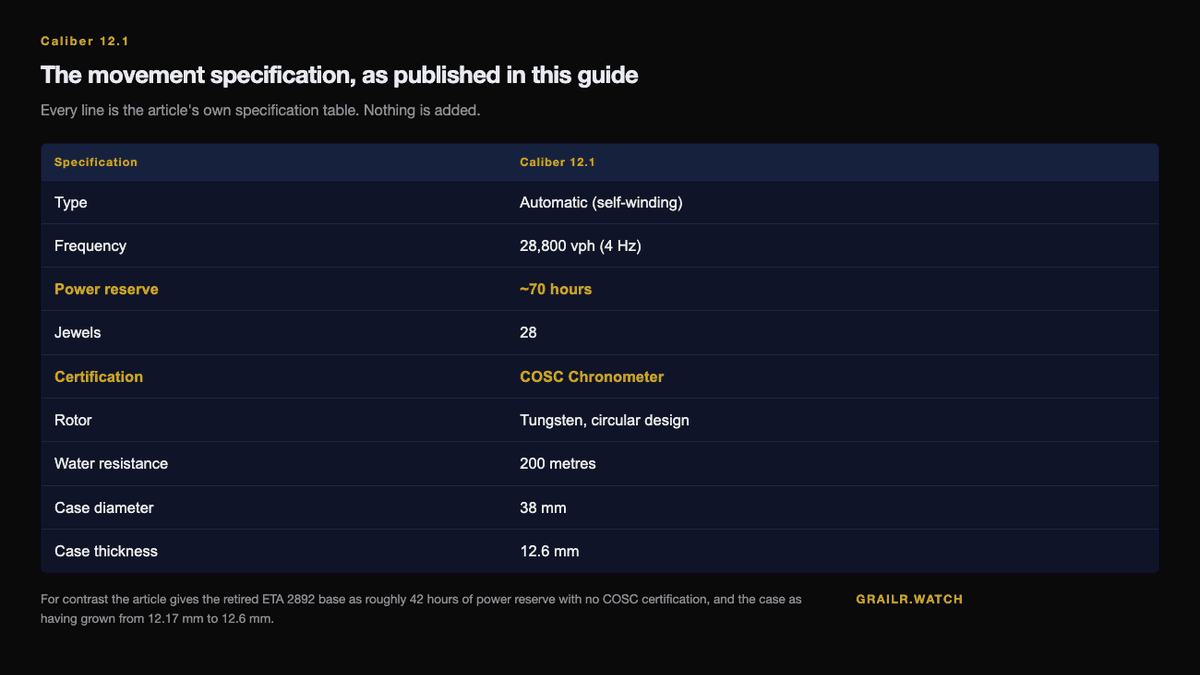
| Specification | Caliber 12.1 |
|---|---|
| Type | Automatic (self-winding) |
| Frequency | 28,800 vph (4 Hz) |
| Power Reserve | ~70 hours |
| Jewels | 28 |
| Certification | COSC Chronometer |
| Rotor | Tungsten, circular design |
| Water Resistance | 200 metres |
| Case Diameter | 38 mm |
| Case Thickness | 12.6 mm |
The 70-hour power reserve means you can take the J12 off on Friday evening and strap it back on Monday morning without resetting the time. COSC certification guarantees accuracy between −4 and +6 seconds per day, though real-world tests typically show the movement running within ±3 seconds. The tungsten rotor is a perfect circle — a deliberate aesthetic choice visible through the sapphire caseback that echoes the round Chanel camellia motif.
For context, the pre-2019 J12 automatic used an ETA 2892 base movement with roughly 42 hours of power reserve and no COSC certification. The upgrade to Caliber 12.1 was the single biggest technical leap in the J12’s history and the reason serious watch collectors began re-evaluating the model. The Grand Prix d’Horlogerie de Genève nominated the revised J12 in 2019, placing it alongside watches from Patek Philippe, A. Lange & Söhne and other traditional manufactures.
Every Chanel J12 Model Compared
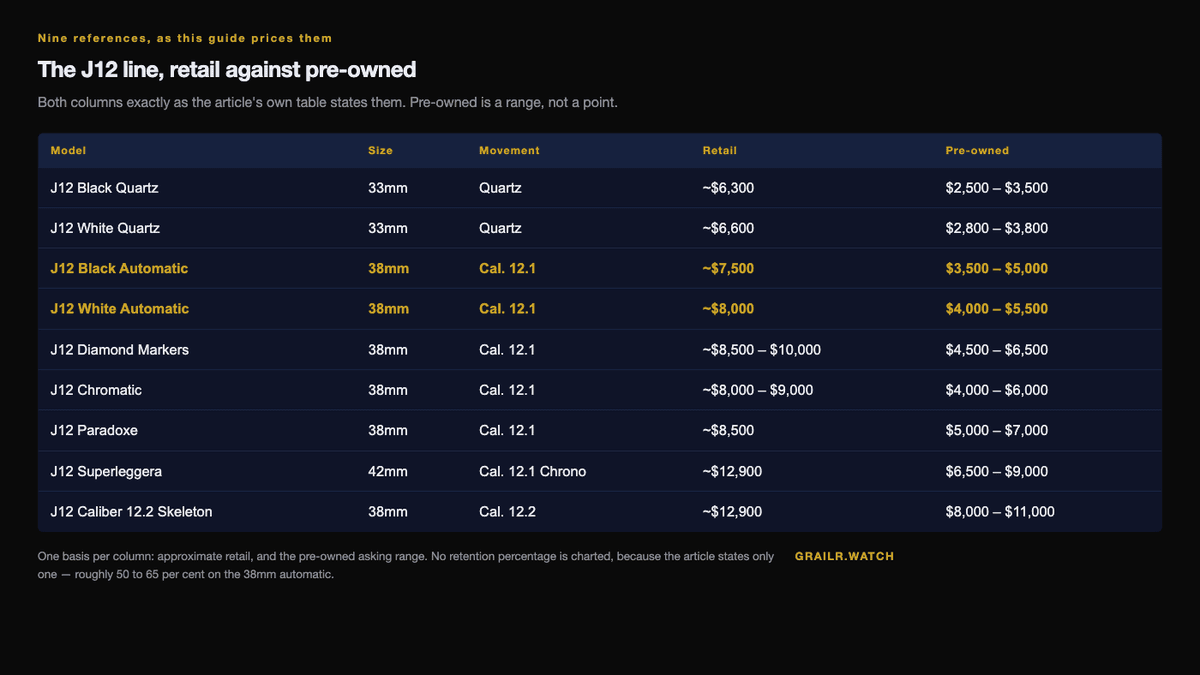
The current J12 range spans quartz and automatic movements, multiple case sizes, and variants from clean time-only pieces to fully gem-set haute joaillerie editions. Below is a comparison of the models most buyers will encounter at an authorised Chanel boutique or on the pre-owned market.
| Model | Size | Movement | Retail | Pre-Owned |
|---|---|---|---|---|
| J12 Black Quartz | 33mm | Quartz | ~$6,300 | $2,500–$3,500 |
| J12 White Quartz | 33mm | Quartz | ~$6,600 | $2,800–$3,800 |
| J12 Black Automatic | 38mm | Cal. 12.1 | ~$7,500 | $3,500–$5,000 |
| J12 White Automatic | 38mm | Cal. 12.1 | ~$8,000 | $4,000–$5,500 |
| J12 Diamond Markers | 38mm | Cal. 12.1 | ~$8,500–$10,000 | $4,500–$6,500 |
| J12 Chromatic | 38mm | Cal. 12.1 | ~$8,000–$9,000 | $4,000–$6,000 |
| J12 Paradoxe | 38mm | Cal. 12.1 | ~$8,500 | $5,000–$7,000 |
| J12 Superleggera | 42mm | Cal. 12.1 Chrono | ~$12,900 | $6,500–$9,000 |
| J12 Caliber 12.2 Skeleton | 38mm | Cal. 12.2 | ~$12,900 | $8,000–$11,000 |
The white ceramic commands a consistent premium over black at every level. This is partly because white ceramic is more technically demanding to produce — any impurity shows through the translucent surface — and partly because it stands out more dramatically on the wrist. Both colours use the same zirconia ceramic grade, so durability is identical.
The J12 Chromatic in titanium ceramic deserves special mention. Its grey case has a subtle lavender or purple shift depending on the light, making it the most distinctive J12 variant. Production is more limited than the black and white models, and collectors have driven secondary-market prices steadily upward since its introduction.
At the top of the range, the Caliber 12.2 skeleton exposes the movement through a partially open-worked dial. Limited to 555 pieces per edition, these are collector’s items rather than everyday watches — but they demonstrate just how far Chanel has pushed the J12 concept from its origins as a ceramic fashion piece.
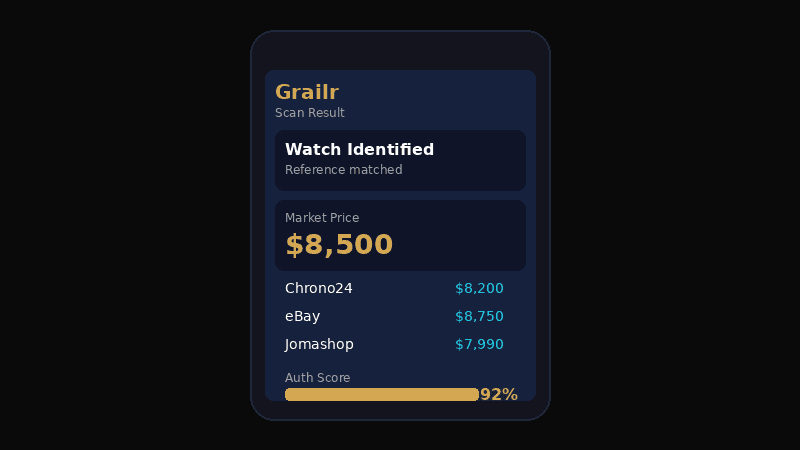
Check Any Watch Price in Seconds
Grailr scans your watch photo and pulls live pricing from Chrono24, eBay, and Jomashop.
- AI identifies brand, model & reference number
- Live market prices from 3+ sources
- Authentication confidence score
Pricing and Resale Value
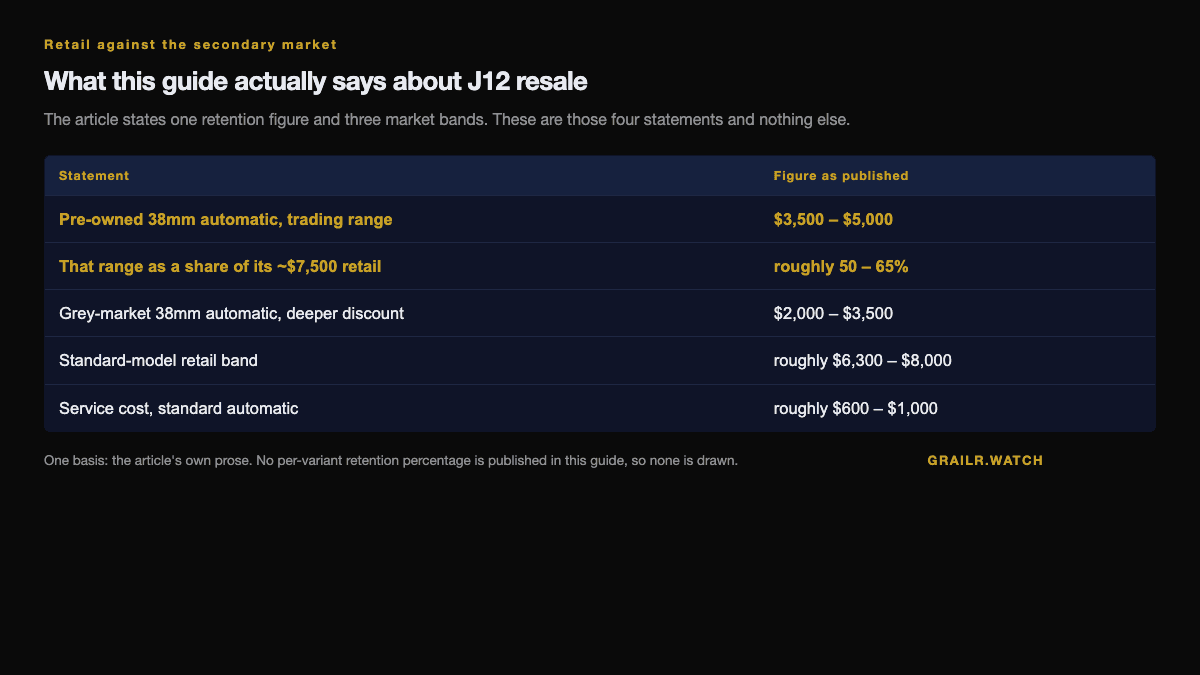
Chanel J12 pricing sits in an interesting space. The retail prices — roughly $6,300 to $8,000 for standard models — put the J12 in direct competition with serious Swiss sports watches from Omega, Tudor and Longines. Unlike those brands, Chanel doesn’t benefit from the same “watch-collector” hype cycle that drives Rolex premiums. The upside: you can almost always walk into a Chanel boutique and buy the J12 you want without a waitlist.
On the secondary market, the J12 retains value significantly better than other fashion-house watches. A pre-owned Gucci, Dior or Louis Vuitton watch typically loses 60–80 percent of its retail price within two years. The J12 38mm automatic, by contrast, holds roughly 50–65 percent of retail — closer to the retention curve of a mid-range Swiss piece than a fashion accessory.
Several factors support J12 resale. The ceramic case doesn’t show wear the way steel does, so a five-year-old J12 can look nearly new. The Caliber 12.1 movement is serviced by Chanel’s own watchmaking ateliers, and parts availability is not an issue. And the Chanel brand itself carries cultural weight that transcends the watch world — J12 buyers include collectors, but they also include people who simply want the best-looking ceramic watch in the room.
The pre-2019 ETA-powered models trade at deeper discounts — typically $2,000 to $3,500 for a 38mm automatic. These remain well-made watches with the same ceramic case, but the lack of a manufacture movement and COSC certification makes them less desirable on the collector circuit. If you’re buying purely for aesthetics and value, a pre-2019 J12 is genuinely compelling. If resale matters, buy the current Caliber 12.1 version. Use Grailr’s value estimate tool to compare current asking prices before committing.
Chanel J12 vs the Competition
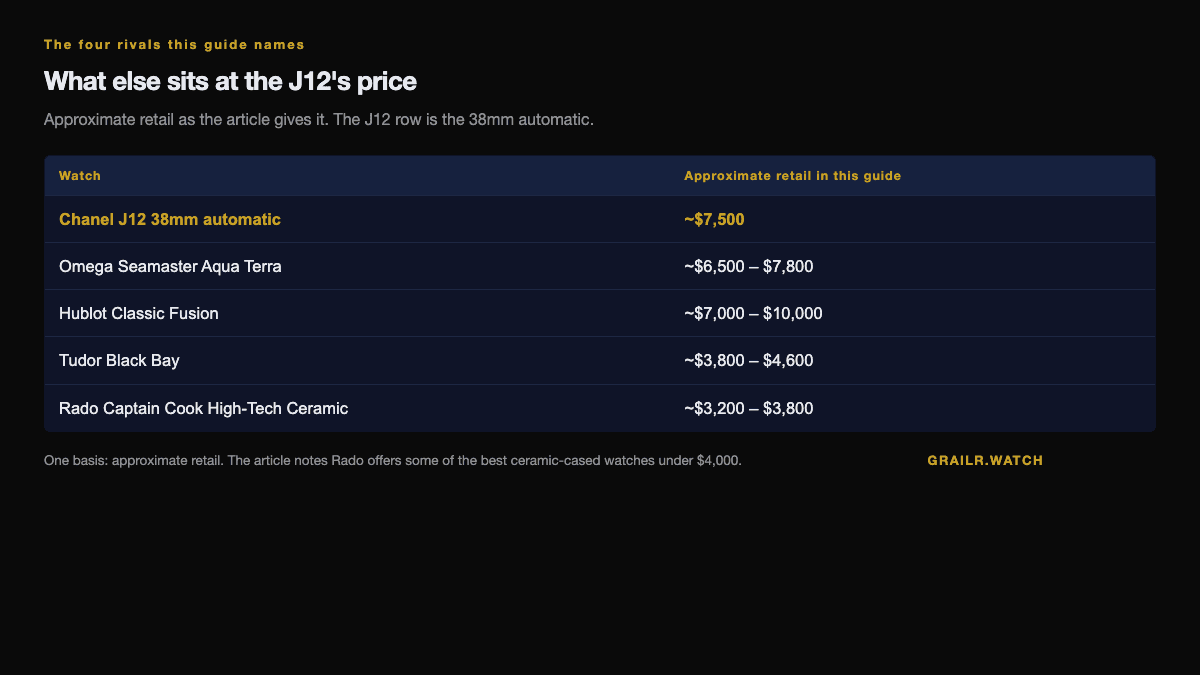
At its price point the J12 competes with established Swiss watch brands, not other fashion houses. Here is how it stacks up against the models most cross-shoppers consider.
J12 vs Omega Seamaster Aqua Terra (~$6,500–$7,800)
The Aqua Terra runs Omega’s Co-Axial Master Chronometer movement with better anti-magnetic resistance and marginally better METAS certification. It uses steel rather than ceramic, which means it picks up desk-diving scratches within weeks. The J12 wins on material durability and design distinctiveness; the Aqua Terra wins on movement pedigree and secondary-market liquidity.
J12 vs Tudor Black Bay (~$3,800–$4,600)
Tudor’s Black Bay is significantly cheaper and backed by the Rolex service network. Its MT5602 movement (also COSC, 70-hour reserve) is mechanically comparable to Caliber 12.1. The J12 offers something the Black Bay cannot: high-tech ceramic construction and a design language that has nothing to do with dive-watch heritage. These are watches for very different wrists.
J12 vs Hublot Classic Fusion (~$7,000–$10,000)
Hublot also uses ceramic extensively, and the Classic Fusion shares the J12’s modern-material ethos. Hublot runs its own UNICO manufacture movements in higher-end variants, though base models use Sellita. The J12 is more refined; the Classic Fusion is more aggressive. Pre-owned Hublots depreciate faster, so if you’re buying for long-term retention, the J12 edges ahead at comparable retail prices.
J12 vs Rado Captain Cook High-Tech Ceramic (~$3,200–$3,800)
Rado pioneered ceramic watchmaking in the 1980s and still makes some of the best ceramic-cased watches under $4,000. The Captain Cook High-Tech Ceramic uses comparable material technology at half the J12’s price. What you lose is the Chanel design language, the manufacture movement, and the brand equity that supports J12 resale. If ceramic material is the draw and budget is the constraint, the Rado is worth considering.
Buying Tips for the Chanel J12
New vs Pre-Owned
Buying new from a Chanel boutique guarantees an unworn watch, the full international warranty, and the current Caliber 12.1 movement. Availability is generally good — unlike Rolex, Chanel does not enforce long waitlists on standard J12 models. The boutique experience itself is part of the appeal: white-glove service, Chanel packaging, and the certainty that every component is correct.
Pre-owned prices represent a substantial saving. A 38mm automatic that retailed for $7,500 can be found for $3,500–$5,000 with one to three years of age. When buying pre-owned, verify the serial number with Chanel or run it through Grailr’s authentication check. Counterfeit J12 watches are common because the ceramic construction makes them harder to spot by feel alone.
What to Check Before You Buy
Ceramic is scratch-resistant but not impact-proof. Inspect the case edges, bezel, and bracelet links for chips — even small cracks in ceramic tend to propagate under stress. Run your fingernail along every bracelet link; a chip feels like a tiny notch that shouldn’t be there. On the caseback, confirm the sapphire crystal is unscratched and that the Caliber 12.1 rotor spins freely when you tilt the watch.
For white ceramic specifically, shine a phone flashlight through the bracelet links. Authentic Chanel white ceramic has a uniform, slightly translucent quality. Counterfeits often use painted or coated steel that blocks light entirely. Also check that the crown screws down smoothly — a cross-threaded crown is a red flag on any pre-owned piece.
Service and Maintenance
Chanel recommends a full service every five to seven years. The brand operates its own watchmaking ateliers in Switzerland, and service costs run roughly $600–$1,000 for a standard automatic service. Third-party watchmakers can handle the Caliber 12.1 since it shares architecture with other Kenissi-produced movements, but Chanel’s own service centres are the safest bet for ceramic bracelet repairs. Replacing a cracked bracelet link requires genuine Chanel ceramic parts — there is no aftermarket equivalent. Upload a photo to Grailr’s watch identifier to confirm your exact reference number before ordering service parts.
Frequently Asked Questions
Is the Chanel J12 a real luxury watch or a fashion watch?
How much does a Chanel J12 cost new in 2026?
Does Chanel J12 ceramic scratch easily?
Should I buy the 33mm quartz or the 38mm automatic J12?
Is white or black ceramic J12 more popular?
How does the Chanel J12 hold its value on resale?
Related Articles
The Bottom Line
The Chanel J12 is one of the few watches that successfully bridges fashion and horology. With the move to Caliber 12.1 in 2019, it earned genuine credibility among watch collectors — a COSC-certified manufacture movement, a 70-hour power reserve, and a ceramic case that shrugs off daily wear. Whether you choose the understated black, the striking white, or the elusive Chromatic, you are getting a timepiece with real substance behind the Chanel name.
For most buyers, the 38mm automatic in black or white ceramic is the sweet spot: manufacture movement, strong resale, and a design that has looked modern for a quarter of a century. If you want to verify a J12’s identity or compare current market prices before buying, scan it with Grailr for a quick identification and price check.
Thinking About a J12?
Snap a photo, get an instant identification and market price from Grailr.
Scan Your Watch