Are Fashion Brand Watches Worth Anything on Resale?
Michael Kors, Gucci, Invicta, Fossil, MVMT and Diesel watches compared — with real resale data and honest answers about where the money goes.
Price context: this guide includes indicative prices from its original publication period. They have not all been refreshed to current quotes. Use the linked primary sources for specifications and policies, and verify prices independently.
- Most fashion watches retain only 10–20% of their retail price on the secondary market
- Generic quartz movements costing $2–5 are inside most Michael Kors, Fossil and MVMT watches
- Horological brands at similar retail prices (Seiko, Tissot, Hamilton) retain 50–70% of value
- Gucci slightly outperforms other fashion brands at 15–20% retention, with rare vintage exceptions
The Short Answer: Not Much
If you’re looking at a Michael Kors, Gucci, Invicta, Fossil or MVMT watch in your drawer and wondering what it’s worth, the honest answer is uncomfortable: somewhere between 10% and 20% of what you paid. A $300 Michael Kors watch that looked stunning at the department store counter is now worth $30–45 on the secondary market. A $200 MVMT or Daniel Wellington? Maybe $15–30.
This isn’t unique to watches. Fashion accessories of all kinds — handbags excepted in certain luxury tiers — depreciate the moment the tag comes off. But watches occupy an unusual space in consumer culture because horological watches (those built by watchmaking companies) actually hold their value remarkably well. The confusion between a “fashion watch” and a “real watch” is where most buyers lose money.
Let’s break down exactly what each major fashion brand is worth on resale, why the numbers are so low, and what you could buy instead if holding value matters to you.
Fashion Watch Resale Values: Brand by Brand
These figures reflect typical secondary-market asking prices for fashion watches in good, working condition with no box or papers. The ranges come from completed sales on resale platforms — not dealer buyback offers, which would be even lower.
Michael Kors ($100–$400 retail → $15–40 resale)
Michael Kors is the single biggest fashion watch brand by volume. The oversized chronograph-style cases became a cultural phenomenon around 2012–2015, and millions were sold through department stores, outlets and online retailers. Today, those watches flood the secondary market. Supply massively outweighs demand, and prices reflect that imbalance. A standard MK chronograph that retailed for $250 now sells for $25–35. Even the higher-end pieces with gold-tone cases and crystal bezels rarely exceed $40. Retention sits at 10–15% of retail. If you’re curious what a specific Michael Kors piece might fetch, our Michael Kors watch guide covers current market pricing in detail.
Gucci ($500–$1,500 retail → $80–250 resale)
Gucci performs slightly better than the rest of the fashion pack, but “better” here means retaining 15–20% instead of 10–15%. The G-Timeless 38mm, one of their most popular models at roughly $890 retail, typically sells used for $130–200. The Gucci name carries genuine cachet — more than Michael Kors or Fossil — and the brand has started using Swiss-made movements in some higher-end pieces since 2021, which helps slightly on the secondary market.
The one genuine bright spot: vintage 1990s Gucci watches have developed modest collector appeal. Pieces from that era, particularly the Horsebit and certain two-tone models, have reportedly appreciated — a rare exception in the fashion watch world. But these are narrow collector niches, not a trend that applies to current production.
Invicta ($50–$150 real retail → $15–25 resale)
Invicta deserves a special note because of its pricing strategy. The brand lists MSRPs of $400–$900, but these numbers are deeply misleading. Nobody pays MSRP for an Invicta. The actual street price — what you really pay on Amazon, at Costco or from Invicta’s own frequent “sales” — is typically $50–150. Retention against the inflated MSRP looks catastrophic (3–5%), but against the real purchase price it’s more like 15–25%, comparable to other fashion brands. The Pro Diver, Invicta’s best-known model, costs around $60–90 new and sells used for $15–25.
Fossil ($100–$300 retail → $20–35 resale)
Fossil is the parent company behind many fashion watch brands (they manufacture for Michael Kors, Diesel, Emporio Armani and others), so the underlying hardware is nearly identical across their portfolio. A Fossil-branded watch retaining $20–35 on the secondary market places it squarely in the 10–15% range. The group’s hybrid smartwatches fare even worse, as outdated software makes them functionally obsolete within two to three years.
MVMT and Daniel Wellington ($100–$200 retail → $10–30 resale)
The Instagram-era watch brands built their following on social-media marketing, minimalist design and aggressive influencer campaigns. The watches themselves use Chinese quartz movements with cases and straps sourced from the same Shenzhen factories that supply dozens of other brands. A $150 MVMT watch sells for $15–25 used. Daniel Wellington fares similarly. The marketing budget that made these brands visible is precisely the cost that disappears on the secondary market.
Diesel ($150–$400 retail → $25–50 resale)
Diesel watches are manufactured by the Fossil Group under licence from the Diesel fashion brand. The oversized cases (often 50mm+) and bold, industrial designs have a dedicated audience, but the resale market doesn’t reward them. A $300 Diesel chronograph typically sells for $30–50. Like other Fossil Group watches, the movements are generic quartz units with no horological distinction.
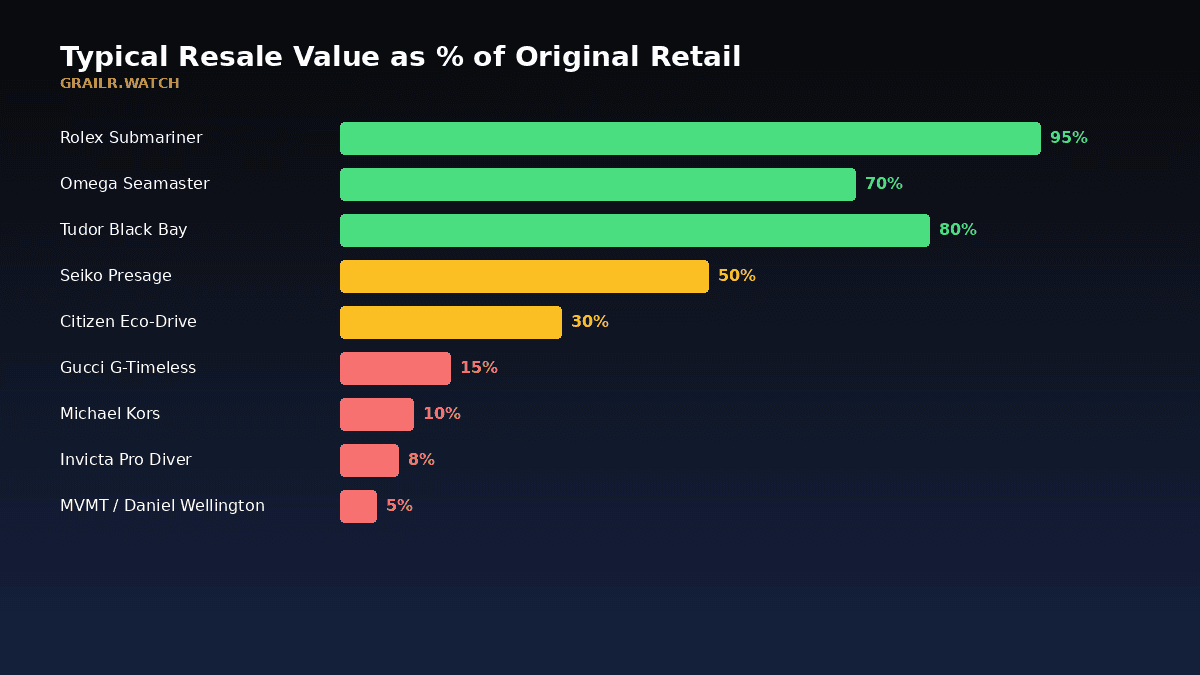
Typical resale retention for fashion watch brands — most lose 80–90% of retail value
The Complete Resale Comparison
| Brand | Retail Range | Resale Range | Retention |
|---|---|---|---|
| Michael Kors | $100–$400 | $15–$40 | 10–15% |
| Gucci | $500–$1,500 | $80–$250 | 15–20% |
| Invicta | $50–$150* | $15–$25 | 15–25% |
| Fossil | $100–$300 | $20–$35 | 10–15% |
| MVMT / Daniel Wellington | $100–$200 | $10–$30 | 10–15% |
| Diesel | $150–$400 | $25–$50 | 12–15% |
*Invicta retail reflects actual street price, not inflated MSRP. Prices are indicative editorial figures, not a verified transaction dataset.
Why Fashion Watches Lose So Much Value
The depreciation isn’t random. There are four structural reasons why fashion watches collapse on the secondary market, and understanding them will help you make smarter buying decisions going forward.
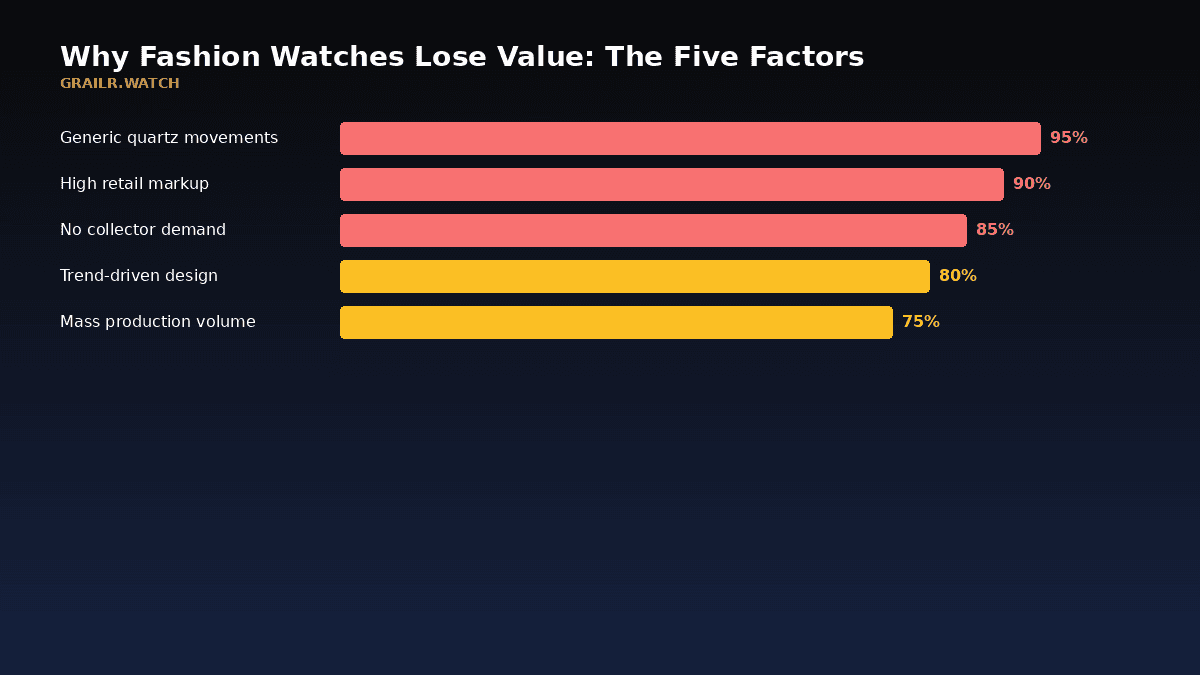
1. Generic Movements with No Intrinsic Value
Inside most fashion watches sits a Miyota or Chinese quartz movement that costs the manufacturer $2–5. It’s the same movement you’d find in a $15 watch from a no-name brand on Amazon. The movement tells time accurately — quartz movements are excellent at that — but it has zero scarcity, zero craftsmanship narrative and zero collector interest. By contrast, a Seiko 4R35 automatic movement (found in their $200–$400 range) costs significantly more to produce, can be serviced, and carries genuine horological interest.
2. The Brand Premium Is for Fashion, Not Horology
When you buy a Michael Kors watch for $250, you’re paying perhaps $20–30 for the actual hardware and the rest for brand licensing, retail margins, marketing campaigns and packaging. The fashion brand is selling you an accessory that matches their clothing line. They are not selling you watchmaking. On the secondary market, the fashion premium evaporates completely — buyers want the watch, not last season’s marketing campaign.
3. No Collector Community Exists
Watch collecting is one of the most active and well-documented enthusiast markets in the world. Forums, YouTube channels, auction houses and dealer networks create a robust secondary market for brands like Rolex, Omega, Seiko, Tudor and dozens of others. Fashion watches have no equivalent ecosystem. Nobody collects Michael Kors references. Nobody tracks Fossil lot numbers. Without collectors to drive demand, prices settle at commodity levels.
4. Oversupply Crushes Pricing
Fashion watch brands produce in enormous volumes. Michael Kors alone sells millions of watches per year through department stores, outlet malls and discount retailers. When a product is mass-produced and widely discounted at retail, the secondary market has no reason to pay more than a fraction of the original price. This is the inverse of what happens with, say, a Rolex Submariner — where restricted supply and wait lists push pre-owned prices above retail.
Check Any Watch Price in Seconds
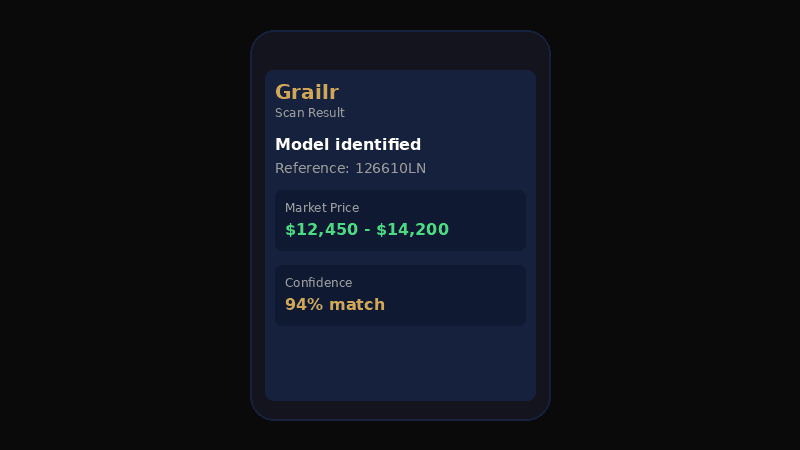
Grailr scans your watch photo and pulls live pricing from Chrono24, eBay, and Jomashop.
- AI identifies brand, model & reference number
- Live market prices from 3+ sources
- Authentication confidence score
Fashion vs Horological: The Value Gap at Every Price
Here’s what makes the fashion-watch depreciation sting: at the same retail price points, horological brands retain dramatically more value. If you’re spending $200–$600 on a watch, the brand you choose is the single biggest factor in whether that money holds or vanishes. Our guide to affordable watches covers these horological alternatives in depth.
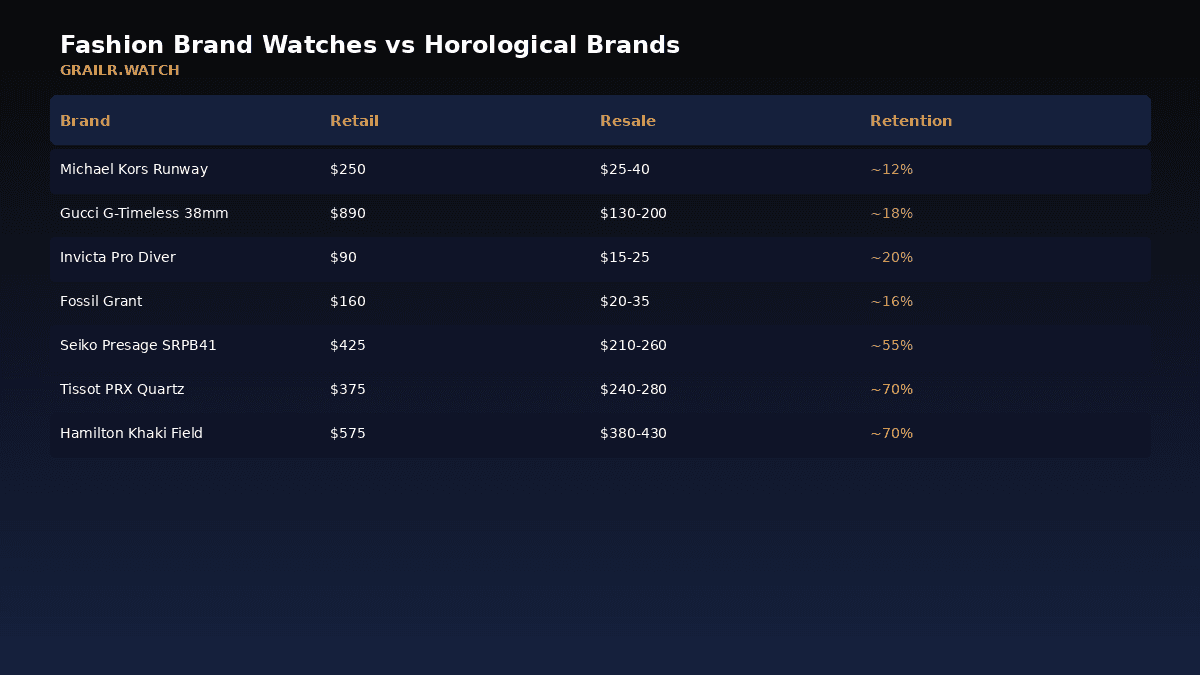
| Watch | Type | Retail | Resale | Retention |
|---|---|---|---|---|
| Michael Kors Runway | Fashion | $250 | $25–35 | ~12% |
| Orient Bambino | Horological | $200 | $95–110 | ~50% |
| Gucci G-Timeless 38mm | Fashion | $890 | $130–200 | ~18% |
| Tissot PRX | Horological | $375 | $250–275 | ~70% |
| Fossil Neutra Chrono | Fashion | $170 | $20–30 | ~14% |
| Seiko Presage | Horological | $425 | $220–250 | ~55% |
| MVMT Classic | Fashion | $150 | $15–25 | ~13% |
| Hamilton Khaki Field | Horological | $575 | $380–420 | ~70% |
Prices are indicative editorial figures, not a verified transaction dataset. Confirm current quotes independently.
What Makes Horological Brands Different
A Seiko Presage at $425 and a Gucci G-Timeless at $890 occupy similar wrist real estate. But the Seiko contains a proprietary automatic movement with 41 hours of power reserve, a hand-finished dial inspired by Japanese artisan techniques, hardlex crystal and a stainless-steel case built in Seiko’s own factory. The Gucci contains a stock quartz movement in a case that was designed in Italy and assembled overseas.
The Seiko has a community of collectors who track references, debate dial variations and bid on discontinued models. The Gucci has fashion consumers who move on to the next season’s accessories. That collector infrastructure is what sustains resale values — and it’s something you cannot build with marketing dollars.
The Tissot PRX at $375 is another striking example. Its integrated bracelet design, Swiss quartz movement and 100m water resistance come from a brand with 170 years of watchmaking heritage. On the secondary market, it retains roughly 70% of its retail value — meaning a used Tissot PRX is worth more than a new Michael Kors watch at a higher retail price.
The Hamilton Khaki Field at $575 takes this further. An in-house H-10 automatic movement with 80 hours of power reserve, a military heritage dating to World War I, and a design so respected it has appeared in dozens of films. Retention of roughly 70% means your $575 Hamilton is worth more used than a $1,500 Gucci is worth used. For more options at this tier, see our best watches for value guide.
The Exceptions: Fashion Watches That Hold Some Value
While the general rule is brutal, a handful of fashion-brand watches have defied the trend. These are narrow exceptions, not a reason to speculate on fashion watches as investments.
Vintage 1990s Gucci
Certain 1990s Gucci models — particularly the signature web-strap pieces and some gold-plated dress watches — have developed a following among vintage fashion collectors. These aren’t appreciating dramatically, but they’ve stabilised at prices that sometimes exceed their original retail after adjusting for inflation. The aesthetic of that era aligns with current vintage fashion trends.
Gucci Horsebit
The Gucci Horsebit has reportedly appreciated in certain configurations, making it one of the rarest genuine value stories in fashion watches. This is driven by the iconic Horsebit motif’s broader appeal in fashion collecting, not by the watch’s mechanical credentials.
Gucci’s Swiss-Made Push
Since 2021, Gucci has started using Swiss-made movements in some higher-end pieces. These cost more at retail but may hold slightly better on the secondary market than their quartz predecessors. It’s too early to have definitive long-term resale data, but the direction is encouraging for Gucci as a brand that straddles fashion and horology.
How to Get the Most for a Fashion Watch You Already Own
If you already have a fashion watch and want to sell it, here are realistic strategies to maximise your return.
1. Sell Direct to a Buyer
Platforms like eBay, Poshmark and Mercari let you list directly. You’ll get more than a pawn shop or dealer buyback, but factor in seller fees (typically 10–15%) and shipping costs. For a $30–50 sale, the net return can be slim after fees.
2. Include the Box and Papers
Even for fashion watches, having the original box, warranty card and receipt can add 10–20% to the selling price. Buyers feel more confident in the purchase, and the presentation suggests the watch was cared for.
3. Time Your Sale
Fashion watches sell better during gift-giving seasons (November through February) when buyers are looking for affordable presents. Avoid summer, when demand is lowest.
4. Scan It Before Listing
Use Grailr’s appraisal tool to get a quick value estimate before deciding whether selling is worth the effort. For watches worth less than $20 on the secondary market, the time spent photographing, listing and shipping may not justify the return. Check the result against live completed sales before pricing your listing. For tips on selling higher-value timepieces, see our guide to selling luxury watches.
Should You Buy a Fashion Watch Anyway?
After all this depreciation data, you might expect us to say “never buy a fashion watch.” That would be dishonest. Fashion watches serve a legitimate purpose — they’re affordable accessories that complement a wardrobe. Not every purchase needs to be an investment.
If you enjoy wearing a Michael Kors or Gucci watch, the depreciation is simply the cost of ownership — the same way a car loses value the moment you drive it off the lot. You pay for the enjoyment of wearing it, and when you’re done, you accept that it was a consumable, not an asset. That’s a perfectly reasonable approach to any accessory.
The mistake is buying a fashion watch expecting it to hold value, or choosing a $300 Michael Kors over a $300 Seiko Presage Cocktail Time without understanding the resale implications. If you’re spending between $100 and $600 on a watch and value retention matters to you at all, horological brands are objectively the better choice. You can explore options in our best cheap watches roundup.
The bottom line: buy fashion watches for fashion. Buy horological watches for value. Know which one you’re buying before you swipe your card.
Frequently Asked Questions
Are Michael Kors watches worth anything on resale?
Michael Kors watches retain roughly 10-15% of their retail price on the secondary market. A watch that retailed for $250 typically sells for $25-40 used. The quartz movements have minimal intrinsic value and there is no collector demand.
Do Gucci watches hold their value?
Gucci watches retain about 15-20% of retail, slightly better than most fashion brands. A G-Timeless 38mm that retails for around $890 sells used for $130-200. Some vintage 1990s Gucci pieces have modest collector appeal.
Why do fashion watches lose so much value?
Fashion watches use generic quartz movements costing $2-5 that any brand can buy. The retail price covers marketing and brand licensing, not horological craftsmanship. Without collector interest or mechanical value, the secondary market prices them near commodity levels.
What watches actually hold their value at the $200-$500 price point?
Horological brands at similar prices retain far more value: the Seiko Presage ($425, retains ~55%), Tissot PRX ($375, retains ~70%), Hamilton Khaki Field ($575, retains ~70%), and Orient Bambino ($200, retains ~50%) all outperform fashion watches on resale.
Is any fashion watch a good investment?
No fashion watch should be considered an investment. Some vintage 1990s Gucci pieces and rare Gucci Horsebit models have appreciated modestly, but these are narrow exceptions. If you enjoy wearing a fashion watch, treat the depreciation as the cost of ownership.
Related Articles
The Bottom Line
Fashion brand watches are worth something on resale — just not much. Expect 10–20% of retail, with Gucci slightly outperforming the pack and vintage pieces occasionally defying the trend. If resale value matters, the same money buys significantly more lasting value from horological brands like Seiko, Tissot, Hamilton and Orient. If you love the look of a fashion watch and accept the depreciation as the price of wearing it, that’s a valid choice too. Just don’t confuse a fashion accessory with a store of value.
Wondering What Your Watch Is Worth?
Snap a photo and Grailr will identify the brand, model and current market value. Works with fashion watches, luxury watches and everything in between.
Scan a Watch NowSources and price context
Prices and resale percentages in this guide are indicative editorial figures derived from publicly available asking prices on secondary-market platforms during the publication period. They are not a verified transaction dataset, authenticated appraisal or guarantee of returns. Asking prices are not completed-sale prices. Confirm the exact reference, condition and current quote before buying or selling. Watch identification and value estimates do not establish authenticity, professional appraisal value or completed-sale prices.